AI Infrastructure
Coherent (COHR) Stock Surge: A Record AI-Optical Quarter and the China-Transceiver Ban
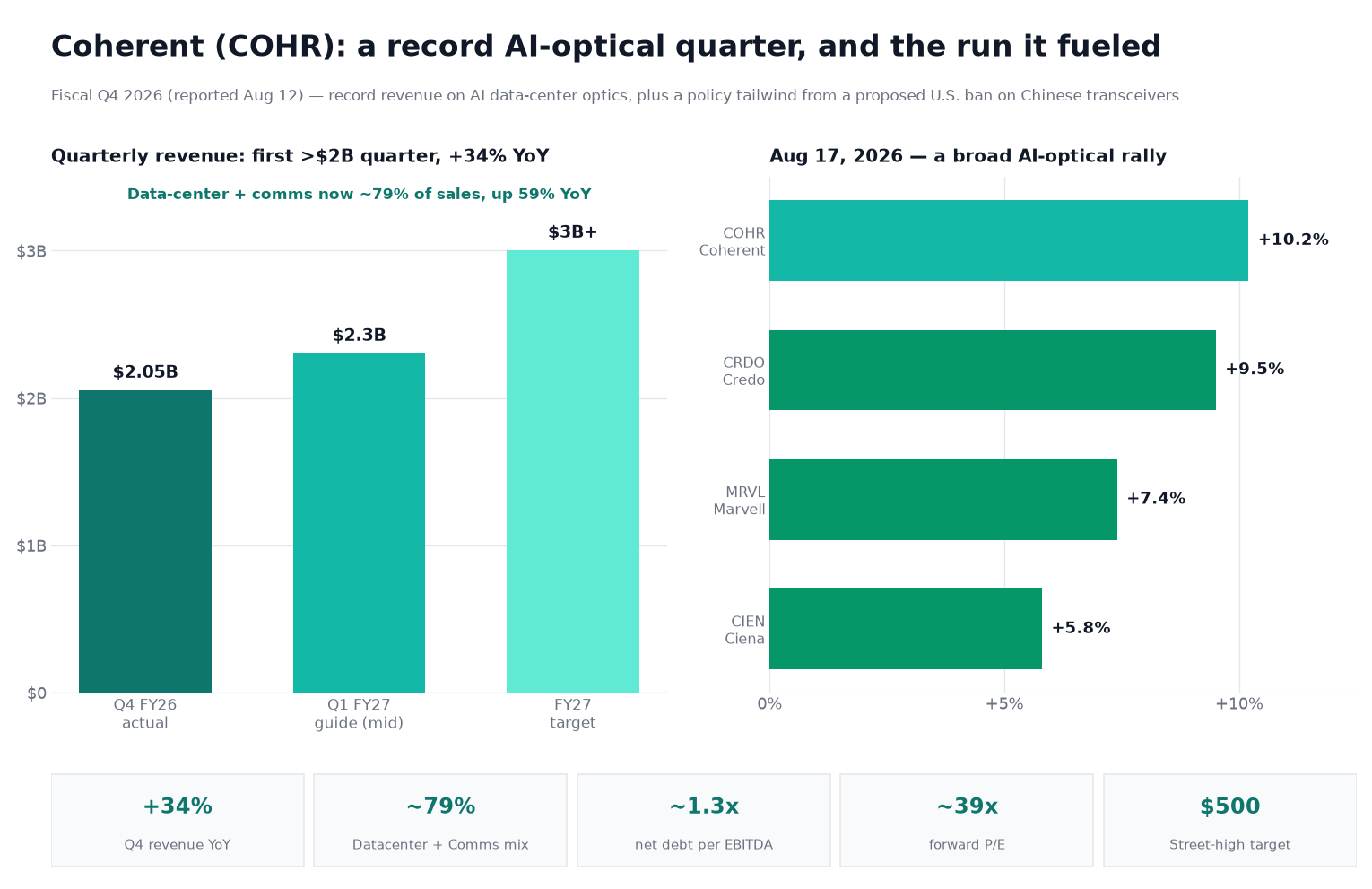
Coherent jumped about 10% on August 17 to roughly $359, extending a surge built on three engines: a record fiscal Q4 (revenue $2.05 billion, +34%, with Datacenter & Communications now ~79% of sales) that triggered a wave of analyst target hikes to a $500 Street-high; a proposed U.S. FCC restriction on Chinese optical transceivers; and the broader AI-optical demand cycle. But the record quarter didn't jump the stock — it had already more than quadrupled and drifted after the print before rebounding. With the old merger leverage down to ~1.3x net debt/EBITDA, the debate is now valuation (~39x forward after the run, near the average target) and whether the contested China-transceiver policy actually lands.
Why Coherent stock is surging: a record quarter meets a policy tailwind
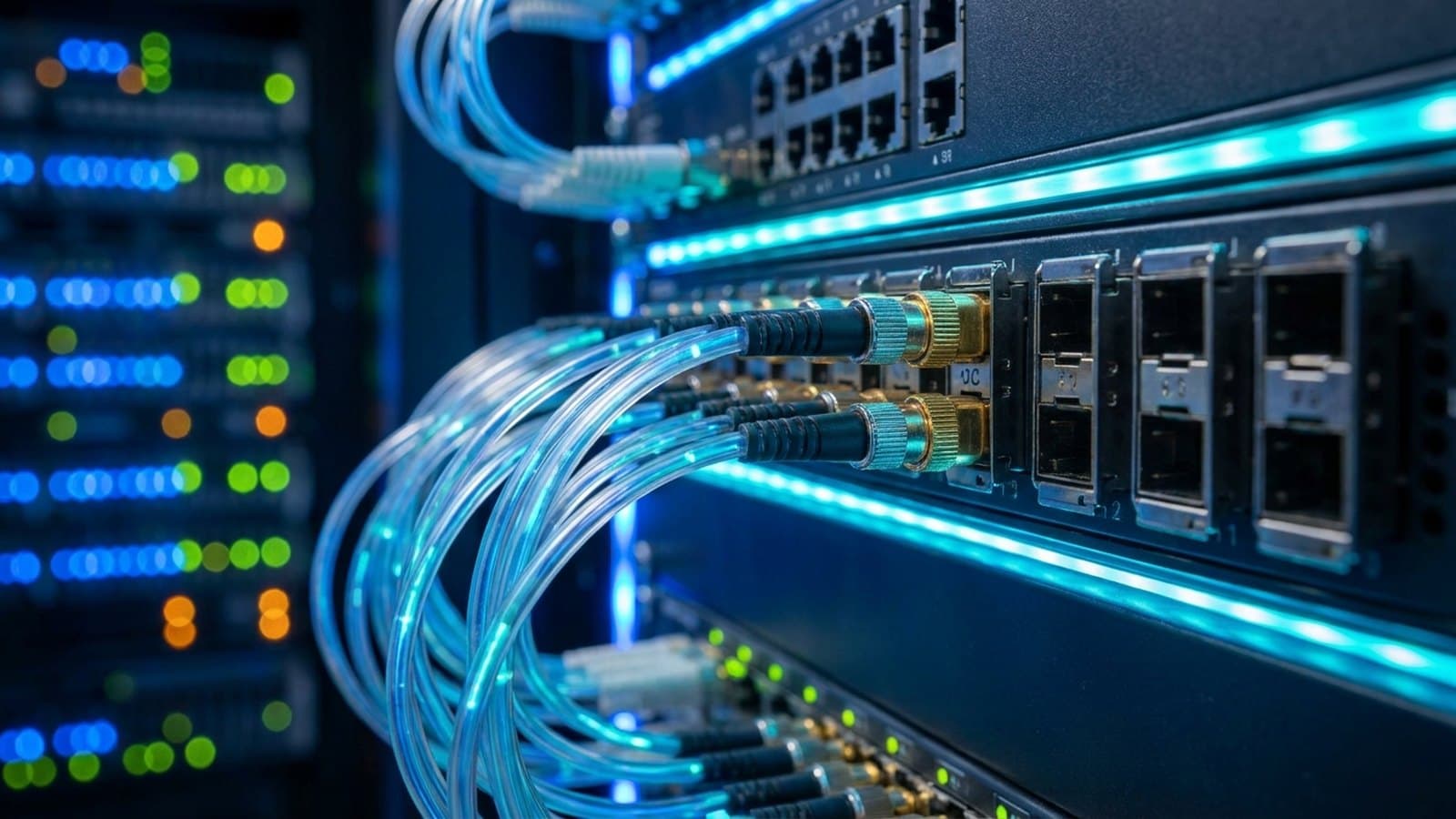
On Monday, August 17, 2026, Coherent (NYSE: COHR) jumped about 10% to roughly $359 intraday, extending one of the year's strongest runs in AI-optical stocks [1]. This was not one event — it is a confluence. Coherent delivered a record fiscal fourth quarter on August 12, which validated the AI-optics thesis and triggered a wave of analyst price-target increases; a proposed U.S. crackdown on Chinese optical transceivers has been re-rating the whole American optics group since early August; and Monday added a broad AI-infrastructure rally. Notably, the record quarter did not immediately send the stock up — it had already run more than fourfold and had risen sharply after the early-August policy report, reaching roughly $379 by August 7, so shares drifted lower after the print before rebounding today. Through the volatility the direction has been decisively higher: COHR now carries a $70 billion market cap, having more than quadrupled from its 52-week low near $84 [1].
Coherent — the former II-VI, which acquired the legacy Coherent in 2022 — makes the optical transceivers, lasers and photonic materials that move data through fiber inside data centers. It has become a relatively direct public-market exposure to AI optical networking: its Datacenter & Communications segment reached about $1.62 billion, roughly 79% of Q4 revenue, up 59% year over year on a pro-forma basis [4]. That mix is why three separate forces — its own results, U.S. policy, and the AI build-out — all push the same stock.
The three engines behind the run
- A record, beat-and-raise fourth quarter. On August 12, Coherent reported fiscal Q4 revenue of $2.05 billion — its first quarter above $2 billion — up about 34% year over year, with non-GAAP EPS of $1.74 (beating the roughly $1.61–1.62 consensus by about 7%) and a non-GAAP gross margin of 40.2%. It guided fiscal Q1 to $2.2–2.4 billion in revenue and said it expects to exceed $3 billion in quarterly revenue by the end of fiscal 2027, powered by its 800G and rapidly ramping 1.6T transceivers [1][4][5].
- A proposed U.S. ban on Chinese transceivers. Since early August, reports that the FCC is drafting restrictions on new Chinese-made optical transceivers — the hardware that routes data over fiber in AI data centers — have re-rated U.S. optics suppliers. The measure would likely hit Chinese firms such as Zhongji Innolight, which holds roughly a 27% share of the global data-center transceiver market. It is a potential rule still being drafted, not enacted, and — as the next section explains — its odds and its benefit are more contested than the rally implies [2].
- An AI-optical demand cycle. As one framing on the earnings call put it, AI "runs on compute, but it scales on optical connectivity." Every additional GPU cluster needs more high-speed optical links, and the industry is transitioning from 800G to 1.6T transceivers — a step-up Coherent is positioned to sell into [4].
Put together, Monday's ~10% move was less a reaction to a single headline than the market continuing to reprice a company at the center of the AI-optical trade — with the record quarter as the fundamentals, the policy proposal as the catalyst, and the AI build-out as the backdrop.
The policy tailwind cuts both ways
The China-transceiver story is the most exciting part of the bull case and the most contested. If enacted, an FCC restriction could shift orders and share opportunities toward U.S. suppliers like Coherent, Lumentum and Applied Optoelectronics, in a market Chinese vendors dominate. But the tailwind is neither certain nor easy to capture. Jefferies and others see limited odds the measure is actually implemented, reading it partly as negotiating leverage ahead of U.S.–China talks and a response to Chinese rare-earth export controls; the measure could also grant exemptions to some non-Chinese suppliers [2]. Even if it passes, analyses warn that Coherent and Lumentum currently lack the scale to replace Chinese vendors quickly, so restricting supply could raise costs or constrain AI deployment. And China's leverage over parts of the upstream indium and materials supply chain remains a risk for the industry, even as Coherent expands its own internal indium-phosphide production [2]. So the policy is a real potential catalyst, but the market is pricing a cleaner, faster benefit than the supply chain may deliver.
Why it matters
Coherent sits at a junction of three of the market's biggest themes: the AI capital-spending boom, U.S.–China technology restrictions, and the optical-networking upgrade cycle. Its surge is a read on all three. If the FCC restricts Chinese transceivers and the 1.6T ramp plays out, U.S. optics suppliers capture a larger, higher-value market — and Coherent, Lumentum and Ciena re-rate together. If the policy stalls, or the supply-chain constraints bite, or AI-optical demand cools, a group trading at high-30s-to-40s forward multiples has a long way to fall. A separate but thematically related U.S. push to steer buyers away from Chinese suppliers has lifted memory names like Micron; optics is the networking-layer version of the same broad trend, though the regulatory actions are distinct.
How the peers and sector traded the same day
Coherent's move was part of a broad AI-optical and interconnect rally on August 17, which is what you would expect if the market is repricing the whole group on the policy and demand narrative rather than one company's news [7]:
| Name (ticker) | Aug 17, 2026 (intraday) | Read-through |
|---|---|---|
| COHR — Coherent | ≈+10.2% | Record Q4, the target-hike wave, and the China-transceiver policy tailwind [1][2] |
| CRDO — Credo Technology | ≈+9.5% | AI interconnect/connectivity — a related beneficiary, not a direct transceiver competitor [7] |
| MRVL — Marvell | ≈+7.4% | Optical DSP and AI-networking silicon; a supplier into the same systems [7] |
| CIEN — Ciena | ≈+5.8% | Optical-networking systems; policy read-through [7] |
Coherent led this group on the day, helped by its own results. The most direct optical-transceiver comparables are Lumentum and Applied Optoelectronics, which are the other names that would gain share under the proposed ban; Credo, Marvell and Ciena are adjacent AI-networking beneficiaries. That the whole cohort rose together points to a sector re-rating on the AI-optical and U.S.-policy narrative rather than an isolated single-stock event [7].
What the Street did with it
The analyst reaction to the quarter was positive — a wave of target increases [6]. Rosenblatt raised its target to $500 from $425 (Buy), the Street-high; Jefferies went to $420 from $375 (Buy), calling it "another beat and raise"; and Morgan Stanley lifted its target to $375 and raised its fiscal-2027 EPS estimate to $9.23 from $8.11, with Needham, Raymond James, Northland and B. Riley also raising [6]. Even so, the overall consensus is a "Moderate Buy" — several firms remain on the sidelines — with an average target near $385–395, only modestly above the ~$359 price after the run [6]. The message: the sell side is convinced on the fundamentals, but the stock has already priced much of the good news.
What to watch
- The FCC proposal — both ways. The single biggest swing factor is whether the proposed restriction on new Chinese transceivers is actually enacted; watch for a final rule and its scope, but also for signs it fades as negotiating leverage [2].
- Capacity and the supply chain. If the measure lands, the question becomes whether U.S. suppliers can scale capacity fast enough to actually capture share — and how exposed the industry remains to China's leverage over the upstream indium and materials supply chain (Coherent is expanding its own internal indium-phosphide production) [2].
- The 1.6T ramp and gross margin. The 1.6T transceiver ramp is the growth engine into fiscal 2027; watch whether it scales toward the $3 billion-quarter target and whether non-GAAP gross margin (40.2%) expands as volume grows [4].
- Customer concentration. With two customers each above 10% of revenue (the largest ~20%), any change in a key customer's orders would move results; watch the concentration in future filings. Moves are tracked on the COHR stock page and the earnings calendar [3].
Illustrative valuation sensitivity
The scenarios below are a descriptive, author-weighted exercise — not a forecast, target, recommendation, or intrinsic fair-value calculation. Each price is expressed as a multiple of Coherent's roughly $9.30 of fiscal-2027 consensus earnings to keep it concrete [3]. The weights are the author's subjective assumptions, anchored loosely to the analyst target distribution (average ~$390, Street-high $500) [6]. The central inputs are whether the FCC restriction is enacted, whether U.S. suppliers can scale to capture it, and how fast 1.6T ramps. The percentages are illustrative and sum to 100%.
| Scenario | Illustrative price | Weight | Key drivers |
|---|---|---|---|
| Upside | ~$500 (≈54x FY27 EPS) | 30% | The FCC restriction is enacted, Coherent scales fast enough to take share, the 1.6T ramp accelerates, and the market keeps paying a premium multiple — toward the Rosenblatt Street-high [6]. |
| Middle | ~$400 (≈43x FY27 EPS) | 45% | Growth stays strong and guidance is delivered, but the stock, already near the average target, drifts up only modestly as the multiple holds rather than expands [6]. |
| Downside | ~$220 (≈24x FY27 EPS) | 25% | The policy proposal stalls, supply-chain constraints cap the benefit, or AI-optical demand pauses, and a ~39x forward multiple compresses toward the mid-range of the 52-week band [1][3]. |
Weighting those (0.30 × $500 + 0.45 × $400 + 0.25 × $220) gives an author-weighted scenario value near $385, close to both the ~$359 quote and the ~$390 average target [1][6]. The point is the width of the band: a stock at ~39x forward earnings on a policy proposal and a product ramp is highly sensitive to both — the upside runs to $500 if they land, and a de-rating is steep if they slip. This is descriptive analysis of a corporate event, not investment advice.
COHR data snapshot — August 17, 2026 (intraday, session open)
| Figure | Value | As-of / source |
|---|---|---|
| Intraday quote | $359.00 (+$33.17, +10.18%) | Aug 17, ~1:13 p.m. ET — StockAnalysis [1] |
| Day's range (Aug 17) | $330.24 – $362.32 | Aug 17 session, still open [1] |
| 52-week range | $84.35 – $440.00 (more than quadrupled off the low) | As of Aug 17 [1] |
| Market cap / EV | ≈$70.3B (195.83M shares); enterprise value ≈$72B | Aug 17 — StockAnalysis [1][3] |
| Balance sheet | Total debt ≈$3.22B, cash & equivalents ≈$1.16B → cash-only net debt ≈$2.06B (≈1.3× EBITDA), or ≈$1.24B (≈0.8×) including short-term investments; D/E ≈0.30 | FY2026 10-K / StockAnalysis [3] |
| Valuation | ≈87× trailing / ≈39× forward P/E (FY27 consensus EPS ≈$9.30); ≈46× EV/EBITDA; EPS (TTM) $4.12 | Aug 17 — StockAnalysis [3] |
| Q4 FY2026 results | Revenue $2.05B (+34% YoY, +13% seq); non-GAAP EPS $1.74 (GAAP $1.19) vs ~$1.61–1.62 consensus; non-GAAP gross margin 40.2%; Datacenter & Communications ≈79% of sales (~$1.62B, +59% YoY pro forma) | Reported Aug 12 — company release [1][4] |
| Guidance | Fiscal Q1 revenue $2.2–2.4B, non-GAAP EPS $1.85–2.05; targeting >$3B quarterly revenue by end of FY2027 | Aug 12 — company release [4] |
| Customer concentration | Two customers each >10% of FY2026 revenue (largest ≈20%, second ≈12%) | FY2026 10-K [3] |
| Policy catalyst | Proposed FCC restriction on new Chinese optical transceivers (targets Zhongji Innolight, ~27% share); not enacted; enactment odds and U.S. scale-up contested | Early–mid Aug 2026 — Reuters / analyst coverage [2] |
| Analyst reaction | Target-hike wave — Rosenblatt $500 (high), Jefferies $420, Morgan Stanley $375; consensus Moderate Buy, avg ≈$385–395 | Aug 12–17 — market coverage [6] |
The August 17 figures are intraday snapshots that moved through the session, not closing prices; the stock has been volatile, trading near $379 on the early-August policy news, drifting lower after the August 12 earnings, then rebounding on August 17.
The setup at a glance
| Question | Answer |
|---|---|
| Why is Coherent stock surging? | A confluence: a record fiscal Q4 on Aug 12 (revenue $2.05B, +34%) that triggered a wave of analyst target hikes, a proposed U.S. ban on Chinese optical transceivers that would benefit U.S. suppliers, and a broad AI-optical rally — with Aug 17 adding ~10%. The stock did not jump on the earnings themselves; it had run up, drifted, and rebounded today [1][2]. |
| What does Coherent do? | It makes optical transceivers, lasers and photonic materials; its Datacenter & Communications segment is now ~79% of revenue, making it a relatively direct AI-optical-networking play. It is the former II-VI, which acquired legacy Coherent in 2022 [4]. |
| How big was the quarter? | Fiscal Q4 revenue of $2.05B (its first >$2B quarter, +34% YoY), non-GAAP EPS $1.74 (a ~7% beat), 40.2% non-GAAP gross margin, and a Q1 guide of $2.2–2.4B, with a path to >$3B quarterly by end of FY2027 [1][4]. |
| Is the China-transceiver ban a sure thing? | No — it is still a draft, not enacted, and some analysts (Jefferies among them) see limited odds it is implemented, reading it as negotiating leverage; it could also grant exemptions. Even if it lands, U.S. suppliers may lack the scale to capture it quickly, and China retains leverage over parts of the upstream indium and materials supply chain, even as Coherent expands its own internal indium-phosphide production [2]. |
| Is the stock expensive? | It is priced for the thesis: ~87× trailing and ~39× forward earnings, ~46× EV/EBITDA after more than quadrupling, with the price having nearly caught the ~$385–395 average analyst target [3][6]. |
| What are the biggest risks? | A policy delay, a supply-chain or scaling constraint, an AI-optical demand pause, and customer concentration — two customers were each above 10% of fiscal-2026 revenue [2][3]. |
Coherent (COHR) stock FAQ
Why did Coherent (COHR) stock surge on August 17, 2026?
Coherent rose about 10% to roughly $359, extending a run driven by a confluence of catalysts rather than a single event. On August 12 it reported a record fiscal Q4 — revenue of $2.05 billion, up about 34% year over year, with non-GAAP EPS of $1.74 beating the ~$1.61–1.62 consensus — which triggered a wave of analyst price-target increases. Separately, reports since early August that the FCC is drafting restrictions on new Chinese-made optical transceivers have re-rated U.S. optics suppliers, with Coherent seen as a beneficiary. Monday added a broad AI-optical rally. Notably, the stock did not jump on the earnings themselves — it had already more than quadrupled and drifted lower after the print before rebounding on August 17.
Is the proposed U.S. ban on Chinese optical transceivers a sure thing?
No, and that is the most contested part of the bull case. Reports indicate the FCC is drafting restrictions on new Chinese-made optical transceivers — targeting firms such as Zhongji Innolight, which holds roughly a 27% share of the data-center transceiver market — but it is a proposed rule, not enacted. Some analysts, including Jefferies, see limited odds it is actually implemented, reading it partly as negotiating leverage ahead of U.S.–China talks and a response to Chinese rare-earth controls. Even if it passes, analyses warn that Coherent and Lumentum lack the scale to replace Chinese vendors quickly, so restricting supply could raise costs or slow AI deployment, and China retains leverage over parts of the upstream indium and materials supply chain (though Coherent is expanding its own internal indium-phosphide production). So the policy is a real potential catalyst, but neither certain nor easy to capture.
Is Coherent's debt still a problem?
Much less than it was. The 2022 combination of II-VI and legacy Coherent — a roughly $7 billion acquisition — left the company heavily leveraged, and for a couple of years the stock was as much a deleveraging story as a growth one. Surging AI-optical demand has resolved much of that: total debt is about $3.2 billion against roughly $1.16 billion of cash and equivalents (about $2.0 billion of net debt, or roughly 1.3 times EBITDA), with a debt-to-equity ratio near 0.30. The balance sheet is no longer the primary risk — the debate has shifted to valuation and policy.
Is Coherent stock expensive after the run?
It is priced for the AI-optical thesis to keep compounding. After more than quadrupling from its 52-week low near $84, Coherent trades at about 87 times trailing and 39 times forward earnings, and near 46 times EV/EBITDA. Notably, after the surge the ~$359 price has nearly caught the analysts' average target of roughly $385–395, even though the Street-high pushed to $500 (Rosenblatt), and the overall consensus rating is a 'Moderate Buy' with several firms neutral. That multiple discounts a sustained 1.6T ramp and a policy-driven share shift, which leaves little room for a policy delay or a demand pause. This is descriptive analysis, not a recommendation.
What does Coherent make, and how is it an AI stock?
Coherent makes optical transceivers, lasers and photonic materials. Its optical transceivers — currently 800G, transitioning to 1.6T — convert electrical signals to light so data can move at high speed over fiber inside data centers, which is how AI clusters of GPUs are connected. As one framing on its earnings call put it, AI 'runs on compute, but it scales on optical connectivity.' Its Datacenter & Communications segment grew 59% year over year (on a pro-forma basis) last quarter and is now about 79% of sales, which is why the stock trades as an AI-infrastructure play — though that segment also includes communications products beyond AI data centers.