Stock Analysis
Axon (AXON) Drops ~9% on a $1 Billion 0% Convertible Notes Offering
Axon Enterprise fell about 9% to roughly $447 on September 15 after announcing a $1.0 billion offering of 0% convertible senior notes due 2031 — a financing event, not a business stumble. The counterintuitive drop on interest-free borrowing is a lesson in how markets price equity-linked debt: convertible notes can turn into shares, so the market immediately prices the potential dilution overhang, and the hedge funds that buy converts typically short the stock to hedge, which tends to add mechanical selling pressure around a deal. Axon is buying capped calls to blunt the dilution and earmarking the rest for acquisitions. The drop landed on a stock already down about 41% from its 2025 high and trading near 50 times forward earnings despite ~35% revenue growth — a de-rated compounder now using its shares as funding currency. The move was starkly company-specific: closest peer Motorola Solutions fell under 1%, Palantir rose, and the S&P 500 barely moved, while the Street's price targets still cluster far above the price.

Why Axon stock dropped — a financing move, not a business stumble
On Tuesday, September 15, 2026, Axon Enterprise (NASDAQ: AXON) fell about 9%, trading near $446.91 intraday, down from a $490.18 prior close [1]. Nothing changed about the maker of Tasers, police body cameras and cloud evidence software on the day — no earnings, no guidance, no lost contract. The trigger was a financing announcement: Axon said it would sell $1.0 billion of 0% convertible senior notes due 2031, in a registered public offering, with an option for underwriters to buy up to $150 million more [2]. It is a textbook example of a stock falling on a capital-raise that, on its face, looks cheap for the company.
Why a 0% convertible offering pushes a stock down
The counterintuitive part is the zero coupon. Axon is borrowing $1 billion and paying no interest — seemingly free money. The catch is what makes it free: convertible notes can turn into equity later, and investors buy them precisely for that conversion right. That creates two sources of downward pressure on the day:
- Potential dilution. The notes are convertible, so they could later be settled in stock — and Axon may choose cash, shares, or a mix at conversion. If shares are used, future earnings are spread across a larger base, and the market prices that potential dilution overhang in now, even years before it might occur [2].
- Convertible arbitrage. Convertible notes are often bought by hedge funds that hedge the equity exposure embedded in them by short-selling the stock. That hedging flow typically adds mechanical selling pressure around a deal — a technical dynamic rather than a verdict on the business. It is a common pattern rather than a confirmed account of who traded on the day, but it is the standard reason convertibles weigh on a stock at announcement [2].
Axon tried to soften the dilution. It said part of the proceeds will pay for capped call transactions — options it buys alongside the notes that offset potential dilution up to a cap price, effectively raising the price at which conversion starts to hurt existing holders [2]. The banks on the other side of those capped calls may in turn buy Axon shares to hedge their own exposure, which can support the stock — so the net near-term trading flow around a convertible deal is genuinely two-sided, not uniformly negative. The rest of the money is earmarked for general corporate purposes, including acquisitions [2]. The conversion price itself was not disclosed; it will be set when the deal prices. In short: a growth company reaching for cheap, equity-linked capital, and a market reacting to the dilution overhang and the technicals before the strategic use of the cash.
A high-growth franchise that had already de-rated
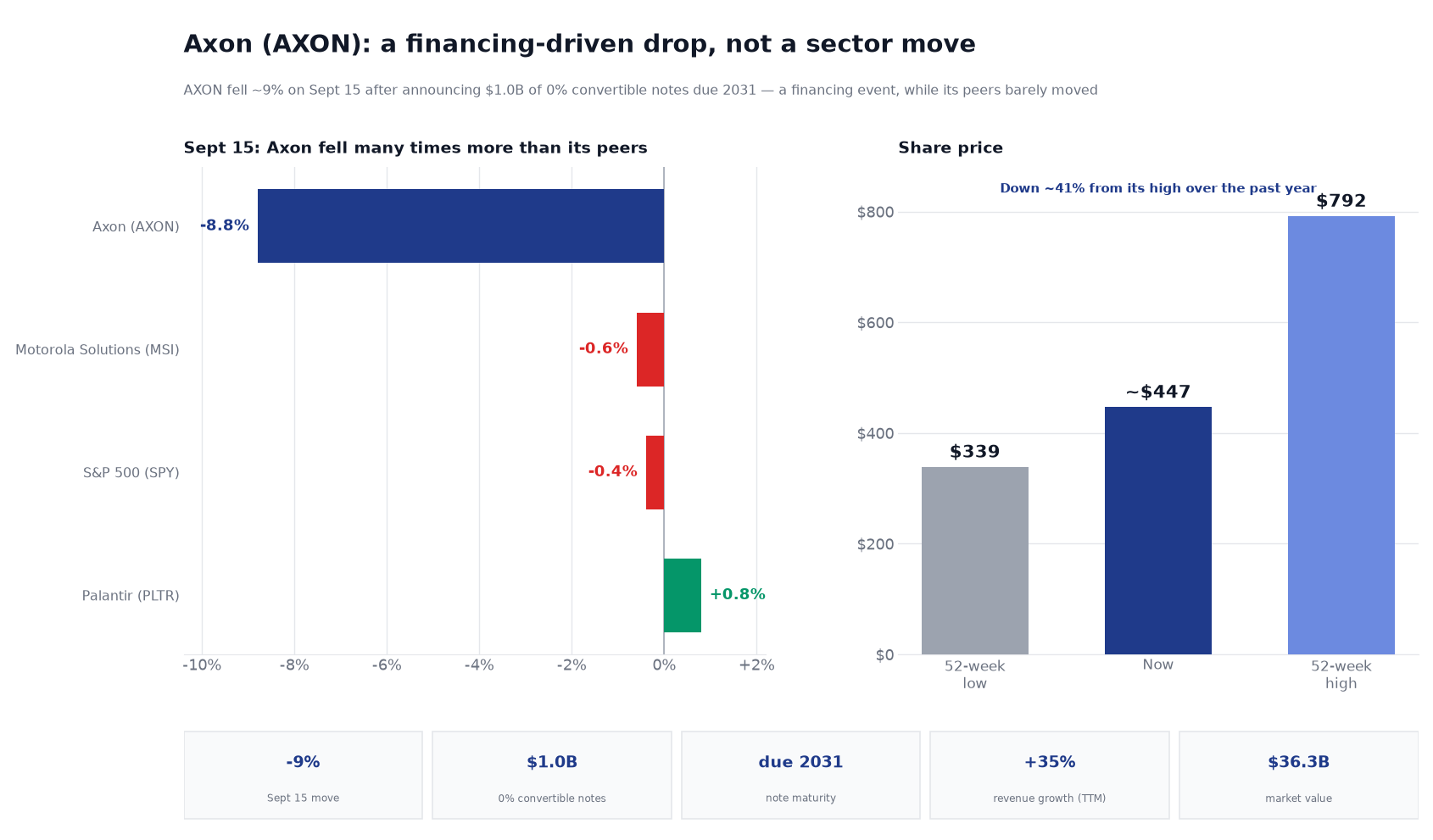
The drop landed on a stock that was already well down. Axon trades about 41% below its 52-week high of $792 and sits beneath both its 50-day (~$558) and 200-day (~$504) moving averages after a year-long unwind of its 2024–25 momentum run [3]. The business itself keeps compounding: revenue grew about 35% over the trailing year to roughly $3.22 billion, and analysts see another ~33% this fiscal year and ~29% next [3]. That growth is why the valuation stays rich even after the fall — the shares change hands near 50 times forward earnings, and the trailing GAAP P/E looks astronomical (~186×) largely because GAAP earnings are materially reduced by unusually heavy stock-based compensation, leaving them far below the adjusted earnings the multiple is usually judged on — not because the company is unprofitable [3]. The selling came on elevated volume — about 1.1 million shares by midday against a 755,000-share 20-day average for a full session — consistent with a fast, event-driven repricing rather than a slow bleed [1].
Why it matters
The episode is a clean lesson in how markets treat equity-linked financing. A convertible note is part debt, part future equity, and the "future equity" part gets priced immediately — through both the potential-dilution overhang and the mechanical short-selling that convertible-arbitrage hedgers typically add. That is why a company can announce essentially interest-free borrowing and watch its stock fall. It is also a read on where Axon sits in its life cycle: a still-fast grower that is now using its shares as an acquisition and funding currency, and a market that, after a year-long de-rating, is less willing to pay up for that optionality than it was at the peak. The business case — dominant position, ~30%+ growth, an expanding software and AI layer — is intact; what moved was the capital structure and the technicals around it.
The move, in one cross-section
The same-day tape shows how company-specific the drop was — Axon fell many times more than its closest peer and the broad market [5]:
| Name (ticker) | Sept 15, 2026 | Read-through |
|---|---|---|
| AXON — Axon Enterprise | ≈−8.8% | Announced a $1.0B 0% convertible notes offering — dilution and hedging pressure [1][2] |
| MSI — Motorola Solutions | ≈−0.6% | Closest public-safety peer — down only modestly with the market [5] |
| PLTR — Palantir | ≈+0.8% | Gov-tech growth comparable — actually higher on the day [5] |
| SPY — SPDR S&P 500 ETF | ≈−0.4% | The broad market was only modestly lower on the day [5] |
Axon falling ~9% while its closest peer slipped less than 1% and a gov-tech comparable rose points to a primarily company-specific event — a financing announcement — rather than a broad sector or market move (the overall market was modestly lower on the day amid higher Treasury yields) [5].
What the Street thinks
Coverage remains overwhelmingly positive, and the targets predate — and tower over — the drop. The consensus rating is a Buy, with an average 12-month target near $706 — roughly 58% above the current price, in a range from a low near $440 to a high near $830 [6]. The most recent notes cluster far above the tape: Needham's Joshua Reilly kept a Buy at $750, Goldman Sachs' Michael Ng holds a Buy at $715 (raised from $535 in August), Barclays' Tim Long a Buy at $688, and Argus Research's John Staszak a Buy at $600 (up from $460) [6]. None of these were issued in reaction to the offering — a convertible raise rarely moves price targets — so they represent the standing bullish view against which the market's skepticism is playing out. The gap between $706 of average target and a stock in the $440s is the whole story: the Street likes the franchise, the market is repricing the multiple.
What to watch
- Deal pricing. The conversion premium and cap price set when the notes price — the higher the effective conversion price, the less near-term dilution risk [2].
- Use of proceeds. Whether the "general corporate purposes, including acquisitions" language turns into a value-creating deal or simply a bigger balance sheet [2].
- The hedging overhang. Whether the convertible-arb short pressure fades once the deal clears, as it usually does, or lingers [2].
- Growth and margins. Whether Axon sustains ~30%+ revenue growth and expands adjusted margins into the next report (due November 3). Moves are tracked on the AXON stock page [1].
Illustrative valuation sensitivity
The scenarios below are anchored to Axon's forward earnings power (about 50× forward earnings on ~30%+ growth) and to the analyst target distribution (a low near $440, average ~$706, a high near $830) [6], turning on how the dilution overhang clears and whether the multiple re-rates or keeps compressing. They are a descriptive, author-weighted exercise — not a forecast, target, recommendation, or intrinsic fair-value calculation — with subjective weights that sum to 100%.
| Scenario | Illustrative price | Weight | Key drivers |
|---|---|---|---|
| Upside | ~$700 | 30% | The hedging overhang clears, growth stays above 30%, acquisitions funded by the notes extend the moat, and the multiple re-rates back toward the analyst targets [6]. |
| Middle | ~$520 | 40% | Growth remains strong but the market keeps a lower multiple than at the 2025 peak; the stock recovers part of the drop toward its moving averages [3]. |
| Downside | ~$410 | 30% | Growth decelerates, dilution and a still-rich multiple keep the de-rating going, and the shares drift back toward the low end of the analyst range [3]. |
Weighting those (0.30 × $700 + 0.40 × $520 + 0.30 × $410) gives an author-weighted reference value near $541, above Tuesday's ~$447 level and well below the ~$706 consensus target [1][6] — reflecting a high-growth franchise whose next leg depends on the financing overhang clearing and growth holding, not on the quality of the business. This is a Street-target-and-earnings-based scenario exercise and descriptive analysis of a news move, not investment advice.
AXON data snapshot — September 15, 2026
| Figure | Value | As-of / source |
|---|---|---|
| Intraday quote | ~$446.91 (−~8.8%), far below its 52-week high — an intraday reading (the session was still open) | Tue, Sep 15, 2026, ~12:32pm ET — StockAnalysis [1] |
| Prior close / open / range | $490.18 prior close; opened $467.68; day range $434.46–$471.41 | Sep 15, 2026 [1] |
| Volume vs average | ≈1.1M shares by midday vs a ≈755K 20-day average for a full session — an event-driven pace | Sep 15 — StockAnalysis [1] |
| 52-week range / trend | $339.01–$792.16; down ~41% over 52 weeks (well off its high); below its ~$558 50-day and ~$504 200-day averages | As of Sep 15 [3] |
| Market cap / EV | ≈$36.3B (81.24M shares); enterprise value ≈$37.5B; beta ≈1.40 | Sep 15 — StockAnalysis [3] |
| Valuation | ≈50× forward earnings (≈58× FY26 non-GAAP EPS ~$7.67, ≈42× FY27 ~$10.57); trailing GAAP P/E ~186× (GAAP earnings materially reduced by heavy stock comp, far below adjusted); ≈11× sales | Sep 15 — StockAnalysis [3] |
| Financials (TTM) | Revenue ≈$3.22B (+34.6%); net income ≈$199M; gross margin ≈60%; ROE ≈6.2%; free cash flow ≈$133M; FY26 revenue seen ≈$3.71B (+33%) | TTM / estimates — StockAnalysis [3] |
| Catalyst | Announced a $1.0B (plus $150M option) 0% convertible senior notes offering due 2031; proceeds for capped calls and general corporate purposes incl. acquisitions — dilution and convertible-arb hedging drove the drop | Sep 15, 2026 — company release [2] |
| Same-day peers | MSI −0.6% (closest peer); PLTR +0.8% (gov-tech comp); SPY −0.4% (market) — Axon's drop was idiosyncratic | Sep 15 [5] |
| Analyst view | Consensus Buy, avg target ≈$706 (~58% above the price), range ~$440 to ~$830; standing pre-offering targets: Needham $750, Goldman Sachs $715, Barclays $688, Argus $600 | Aug–Sep 2026 — StockAnalysis / analyst notes [6] |
Axon (AXON) stock FAQ
Why did Axon (AXON) stock drop on September 15, 2026?
Axon fell about 9% to roughly $447 after announcing a $1.0 billion offering of 0% convertible senior notes due 2031 (a registered public offering, with a $150 million over-allotment option). It was a financing event, not a business problem — no earnings miss or lost contract. The stock dropped because convertible notes can later be settled in shares, so the market immediately prices the potential dilution overhang, and the hedge funds that buy convertibles typically short the stock to hedge, which tends to add mechanical selling pressure around a deal (Axon can settle conversions in cash, stock, or a mix, and is buying capped calls to limit the dilution).
Why would a stock fall on a 0% (interest-free) borrowing?
Because a convertible note is part debt and part future equity, and the 'future equity' part is what gets priced immediately. The zero coupon is only possible because investors are paid instead through the right to convert the notes into Axon shares later. That creates two headwinds on announcement day: potential dilution (more shares if the notes are ultimately settled in stock, though the issuer can also settle in cash) and convertible arbitrage (the hedge-fund buyers that typically short the stock to hedge the equity exposure in the note). So a company can raise cheap, interest-free capital and still see its shares fall — the drop reflects the equity-linked nature of the paper, not the cost of the debt.
What are the capped call transactions Axon is using?
Capped calls are options Axon buys alongside the convertible notes to reduce the dilution if the notes convert. In effect they raise the price at which conversion begins to hurt existing shareholders, up to a cap set when the deal prices. Axon said part of the offering's proceeds will pay for these capped calls, with the remainder going to general corporate purposes, including potential acquisitions. The capped calls are a signal that management is trying to limit the dilution that spooked the market, though they do not eliminate it.
Is Axon stock expensive after the drop?
Still yes, on the multiple — but it is a growth stock, not a value one. Even after falling about 41% from its 2025 high, Axon trades near 50 times forward earnings, with a trailing GAAP P/E that looks extreme (~186×) largely because GAAP earnings are materially reduced by heavy stock-based compensation, leaving them far below adjusted earnings. The justification is growth: revenue rose about 35% over the past year to roughly $3.22 billion, with analysts modeling ~33% more this fiscal year. A rich multiple on a fast grower can keep de-rating if growth cools, which is the central risk the market is weighing.
What do analysts think of Axon stock now?
Coverage is overwhelmingly bullish, and the targets sit far above the price. The consensus rating is a Buy, with an average 12-month price target near $706 — roughly 58% above the post-drop level — in a range from about $440 to $830. The most recent notes, all issued before the offering, cluster high: Needham's Joshua Reilly at $750, Goldman Sachs' Michael Ng at $715 (raised from $535 in August), Barclays' Tim Long at $688, and Argus Research's John Staszak at $600 (up from $460). A convertible raise rarely changes price targets, so these represent the standing view against which the market's skepticism is playing out.
What is the biggest risk for Axon now?
That its still-rich multiple keeps compressing. Axon trades near 50 times forward earnings, so any deceleration in its ~30%+ growth, or a sense that the new capital is not being deployed accretively, could extend the year-long de-rating. The convertible offering adds a dilution overhang and near-term hedging pressure on top of that. The offsetting strengths are a dominant, expanding ecosystem of hardware, cloud and AI in public safety, strong revenue growth, and a balance sheet now flush with cheap capital for acquisitions — which is exactly why analysts' targets remain far above the price.