Clean Energy
Bloom Energy (BE) Stock Falls More Than 10%: The AI-Power Selloff, a $61B Valuation, and a Short-Seller Overhang
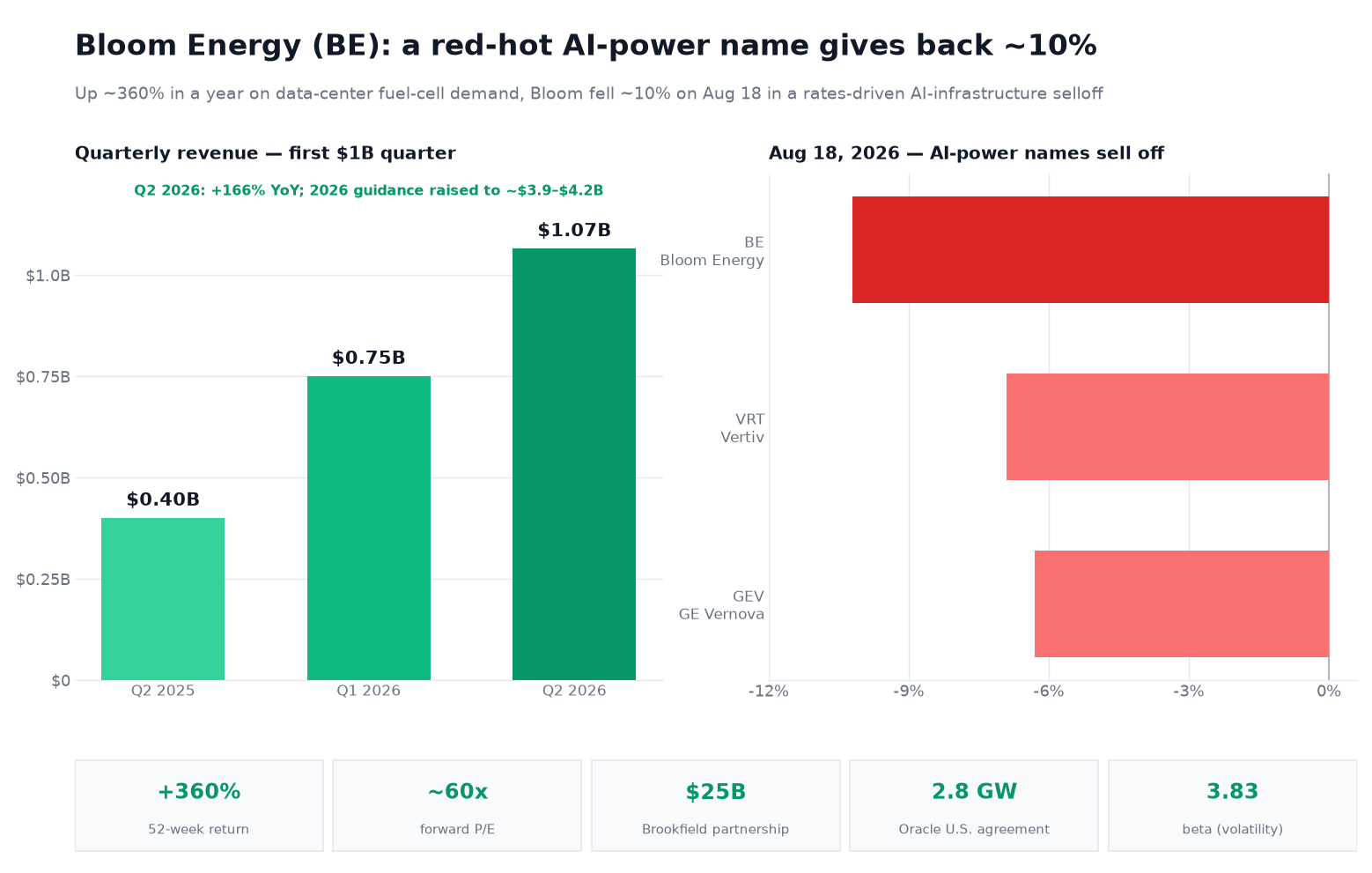
Bloom Energy fell more than 10% on August 18 (to around $207 by early afternoon) — not on any new company disclosure, but in a broad, rates- and macro-driven selloff of AI-infrastructure stocks (Vertiv −6.9%, GE Vernova −6.3% the same day) as long-dated Treasury yields hit multi-year highs. Bloom fell hardest, consistent with being an unusually high-beta name in the group (β 3.83), up ~360% in a year on data-center fuel-cell demand, trading near 60× forward earnings, with an unresolved short-seller allegation about its scandium supply chain hanging over it. The bull case is real — a first $1B quarter (+166% YoY), a master agreement to supply up to 2.8 GW to Oracle, and a $25B Brookfield financing partnership — but analyst targets from $97 to $390 capture just how contested the valuation is.
Why Bloom Energy dropped — and the run that set it up
On Tuesday, August 18, 2026, Bloom Energy (NYSE: BE) fell more than 10% — trading around $207 by early afternoon and extending losses through the session — from a $232.16 prior close [1]. There was no new adverse disclosure from Bloom behind it. The day was a broad, rates- and macro-driven risk-off in AI-infrastructure and high-growth stocks — the 30-year Treasury yield pushed to about 5.3%, its highest since 2007, amid oil, inflation and geopolitical worries, and the market took profits in the names most sensitive to interest rates and momentum. Other picks-and-shovels power plays fell alongside it: Vertiv dropped about 6.9% and GE Vernova about 6.3% the same day [8]. Bloom fell harder still, consistent with its profile as one of the highest-octane stocks in the group — its five-year beta of 3.83 marks it as an unusually high-beta large-cap — well above Vertiv's ~2.1 and GE Vernova's ~1.0 — though that sensitivity makes the size of the move plausible rather than mechanically explaining it [2]. Volume, meanwhile, ran roughly in line with its recent average rather than spiking — consistent with broad de-risking rather than a rush to trade fresh company news [2].
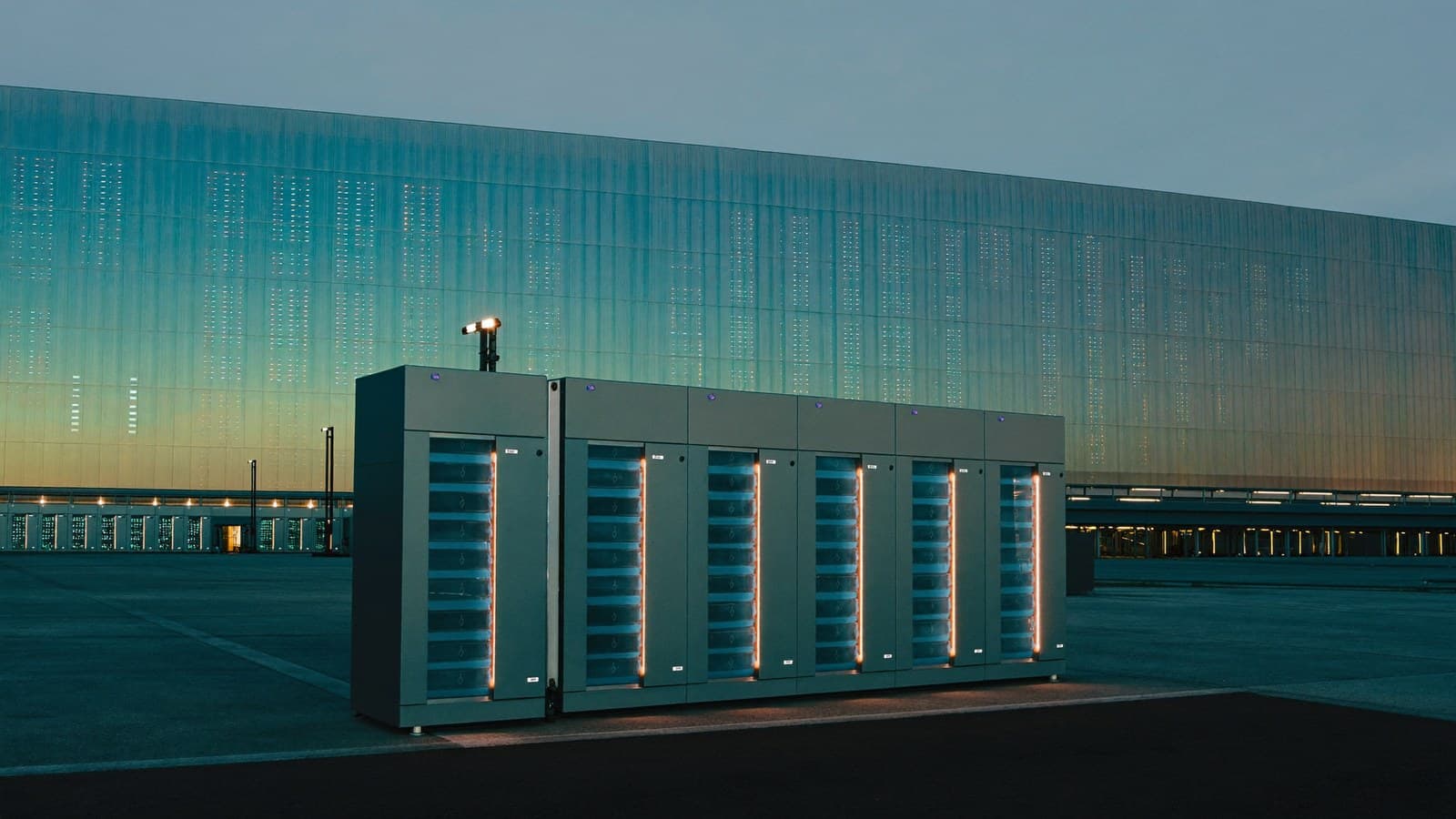
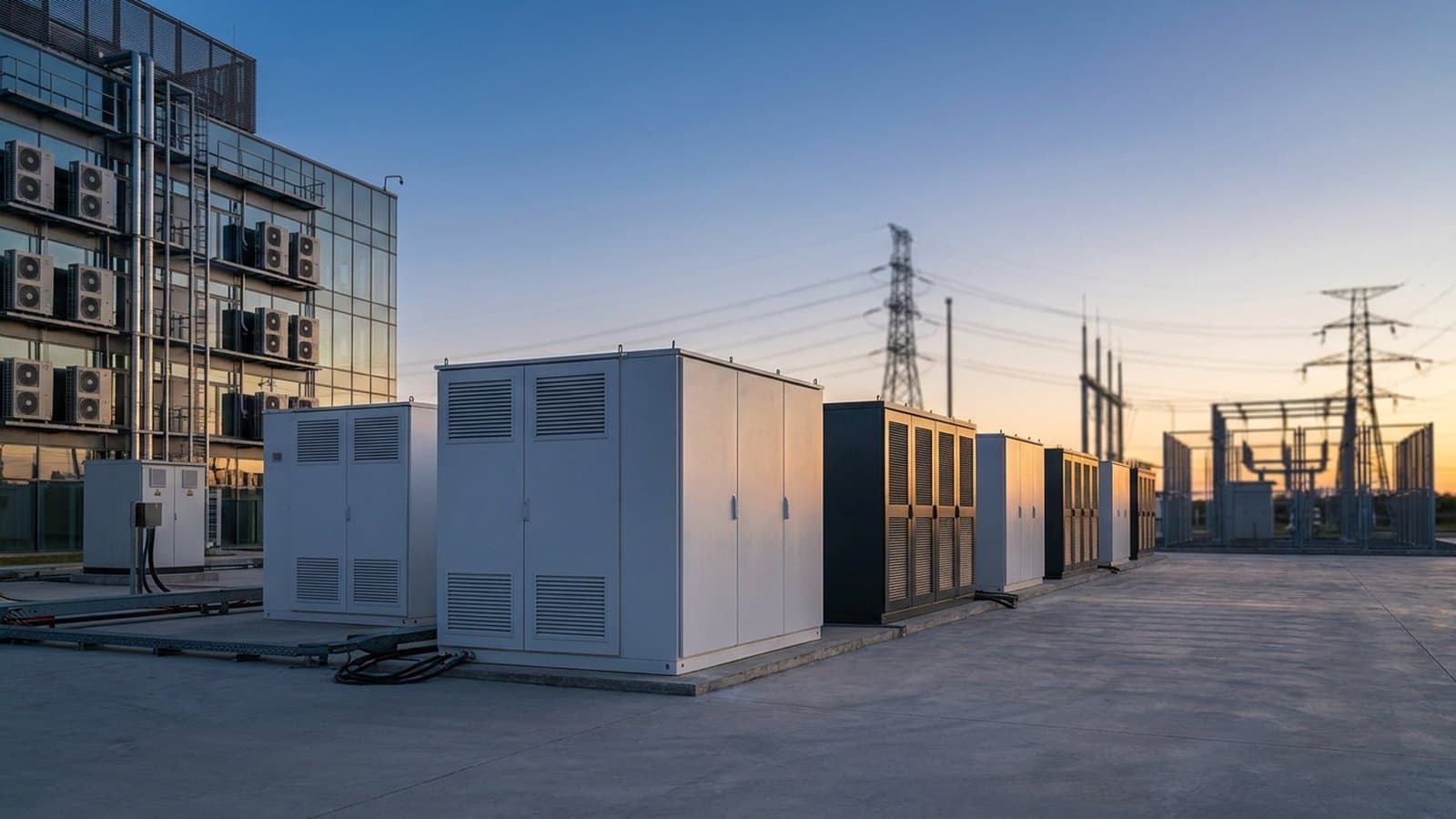
Bloom Energy makes solid-oxide fuel cells — refrigerator-to-shipping-container-sized units that generate electricity on-site from natural gas or hydrogen. In 2026 it became one of the defining "AI power" stories: hyperscalers racing to build data centers cannot get grid connections fast enough, and Bloom's pitch is time-to-power — the company says it can stand up on-site generation in as little as about 90 days, versus the multi-year waits it cites for new grid capacity. That single advantage has turned a long-struggling fuel-cell company into a favored way to bet on the electricity bottleneck behind the AI build-out, and the stock is up roughly 360% over the past year [2].
The run: giant deals and a first billion-dollar quarter
The rally has real business behind it. In April, Bloom expanded its master agreement with Oracle to supply up to 2.8 gigawatts of fuel-cell power across Oracle's U.S. projects; Oracle's "Project Jupiter" campus in New Mexico alone is slated for up to about 2.45 gigawatts [3]. At the end of June, it expanded a financing partnership with Brookfield for AI-infrastructure power projects from $5 billion to $25 billion — a financing framework, rather than booked revenue, that gives Bloom a deep-pocketed backer to fund deployments [4]. And in early August, Bloom reported its first billion-dollar quarter: second-quarter revenue of about $1.065 billion, up roughly 166% year over year, with management raising 2026 revenue guidance to a range of about $3.9 billion to $4.2 billion and posting real profits — trailing-twelve-month net income of about $245 million [5][2].
The flip side is valuation. After a near-quintupling from its 52-week low, Bloom carries a $61 billion market capitalization, a forward price/earnings ratio near 60× on a next-twelve-month basis (closer to the mid-to-high 70s against consensus 2026 adjusted earnings), a trailing P/E above 230×, and a price-to-sales ratio around 21× [2]. A stock priced for years of flawless execution is, almost by definition, the kind that falls hardest when the market's appetite for risk cools — which is exactly what happened on August 18.
The short-seller cloud that hasn't cleared
There is also a live overhang specific to Bloom. On July 8, 2026, short-seller Hunterbrook Media published a report titled "Bloom's Big Lie," alleging that Bloom had sourced scandium — a critical material for its fuel cells — from China through intermediary countries (Thailand, Japan, South Korea and others), despite telling investors it had no China supply chain [6]. The stock fell about 5.7% that day, and shareholder law firms have since filed a securities class-action lawsuit in the Northern District of California covering investors who bought between February 2025 and July 2026 [6]. These allegations are unproven and disputed by the company, and Bloom rallied back strongly in August after its record quarter. But an open supply-chain-disclosure question is the kind of risk that gets ignored on the way up and re-priced on the way down — one more reason a high-beta name like this sells off sharply when sentiment turns.
Why it matters
Bloom sits at the center of the market's favorite second-order AI trade: if the bottleneck for artificial intelligence is power, then the companies that supply power to data centers should compound for years. That thesis has lifted an entire cohort — fuel cells, grid equipment, cooling, and even nuclear developers — to valuations that assume the build-out runs uninterrupted. Days like August 18 are a reminder that the same thesis is highly sensitive to two things it cannot control: interest rates, which set the discount on all those far-off profits, and risk appetite, which can compress rich multiples quickly. When long-dated yields jump, the most expensive, highest-beta expressions of the AI-power trade — Bloom foremost among them — are the first to give ground, regardless of how their businesses are actually performing.
How the AI-power group traded the same day
Bloom's decline was the sharpest example of a broad, single-day pullback across AI-infrastructure power names [8]:
| Name (ticker) | Aug 18, 2026 (intraday) | Read-through |
|---|---|---|
| BE — Bloom Energy | ≈−10.2% | Highest-beta AI-power name (β 3.83); a rich multiple plus the scandium overhang amplified the sector move [1][2] |
| VRT — Vertiv | ≈−6.9% | Data-center power and cooling; profit-taking after a big run [8] |
| GEV — GE Vernova | ≈−6.3% | Grid and power equipment; same rates-driven rotation out of AI-infrastructure winners [8] |
That the group fell together — with Bloom simply falling the most — is the tell that this was a macro-driven rotation, not a company-specific verdict on any one of them [8].
What the Street did with it
Analyst targets on Bloom span a remarkable range. Bulls include UBS at $350 and J.P. Morgan at $314 (Buy, trimmed from $346), while a large cluster of holds sits closer to the current price — Bernstein at $282, Barclays at $276, Mizuho at $242, Jefferies at $229, and Wells Fargo at $176 — and the low end of the reported target range sits near $97 [7]. The S&P Global-compiled consensus is a Buy with an average target near $275, but the sheer dispersion — a roughly $97-to-$390 spread — is the real message: this is a stock where reasonable analysts disagree by nearly 4× on what it is worth, which is why it trades with such violence [7].
What to watch
- Deployment execution. The Oracle and Brookfield deals are commitments; the value is in delivered gigawatts. Watch installation pace, any regulatory friction on large campuses, and whether the $25 billion Brookfield facility translates into signed projects [4].
- The scandium litigation. Watch Bloom's response to the supply-chain allegations and the progress of the class action; a credible rebuttal removes an overhang, an adverse development adds one [6].
- Rates and risk appetite. As a high-beta, long-duration stock, Bloom is unusually sensitive to the 10- and 30-year Treasury yields; watch them as much as the company itself [1].
- Margins and cash. Bloom has roughly $2.7 billion of cash and cash equivalents against $2.8 billion of debt and is spending to scale; watch gross margin (about 32%), free cash flow, and any need to raise capital. Moves are tracked on the BE stock page and the earnings calendar [2].
Illustrative valuation sensitivity
The scenarios below are a descriptive, author-weighted exercise — not a forecast, target, recommendation, or intrinsic fair-value calculation. Because Bloom trades on growth expectations rather than trailing earnings, the price points are a Street-target-based scenario exercise, anchored to the analyst target distribution (low ~$97, average ~$275, high ~$390) and to execution milestones rather than to an earnings multiple [7]. The weights are the author's subjective assumptions and sum to 100%.
| Scenario | Illustrative price | Weight | Key drivers |
|---|---|---|---|
| Upside | ~$390 | 25% | Deployments accelerate on the Oracle and Brookfield deals, margins keep rising, the scandium cloud clears, and the market keeps paying a premium for time-to-power — toward the Street-high [7]. |
| Middle | ~$275 | 45% | Bloom executes and grows into its guidance, but a rich multiple and periodic risk-off episodes cap the upside; the stock tracks the consensus target [7]. |
| Downside | ~$97 | 30% | Rates stay high, growth-multiple compression bites a 60× forward P/E, the litigation escalates or deployments slip, and a high-beta stock de-rates toward the low end of the range [2][7]. |
Weighting those (0.25 × $390 + 0.45 × $275 + 0.30 × $97) gives an author-weighted reference value near $250 [1]. That figure is not a fair-value estimate or independent evidence that the stock is cheap — the middle anchor is itself the analyst average and the endpoints are drawn from the same distribution (which carries targets of differing dates and horizons; the ~$97 low is the low end of the reported range rather than necessarily a fresh bear call). The honest takeaway is the width of the band, from $97 to $390: Bloom is a high-conviction growth story and a high-multiple, litigation-shadowed, rate-sensitive stock at the same time, and a single day like August 18 can move it 10% without changing either case. This is a Street-target-based scenario exercise and descriptive analysis of a market move, not investment advice.
BE data snapshot — August 18, 2026 (intraday)
| Figure | Value | As-of / source |
|---|---|---|
| Intraday quote | $208.42 (−10.23%) at ~1:39 p.m.; ~$206.62 (−11.0%) by ~2:09 p.m. | Aug 18 — StockAnalysis [2] |
| Prior close | $232.16 | Mon, Aug 17, 2026 [1] |
| 52-week performance / range | Up ≈360%; range $40.56–$351.28 (≈40% off high) | As of Aug 18 [2] |
| Market cap / EV | ≈$61.4B (294.5M shares); enterprise value ≈$61.5B | Aug 18 — StockAnalysis [2] |
| Valuation | Forward P/E ≈60× (next-twelve-month; ~mid-to-high 70s vs 2026 adj. EPS); trailing P/E >230×; price-to-sales ≈21× | Aug 18 — StockAnalysis [2] |
| Financials (TTM) | Revenue ≈$3.11B (+91%); net income ≈$245M (EPS $0.89); gross margin ≈32%; no dividend | TTM — StockAnalysis [2] |
| Balance sheet | Cash & cash equivalents ≈$2.72B (≈$2.67B per the Q2 filing); total debt ≈$2.82B | Aug 18 — StockAnalysis [2] |
| Volatility / volume | Beta ≈3.83; volume tracking near the ~16.2M 20-day average, not spiking | Aug 18 — StockAnalysis [2] |
| Q2 2026 results | Revenue ≈$1.065B (first $1B+ quarter, +166% YoY); 2026 guidance raised to ≈$3.9–4.2B | Aug 2026 — company / coverage [5] |
| Key partnerships | Oracle U.S. master agreement up to 2.8 GW (Project Jupiter campus ≈2.45 GW); Brookfield financing framework expanded $5B → $25B | Apr–Jun 2026 [3][4] |
| Short-seller / litigation | Hunterbrook "Bloom's Big Lie" (Jul 8) — scandium/China supply-chain claims; securities class action (N.D. Cal.); unproven, disputed | Jul–Aug 2026 [6] |
| Analyst reaction | Consensus Buy, avg target ≈$275 (range ~$97–$390); recent: JPM $314, UBS $350, Mizuho $242, Jefferies $229, Wells Fargo $176 | Aug 2026 — market coverage [7] |
The August 18 figures are intraday snapshots that moved through the session, not closing prices.
The setup at a glance
| Question | Answer |
|---|---|
| Why did Bloom Energy stock fall on August 18? | A broad, rates- and macro-driven selloff in AI-infrastructure and high-growth stocks — the 30-year Treasury yield hit its highest since 2007 (amid oil, inflation and geopolitical worries) and investors took profits in rate-sensitive names. Bloom fell hardest (more than 10%), consistent with being an unusually high-beta name in the group (β 3.83) with a rich valuation and an unresolved short-seller overhang. Peers Vertiv (−6.9%) and GE Vernova (−6.3%) fell the same day [1][2][8]. |
| What does Bloom Energy do? | It makes solid-oxide fuel cells that generate electricity on-site from natural gas or hydrogen. Its edge is "time-to-power" — it can deploy on-site generation in about 90 days, versus multi-year waits for new grid connections, which has made it a favored way to bet on the electricity bottleneck behind the AI build-out [3]. |
| Is the business actually growing? | Yes, rapidly. Q2 2026 was Bloom's first billion-dollar quarter — revenue of about $1.065 billion, up ~166% year over year — and it raised 2026 guidance to about $3.9–4.2 billion, with trailing-twelve-month net income around $245 million. It has expanded a master agreement with Oracle (up to 2.8 GW across U.S. projects) and a financing partnership with Brookfield ($25 billion) [4][5]. |
| Is the stock expensive? | Very, by conventional measures — a forward P/E near 60×, a trailing P/E above 230×, and a price-to-sales ratio around 21× after a ~360% one-year run. That is why it is so sensitive to interest rates and risk appetite, and why analyst targets range from about $97 to $390 [2][7]. |
| What is the scandium short-seller issue? | In July 2026, Hunterbrook Media alleged Bloom sourced scandium (a fuel-cell material) from China through intermediary countries while telling investors it had no China supply chain. A securities class action followed. The allegations are unproven and disputed by Bloom, but the unresolved question is an overhang that gets re-priced on risk-off days [6]. |
| What do analysts think? | Officially a Buy, average target near $275 (above the ~$208 price) — but a split book (roughly 15 buys, 12 holds, 2 sells) and an enormous $97–$390 target range. Even several bulls have trimmed targets recently [7]. |
Bloom Energy (BE) stock FAQ
Why did Bloom Energy (BE) stock fall more than 10% on August 18, 2026?
Bloom Energy fell more than 10% — to around $207 by early afternoon, from a $232.16 prior close — but not because of any new adverse Bloom disclosure. August 18 was a broad, rates- and macro-driven selloff in AI-infrastructure and high-growth stocks: the 30-year Treasury yield hit about 5.3% (its highest since 2007) amid oil, inflation and geopolitical worries, and investors took profits in rate-sensitive names. Bloom fell harder than its peers — Vertiv dropped about 6.9% and GE Vernova about 6.3% the same day — consistent with its profile as an unusually high-beta name in the group, with a five-year beta of 3.83 (well above Vertiv's ~2.1 and GE Vernova's ~1.0). A rich valuation and an unresolved short-seller allegation added to the fragility. Volume was running roughly in line with its recent average, consistent with broad de-risking rather than a reaction to company news.
What does Bloom Energy do, and why has the stock run so much?
Bloom Energy makes solid-oxide fuel cells — on-site units that generate electricity from natural gas or hydrogen. Its competitive edge is 'time-to-power': the company says it can deploy on-site generation in as little as about 90 days, versus the multi-year waits it cites for new electric-grid connections. Because power has become the key bottleneck for AI data centers, that speed has made Bloom a favored way to bet on the electricity shortage behind the AI build-out, and the stock is up roughly 360% over the past year. It has landed marquee partnerships — a master agreement to supply up to 2.8 gigawatts to Oracle across U.S. projects (its New Mexico 'Project Jupiter' campus alone slated for up to about 2.45 gigawatts) and a financing partnership with Brookfield expanded to $25 billion.
Is Bloom Energy actually profitable and growing?
Yes on both counts, which is unusual for a company that spent years losing money. Its second quarter of 2026 was its first billion-dollar quarter — revenue of about $1.065 billion, up roughly 166% year over year — and management raised full-year 2026 guidance to a range of about $3.9 billion to $4.2 billion. Over the trailing twelve months Bloom earned net income of about $245 million (roughly $0.89 per share) at a gross margin near 32%. The debate is not whether Bloom is growing, but whether that growth justifies a forward price/earnings ratio near 60 times next-twelve-month earnings (and closer to the mid-to-high 70s against consensus 2026 adjusted earnings).
Why is Bloom Energy's stock so volatile?
Two reasons. First, valuation: after a ~360% run, Bloom trades at a forward P/E near 60×, a trailing P/E above 230×, and a price-to-sales ratio around 21×, so small changes in growth expectations or interest rates move the price a lot. Second, its five-year beta is 3.83 — an unusually high level for a large stock — a measure of how sharply it has moved with the market historically. Add an unresolved short-seller allegation and you have a stock that can move 10% in a single session, as it did on August 18, without any change in the underlying business.
What is the Bloom Energy scandium / short-seller controversy?
On July 8, 2026, short-seller Hunterbrook Media published a report alleging that Bloom sourced scandium — a critical material for its fuel cells — from China through intermediary countries such as Thailand, Japan and South Korea, despite telling investors it had no China supply chain. Bloom's stock fell about 5.7% that day, and shareholder law firms subsequently filed a securities class-action lawsuit in the Northern District of California. The allegations are unproven and disputed by the company, and the stock recovered strongly in August after a record quarter — but the unresolved supply-chain question remains an overhang that tends to get re-priced whenever the market turns risk-averse.
What do analysts think of Bloom Energy stock?
Analysts are officially positive but deeply divided. The consensus rating is a Buy with an average 12-month target near $275, above the ~$208 price, but the ratings are split roughly 15 buys to 12 holds and 2 sells, and the target range is enormous — from about $97 on the low end to $390 on the high end. Even several bullish analysts have trimmed their targets recently (J.P. Morgan to $314, Mizuho to $242) while staying constructive, and a cluster of holds sits near the current price. That nearly four-fold spread in fair-value estimates is the clearest sign of how contested the stock is. This is descriptive analysis, not a recommendation.