Stock Analysis
Why Circle (CRCL) Stock Jumped, Then Faded After OCC Trust-Bank Approval
CRCL spiked as much as ~15.6% intraday on July 10 after the OCC approved its national trust bank, then faded to about +4.3% — a real regulatory win the market sold, leaving the stock near the Street's most bearish targets.

Summary
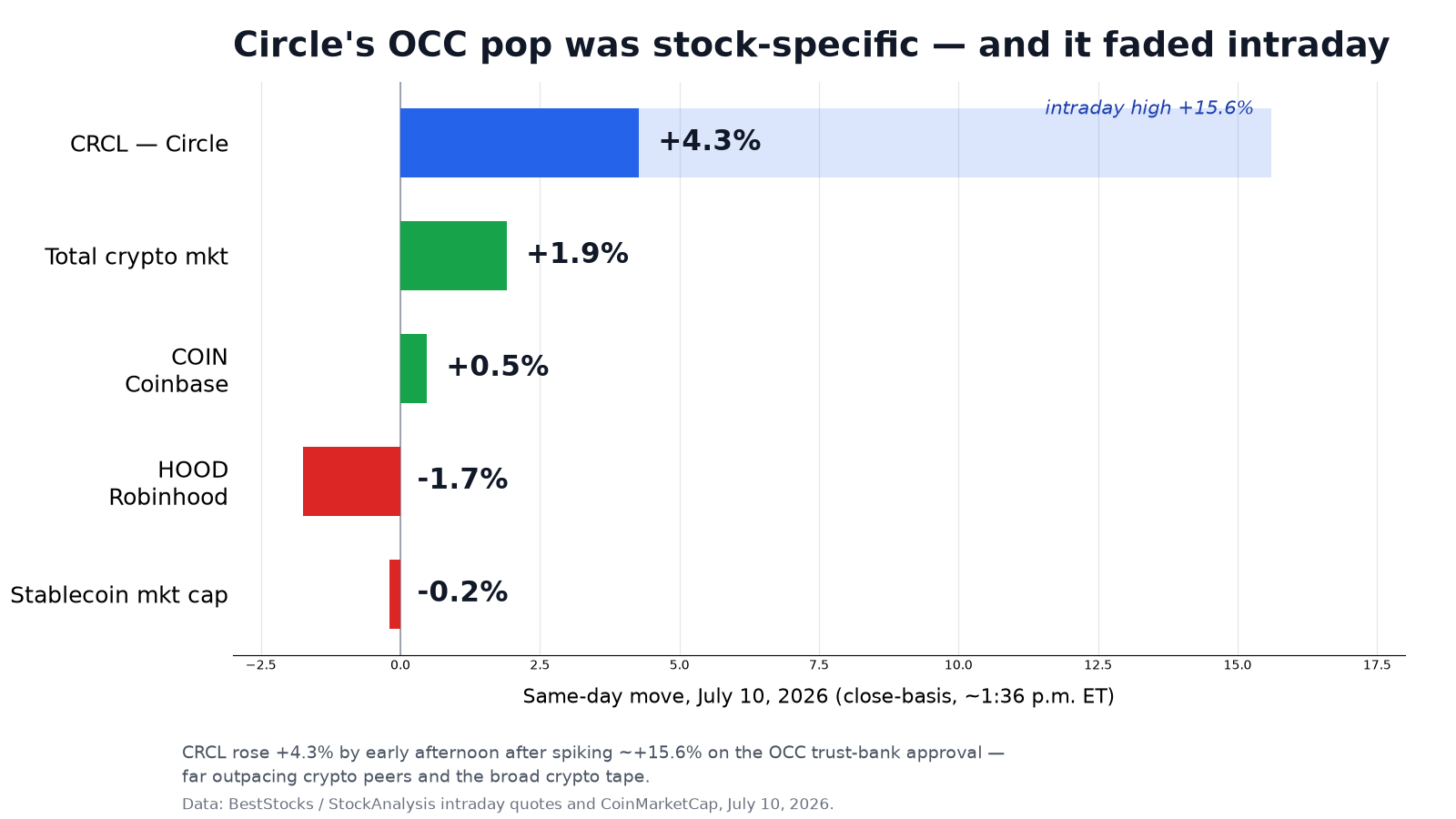
Circle Internet Group (NYSE: CRCL) jumped on Friday, July 10, 2026, on the day's clearest single-stock catalyst — one of the biggest moves flagged on the BestStocks change feed that session: final approval from the U.S. Office of the Comptroller of the Currency (OCC) to establish a national trust bank [1][4][5]. The reaction was violent but short-lived. The stock gapped up roughly 14% before the open, touched an intraday high of $72.86 — about 15.6% above Thursday's $63.01 close — and then gave most of it back, trading near $65.70 (+4.27%) by early afternoon [2][6]. That is an intraday fade consistent with a sell-the-news reaction: a structurally important, federally-blessed milestone that did not, by itself, change the near-term math on how Circle actually earns money. The move was unmistakably stock-specific — Circle outran every crypto proxy on the tape, with Coinbase (COIN) up just 0.5%, Robinhood (HOOD) down 1.7%, and the total crypto market up about 1.9% on the day [10][11][12].
What changed
The catalyst is concrete and easy to verify. Circle announced that the OCC granted final approval for First National Digital Currency Bank, N.A., which will operate as Circle National Trust — a federally-supervised national trust bank [4][7]. This was not a surprise out of nowhere: Circle filed its application on June 30, 2025 and received conditional approval in December 2025, so Friday closed a process the market had known about for more than a year [4][5]. On opening, Circle National Trust will provide fiduciary digital-asset custody services for Circle and its affiliates and, subject to demand, may extend custody to institutional clients such as banks and other financial firms. It is a limited-purpose trust charter, not a full-service bank — it does not authorize ordinary deposit-taking or lending. Crucially for the long-term thesis, the charter is designed to enable Circle to manage the reserves backing USDC — the world's second-largest dollar-pegged stablecoin, with roughly $73.2 billion in circulation against Tether's $184.1 billion — under direct federal oversight in the future [4][5]. CEO Jeremy Allaire framed it as "a defining step in bringing blockchain technology and digital assets into the core of the U.S. financial system" [5].
So why did a genuine win fade within hours? Three reasons. First, expectations: with conditional approval already in hand since December, much of the good news was priced, and the "final" stamp was more a de-risking than a fresh surprise. Second, Circle is no longer alone in the OCC pipeline — several rivals are advancing through the same process, mostly on conditional approvals (Crypto.com received conditional approval in February 2026; BitGo, Ripple, Paxos, and Fidelity Digital Assets in December 2025), which blunts the first-mover-moat narrative [5]. Third, and most important, the approval does not immediately touch Circle's profit engine. Circle earns primarily from interest on the reserves that back USDC; a trust-bank charter improves the governance and optionality of that model but does not lift reserve yields or settle the competitive threats bearing down on reserve economics [9]. The market took the structural point and then went back to worrying about the earnings point.
Why it matters
Circle is one of the purest public bets on regulated stablecoins, and the OCC charter is a milestone for the whole category, not just one issuer. A national trust bank pulls USDC's custody — and eventually its reserve management — inside the federal perimeter, which is precisely the assurance that conservative institutions (banks, asset managers, payment companies) say they need before routing real volume through a stablecoin. In that sense Friday advanced the bull thesis that USDC can become default dollar infrastructure in a post-GENIUS Act world, where major firms increasingly choose to adopt USDC rather than build their own [9]. The stakes are visible in the payments complex: incumbents like Visa (V) and Mastercard (MA), and fintechs such as PayPal (PYPL) with its own PYUSD, are all circling the same regulated-stablecoin opportunity [9].
But the fade matters just as much as the milestone. It is a reminder that Circle's valuation debate is not about legitimacy — that question is increasingly settled — but about economics. The company's revenue-less-distribution margin has expanded even as operating margins compressed to roughly 6% from 16% a year earlier, because it is spending heavily to defend distribution and build out its "Arc" network [9]. A trust-bank charter helps Circle capture more of the value chain over time, yet it does nothing to stop a rival from sharing reserve yield with partners tomorrow. Friday was the market saying, in effect: the regulatory story is winning, and the profit story is still up for grabs.
What to watch
First, the Coinbase agreement: the initial three-year term of Circle's largest cost line expires in August 2026 — a potential renegotiation point (absent agreed changes, it can auto-renew) and the single biggest swing factor on near-term margins, so any read on terms will move the stock more than another regulatory headline [9]. Second, post-approval analyst revisions — the current ~$133 average target and the tight cluster of recent Neutral marks ($69–$106) predate Friday's news, so watch whether any bank lifts numbers specifically for the charter or holds firm on the reserve-economics worry [8]. Third, USDC circulation: the bull case rests on continued double-digit growth (at March 31, 2026, USDC circulation was up about 28% year over year, with Q1 2026 on-chain transaction volume up 263% year over year), so a stall would validate the bears [9]. Fourth, competitive stablecoin launches and yield-sharing models like Open USD, which directly target Circle's reserve income [9]. Finally, whether Circle can convert the charter into actual fee-bearing custody and reserve-management mandates — the difference between owning a bank license and earning from it [4].
Why did CRCL stock jump on July 10, 2026?
Circle (CRCL) rose after the U.S. Office of the Comptroller of the Currency (OCC) granted final approval for the company to establish Circle National Trust, a national trust bank [4]. The stock gapped up about 14% pre-market and hit an intraday high near $72.86 — roughly 15.6% above Thursday's $63.01 close — before fading to about $65.70 (+4.27%) by early afternoon [2][5]. The charter lets Circle custody digital assets and, in the future, manage USDC's reserves under federal oversight — a structural win. The fade reflected that conditional approval was already known since December 2025, that rival crypto firms also hold charters, and that the approval does not immediately change Circle's reserve-based earnings [5][9].
What is the OCC national trust bank approval, and what does it let Circle do?
The OCC is the primary federal regulator for national banks and national trust banks. Its final approval lets Circle open First National Digital Currency Bank, N.A. — operating as Circle National Trust — a federally-supervised entity [4]. At launch it will provide fiduciary digital-asset custody for Circle and its affiliates and may extend custody to institutional clients. The charter is also designed to allow Circle to manage the reserves backing USDC under OCC supervision in the future, bringing a core part of stablecoin infrastructure inside the federal system [4][5]. Circle applied on June 30, 2025 and received conditional approval in December 2025 [4].
The July 10 move in numbers
| Measure | Value | Note |
|---|---|---|
| CRCL prior close, Thu Jul 9 | $63.01 | Reference close [2] |
| CRCL, Fri Jul 10 (StockAnalysis) | $65.70 | +4.27%, +$2.69; ~1:36 p.m. ET [2] |
| Open / intraday high / low | $70.66 / $72.86 / $65.62 | High ≈ +15.6% vs prior close; ~+14% pre-market [2][5] |
| Volume vs. average | ~30.4M vs. 13.9M 20-day avg | ~2.2× average, by early afternoon [2][3] |
| Short interest | ~22.3M shares (~8.97% of shares out) | StockAnalysis [3] |
| 52-week range | $49.90 – $262.97 | ~75% below the post-IPO high [2] |
| Market capitalization | ~$16.3 billion | 248.6M shares; Jul 10, 2026 [2] |
| Revenue (ttm) / trailing profitability | ~$2.86B (+51.5%) / small net loss (~$79M ttm) | GAAP near breakeven; Circle turned positive in Q1 2026 (+$0.21 diluted EPS, $55.3M net income) [2][14] |
How did crypto and fintech peers move the same day?
| Stock / market | Jul 10 move | Note |
|---|---|---|
| CRCL — Circle | +4.3% (intraday +15.6%) | OCC national trust bank approval [2][4] |
| COIN — Coinbase | +0.5% | Largest crypto exchange; muted [10] |
| HOOD — Robinhood | -1.7% | Retail brokerage / crypto [11] |
| Total crypto market cap | +1.9% | Bitcoin ~$63,357, +1.84% [12][13] |
| Stablecoin market cap | -0.2% | Sector ~$307.7B, roughly flat [12] |
The divergence is the point: a +4.3% close (and a +15.6% intraday spike) against a barely-changed crypto complex shows the market was reacting to Circle's charter, not to a sector-wide rally.
What do analysts say about CRCL stock?
The Street was cautious heading into the news, and the recent cluster of ratings sits below the flattering average. These marks predate the OCC approval.
| Firm | Rating | Target | Note / date |
|---|---|---|---|
| Goldman Sachs (J. Yaro) | Neutral | $96 (from $111) | Lowered, early July 2026 [8][9] |
| Morgan Stanley | Neutral | $106 | Reiterated, early July 2026 [8] |
| Susquehanna (J. Friedman) | Neutral | $69 | Initiated, early July 2026 [8] |
| Bernstein | Buy / Outperform | — | Reaffirmed bull case [9] |
| Consensus | Buy-lean / Hold split | ~$133 avg (range $55–$243) | StockAnalysis, ~25 analysts, Jul 10; other trackers ~$117–$134 [2][8] |
CRCL valuation scenarios: bull, base, bear
The scenarios below are the author's hypothetical, illustrative estimates — not forecasts, analyst consensus, or investment advice. The probabilities are judgment calls, and each price range is anchored to the cited inputs: recent Street targets (low $55, average ~$133, high $243) and Circle's reserve-income economics. They are meant to frame the risk, not to price it precisely.
| Scenario | Price | Prob. | Key drivers |
|---|---|---|---|
| Bull | ~$140–180 | 30% | OCC charter plus GENIUS-Act adoption cement USDC as default regulated dollar infrastructure; circulation keeps compounding (up ~28% YoY), and custody/reserve-management fees add new revenue; a re-rate toward the ~$133 average and the $243 Street high [8][9] |
| Base | ~$95–110 | 45% | Reserve-income model intact, but distribution costs (the Coinbase renegotiation) and eventual rate normalization cap the multiple; roughly Goldman's $96 and Morgan Stanley's $106 [8] |
| Bear | ~$55–70 | 25% | Yield-sharing rivals like Open USD erode reserve economics, the August 2026 Coinbase renegotiation lifts distribution costs, and rate cuts compress reserve yield; toward Susquehanna's $69 and the $55 Street low — where the stock already trades [9] |
Blending those gives a probability-weighted fair value near $110 (weighting the scenario midpoints; about $99–$121 across the range endpoints), well above Friday's ~$65.70 — a gap that says the market is currently pricing CRCL close to the bear case, giving little credit to the regulatory moat the OCC charter just widened [2][8]. Whether that is an opportunity or a warning depends entirely on the reserve-economics debate the fade left unresolved.
Is CRCL stock a buy after the OCC approval?
This piece does not make recommendations. The bull case is that Circle just cleared its biggest regulatory hurdle, USDC keeps compounding, and at ~$65.70 the stock trades below almost every analyst target and roughly 75% under its post-IPO high, leaving room if the reserve-income fears prove overdone [2][9]. The bear case is that a trust-bank charter does not fix the core threat — yield-sharing competitors and a looming Coinbase cost renegotiation aimed squarely at reserve economics — which is why the +15.6% pop faded to +4.3% on the day [2][9]. High short interest and a still-shattered chart make near-term moves volatile in both directions [3].
What is Circle (CRCL) and USDC?
Circle Internet Group is the issuer of USDC, a U.S.-dollar-pegged stablecoin backed one-to-one by cash and short-term U.S. Treasuries. USDC is the world's second-largest stablecoin, with roughly $73.2 billion in circulation versus Tether's USDT at about $184.1 billion; together the two control the vast majority of the ~$308 billion stablecoin market [5][12]. Circle earns primarily from interest on the reserves that back USDC, which makes its profits sensitive to both stablecoin circulation and interest rates. The company went public in June 2025, spiked far above its offer price, and has since fallen sharply — trading near $65.70 on July 10, 2026, about 75% below its 52-week high of $262.97 [2]. The July 10 OCC approval to establish Circle National Trust is a step toward bringing USDC's custody and reserve management under federal banking supervision [4].
Circle (CRCL) stock FAQ
Why did Circle (CRCL) stock jump on July 10, 2026?
Circle rose after the U.S. Office of the Comptroller of the Currency (OCC) granted final approval for the company to establish Circle National Trust, a national trust bank. The stock gapped up about 14% pre-market and hit an intraday high near $72.86 — roughly 15.6% above the $63.01 prior close — before fading to about $65.70 (+4.27%) by early afternoon. The charter lets Circle custody digital assets and eventually manage USDC's reserves under federal oversight.
Why did the stock fade after the initial pop?
Three reasons. Conditional approval had been public since December 2025, so much of the news was priced in. Circle is no longer alone in the OCC pipeline — Crypto.com, BitGo, Ripple, Paxos, and Fidelity Digital Assets are advancing through the same process, mostly on conditional approvals. And the approval does not immediately change how Circle makes money: it earns mainly from interest on USDC reserves, which a trust-bank charter does not lift.
What does the OCC national trust bank approval let Circle do?
It lets Circle open First National Digital Currency Bank, N.A., operating as Circle National Trust — a federally-supervised entity that will provide fiduciary digital-asset custody for Circle and its affiliates and may extend custody to institutional clients. The charter is also designed to let Circle manage the reserves backing USDC under OCC oversight in the future.
Was the move specific to Circle or a crypto-wide rally?
It was stock-specific. On the same day, Coinbase rose about 0.5%, Robinhood fell about 1.7%, the total crypto market was up roughly 1.9%, and the stablecoin sector was down 0.2%. Circle's +4.3% close (after a +15.6% intraday spike) far outran every proxy, showing the market was reacting to its charter, not the sector.
What is the analyst price target for CRCL?
The consensus average is around $133, with a range from roughly $55 to $243 across about 25 analysts, but the most recent marks are cautious and cluster below the average: Susquehanna initiated Neutral at $69, Morgan Stanley is at $106, and Goldman Sachs cut to $96. Those ratings predate the OCC approval, so post-news revisions are worth watching.
What is Circle (CRCL) and USDC?
Circle Internet Group issues USDC, a dollar-pegged stablecoin backed one-to-one by cash and short-term U.S. Treasuries. USDC is the world's second-largest stablecoin, with about $73.2 billion in circulation versus Tether's ~$184.1 billion. Circle earns primarily from interest on USDC's reserves, so its profits depend on both stablecoin circulation and interest rates. It went public in June 2025 and traded near $65.70 on July 10, 2026, about 75% below its 52-week high.