Healthcare
Merck (MRK) Stock Jumps to a 52-Week High: The Moderna Cancer-Vaccine Phase 3 Win and the Keytruda Cliff
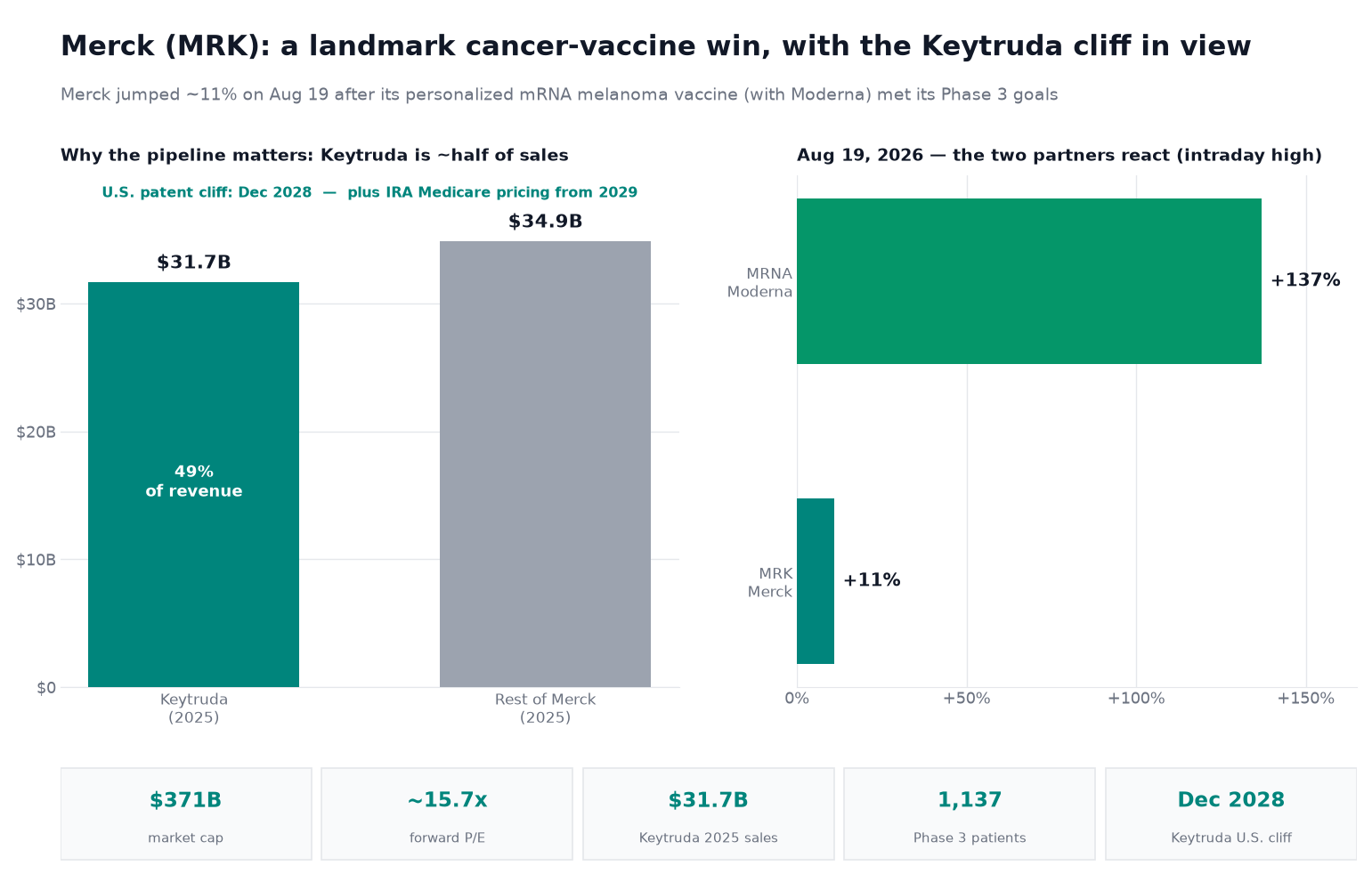
Merck jumped more than 9% (about 11% intraday) to a 52-week high on August 19 after it and partner Moderna said their personalized mRNA cancer vaccine (intismeran/V940) plus Keytruda succeeded in a pivotal Phase 3 melanoma trial, meeting both recurrence-free and distant-metastasis-free survival goals. It matters because Keytruda — ~49% of Merck's revenue — faces a U.S. patent cliff in December 2028 (plus IRA pricing pressure), and this is the first Phase 3 win for a potential post-Keytruda growth platform. Moderna, for which the program is far more material, more than doubled. But after the pop to a 52-week high, Merck trades above the average analyst target (~$137) on a forward P/E near 16×, and the vaccine's revenue is still years — and a regulatory path — away.

Why Merck stock jumped — a win for its most important pipeline bet
On Tuesday, August 19, 2026, Merck (NYSE: MRK) jumped more than 9% — trading above $150, up about 11% intraday, to a fresh 52-week high — from a $135.17 prior close [1]. The catalyst was unusually clean for a company this size: Merck and its partner Moderna announced that their personalized mRNA cancer vaccine, combined with Merck's blockbuster Keytruda, succeeded in a pivotal Phase 3 melanoma trial. The reaction split along the two companies' very different sizes — Moderna, for which the program is far more material, more than doubled (rising as much as roughly 137% at its intraday high), while Merck's move, though large for a $370 billion company, was more measured [1][8].
The therapy — intismeran autogene, known in development as V940 or mRNA-4157 — is an investigational individualized neoantigen therapy: a bespoke vaccine built for each patient from the specific mutations in their own tumor, designed to train the immune system to recognize cancer cells, and given alongside Keytruda. It is a therapeutic cancer vaccine, given after surgery to reduce the risk of recurrence, not a prophylactic vaccine meant to prevent cancer from developing. In the Phase 3 INTerpath-001 trial, the combination was tested against Keytruda alone in 1,137 patients whose Stage IIB–IV melanoma had been surgically removed — the "adjuvant" setting, where the goal is to stop cancer from coming back. It met both of its main goals: a statistically significant improvement in recurrence-free survival (keeping patients cancer-free) and in distant metastasis-free survival (preventing spread to other organs), with no new safety concerns. Merck called it the first combination to show such a benefit over Keytruda alone in this setting [2].
Why it matters so much: the Keytruda cliff
To understand why a single melanoma trial moved a mega-cap, you have to understand Merck's central problem. Keytruda is the best-selling drug in the world, generating roughly $31.7 billion in 2025 — about 49% of Merck's total revenue [5]. Its main U.S. patent expires in December 2028, after which lower-cost biosimilars can gradually erode the franchise; more than $25 billion of annual Keytruda revenue is exposed to that eventual biosimilar competition, and Merck now expects Keytruda to enter U.S. Medicare price setting under the Inflation Reduction Act with a government-set price effective in 2029 — around the same period the patent cliff begins. That looming "patent cliff" is the single biggest question hanging over the stock, and Merck has spent years and tens of billions of dollars — on acquisitions and its own pipeline — trying to build the revenue that will replace it [5].
The Moderna partnership is one of the most-watched answers to that question. A personalized cancer vaccine that meaningfully improves outcomes on top of Keytruda is not just a new product; it is a potential post-Keytruda growth platform — one that could extend Merck's immuno-oncology leadership past the cliff and, because the same technology is being tested in lung and other cancers, span multiple large markets. Merck and Moderna share the program's development costs and any profits equally, so the economics for Merck are meaningful but not exclusive. Tuesday's result is the program's first Phase 3 win, which is why the market treated it as a genuine de-risking of Merck's post-2028 future rather than a routine trial readout [2].
The catch: a lot is now priced in — and revenue is years away
The enthusiasm is warranted, but two facts temper it. First, this is a topline announcement: Merck reported that the trial met its goals but has not yet released the actual hazard ratios that quantify the benefit, and overall survival remains under evaluation — those details come at a future medical meeting, and regulatory filings, approval and launch are years away, likely well after the 2028 cliff begins. Second, the stock's run has already outpaced the Street. After the pop, Merck trades above the average analyst 12-month target of about $137 and near the highest target on the board (about $155) [7]. Most of those targets predate Tuesday's news and may now be revised upward — but at a 52-week high, the market has quickly priced in a good deal of optimism for a benefit that will not show up in revenue for some time.
Why it matters
Beyond Merck, Tuesday was a milestone for an idea the industry has chased for years: personalized cancer vaccines. A Phase 3 win in melanoma is the strongest evidence yet that a bespoke, mRNA-based therapy — manufactured individually for each patient — can change outcomes when paired with an established immunotherapy. That is why the reaction was so lopsided: for Moderna, whose post-COVID story badly needed a win, an oncology validation is transformational, hence the more-than-doubling of the stock; for Merck, it is one important piece of a much larger portfolio. The result also raises the stakes for the broader field, from other neoantigen programs to the immuno-oncology giants whose franchises a new modality could eventually reshape.
How the two partners traded
Healthcare had a firm session broadly — the sector rose a few percent, with Eli Lilly up about 5% — but the moves in the two companies with a direct stake in the trial dwarfed the rest, marking this as a company-specific catalyst by magnitude rather than a sector event [8]:
| Name (ticker) | Aug 19, 2026 (intraday) | Read-through |
|---|---|---|
| MRNA — Moderna | more than doubled (≈+93% early, ~+137% at the intraday high) | The co-developer; an oncology validation is far more material to a company its size [8] |
| MRK — Merck | ≈+11% | A meaningful post-Keytruda-cliff de-risking, but one piece of a $66B-revenue portfolio (with the vaccine's economics shared with Moderna) [1] |
The scale of Moderna's move versus Merck's is the clearest read on relative stakes: the same data point that de-risks one line of Merck's pipeline effectively re-rates Moderna's entire oncology thesis [8].
What the Street did with it
Coming into the readout, the Street was constructive but its published targets were conservative: recent marks included Wells Fargo and Barclays at $150, BMO Capital at $142, and Bernstein at $105 (raised from $100), against a consensus average near $137 and a Buy-tilted rating distribution [7]. Because most of those targets predate Tuesday's result — and the stock has now traded through them — the more relevant question is how far analysts raise their numbers once the actual hazard ratios are disclosed. The efficacy bar Citi laid out (a recurrence-free-survival hazard ratio around 0.65–0.72) is the yardstick to watch [7].
What to watch
- The actual data. The topline release confirmed the trial "worked"; the hazard ratios for recurrence-free and distant-metastasis-free survival, due at an upcoming medical meeting, will determine how strong the benefit is and how much targets move [2].
- Regulatory timeline. Watch for filing submissions and the path to approval and launch — and how that timing lines up against the 2028 Keytruda cliff [2].
- The rest of the platform. The same technology is in Phase 3 for lung cancer (NSCLC) and being tested in other tumors; each readout is a free option on expanding the opportunity [2].
- The cliff mitigation overall. V940 is one piece; watch subcutaneous Keytruda (Qlex), recent acquisitions, and the broader pipeline against the ~$31.7 billion of revenue at risk. Moves are tracked on the MRK stock page and the earnings calendar [5].
Illustrative valuation sensitivity
The scenarios below are a descriptive, author-weighted exercise — not a forecast, target, recommendation, or intrinsic fair-value calculation. They are anchored to Merck's forward earnings power (a forward P/E near 16×) and to the analyst target distribution (low ~$105, average ~$137, high ~$155, most predating this readout), adjusted for the pipeline optionality this result adds. The weights are the author's subjective assumptions and sum to 100%.
| Scenario | Illustrative price | Weight | Key drivers |
|---|---|---|---|
| Upside | ~$175 | 30% | Strong disclosed hazard ratios, the vaccine platform reads out in lung and other tumors, and the market re-rates Merck's post-cliff pipeline — targets move well above today's price [7]. |
| Middle | ~$150 | 45% | A solid but not spectacular data set; analysts raise targets toward the current price, and the stock consolidates its gains as the 2028 cliff stays firmly in view [7]. |
| Downside | ~$115 | 25% | The Keytruda cliff bites in 2028–2029 before the vaccine and other pipeline scale, biosimilars erode $25B+ of revenue, and the stock gives back the post-readout enthusiasm toward the prior target range [3][5]. |
Weighting those (0.30 × $175 + 0.45 × $150 + 0.25 × $115) gives an author-weighted reference value near $149, essentially the current quote [1] — a reminder that after an 11% jump to a 52-week high, the good news is largely reflected, and the debate is now about how a years-away pipeline stacks up against a 2028 revenue cliff. This is descriptive analysis of a market move, not investment advice or a valuation substitute.
MRK data snapshot — August 19, 2026 (intraday)
| Figure | Value | As-of / source |
|---|---|---|
| Intraday quote | ~$147.45 (+9.1%) early, ~$150.40 (+11.3%) mid-morning, and higher still into the afternoon (intraday high ~$151.72) | Aug 19 — StockAnalysis / Change Feed [1] |
| Prior close | $135.17 | Mon, Aug 18, 2026 [1] |
| 52-week price change / range | ≈+76% over 52 weeks; 52-week range $77.58–$151.72 (making fresh highs intraday) | As of Aug 19 [3] |
| Market cap / EV | ≈$371B (2.47B shares); enterprise value ≈$418B | Aug 19 — StockAnalysis [3] |
| Valuation | Forward P/E ≈15.7×; trailing P/E ≈120× (distorted by acquisition-related charges); price-to-sales ≈5.5× | Aug 19 — StockAnalysis [3] |
| Financials (TTM) | Revenue ≈$66.6B (+4.6%); gross margin in the mid-70s%; net income ≈$3.2B (EPS $1.27) depressed by ≈$14.7B of 2026 acquired-IPR&D charges ($9.0B Cidara + $5.7B Terns) | TTM — StockAnalysis / filings [3] |
| Balance sheet / dividend | Cash & short-term investments ≈$7.1B; total debt ≈$53.9B; dividend yield ≈2.3% ($3.40/yr) | Aug 19 — StockAnalysis [3] |
| Volume | Heavy on the news; 20-day average ≈7.7M shares | Aug 19 — StockAnalysis [3] |
| The catalyst | Phase 3 INTerpath-001: intismeran (V940) + Keytruda met RFS and DMFS vs Keytruda alone in resected Stage IIB–IV melanoma (1,137 patients, 2:1); no new safety signals | Aug 19 — Merck/Moderna [2] |
| Strategic stakes | Keytruda ≈$31.7B in 2025 (~49% of revenue); U.S. patent cliff Dec 2028; IRA Medicare price effective 2029; >$25B of Keytruda revenue exposed to eventual biosimilars | 2025–2026 — company / coverage [5] |
| Partner reaction | Moderna (MRNA) more than doubled (≈+93% early, ~+137% at the intraday high) | Aug 19 [8] |
| Analyst reaction | Consensus Buy, avg target ≈$137 (range ~$105–$155); recent (mostly pre-readout): Wells Fargo/Barclays $150, BMO $142, Bernstein $105 | Aug 2026 — market coverage [7] |
The August 19 figures are intraday snapshots that moved through the session, not closing prices.
The setup at a glance
| Question | Answer |
|---|---|
| Why did Merck stock jump on August 19? | Merck and Moderna announced that their personalized mRNA cancer vaccine (intismeran/V940) plus Keytruda succeeded in a pivotal Phase 3 melanoma trial (INTerpath-001), meeting both recurrence-free and distant-metastasis-free survival goals versus Keytruda alone. Merck rose more than 9% (about 11% intraday) to a 52-week high; partner Moderna more than doubled [1][2]. |
| What is the therapy? | Intismeran autogene (V940 / mRNA-4157) is an individualized neoantigen therapy — a personalized mRNA vaccine built from each patient's own tumor mutations, given with Keytruda to help the immune system attack cancer. It is being developed by Merck and Moderna [2]. |
| Why does one melanoma trial matter so much? | Because of the Keytruda patent cliff. Keytruda is ~49% of Merck's revenue (~$31.7B in 2025) and loses U.S. patent protection in December 2028. A first Phase 3 win for a multi-tumor personalized-vaccine platform is exactly the kind of successor Merck needs to offset that cliff [5]. |
| Is Merck stock cheap or expensive now? | Its trailing P/E above 100× is misleading — trailing earnings are depressed by one-time charges. The meaningful forward P/E is near 16×, undemanding for a business with ~76% gross margins. But after an 11% jump to a 52-week high, the stock trades above the average analyst target (~$137), so much of the near-term good news is priced in [3][7]. |
| Why did Moderna jump so much more than Merck? | Relative stakes. Moderna is a far smaller company for which an oncology validation is transformational, so the same data re-rated its entire cancer-vaccine thesis (the stock more than doubled). For Merck, a $370 billion company, it is one important piece of a much larger portfolio (~+11%) [8]. |
| What do analysts think? | Buy-tilted, with a consensus target near $137 that mostly predates the readout — meaning the stock has traded above it and targets are likely to be raised once the actual hazard ratios are disclosed. Recent marks ran $105–$155 [7]. |
Merck (MRK) stock FAQ
Why did Merck (MRK) stock jump on August 19, 2026?
Merck and its partner Moderna announced that their personalized mRNA cancer vaccine — intismeran autogene (V940), given together with Merck's blockbuster Keytruda — succeeded in a pivotal Phase 3 melanoma trial called INTerpath-001. The combination met both of its main goals versus Keytruda alone: a statistically significant improvement in recurrence-free survival and in distant-metastasis-free survival in patients whose melanoma had been surgically removed. Merck rose more than 9% (about 11% intraday) to a 52-week high, while Moderna, for which the program is far more material, more than doubled — rising as much as roughly 137% at its intraday high.
What is intismeran autogene (V940 / mRNA-4157)?
It is an investigational individualized neoantigen therapy — a personalized, therapeutic cancer vaccine given after surgery to reduce the risk of recurrence, not a preventive (prophylactic) vaccine. Rather than a one-size-fits-all drug, it is manufactured specifically for each patient using the unique mutations found in that patient's own tumor, and it uses mRNA technology (the same broad approach behind mRNA COVID vaccines) to train the immune system to recognize and attack cancer cells. It is designed to be used together with Keytruda, Merck's immunotherapy, and is being developed jointly by Merck and Moderna. Beyond melanoma, the same technology is in Phase 3 testing for lung cancer and being studied in other tumor types.
Why does this trial matter so much for Merck?
Because of the 'Keytruda patent cliff.' Keytruda is the world's best-selling drug and generated about $31.7 billion in 2025 — roughly 49% of Merck's total revenue. Its main U.S. patent expires in December 2028, after which lower-cost biosimilars can gradually erode more than $25 billion of annual revenue (and U.S. Medicare price setting is due to take effect in 2029). Merck has spent years and tens of billions of dollars trying to build products to replace that income, and the personalized cancer vaccine is one of the most-watched candidates. A first Phase 3 win is a genuine de-risking of Merck's post-2028 future, which is why the market reacted so strongly.
Is Merck stock expensive after the jump?
On the surface its trailing price/earnings ratio looks extreme (above 100 times), but that is misleading — trailing earnings are temporarily depressed by large one-time acquisition-related charges. The more meaningful forward P/E is near 16 times, which is undemanding for a company with gross margins in the mid-70s percent (the ~$14.7 billion of 2026 acquisition-related in-process-R&D charges is what depresses the trailing figure). That said, after an 11% jump to a 52-week high, the stock now trades above the average analyst 12-month target (around $137) and near the highest target on the board (around $155). Those targets mostly predate the trial news and will likely be revised upward, but the near-term good news is already substantially reflected in the price.
Why did Moderna more than double when Merck rose only about 11%?
It comes down to relative stakes. Moderna is a much smaller company whose post-COVID story badly needed a major clinical win, so a Phase 3 success in oncology effectively re-rated its entire cancer-vaccine thesis — a transformational event that saw the stock more than double intraday (rising as much as ~137%). For Merck, a company with about $66 billion in annual revenue and a huge existing portfolio (and which shares the vaccine's economics equally with Moderna), the same result is very important but is one piece of a much larger business, so the stock rose a more measured 11%. The lopsided reaction is itself the clearest signal of how much more the program means to each partner.
When could the cancer vaccine actually generate revenue?
Not for several years, and likely after the Keytruda cliff has already begun. The August 19 announcement was a topline result — Merck confirmed the trial met its goals but has not yet released the detailed hazard ratios, which are due at a future medical meeting. The companies then have to file with regulators, obtain approval, and launch, and they face the practical challenge of manufacturing a bespoke vaccine for each patient at scale. So while the result de-risks Merck's long-term pipeline, investors should treat it as a multi-year opportunity rather than a near-term revenue driver. This is descriptive analysis, not a recommendation.