Technology
Dell (DELL) Stock Falls More Than 6%: The AI-Server Boom Meets a Memory-Cost Squeeze
Dell fell about 6–7% to roughly $440 on August 19 — not on any demand warning (analysts actually raised targets that day), but as AI-hardware names lagged a firm market and investors refocused on a known worry: rising DRAM/NAND memory and HDD storage costs squeezing the already-thin margins on its booming AI servers, ahead of the September 1 earnings. It is the uncomfortable other side of the storage/memory super-cycle: soaring prices lift the makers (Micron and SanDisk in memory, Western Digital in hard drives) but raise input costs for system assemblers like Dell. After a ~218% one-year run and a re-rating to ~24× forward earnings on a ~19%-gross-margin business, the September print — where the AI-server margin line will show whether the squeeze is temporary or structural — is the key test. Analyst targets run from $360 to $700.
Why Dell stock dropped — the AI-server boom's uncomfortable other side
On Wednesday, August 19, 2026, Dell Technologies (NYSE: DELL) fell about 6–7% to roughly $440, from a $468.65 prior close [1]. There was no new demand warning — Dell's AI-server orders are booming, and analysts actually raised targets on the stock that day. The slide appears to reflect something subtler: with the broader market firm but AI-hardware and chip names lagging, investors took profits after Dell's enormous re-rating and refocused on a known worry — that the profits on Dell's AI servers are being squeezed as component costs climb, right before its next earnings report. As the prices of DRAM and NAND memory, and HDD storage, surge in the AI build-out, the cost of the parts Dell puts inside its servers is rising fast, and AI-optimized servers already earn thinner margins than the rest of Dell's business [2].
This is the uncomfortable other side of a trade this site has covered from the winning end. The storage/memory super-cycle that has powered Micron and SanDisk (in DRAM and NAND memory) — and supports hard-drive makers like Western Digital — is two-sided. Rising memory and storage prices are a tailwind for the companies that make those parts, but an input-cost headwind for the system vendors that buy them to assemble servers. Dell is the largest of those assemblers, so the same price surge that lifts the component makers lands on Dell as a bigger bill [3].
The boom is real — and so is the margin question
There is no demand problem. In its most recent quarter Dell booked roughly $24 billion of AI-server orders and raised its full-year revenue guidance to about $165–169 billion, with full-year AI-server revenue guided near $60 billion and a large multibillion-dollar backlog [5]. That growth is why the stock has been one of the market's biggest AI-hardware winners, up roughly 218% over the past year and re-rated from a low-multiple hardware stock into a growth name trading near 24× forward earnings [3].
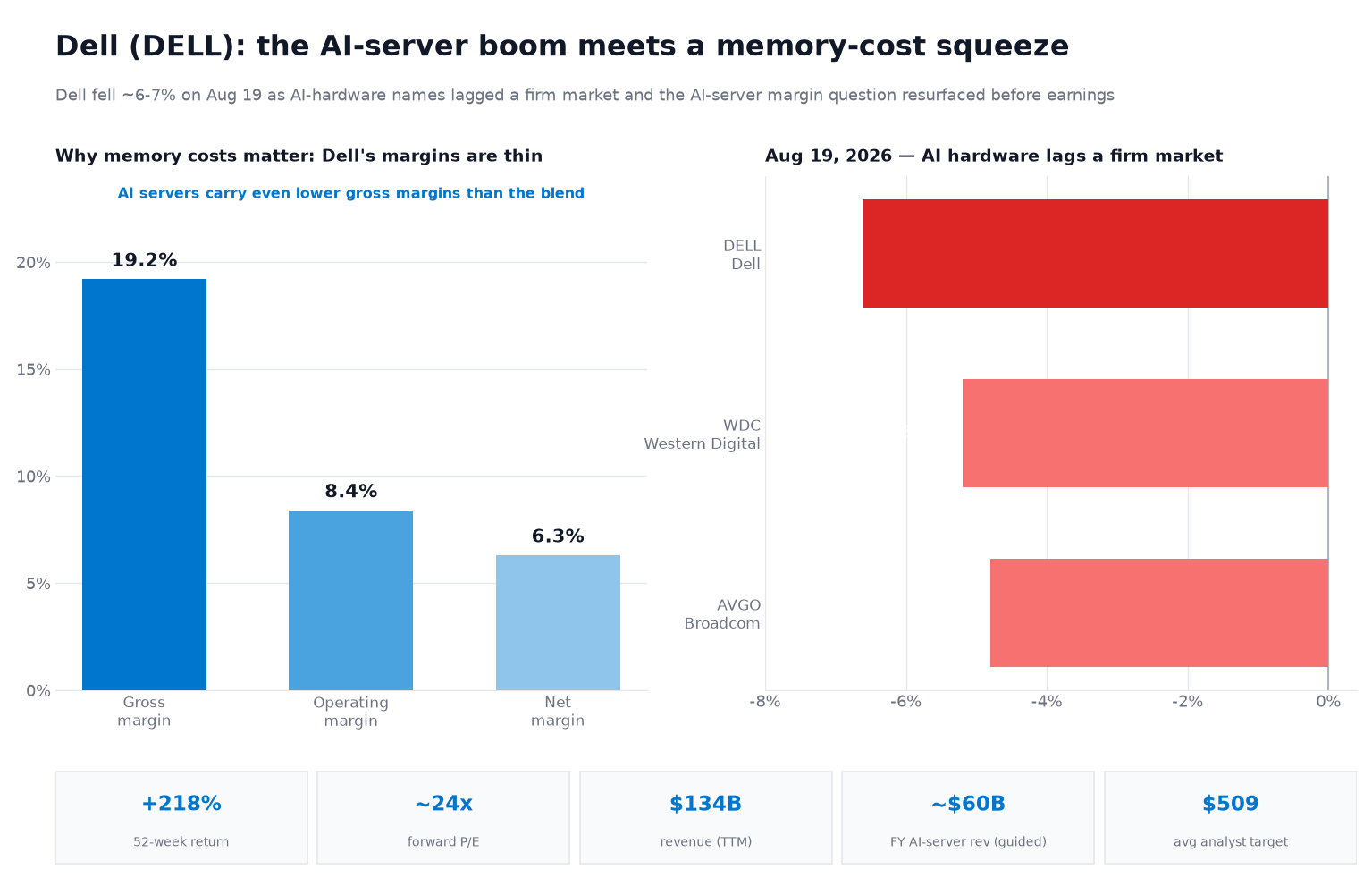
But Dell's business is structurally thin-margin: a gross margin around 19%, an operating margin around 8%, and a net margin around 6% [3]. AI servers, packed with expensive GPUs and memory that Dell largely passes through, carry even lower gross margins than that blend. Management has already flagged "atypically rapid" cost increases across DRAM, NAND, HDD and leading-edge nodes, and pointed to one-time supply-chain expenses and aggressive early pricing on new-generation servers as pressures it expects to ease. The market's worry, resurfacing on August 19, is that the squeeze proves structural rather than temporary — that Dell is booking enormous AI revenue at margins too thin to justify a growth multiple [2][5].
Why the Street is split
Wall Street is broadly bullish on Dell but sharply divided on how much the margin risk matters. The consensus is a Buy with an average 12-month target near $509 — well above the ~$440 price — and targets ranging from about $360 to $700 [7]. The bulls are emphatic: Susquehanna at $700, Evercore ISI at $550, Wells Fargo at $545, Goldman Sachs at $510, all rating Dell a Buy on its AI-server leadership [7]. Strikingly, two of them raised or reaffirmed their targets on August 19 itself — Evercore lifting Dell to $550 and Susquehanna reiterating $700 — even as the stock fell [7]. The lone cautious anchor is Morgan Stanley's Erik Woodring, who earlier in the month cut his target to $430 from $477 and stayed at Equal Weight (Hold), citing limited valuation upside and a squeezed risk-reward into earnings; the stock's slide toward that lower target is a sign the market is, for now, weighting the margin worry over the growth story ahead of the September 1 print [2][7].
Why it matters
Dell is a useful barometer for a question the whole market is now asking: who actually keeps the profit in the AI build-out? The memory makers are capturing pricing power; the chip designers command huge margins; but the assemblers who turn those parts into finished AI servers sit in the middle, passing through expensive components at thin markups. When memory costs spike, that middle gets pinched. Dell's slide is a reminder that "AI winner" is not one trade but several, with very different economics — and that a stock can have booming revenue and a falling price at the same time if the market decides the growth is not profitable enough to support the multiple it has been awarded.
How AI hardware traded the same day
Even as the broader market held firm on August 19, AI-hardware and semiconductor names lagged, and Dell fell hardest in the group [8]:
| Name (ticker) | Aug 19, 2026 (intraday) | Read-through |
|---|---|---|
| DELL — Dell | ≈−6.6% | Fell hardest as the AI-server margin question resurfaced ahead of earnings, atop a standing valuation overhang [1][2] |
| WDC — Western Digital | ≈−5.2% | A hard-drive (storage) maker; pulled back with the group despite the storage-pricing tailwind [8] |
| AVGO — Broadcom | ≈−4.8% | AI chips; profit-taking extending an earlier analyst-driven decline [8] |
That these names fell while the broad market rose points to a rotation out of AI hardware, and Dell's extra decline reflects its specific overhang — the one name in the group where rising memory and storage prices are a cost, not a benefit [8].
What the Street did with it
The telling detail is that the analyst flow on August 19 was actually bullish — Evercore ISI raised its target to $550 and Susquehanna reiterated $700 — and the stock fell anyway, a sign the day's move was about sector positioning and margin fear rather than fresh negative news [7]. The cautious anchor is older: Morgan Stanley's Erik Woodring cut his target to $430 (from $477), at Equal Weight, earlier in the month on valuation and margin risk — a standing overhang, not a same-day catalyst [2]. Those views frame the consensus (a Buy near $509) and its unusually wide $360-to-$700 range, which is the real signal: the disagreement is not about whether Dell is winning AI-server share (it is), but about whether that share converts into enough profit to justify the re-rated stock [7].
What to watch
- September 1 earnings — the margin line. Watch AI-server gross margins and the ISG (server) segment operating margin, and whether management reaffirms that the component-cost squeeze is temporary [5].
- Memory and storage prices. DRAM, NAND and HDD spot and contract pricing are now a direct input to Dell's margins; watch them as much as Dell's order book [3].
- Backlog and guidance. Watch the AI-server backlog and any change to the ~$165–169 billion full-year revenue and ~$60 billion AI-server guidance [5].
- The valuation debate. With targets from $360 to $700, watch whether analysts converge after earnings. Moves are tracked on the DELL stock page and the earnings calendar [7].
Illustrative valuation sensitivity
The scenarios below are a descriptive, author-weighted exercise — not a forecast, target, recommendation, or intrinsic fair-value calculation. They are anchored to Dell's forward earnings power and to the analyst target distribution (low ~$360, average ~$509, high ~$700), turning on the single question of AI-server margins. On Dell's own ~$17.90 fiscal-2027 non-GAAP EPS guidance midpoint, the scenario prices below imply roughly 34×, 28× and 21× forward earnings respectively (on the ~$18.64 Street EPS consensus, closer to 32×/27×/20×). The weights are the author's subjective assumptions and sum to 100%.
| Scenario | Illustrative price | Weight | Key drivers |
|---|---|---|---|
| Upside | ~$600 | 30% | September earnings show AI-server margins stabilizing or recovering (mix, scale, easing one-time costs); the backlog and guidance hold, and the growth multiple is validated toward the bull targets [7]. |
| Middle | ~$500 | 40% | Growth continues but margins stay pressured; the stock recovers toward the consensus target as investors give management the benefit of the doubt on a temporary squeeze [7]. |
| Downside | ~$380 | 30% | The component-cost squeeze proves structural, AI-server margins stay thin, and a ~24× forward multiple de-rates toward Morgan Stanley's caution and the low end of the target range [2][3]. |
Weighting those (0.30 × $600 + 0.40 × $500 + 0.30 × $380) gives an author-weighted reference value near $494, above the ~$440 quote [1] — reflecting the Street's net-bullish tilt while acknowledging that the whole debate now hinges on one margin line in one earnings report. This is a Street-target-based scenario exercise and descriptive analysis of a market move, not investment advice or a valuation substitute.
DELL data snapshot — August 19, 2026 (intraday)
| Figure | Value | As-of / source |
|---|---|---|
| Intraday quote | $440.23 (−6.06%); ~$437.77 (−6.6%) earlier | Aug 19 — StockAnalysis / Change Feed [1] |
| Prior close | $468.65 | Mon, Aug 18, 2026 [1] |
| Day's range | $427.54–$471.75 | Aug 19 [1] |
| 52-week price change / range | ≈+218% over 52 weeks; 52-week range $110.22–$514.00 (~14% off the high) | As of Aug 19 [3] |
| Market cap / EV | ≈$283B (646M shares); enterprise value ≈$303B | Aug 19 — StockAnalysis [3] |
| Valuation (at ~$440) | Forward P/E ≈24×; trailing P/E ≈35×; price-to-sales ≈2.1× | Aug 19 — StockAnalysis [3] |
| Margins (thin) | Gross ≈19%; operating ≈8%; net ≈6% (StockAnalysis; AI servers lower still) | TTM — StockAnalysis [3] |
| Financials (TTM) | Revenue ≈$134B (+38.6%); net income ≈$8.4B (EPS $12.51); dividend yield ≈0.6% | TTM — StockAnalysis [3] |
| Balance sheet | Cash ≈$11.6B; total debt ≈$31.9B | Aug 19 — StockAnalysis [3] |
| Volume | Heavy — roughly 2× the time-adjusted normal by early session; 20-day average ≈5.7M shares | Aug 19 — Change Feed / StockAnalysis [1] |
| AI-server business | ~$24B AI orders in the latest quarter; FY revenue guided ~$165–169B; FY AI-server revenue guided ~$60B | FY2027 guidance [5] |
| Next catalyst | Fiscal Q2 earnings & call — September 1, 2026 | Company calendar [5] |
| Analyst reaction | Consensus Buy, avg target ≈$509 (range ~$360–$700); on Aug 19 Evercore raised to $550 and Susquehanna reiterated $700; Morgan Stanley at $430 (Equal Weight, cut earlier in the month) | Aug 2026 — market coverage [7] |
The August 19 figures are intraday snapshots that moved through the session, not closing prices; the AI-hardware names, Dell included, pared some of these declines later in the day.
The setup at a glance
| Question | Answer |
|---|---|
| Why did Dell stock fall on August 19? | Not on any new demand warning — analysts actually raised targets that day. With the broader market firm but AI-hardware names lagging, investors took profits after Dell's huge re-rating and refocused on a known worry: rising DRAM/NAND memory and HDD storage costs squeezing the thin margins on its AI servers, ahead of its September 1 earnings. An earlier Morgan Stanley target cut and months of insider selling are background, not same-day triggers. Dell fell ~6–7% as the group lagged (Western Digital −5.2%, Broadcom −4.8%) [1][2][8]. |
| Isn't Dell's AI business booming? | Yes — that's the paradox. Dell booked ~$24 billion of AI-server orders last quarter and guides to ~$60 billion of full-year AI-server revenue. The concern is not demand but profitability: AI servers carry very thin margins, and rising component costs make them thinner [5]. |
| Why do component costs hurt Dell but help Micron? | Because they are on opposite sides of the same trade. Micron and SanDisk make DRAM/NAND memory, and Western Digital makes hard drives — so rising memory and storage prices lift their revenue and margins. Dell buys those parts to build servers, so rising prices raise its costs. The storage/memory super-cycle is a tailwind for the makers and a headwind for the assemblers [3]. |
| Is Dell stock expensive now? | By its own history, yes. After a ~218% one-year run, Dell trades near 24× forward earnings — roughly double the low multiple it long carried as a hardware company — on a business with a ~19% gross margin and ~6% net margin. That re-rating is what makes the margin question so important [3]. |
| What do analysts think? | Mostly bullish but divided: a Buy consensus with an average target near $509 and a range from $360 to $700. On August 19 itself Evercore raised to $550 and Susquehanna reiterated $700; Morgan Stanley is the cautious anchor at $430 (Equal Weight), a target it cut earlier in the month [7]. |
| What is the key catalyst to watch? | Dell's fiscal Q2 earnings on September 1, 2026 — specifically the AI-server and ISG margin lines, which will show whether the component-cost squeeze is temporary or structural [5]. |
Dell (DELL) stock FAQ
Why did Dell (DELL) stock fall on August 19, 2026?
Dell fell about 6–7% to roughly $440 (from a $468.65 prior close), but not because of any new demand warning — its AI-server orders are booming, and analysts actually raised targets on the stock that day. With the broader market firm but AI-hardware and chip names lagging, investors took profits after Dell's huge run and refocused on a known worry: as the prices of DRAM and NAND memory and HDD storage surge in the AI build-out, the cost of the components inside Dell's servers is rising, and AI-optimized servers already carry thinner margins than the rest of Dell's business. An earlier Morgan Stanley target cut (to $430, Equal Weight) and months of insider selling are background overhangs rather than fresh triggers. On the day, Dell fell within a lagging group (Western Digital −5.2%, Broadcom −4.8%) ahead of its September 1 earnings.
If AI-server demand is so strong, why is the stock falling?
That is the paradox at the heart of the story. Dell booked roughly $24 billion of AI-server orders in its most recent quarter and guides to about $60 billion of full-year AI-server revenue, with a large backlog — so demand is not the problem. The problem is margin: AI servers are packed with expensive GPUs and memory that Dell largely passes through at a thin markup, so they earn even lower gross margins than Dell's already-modest ~19% blend. When memory costs rise faster than Dell can offset them, those thin margins get thinner, and after a ~218% run the stock is priced for growth that the market wants to see convert into profit.
Why do rising memory prices hurt Dell but help Micron and Western Digital?
Because they sit on opposite sides of the same trade. Micron and SanDisk make DRAM and NAND memory, and Western Digital makes hard drives (storage), so rising memory and storage prices lift their revenue and margins — that is the storage/memory super-cycle that has powered those stocks. Dell buys those components to assemble servers, so the same rising prices are an input cost that squeezes its margins. The boom is therefore a two-sided trade: a tailwind for the makers and a headwind for the assemblers like Dell that must build the finished machines.
Is Dell stock expensive after its run?
By its own history, yes. After climbing about 218% over the past year, Dell trades near 24 times forward earnings — roughly double the low-teens multiple it long carried as a traditional hardware company — on a business with a gross margin around 19% and a net margin around 6%. The AI-server boom drove that re-rating, which is exactly why the margin question matters so much: a growth multiple on a thin-margin business leaves little room for disappointment if AI-server profitability does not improve.
What did Morgan Stanley say about Dell?
Earlier in August, Morgan Stanley analyst Erik Woodring lowered his Dell price target to $430 from $477 and kept an Equal Weight (Hold) rating, citing limited valuation upside and a squeezed risk-reward heading into earnings. That was not an August 19 event — it was a standing bearish overhang — and it stands out because most of Wall Street is far more bullish: Susquehanna at $700, Evercore ISI at $550, Wells Fargo at $545 and Goldman Sachs at $510, keeping the consensus a Buy with an average target near $509. In fact, on August 19 itself Evercore raised its target to $550 and Susquehanna reiterated $700 — yet the stock fell toward Morgan Stanley's lower target anyway, a sign the market was weighting the margin worry over fresh bullish calls ahead of the September 1 earnings.
What is the key catalyst for Dell stock?
Dell's fiscal second-quarter earnings and conference call on September 1, 2026. The most important number will be the margin on its AI-server and broader server (ISG) business, which will reveal whether the pressure from rising memory and storage costs is a temporary function of product mix and one-time expenses — as management contends — or a more structural problem. With analyst targets spanning $360 to $700, that single margin line is likely to resolve much of the debate. This is descriptive analysis, not a recommendation.