Financials
Coinbase (COIN) Stock Jumps ~7%: A Bitcoin Rebound, Treasury Buybacks, and the CLARITY Act
Coinbase jumped about 7% to roughly $171 on August 20 — part of a ~17% two-day surge — as several forces pulled together: a genuine Bitcoin rebound (up ~3.5% to ~$71,500), a U.S. Treasury buyback move that eased yields, short-covering, and a White House crypto event where President Trump pushed the CLARITY Act — a tailwind uniquely relevant to the largest U.S. exchange. The high-beta crypto stocks outran the coin (COIN ~+7%, MSTR high-single digits vs Bitcoin ~+3.5%), magnifying the bounce. It landed on a beaten-down, loss-making stock (down ~43% over 52 weeks, a $359M Q2 loss), so the snap-back was sharp. Wall Street stays net-bullish (Buy consensus, ~$196 target), but targets have been falling and the move rests partly on a crypto rebound and a bill that still faces a mid-September Senate vote.

Why Coinbase stock jumped — a crypto rebound, amplified
On Thursday, August 20, 2026, Coinbase Global (NASDAQ: COIN) jumped about 7% to roughly $171, from a $160.20 prior close — part of a surge that left the stock roughly 17% above Tuesday's close in two sessions [1]. Several forces pulled in the same direction. Bitcoin was in a genuine rally, up about 3.5% on the day to around $71,500 after jumping roughly 7% the session before and briefly topping $72,000 [4]; a U.S. Treasury move to expand debt buybacks had eased longer-dated yields, lifting risk assets; and short-covering added fuel [8]. On top of that came a Washington tailwind uniquely relevant to Coinbase — a White House crypto event where President Trump pushed Congress to pass digital-asset legislation. As the largest U.S. exchange and one of the highest-beta names in the group, Coinbase took a broad crypto rebound and magnified it.
The Coinbase-specific catalyst: the CLARITY Act
On Wednesday, August 19, President Trump hosted a White House crypto event — themed "End the War on Crypto," and not the administration's first, following a digital-assets summit in early 2025 — with industry figures including Coinbase CEO Brian Armstrong and Robinhood's Vlad Tenev, alongside SEC Chair Paul Atkins and CFTC Chair Michael Selig [2]. The fresh, market-moving element was Trump's call for Congress to pass the CLARITY Act — a market-structure bill that would define once and for all whether a given crypto asset is a security or a commodity, and split oversight between the SEC and CFTC — ahead of a Senate procedural vote expected in mid-September [2]. (He also referenced, in the past tense, moves his administration had already made: a Strategic Bitcoin Reserve established by executive order earlier in 2025 and the wind-down of "Operation Chokepoint 2.0," the debanking of crypto firms — context, not new announcements [2].) For a company whose entire history has been shadowed by the question of whether U.S. regulators consider its listings unregistered securities, a credible path to a federal rulebook is not a small thing — it is close to an existential one.
The rates backdrop mattered too. On the same day, the U.S. Treasury said it would roughly double its longer-dated debt-buyback operations (to at least $4 billion per operation, on a schedule beginning September 9 and running through November 4), which helped ease yields and support risk assets on Wednesday [8]. The relief proved short-lived — yields were rising again by Thursday — but the initial move lower is a tailwind for exactly the kind of long-duration, speculative growth names that crypto stocks are.
Why the stocks outran the coin
The revealing part is not that crypto rallied but how much more the equities moved than the asset. On August 20, Coinbase rose about 7% and Strategy (MSTR) climbed high-single digits, while Bitcoin itself gained about 3.5% and the S&P 500 slipped [3]. When the shares of companies built on an asset outrun the asset by roughly two-to-one, the market is doing more than tracking the coin — it is repricing the businesses, their regulatory risk and their future addressable market. Coinbase, with a beta above 3, is the most sentiment-sensitive of the group, and as the dominant regulated U.S. exchange it is the most direct beneficiary of a rulebook that would let it list more assets, expand derivatives and court institutions without legal overhang [5]. That is why a broad crypto bounce showed up as an outsized move in COIN. (Same-day equity percentages varied widely by the minute and by source, so treat them as directional [3].)
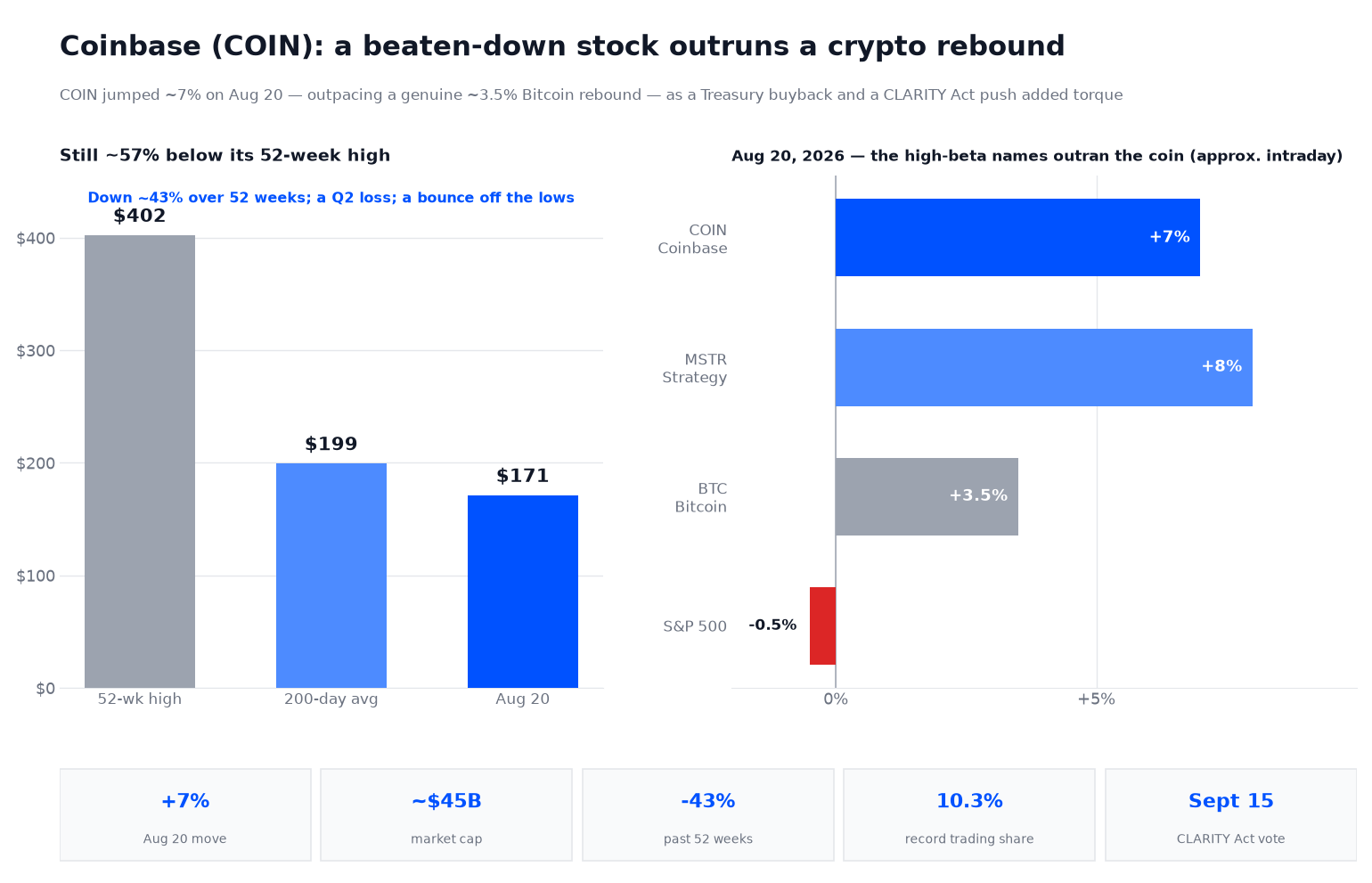
A beaten-down stock with room to bounce
Context explains why the move was so violent. Coming into this week, Coinbase was a broken chart: down about 43% over the prior 52 weeks, trading near the low of a $139–$402 range and well below its 200-day average around $199 [5]. The proximate cause was a weak second quarter. On July 30 the company missed on revenue ($1.22 billion versus a roughly $1.30 billion consensus) and posted a $359 million net loss, as transaction revenue fell 21% quarter over quarter to $599 million on softer trading; the stock dropped to around $155 in after-hours trading and slid further in the sessions that followed [6]. When a stock is that oversold and that hated, a broad crypto rebound plus a positive turn on the one risk that matters most — regulation — can produce an outsized snap-back. That is what this week was.
Why it matters
Coinbase is the closest thing the public market has to a pure bet on U.S. crypto policy. Unlike Strategy, which is really a leveraged Bitcoin holding, or Circle, a stablecoin issuer, Coinbase is an operating exchange whose revenue, product roadmap and legal exposure all turn directly on how Washington decides to regulate digital assets. That makes its stock a real-time barometer of the policy trade: when the odds of a federal framework rise, Coinbase is where the market expresses it. This week's move is a reminder that after years in which regulation was the sector's biggest overhang, the same regulation is now, at least in the market's eyes, becoming a potential catalyst — even if this particular rally was led by a Bitcoin rebound and easing yields, with policy as the accelerant. The exchange's fortunes still hinge on the price of Bitcoin and on trading volumes; what has changed is that the fate of a bill now sits alongside them.
How the crypto complex traded that day
August 20 was a sector move: crypto assets and crypto equities rallied together, but the highest-beta stocks outran the coin. The exact percentages swung widely through the session and by source, so treat them as directional [3]:
| Name (ticker) | Aug 20, 2026 (approx. intraday) | What it is |
|---|---|---|
| MSTR — Strategy | ≈+4% to +12% | A leveraged Bitcoin holding company — the highest-beta way to play the move [3] |
| COIN — Coinbase | ≈+6% to +7% | The largest U.S. exchange — the clearest winner from market-structure clarity [1] |
| CRCL — Circle | ≈+4% to +10% | The USDC stablecoin issuer — a beneficiary of stablecoin legislation [3] |
| HOOD — Robinhood | ≈flat to +6% | A broker with a growing crypto business [3] |
| BTC — Bitcoin | ≈+3.5% | The underlying asset — a real rebound, but outrun by the high-beta stocks [4] |
| S&P 500 | ≈−0.5% | A slightly lower broad market, underscoring the sector-specific catalyst [3] |
Bitcoin's ~3.5% rebound was real; Coinbase and Strategy roughly doubled it. That leverage — not a move in the coin alone — is what turned a crypto bounce into a 7% day for COIN [3].
What the Street thinks
Despite the beaten-down price and the loss-making year, Wall Street stays net-constructive. Across 34 analysts the consensus is a Buy with an average 12-month target near $196 — roughly 14% above Thursday's level — on a distribution of about 19 strong buy, 3 buy, 9 hold, 1 sell and 2 strong sell [7]. But the targets have been coming down and the bear camp is real. Bank of America holds a Buy but cut its target to $174 from $203 in early August, and Cantor Fitzgerald carries a Buy with a $184 target — both now below Thursday's ~$171 only modestly, a sign of how far estimates have compressed [7]. On the bearish side, Barclays rates the stock Underweight and cut its target to about $95 in late July, and Monness Crespi has carried a negative (Sell) view since early in the year [7]. That mix — a bullish headline consensus alongside falling targets and a genuine sell-side minority — is the reminder that plenty of the Street wants to see the legislation pass, and the trading business recover, before underwriting a full re-rating.
What to watch
- The CLARITY Act vote. A large piece of the bull case rests on legislation. Watch the Senate procedural vote expected in mid-September and the bill's path from there [2].
- Trading volumes. Coinbase still lives on transaction revenue, which fell 21% last quarter. Watch whether volumes and volatility recover [6].
- The diversification mix. Subscription and services — stablecoins, staking, custody — was 48% of net revenue in Q2. Watch whether that recurring base keeps growing to cushion the trading cycle [6].
- Bitcoin itself. A regulatory bid can fade if the asset rolls over; watch whether crypto prices confirm or undercut the equity move. Moves are tracked on the COIN stock page [4].
Illustrative valuation sensitivity
Because Coinbase lost money over the past year, there is no clean trailing earnings anchor, so the scenarios below are anchored instead to the analyst target distribution (low ~$95, average ~$196, high well above) and to two swing factors — whether the crypto rebound holds and whether the CLARITY Act's path clears or stalls. They are a descriptive, author-weighted exercise, not a forecast, target, recommendation, or intrinsic fair-value calculation; the weights are the author's subjective assumptions and sum to 100%.
| Scenario | Illustrative price | Weight | Key drivers |
|---|---|---|---|
| Upside | ~$230 | 30% | The CLARITY Act advances, trading volumes recover, and the market pays up for a de-risked, clarity-blessed franchise toward and beyond the bullish analyst targets [7]. |
| Middle | ~$196 | 40% | Regulatory momentum holds but the legislative timeline drifts; COIN drifts toward the consensus target as the recovery is priced gradually [7]. |
| Downside | ~$135 | 30% | The crypto rebound reverses, the bill stalls at the Senate vote, or trading volumes stay soft; the loss-making, high-beta name round-trips toward the low end of its range and the bearish (~$95) targets [6][7]. |
Weighting those (0.30 × $230 + 0.40 × $196 + 0.30 × $135) gives an author-weighted reference value near $188, above Thursday's ~$171 but short of the ~$196 consensus [1][7] — a reflection of how much of this stock's value is a bet on a bill that has not yet passed. This is a Street-target-and-catalyst-based scenario exercise and descriptive analysis of a news move, not investment advice.
COIN data snapshot — August 20, 2026 (intraday)
| Figure | Value | As-of / source |
|---|---|---|
| Intraday quote | ~$171.05 (+7.0%; ~$170.18 / +6.2% at 3 p.m. ET); part of a ~17% two-day surge from Tuesday's $146.23 close | Aug 20 — StockAnalysis / Change Feed [1] |
| Prior close | $160.20 | Wed, Aug 19, 2026 [1] |
| 52-week range / change | $139.11–$402.16; down ~43% over 52 weeks (~57% off the high, near the low) | As of Aug 20 [5] |
| Market cap / EV | ≈$45B (264M shares); enterprise value ≈$43B; beta ≈3.4 | Aug 20 — StockAnalysis [5] |
| Valuation | No trailing P/E (net loss); forward P/E ≈150×; ≈7.4× sales; ≈3.4× book | Aug 20 — StockAnalysis [5] |
| Financials (TTM) | Revenue ≈$6.0B (−9%); net loss ≈$0.99B (EPS −$3.73); gross margin ≈86%; no dividend | TTM — StockAnalysis [5] |
| Volume | ~13.9M shares by ~3 p.m. ET vs a ~8.0M 20-day average (well above average) | Aug 20 — StockAnalysis [5] |
| Latest quarter (Q2, Jul 30) | Revenue $1.22B (miss vs ~$1.30B); net loss $359M; transaction rev −21% QoQ to $599M; subscription & services $555M (48% of net rev); record 10.3% trading market share; stock fell after-hours to ~$155 | Jul 30 — company [6] |
| The catalyst | Aug 19 White House crypto event where Trump pushed the CLARITY Act (Senate vote ~Sept 15) — the fresh element — atop a genuine Bitcoin rebound and a Treasury buyback expansion that eased yields; a Strategic Bitcoin Reserve and the end of crypto debanking were prior 2025 moves he referenced, not new announcements | Aug 19 — market coverage [2][8] |
| Same-day (approx., varied by source) | COIN ≈+6–7%, MSTR ≈+4–12%, CRCL ≈+4–10%, HOOD ≈flat–6%; Bitcoin ≈+3.5% (to ~$71,500); S&P 500 ≈−0.5% | Aug 20 [3][4] |
| Analyst view | 34 analysts, consensus Buy, avg target ≈$196 (19 strong buy / 3 buy / 9 hold / 1 sell / 2 strong sell); BofA Buy $174 (cut from $203), Cantor Buy $184, Barclays Underweight ≈$95, Monness Crespi Sell | Aug 2026 — StockAnalysis / market coverage [7] |
The August 20 figures are intraday snapshots that moved through the session, not closing prices, and the sector percentages are approximate intraday readings that varied by the minute.
The setup at a glance
| Question | Answer |
|---|---|
| Why did Coinbase stock jump on August 20? | A combination. Bitcoin was in a genuine rebound (up ~3.5% to ~$71,500), a U.S. Treasury buyback move had eased yields, and short-covering added fuel — then a White House crypto event, where President Trump pushed the CLARITY Act, added a tailwind uniquely relevant to Coinbase. As the largest U.S. exchange and a high-beta name, Coinbase rose ~7% — part of a ~17% two-day surge — magnifying the broad crypto bounce [1][2]. |
| Why did the stocks rise more than Bitcoin? | Leverage and sentiment. Bitcoin rose about 3.5%, but the highest-beta equities roughly doubled that — Coinbase up ~7% and Strategy (MSTR) up high-single digits. When the businesses move far more than the asset, the market is repricing their regulatory risk and future addressable market on top of the coin's move, not just tracking the token [3]. |
| What is the CLARITY Act? | A U.S. digital-asset market-structure bill that would define whether a crypto asset is a security or a commodity and split oversight between the SEC and CFTC — resolving the question that has shadowed Coinbase for years. A Senate procedural vote is expected in mid-September [2]. |
| Is Coinbase profitable? | Not over the past year. Coinbase posted a trailing-twelve-month net loss of about $1 billion (EPS −$3.73) and lost $359 million in Q2 alone on a revenue miss, so there is no trailing P/E; it trades at roughly 7× sales and about 150× forward earnings. The stock is a high-beta bet on a recovery and a rulebook, not a value name [5][6]. |
| What is the biggest risk? | That the rebound fades on two fronts. "Trump backs the bill" is not "the bill passes," and the Senate vote is only mid-September; and much of this move rode a crypto bounce and easing yields that could reverse. If either fades, a loss-making, triple-beta stock can round-trip its gains [6][7]. |
| What do analysts think? | Net-bullish but with falling targets and a real bear camp. Across 34 analysts the consensus is Buy, average target near $196, but the tail includes 9 holds, 1 sell and 2 strong sells. BofA holds a Buy but cut its target to $174; Cantor is Buy at $184; Barclays is Underweight near $95, and Monness Crespi carries a Sell [7]. |
Coinbase (COIN) stock FAQ
Why did Coinbase (COIN) stock jump on August 20, 2026?
It was a combination of forces, not a single catalyst. Bitcoin was in a genuine rebound — up about 3.5% on the day to roughly $71,500, after jumping about 7% the session before — while a U.S. Treasury move to expand debt buybacks had eased longer-dated yields and short-covering added fuel. On top of that came a Washington tailwind uniquely relevant to Coinbase: on August 19, President Trump hosted a White House crypto event, themed 'End the War on Crypto,' where he pushed Congress to pass the CLARITY Act (he also referenced, in the past tense, earlier 2025 moves such as a Strategic Bitcoin Reserve and the end of crypto 'debanking'). As the largest U.S. exchange and one of the highest-beta names in the group, Coinbase magnified the broad crypto rebound and rose about 7%, part of a roughly 17% two-day surge.
Why did crypto stocks rise more than Bitcoin itself?
Leverage and sentiment. Bitcoin's rebound was real — up about 3.5% on the day — but the highest-beta crypto equities roughly doubled that, with Coinbase up about 7% and Strategy (MSTR) up high-single digits, while the S&P 500 slipped. When the shares of companies built on an asset outrun the asset by roughly two-to-one, the market is repricing the businesses — their regulatory risk and future addressable market — on top of the coin's move, not merely tracking the token. Coinbase, with a beta above 3, is the most sentiment-sensitive of the group. (Same-day equity percentages varied widely by the minute and by source, so they are best read as directional.)
What is the CLARITY Act and why does it matter to Coinbase?
The CLARITY Act is a proposed U.S. digital-asset market-structure law. It would define whether a given crypto asset is a security or a commodity and divide oversight between the SEC and the CFTC — resolving the central legal question that has shadowed Coinbase for years, namely whether the tokens it lists are unregistered securities. A clear federal framework would let the largest compliant U.S. exchange list more assets and expand products without that overhang, which is why Coinbase's stock reacts so strongly to the bill's odds. A Senate procedural vote is expected in mid-September, so the catalyst is a probability, not yet a fact.
Is Coinbase profitable, and is the stock expensive?
Coinbase was not profitable over the past year. It posted a trailing-twelve-month net loss of about $1 billion (a loss of $3.73 per share) and lost $359 million in the second quarter alone, on a revenue miss, as transaction revenue fell 21% quarter over quarter. Because it is loss-making there is no meaningful trailing price-to-earnings ratio; the stock trades at roughly 7 times sales and about 150 times forward earnings. With a beta above 3, it behaves like a leveraged bet on a crypto-volume recovery and on regulation — not like a value stock. This is descriptive analysis, not a recommendation.
How far has Coinbase stock fallen?
A long way. Coming into the week, Coinbase was down about 43% over the prior 52 weeks and traded near the low of a $139–$402 range, well below its 200-day average around $199. The proximate cause was a weak second quarter — the July 30 revenue miss and $359 million loss pushed the stock down to around $155 in after-hours trading, and it slid further afterward. That oversold setup is a big reason the crypto rebound and regulatory news produced such an outsized bounce: when a hated, beaten-down stock gets a broad rally plus a positive turn on its single biggest risk, the snap-back can be sharp.
What do analysts think of Coinbase?
Net-bullish on the headline, but with falling targets and a real bear camp. Across 34 analysts the consensus is a Buy with an average 12-month price target near $196, about 14% above the August 20 level, on a distribution of roughly 19 strong buy, 3 buy, 9 hold, 1 sell and 2 strong sell. But estimates have been coming down: Bank of America keeps a Buy yet cut its target to $174 from $203 in early August, and Cantor Fitzgerald carries a Buy at $184. On the bearish side, Barclays rates the stock Underweight and cut its target to about $95 in late July, and Monness Crespi has held a negative (Sell) view since early in the year. The mix is a reminder that much of the Street wants to see the legislation pass and trading recover before underwriting a full re-rating.