Stock Analysis
CoreWeave (CRWV) Jumps ~25% on a Q3 Beat, Raised Guidance and a $133B Backlog
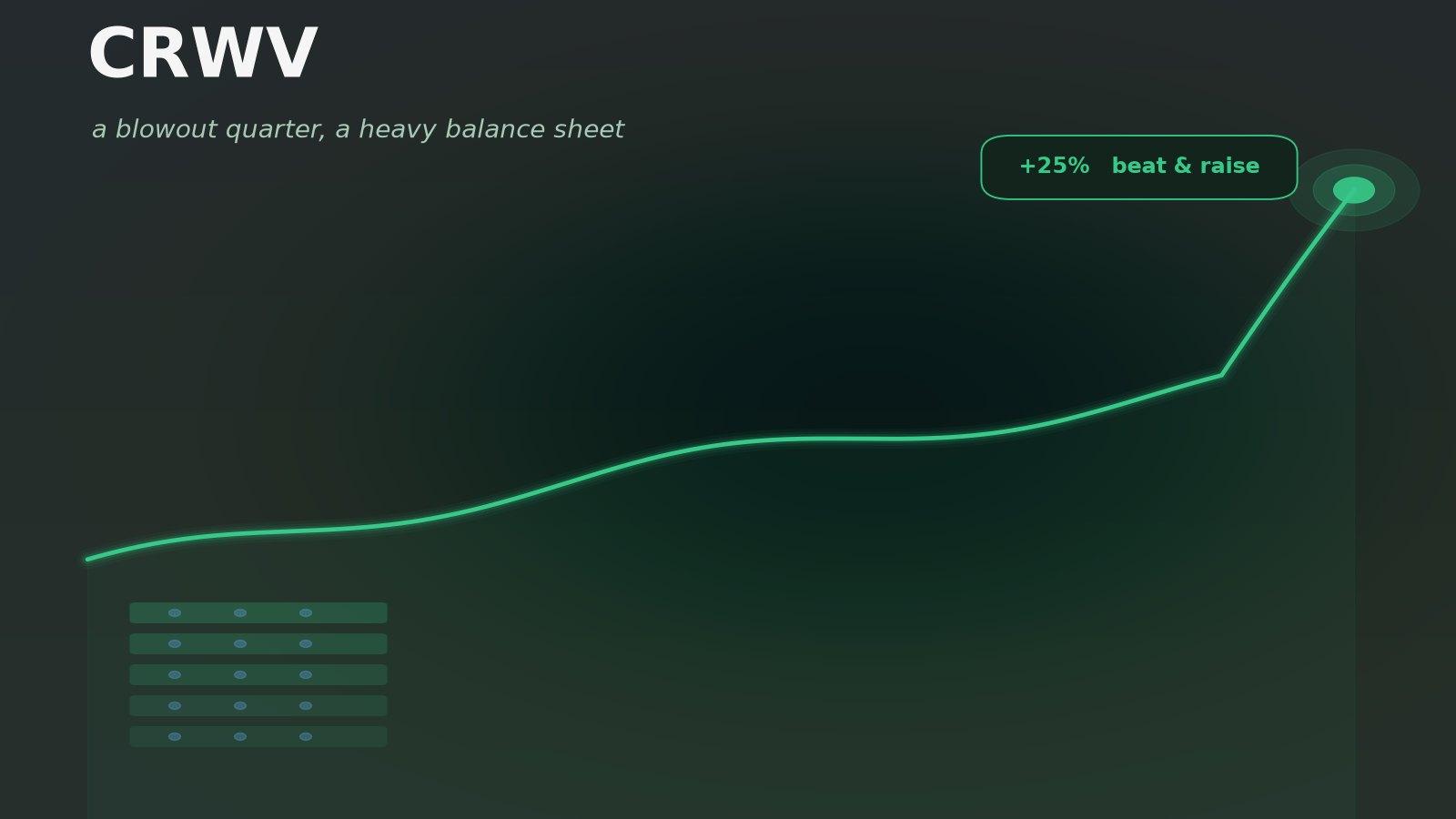
CoreWeave jumped about 25% to roughly $61 on November 11 after reporting a blowout third quarter the evening before. Revenue rose 168% to about $3.7 billion, above the high end of guidance, and the company raised its full-year outlook while reporting a record $133 billion revenue backlog. For the purest public play on the AI-infrastructure buildout — it rents Nvidia GPUs to the largest AI developers — it was emphatic proof that demand is not the problem. The more important shift was on the other question hanging over the stock: financing. CoreWeave is building a GPU empire on borrowed money, posting a $709 million net loss driven by $846 million of quarterly interest expense, with $14.5 billion of capital spending in the quarter and $37–$39 billion guided for the year. The stock had fallen more than 50% from its high on exactly those worries, so what sparked the rally was management addressing them — a shift toward contract-matched debt and customer prepayments, a lower cost of borrowing, and a path to adjusted profitability by 2028. Still, the balance sheet remains the defining feature: enterprise value near $95 billion against a roughly $33 billion equity value, the gap some $66 billion of debt. Tellingly, even as the stock soared, several analysts cut their price targets hard — from $176 to $100, from $100 to $45 — a sign the demand question is answered but the financing math still has to play out. The move led the AI-infrastructure complex and far outpaced the chip sector, marking it as company-specific.
Why CoreWeave stock jumped — a blowout quarter that eased the balance-sheet fear
On Wednesday, November 11, 2026, CoreWeave (NASDAQ: CRWV) jumped about 25%, trading near $61 intraday, after reporting third-quarter results the evening before [1]. The operational numbers were enormous: revenue rose 168% to about $3.7 billion, above the high end of the company's own guidance, and CoreWeave raised its full-year outlook while reporting a record $133 billion revenue backlog (a company measure broader than formal contracted obligations) [2]. For the purest public play on the AI-infrastructure buildout — a company that rents out Nvidia GPUs to the largest AI developers — it was emphatic proof that demand is not the problem. The move also far outpaced an already strong day for AI and chip stocks, marking it as CoreWeave's own result rather than a sector drift [5].
But the more important part of the story is what the quarter did to the other question hanging over this stock: not whether CoreWeave can grow, but whether it can finance its growth. CoreWeave is building a GPU empire on borrowed money, and the cost of that is stark — the company posted a $709 million net loss even as the business scaled. Its own operations were profitable — GAAP operating income was about $207 million — but $846 million of interest expense in the quarter, more than four times operating income, swamped that, and capital spending was $14.5 billion [2]. The stock had fallen more than 50% from its high on exactly those worries. What sparked the rally was management addressing them head-on: a shift toward contract-matched debt and customer prepayments, a lower cost of borrowing, and a stated path to adjusted profitability by 2028 [2]. The beat-and-raise mattered, but the de-risking of the financing model mattered as much.
What actually drove the move — demand proven, financing reframed
Three things powered the rally. First, the operational beat: besides the 168% revenue jump, adjusted operating income of about $379 million blew past the $200–$260 million the company had guided, and the adjusted operating margin recovered to 10% from just 1% two quarters earlier (though it is still below the 16% of a year ago, so this is a rebound rather than an uninterrupted climb), with adjusted EBITDA margins above 60% [2]. Second, the raised guidance and backlog: full-year revenue guidance went up to $13.0–$13.3 billion, the adjusted-operating-income outlook rose about 26% at the midpoint, and the $133 billion backlog (up 138% year over year, more than half of it tied to contracts starting delivery by year-end) gives unusual visibility into future revenue [2]. Third, and most specific to this stock, the financing reframe: management said it does not plan to issue more parent-level unsecured debt at current yields, will fund most remaining capital spending with delayed-draw term loans matched to specific customer contracts (more than three-quarters of committed 2027 spending is tied to investment-grade or enterprise customers), and expects roughly $9 billion of customer prepayments and deposits over the next three months — with the weighted-average cost of debt down to 7.9% [2].
Yet the balance sheet remains the defining feature, and it is why this is not an unambiguous good-news story. CoreWeave's enterprise value is about $95 billion against a roughly $33 billion equity value — the gap is some $66 billion of debt, so the company is far larger as an enterprise than as a stock [3]. Interest expense is still rising and is guided to $1.05–$1.15 billion next quarter, and 2026 capital spending of $37–$39 billion dwarfs the company's revenue [2]. The tell that the risk is not resolved: even as the stock leapt 25%, several analysts cut their price targets hard on the report — one from $176 to $100, another from $100 to $45 — reflecting continued caution about the capital intensity and potential dilution, even as they acknowledged the operational strength [6]. The quarter made the bull case louder, but it did not silence the bear case.
The valuation question
CoreWeave cannot be valued on earnings — it loses money on a GAAP basis, weighed down by interest and depreciation on its GPU fleet [3]. On sales the equity looks almost cheap: about 2.7 times trailing revenue, and closer to one times the roughly $13 billion of revenue it now guides to for the year [3]. But that understates the true cost of the business, because the enterprise — equity plus about $66 billion of net debt — trades near ten times trailing sales, and it is the enterprise, not just the equity, that has to be financed and serviced [3]. That is the crux: CoreWeave's revenue is growing explosively and its contracted backlog is enormous, but the capital required to deliver it is immense and largely borrowed, so the equity is a thin, volatile slice sitting on top of a heavily leveraged infrastructure company. Whether that slice is cheap or expensive depends almost entirely on whether the debt-funded buildout converts into durable free cash flow — the very question the quarter advanced but did not settle.
Why it matters
CoreWeave is the purest public test of a question that hangs over the entire AI trade: not whether demand for AI compute is real — this quarter, with 168% growth and a $133 billion backlog, settles that — but whether the enormous, debt-funded buildout required to serve that demand can be financed all the way to profitability. CoreWeave spends more on GPUs in a year ($37–$39 billion) than it earns in revenue, funds it with roughly $66 billion of debt, and pays over $800 million a quarter in interest, so it is effectively a highly leveraged bet that AI capital spending keeps compounding and that credit stays available on reasonable terms. That makes its results a bellwether far beyond its own stock: a clean beat-and-raise with an improving financing story is a vote of confidence in the durability of the AI-infrastructure cycle, which is why it dragged the whole neocloud and chip complex higher on the day [5]. The risk cuts the other way too — if financing tightened or AI capital spending paused, a company built on this much leverage would feel it first and hardest. The analyst target cuts into the rally are the market's way of saying the demand is proven but the financing math still has to play out.
The move, in one cross-section
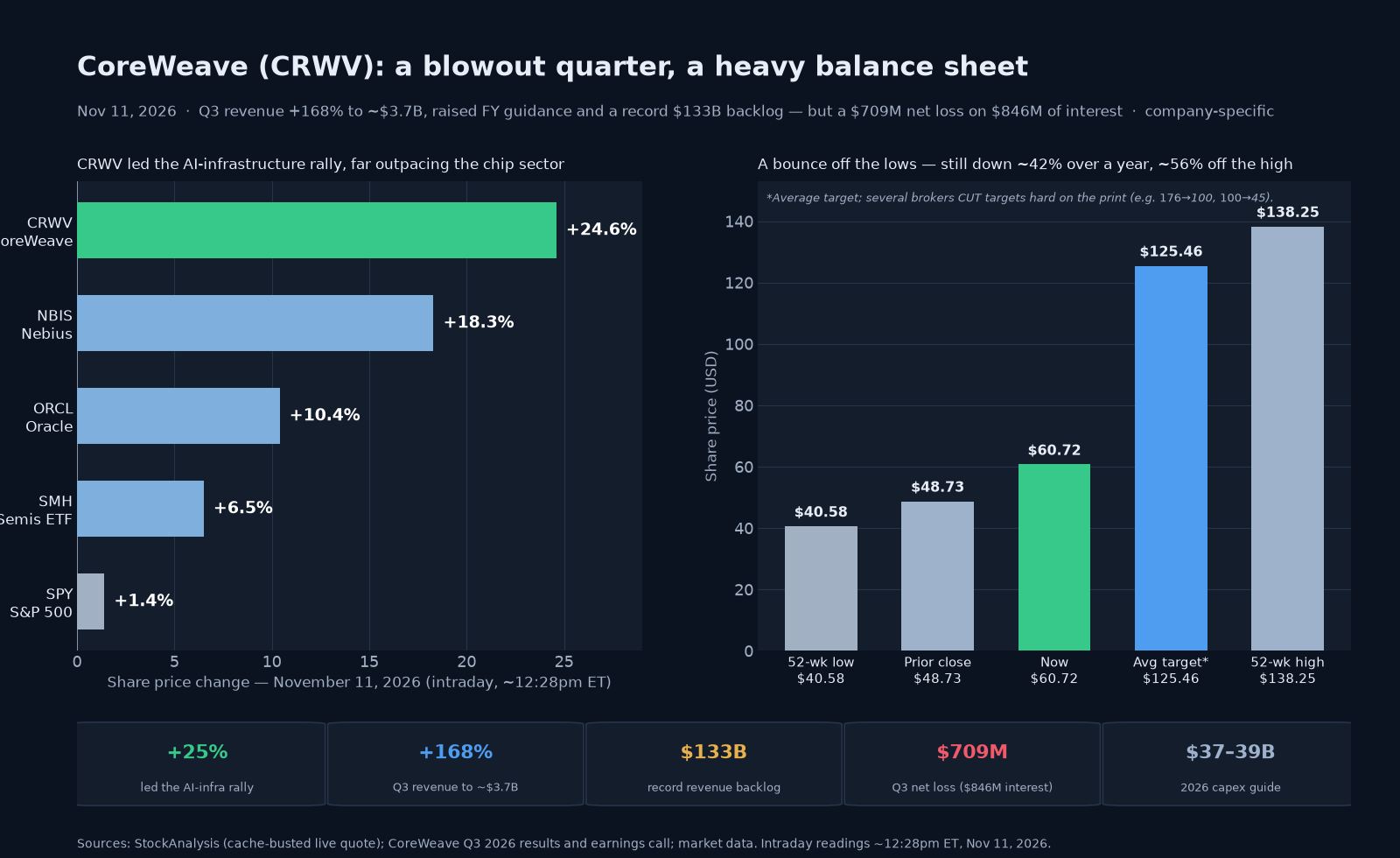
The same-session tape shows CoreWeave leading the AI-infrastructure complex on its own results, far outpacing the broad chip sector [5]:
| Name (ticker) | Nov 11, 2026 (intraday) | Read-through |
|---|---|---|
| CRWV — CoreWeave | ≈+25% | The earnings name — jumped on a Q3 beat, raised guidance, a record $133B backlog and an eased financing story [1][2] |
| NBIS — Nebius | ≈+18.3% | Closest neocloud peer — rallied hard in sympathy, but behind CoreWeave's own-results move [5] |
| ORCL — Oracle | ≈+10.4% | AI-cloud infrastructure — up on the broad AI-infra enthusiasm [5] |
| SMH — Semiconductor ETF | ≈+6.5% | The chip sector was strong, but a quarter of CoreWeave's move [5] |
| SPY — S&P 500 (ETF) | ≈+1.4% | Broad market up modestly — CoreWeave's move was far larger [5] |
CoreWeave up about 25% — roughly four times the chip sector and leading even its closest neocloud peer — is the signature of a company-specific catalyst (its own blowout quarter) amplified by a strong day for AI infrastructure [5].
What the Street thinks
The Street is bullish in the aggregate but was busy trimming on the day. The consensus rating is a Buy from more than 40 analysts, with an average 12-month target near $125 — well above the price — but that average is stale and masks a very wide range, from about $39 to $278 [6]. The more telling signal is the fresh action: on the report, multiple brokers cut their targets sharply even while the stock jumped 25% — examples included moves from $176 to $100, $150 to $100, and $100 to $45 — clustering the newest targets well below the stale average [6]. That is unusual and revealing: analysts acknowledged the operational beat but grew more cautious on valuation and the capital-intensity and dilution risk, so the headline Buy consensus overstates near-term conviction. The disagreement is not about whether CoreWeave is growing — it plainly is — but about what the leveraged, capital-hungry business model is worth, which is why the targets span nearly sevenfold [6].
What to watch
- The financing execution. Whether the contract-matched debt, the roughly $9 billion of expected customer prepayments and the lower cost of borrowing materialize as described — the key to the whole thesis [2].
- Interest expense versus operating income. Whether rising adjusted operating income can outrun interest costs guided above $1 billion a quarter, on the path to the 2028 adjusted-profitability target [2].
- Backlog conversion. Whether the $133 billion backlog turns into delivered, paid revenue on schedule, especially the portion starting by year-end [2].
- AI capital-spending signals. Any sign that the big AI customers are slowing GPU commitments, which CoreWeave would feel acutely. Moves are tracked on the CoreWeave stock page [5].
Illustrative scenario sensitivity
Because the move is a reaction to demand being proven and financing being reframed rather than to current earnings, the scenarios below are anchored to whether CoreWeave can finance its debt-funded buildout to profitability rather than to a single valuation [6]. They are a descriptive, author-weighted exercise over roughly the coming six-to-twelve months as the financing and backlog-conversion path clarifies — not a forecast, target, recommendation, or trading advice — with subjective weights that sum to 100%.
| Scenario | Illustrative price | Weight | Key drivers |
|---|---|---|---|
| Demand holds, financing executes | ~$95 | 25% | Backlog converts on schedule, contract-matched financing and prepayments fund the buildout, adjusted operating income outruns interest, and the stock re-rates toward the higher fresh analyst targets [6]. |
| Cheap on sales, but leverage caps it | ~$60 | 45% | Growth stays explosive but the market withholds a re-rating while interest expense, capital intensity and dilution risk weigh; the stock stays volatile near current levels [1]. |
| Financing or AI-capex strain | ~$42 | 30% | Credit tightens, AI capital spending digests, or dilution mounts; the leveraged structure is punished and the stock drifts back toward its 52-week low [3]. |
Weighting those (0.25 × $95 + 0.45 × $60 + 0.30 × $42) gives an author-weighted reference value near $63 — an illustrative, probability-weighted scenario output mechanically derived from the weights above, and not a price target, fair-value estimate, or prediction — a touch above Wednesday's ~$61 intraday price [1][6]. The modest premium reflects explosive, now-profitable-at-the-operating-line growth and a huge backlog, offset by a heavily leveraged balance sheet and the fact that analysts cut targets even into the rally; the wide dispersion between the scenarios is the honest signal that the outcome hinges on financing and backlog conversion far more than on this one quarter. This is a scenario exercise and descriptive analysis of a news-driven move, not investment advice.
CoreWeave data snapshot — November 11, 2026
| Figure | Value | As-of / source |
|---|---|---|
| Intraday quote | ~$61 (+~25%) — an intraday reading (the session was open); day range $53.81–$61.54 | Wed, Nov 11, 2026, ~12:31pm ET — StockAnalysis [1] |
| Prior close / open | $48.73 prior close; opened $55.97 (Q3 reported after the Nov 10 close) | Nov 11, 2026 [1] |
| 52-week trend | 52-week range $40.58–$138.25; down ~42% over 52 weeks and ~56% off the high (bouncing off the lows after financing-driven weakness) | As of Nov 11 [1] |
| Market cap / enterprise value | Market cap ≈$33.5B (≈551M shares); enterprise value ≈$95.5B — the ~$62B gap is net debt (~$66B debt vs ~$4–6.5B cash) | Nov 11 — StockAnalysis [3] |
| Valuation | GAAP loss-making (net loss ttm ≈−$2.56B, EPS ttm ≈−$4.77; no P/E); price-to-sales ≈2.7× on ~$9.9B trailing revenue (~1.1× forward on ~$13B), but EV/sales ≈10× trailing; gross margin ≈67% | Nov 11 — StockAnalysis [3] |
| Q3 2026 results | Revenue ~$3.7B (+168% YoY, above the high end of guidance); adj. operating income ~$379M (beat the $200–260M guide; 10% margin); adj. EBITDA ~$2.3B (62% margin); GAAP net loss ~$709M on ~$846M interest expense; capex ~$14.5B | Nov 11 — CoreWeave Q3 2026 results [2] |
| Catalyst | Q3 earnings: a blowout operational quarter that eased financing fears. Revenue beat and FY guidance raised to $13.0–13.3B; record $133B backlog (+138%); exit ARR $20–21B. Management reframed financing (contract-matched debt, ~$9B of customer prepayments in 3 months, lower cost of debt) and guided to adjusted profitability by 2028 — against $37–39B of 2026 capex | Nov 11, 2026 — company results + earnings call [2] |
| Same-day cross-section | NBIS +18.3% (neocloud peer), ORCL +10.4%; SMH +6.5% (semi ETF), SPY +1.4% (market) — CRWV's ~25% led the AI-infra complex and far outpaced the chip sector | Nov 11 intraday [5] |
| Analyst view | Consensus Buy from ~41 analysts, avg target ~$125 (low ~$39, median ~$125, high ~$278) — but stale: on the print brokers CUT targets hard even as the stock jumped (e.g. $176→$100, $150→$100, $100→$45) | Nov 11, 2026 — StockAnalysis / analyst notes [6] |
CoreWeave (CRWV) stock FAQ
Why did CoreWeave (CRWV) stock jump on November 11, 2026?
CoreWeave jumped about 25% to roughly $61 after reporting a blowout third quarter the evening before. Revenue rose 168% to about $3.7 billion, above the high end of its own guidance; it raised full-year guidance (to $13.0–$13.3 billion of revenue); and it reported a record $133 billion revenue backlog. Just as important for this stock, management addressed the financing fears that had cut it more than 50% from its high — shifting toward debt matched to specific customer contracts, pointing to about $9 billion of expected customer prepayments, noting a lower cost of borrowing, and guiding to adjusted profitability by 2028. So the rally combined a clear operational beat-and-raise with a credible answer to the question of how CoreWeave funds its enormous buildout. It is worth noting the company still posted a $709 million net loss, driven by $846 million of interest expense, so the jump was a relief rally off depressed levels rather than a sign the business is now profitable.
What is CoreWeave and why is its balance sheet such a focus?
CoreWeave is an AI-infrastructure company — a 'neocloud' — that buys large quantities of Nvidia GPUs and rents that computing capacity to AI developers and cloud customers. Building that capacity is extraordinarily capital-intensive: CoreWeave guided to $37–$39 billion of capital spending in 2026, far more than its revenue, and it funds much of that with debt. The result is a balance sheet that dominates the story: roughly $66 billion of debt, an enterprise value near $95 billion against a roughly $33 billion equity value, and interest expense of $846 million in the third quarter alone (guided above $1 billion next quarter). That is why the market focuses less on whether CoreWeave can grow — it clearly can — and more on whether it can finance and service that debt-funded buildout all the way to sustainable profitability. The equity is effectively a leveraged bet on AI compute demand continuing and financing staying available.
If CoreWeave beat and raised guidance, why did analysts cut their price targets?
Because the beat answered the demand question but not the valuation-and-financing question. On the report, several analysts cut their targets sharply even as the stock jumped 25% — examples included moves from $176 to $100, from $150 to $100, and from $100 to $45 — while generally keeping constructive ratings. The operational results were strong, but analysts grew more cautious about what the business is worth given its capital intensity, the roughly $66 billion of debt, rising interest expense, and the potential for future equity dilution to fund the buildout. In other words, they acknowledged CoreWeave is executing while concluding the stock had been priced for more than the leverage and spending justify. The unusually wide target range — from about $39 to $278 — captures how differently analysts weigh the explosive growth against the balance-sheet risk. It is a reminder that a rising stock and falling targets can coexist when the debate is about valuation rather than performance.
Is CoreWeave profitable?
Not on a GAAP basis. CoreWeave reported a $709 million net loss in the third quarter and loses money on a trailing basis, primarily because of the interest on its large debt load and depreciation on its GPU fleet. However, the underlying operating economics are improving: adjusted operating income was about $379 million (beating guidance), the adjusted operating margin rose to 10% from 1% two quarters earlier, and adjusted EBITDA margins are above 60%, with positive operating cash flow. Management guided to adjusted profitability by 2028. So the picture is a business that is increasingly profitable at the operating level but still deeply unprofitable after financing costs — which is exactly why the trajectory of interest expense versus operating income, and the execution of the financing plan, matter more than any single quarter's headline loss.
How did CoreWeave's move compare with other AI stocks that day?
CoreWeave led the group on its own results. It was a strong day for AI and chip stocks broadly, but CoreWeave's roughly 25% jump far outpaced the sector: the semiconductor ETF SMH rose about 6.5%, Nvidia about 4%, and the S&P 500 about 1.4%, while CoreWeave's closest 'neocloud' peer, Nebius, rose about 18% — a big move, but still behind CoreWeave's. That pattern — CoreWeave up roughly four times the chip sector and ahead of even its nearest peer — marks the move as company-specific, driven by its own beat-and-raise and financing update, amplified by a strong day for AI infrastructure rather than explained by it. The fact that CoreWeave dragged the whole complex higher also illustrates its role as a bellwether for the AI-infrastructure buildout: a strong result from the most leveraged, pure-play name is read as a vote of confidence in the durability of AI capital spending.
What should investors watch next for CoreWeave?
Four things. First and most important, financing execution — whether the contract-matched debt, the roughly $9 billion of expected customer prepayments and the lower cost of borrowing materialize as management described, since the whole thesis rests on funding the buildout without open-ended dilution. Second, interest expense versus operating income — whether rising adjusted operating income can outrun interest costs guided above $1 billion a quarter, on the path to the 2028 adjusted-profitability target. Third, backlog conversion — whether the record $133 billion backlog turns into delivered, paid revenue on schedule. Fourth, AI capital-spending signals — any sign that the large AI customers are slowing GPU commitments, which a highly leveraged company like CoreWeave would feel first. Because the stock is a leveraged bet on the AI-infrastructure cycle, it is likely to stay highly volatile and to react sharply to any news on financing, credit conditions or AI demand. This is descriptive analysis, not investment advice.