Healthcare
Cytokinetics (CYTK) Stock Falls Despite a Positive Phase 3 Aficamten Win
Cytokinetics fell about 7.5% on Friday and another ~3% Monday (to roughly $70) even though its pivotal Phase 3 ACACIA-HCM trial of aficamten met its goals in non-obstructive hypertrophic cardiomyopathy. The full data, presented at the ESC 2026 congress, hit both primary endpoints (symptoms and exercise capacity) — but the positive topline had been known since May, the stock had nearly doubled over the year, and the details disappointed: a modest effect size, two secondary endpoints that missed significance, and reduced ejection fraction (below-50% in ~10.5% of patients versus 0.8%; a known, reversible class effect). With a supplemental FDA filing not due until Q4 2026, revenue is years off, so investors sold. CYTK underperformed a soft biotech tape. Still, the Street stayed bullish: across 22 analysts, 20 rate CYTK a buy-equivalent, with an average target near $110 (about 57% above the price). Aficamten, already sold as Myqorzo for obstructive HCM, would expand into a large new patient group if the data carries through — the debate is about the details and the timeline, not whether the drug works.

Why Cytokinetics stock dropped — the details underwhelmed a high bar
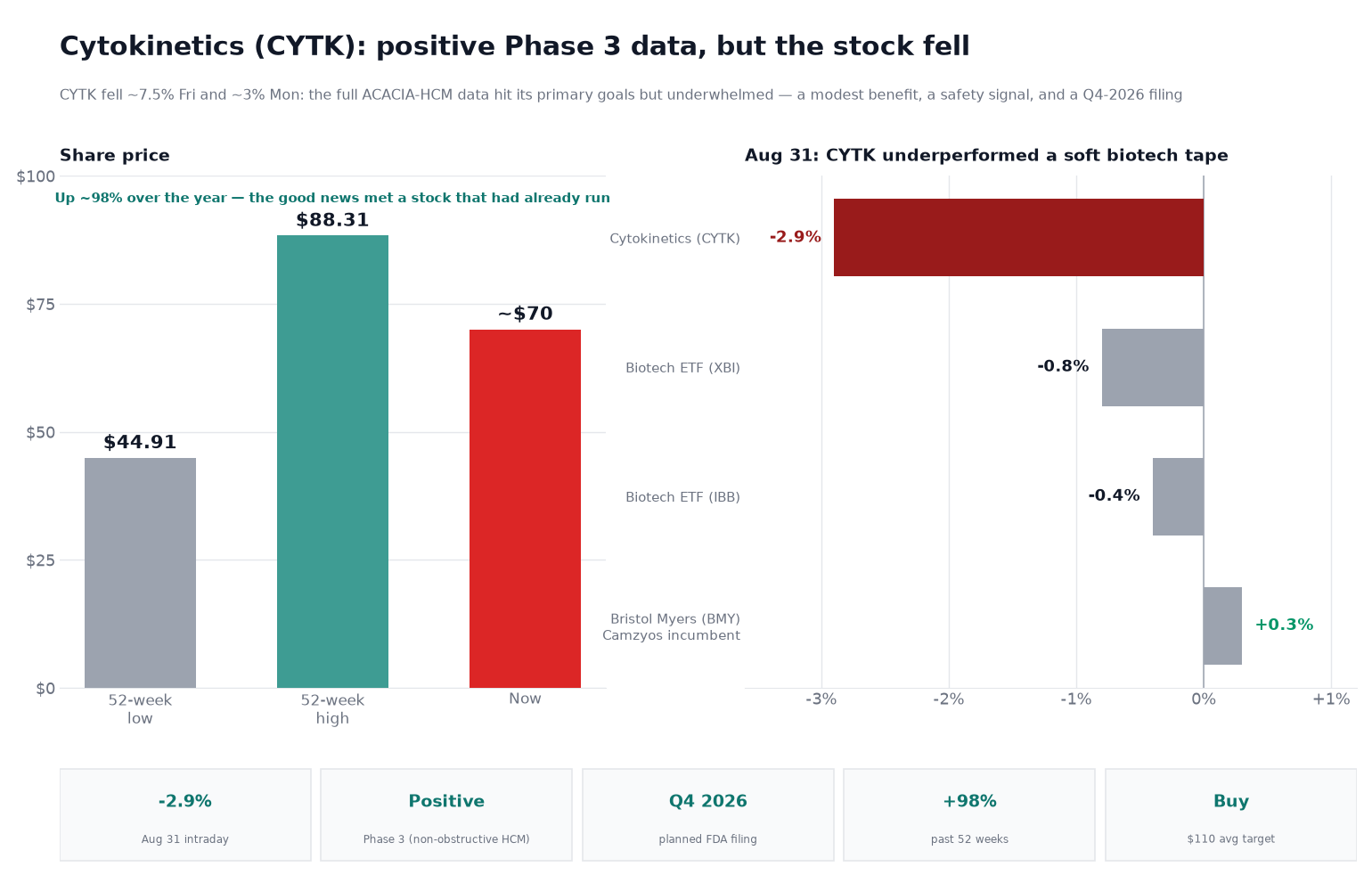
Over Friday, August 28 and Monday, August 31, 2026, Cytokinetics (NASDAQ: CYTK) fell hard — down about 7.5% Friday and another ~3% Monday (to roughly $70 intraday, from a $72.09 close) — even though the cardiovascular biotech had, on its face, positive news [1]. At the European Society of Cardiology congress in Munich, Cytokinetics presented the full Phase 3 results of its ACACIA-HCM trial of aficamten, its cardiac myosin inhibitor already sold as Myqorzo for obstructive hypertrophic cardiomyopathy [2]. The study hit its two primary goals in non-obstructive HCM (nHCM) — a large new patient group — improving both symptoms and exercise capacity with statistical significance [2]. But the positive topline had been known since May, the stock had nearly doubled since, and the detailed data carried enough blemishes to disappoint. So the shares sold off.
Positive on the headline, mixed in the details
The full ACACIA-HCM data cut both ways. The primary endpoints were met: aficamten improved patient-reported symptoms (the KCCQ health-status score) and exercise capacity (peak oxygen uptake) versus placebo, both statistically significant [2]. But investors zeroed in on the qualifiers. The magnitude of benefit was modest (a roughly 3-point symptom-score improvement and a small gain in peak oxygen uptake); two secondary endpoints — left-atrial volume and time to a first cardiovascular event — did not reach statistical significance (though others, including functional class and a heart-stress biomarker, did); and reduced heart function (an ejection fraction below 50%) occurred in about 10.5% of aficamten patients versus 0.8% on placebo — a known, generally reversible class effect of cardiac myosin inhibitors that nonetheless drew scrutiny [2]. On top of that, the payoff is far off — Cytokinetics plans to file its supplemental FDA application only in the fourth quarter of 2026, pushing any approval and revenue well into the future [2]. For a stock up about 98% over the past year, having already "bought the rumor" of the May topline, an in-line-but-imperfect confirmation was not enough to clear the bar, and traders sold the news [3].
Why the Street and the stock disagreed
The clinical result and the share-price reaction pointed in opposite directions, and both are defensible. Strategically, a positive pivotal Phase 3 in non-obstructive HCM matters: it extends aficamten's opportunity beyond the obstructive form that Myqorzo already treats, into a large patient population with few targeted options — a genuine expansion of the long-term franchise [2]. That is why analysts largely kept their bullish ratings and targets. Traders, meanwhile, focused on what the full data did not do — the modest effect size, two secondary endpoints that missed significance, and the reduced-ejection-fraction findings — against a stock that had already surged and a revenue timeline that stretches past a Q4-2026 filing [2]. The gap between a stock down sharply and a Street holding targets more than 50% higher is the debate in one number: a win that de-risks the science, meeting a market that had priced in more and wants near-term proof.
Why it matters
The reaction is a clean lesson in how biotech prices de-risking versus monetization — and in how much the details matter. A pivotal trial win is generally good for the long-term value of a drug, but the market pays for cash flows and reads the fine print, and both worked against CYTK here: the distance between "the data works" and "the product sells" is measured in years, and the full readout, while positive, was not the clean sweep a doubled stock had priced in. It also matters for the broader hypertrophic cardiomyopathy market, where cardiac myosin inhibitors are reshaping treatment: aficamten's move into non-obstructive HCM is a competitive marker in a category that includes Bristol Myers Squibb's Camzyos, and expanding the eligible population is how these franchises grow. The drop does not say aficamten failed — the trial met its primary goals — but it says the market wanted more, sooner, and with fewer caveats.
CYTK underperformed a soft biotech tape
Biotech had been weak into the weekend (the biotech ETFs fell several percent on Friday), so part of the move rode a softer group — but Cytokinetics fell far more than its peers, marking a company-specific component on top of the sector [5]. The Monday cross-section shows the gap [5]:
| Name (ticker) | Aug 31, 2026 | Read-through |
|---|---|---|
| CYTK — Cytokinetics | ≈−2.9% | Sell-the-news on its own positive Phase 3 data [1][2] |
| XBI — SPDR biotech ETF | ≈−0.8% | The equal-weight biotech group was barely lower [5] |
| IBB — Nasdaq biotech ETF | ≈−0.4% | Large-cap biotech was essentially flat [5] |
| BMY — Bristol Myers Squibb | ≈+0.3% | The HCM incumbent (Camzyos) barely moved on aficamten's expansion [5] |
With the biotech ETFs down modestly on Monday and the category incumbent flat, Cytokinetics' larger decline points to a company-specific driver — its own data — layered on a soft sector [5].
What the Street did
The analyst view was the mirror image of the tape and barely budged. Across 22 analysts the consensus is a Buy, with an average 12-month target near $110 — roughly 57% above the price — a median around $107.50, a high of $146 and a low of $85 [6]. The standing ratings run heavily bullish: H.C. Wainwright's Joseph Pantginis carries a Buy near a Street-high $140, Needham's Serge Belanger a Buy at $112, Evercore ISI's Cory Kasimov a Buy at $100 and Goldman Sachs' Paul Choi a Buy, while Bank of America's Jason Zemansky sits at the cautious end (Hold, $85) [6]. The distribution — thirteen strong buys, seven buys, and two holds, with no sells — tells you the sell side reads the trial as confirming, not challenging, the thesis. When the stock falls and targets hold, the disagreement is about when, not whether.
What to watch
- The supplemental FDA filing. Whether Cytokinetics files the non-obstructive-HCM application on its fourth-quarter-2026 timeline — the next hard, dateable milestone [2].
- Full ACACIA-HCM data. The detailed results and safety profile behind the topline win, which analysts will scrutinize [2].
- Cash and burn. Operating losses and the balance sheet, the key risks for a pre-profit biotech bridging to broader commercialization [3].
- Commercial traction. Uptake for aficamten in its existing use, the real-world proof that a trial win converts to sales. Moves are tracked on the CYTK stock page [1].
Illustrative valuation sensitivity
Because Cytokinetics is pre-profit — valued on Myqorzo's commercial ramp and the potential non-obstructive-HCM label expansion rather than current earnings — the scenarios below are anchored to the analyst target distribution (low $85, average ~$110, high $146) [6], turning on how the label expansion and the regulatory timeline play out. They are a descriptive, author-weighted exercise — not a forecast, target, recommendation, or intrinsic fair-value calculation — with subjective weights that sum to 100%.
| Scenario | Illustrative price | Weight | Key drivers |
|---|---|---|---|
| Upside | ~$130 | 30% | The supplemental filing proceeds on schedule, the non-obstructive-HCM expansion is embraced, and the stock re-rates toward the bullish Street targets [6]. |
| Middle | ~$95 | 40% | The data de-risks the story but the wait dominates; the stock grinds back toward the lower half of the analyst range as the timeline advances [6]. |
| Downside | ~$60 | 30% | Regulatory or commercialization delays, cash and dilution concerns, or a biotech risk-off pull the stock below its recent range and the analyst low [3]. |
Weighting those (0.30 × $130 + 0.40 × $95 + 0.30 × $60) gives an author-weighted reference value near $95, well above Monday's ~$70 level and toward the lower half of the analyst range [1][6] — reflecting a franchise whose debate is about the strength of the data, the regulatory timeline, and execution rather than whether the drug works at all. This is a Street-target-based scenario exercise and descriptive analysis of a news move, not investment advice.
CYTK data snapshot — August 31, 2026
| Figure | Value | As-of / source |
|---|---|---|
| Two-day move | Down ~7.5% Fri (Aug 28) and another ~3% Mon (Aug 31) to ~$70 — an intraday reading (the session was still open; down more earlier) | Aug 28–31, 2026 — StockAnalysis [1] |
| Prior close / open / range | $72.09 prior close; opened $71.54; Aug 31 day range $69.31–$71.79 | Aug 31, 2026 [1] |
| 52-week range / trend | $44.91–$88.31; up ~98% over 52 weeks; below its ~$80 50-day average, near its ~$70 200-day; momentum rolling over (an intraday RSI in the mid-30s) | As of Aug 31 [3] |
| Market cap / EV | ≈$9.7B (139M shares); enterprise value ≈$10.0B; beta ≈0.38 | Aug 31 — StockAnalysis [3] |
| Valuation | Unprofitable — no P/E; a trailing net loss of ≈$894M (EPS −$7.18); valued on Myqorzo's commercial ramp and the potential nHCM label expansion, not current earnings; no dividend | Aug 31 — StockAnalysis [3] |
| The catalyst | Full Phase 3 ACACIA-HCM results presented at ESC 2026 (Munich; the positive topline was first reported in May): aficamten met both primary endpoints (KCCQ symptom score and peak-VO₂ exercise capacity) in non-obstructive HCM, but the benefit magnitude was modest, two secondary endpoints missed significance, and a known reduced-ejection-fraction class effect drew scrutiny (LVEF <50% in ~10.5% vs 0.8% placebo); a supplemental FDA filing is planned for Q4 2026 | Aug 28–31 — company / ESC coverage [2] |
| Financials (TTM) | Revenue ≈$68M (Myqorzo, approved Dec 2025 for obstructive HCM, in early commercial ramp); trailing net loss ≈$894M as the company invests in R&D and launch | TTM — StockAnalysis [3] |
| Volume | ~1.5M shares by mid-afternoon vs a ~1.9M 20-day average (running near or below average) | Aug 31 [1] |
| Same-day peers | XBI −0.8%, IBB −0.4% (biotech ETFs); BMY (Camzyos incumbent) +0.3% — CYTK underperformed a soft biotech tape (the biotech ETFs also fell several percent the prior Friday) | Aug 31 [5] |
| Analyst view | 22 analysts (13 strong buy / 7 buy / 2 hold / 0 sell), consensus Buy, avg target ≈$110 (median $107.50, high $146, low $85); standing ratings — H.C. Wainwright $140, Needham $112, Evercore $100, Goldman Sachs (Buy); BofA $85 (Hold) | Aug 2026 — StockAnalysis / analyst notes [6] |
The setup at a glance
| Question | Answer |
|---|---|
| Why did Cytokinetics stock drop? | Because the full trial data underwhelmed a stock that had already run. At the ESC 2026 congress, Cytokinetics presented the complete Phase 3 ACACIA-HCM results for aficamten in non-obstructive HCM. The trial met both primary endpoints (symptoms and exercise capacity), but the benefit magnitude was modest, two secondary endpoints missed significance, and a known reduced-ejection-fraction class effect drew scrutiny. With the positive topline already known since May, the stock up ~98% over the year, and the supplemental FDA filing not due until Q4 2026, investors sold — down about 7.5% Friday and another ~3% Monday [1][2]. |
| Wait — the trial succeeded and the stock fell? | Yes, and that is common in biotech. The topline win was announced back in May, so the trial's success was old news; what moved the stock was the detailed data at ESC, which was positive but imperfect — a modest effect size, two secondary endpoints that missed significance, and an expected ejection-fraction class effect — and the reality that revenue is years away (a Q4-2026 filing, then approval and launch). When a stock has nearly doubled in anticipation, an in-line-but-blemished confirmation can trigger profit-taking [2]. |
| Is the drop a warning that aficamten failed? | No — the trial met its primary goals, and the sell side largely kept Buy ratings with targets well above the price. But it is not a clean bill of health either: the effect size was modest, two secondary endpoints did not reach significance, and reduced ejection fraction (below 50%) occurred in about 10.5% of aficamten patients versus 0.8% on placebo. The decline reflects those details plus the timeline and the run-up, not a failed trial [2][6]. |
| Why is non-obstructive HCM a big deal? | Because it widens the market. Aficamten was first developed for obstructive hypertrophic cardiomyopathy; a positive result in the non-obstructive form extends its potential to a large additional group of patients with few targeted options. That expansion is central to the drug's long-term commercial opportunity, which is why analysts framed the win as strategically important even as the stock dipped [2]. |
| What is the biggest risk now? | Two things: the data details and the wait. On the data, the modest effect size and the reduced-ejection-fraction findings could weigh on how regulators and physicians view the non-obstructive-HCM expansion. On the timeline, Cytokinetics remains pre-profit with large operating losses, and a supplemental filing is not due until late 2026 — so approval, launch and meaningful sales are further out, keeping cash, dilution and commercialization-pace questions front and center [3]. |
| What do analysts think? | They are overwhelmingly positive. Of 22 analysts, 20 rate Cytokinetics a buy-equivalent and only two a hold, for a Buy consensus with an average target near $110 — about 57% above the current price — ranging from $85 to $146. The standing ratings include H.C. Wainwright at $140, Needham at $112, Evercore ISI at $100 and Goldman Sachs (Buy), while Bank of America sits at Hold ($85). The stock fell, but the targets held — a sign the Street reads the trial as confirming the thesis [6]. |
Cytokinetics (CYTK) stock FAQ
Why did Cytokinetics (CYTK) stock drop on August 31, 2026?
Because the full trial data underwhelmed a stock that had already run up. At the European Society of Cardiology congress, Cytokinetics presented the complete Phase 3 ACACIA-HCM results for aficamten in non-obstructive hypertrophic cardiomyopathy. The trial met both primary endpoints — symptoms and exercise capacity — but the benefit magnitude was modest, two secondary endpoints missed significance, and a known reduced-ejection-fraction class effect drew scrutiny. Because the positive topline had been known since May and the stock was up about 98% over the year, and with a supplemental FDA filing not due until the fourth quarter of 2026, investors sold — the shares fell about 7.5% on Friday and another roughly 3% on Monday.
The trial succeeded — why did the stock fall?
This is common in biotech, and here there were two reasons. First, timing: the positive topline was announced back in May, so the trial's success was not news; what the market reacted to was the detailed data at the ESC congress and the fact that revenue is years away (a Q4-2026 filing, then approval and launch). Second, the details: the full readout was positive but imperfect — a modest effect size, two secondary endpoints that missed significance, and an expected ejection-fraction class effect — which fell short of the blowout a nearly doubled stock had priced in. So a de-risking-but-imperfect confirmation triggered profit-taking.
Is the drop a warning sign that aficamten failed?
No — the Phase 3 ACACIA-HCM trial met its primary endpoints, and analysts largely kept Buy ratings with targets well above the price. But the full data was not a clean sweep: the effect size was modest, two secondary endpoints (left-atrial volume and time to a first cardiovascular event) did not reach significance, and reduced ejection fraction (below 50%) occurred in about 10.5% of aficamten patients versus 0.8% on placebo. The decline reflects those caveats, the long timeline, and a big prior run-up — not a failed trial. Expanding into non-obstructive HCM still strengthens the drug's long-term case if the data holds up in review.
Why does the non-obstructive HCM result matter?
Because it widens the addressable market. Aficamten, a cardiac myosin inhibitor, was first developed for obstructive hypertrophic cardiomyopathy; a positive Phase 3 result in the non-obstructive form extends its potential use to a large additional group of patients who have had few targeted treatment options. That expansion is central to the drug's long-term commercial opportunity and to Cytokinetics' position in a hypertrophic-cardiomyopathy market that also includes Bristol Myers Squibb's Camzyos, which is why analysts framed the win as strategically important even as the stock dipped.
What is the biggest risk for Cytokinetics now?
Both the data details and the wait. On the data, the modest effect size and the reduced-ejection-fraction findings could influence how regulators and physicians view the non-obstructive-HCM expansion. On the timeline, Cytokinetics remains pre-profit with large operating losses, and it does not plan to file its supplemental application until late 2026 — so approval, a commercial launch, and meaningful sales are further out still. That keeps the classic biotech risks front and center: the company's cash position and potential dilution, regulatory timing, and how quickly a newly expanded indication is adopted in practice.
What do analysts think of Cytokinetics stock?
They are overwhelmingly positive. Of 22 analysts, 20 rate Cytokinetics a buy-equivalent and only two a hold — no sells — for a Buy consensus with an average 12-month target near $110, about 57% above the post-drop price, ranging from $85 to $146. The standing bullish calls include H.C. Wainwright's Joseph Pantginis at $140, Needham's Serge Belanger at $112, Evercore ISI's Cory Kasimov at $100 and Goldman Sachs' Paul Choi (Buy), while Bank of America's Jason Zemansky sits at the cautious end with a Hold at $85. The stock fell but the targets held, which tells you the Street reads the trial as confirming the thesis, with the debate over when the value is realized.