Industrials
Deere (DE) Hits a Record High After a Baird Upgrade on a 2027 Ag Recovery
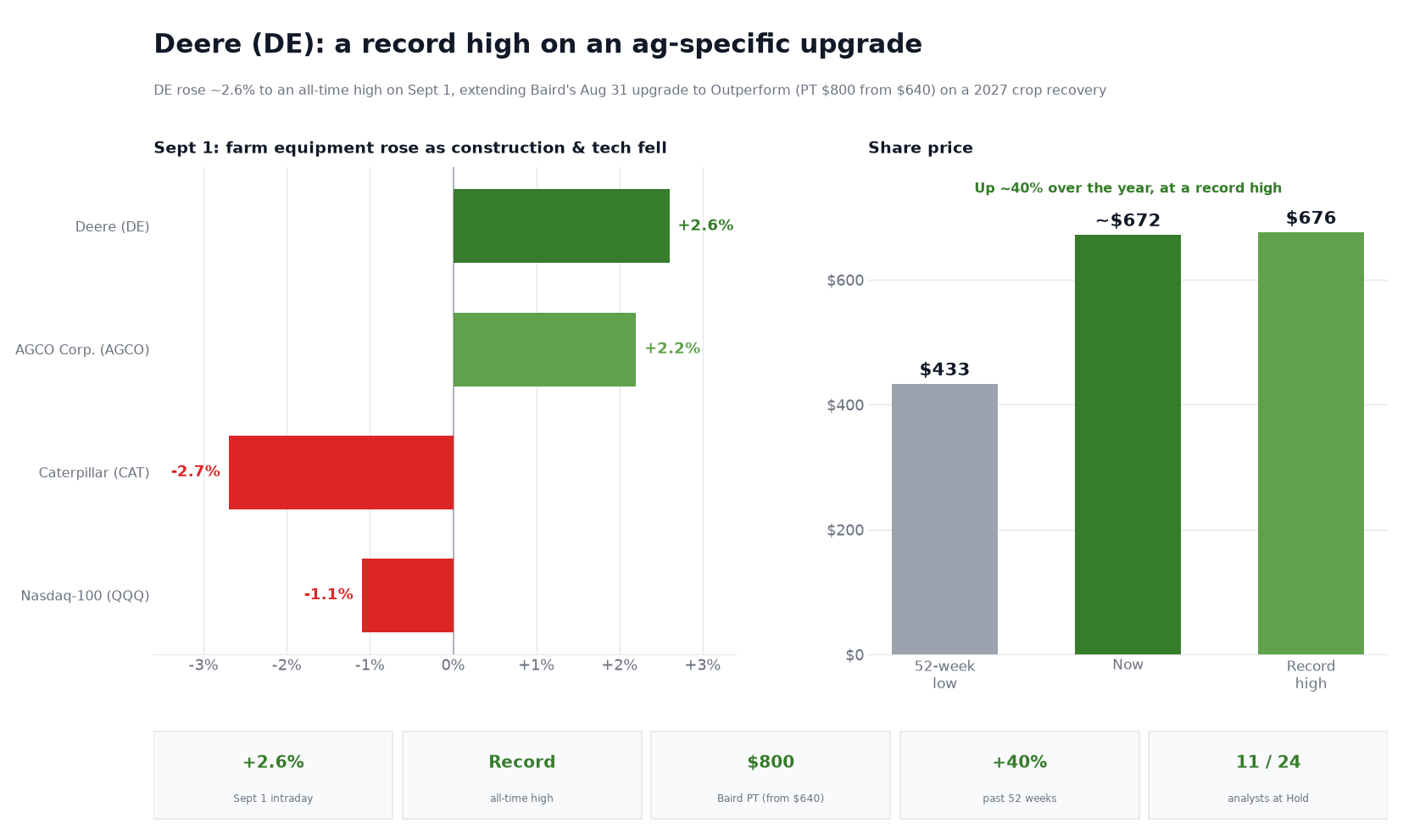
Deere rose about 2.6% to a record high near $676 on September 1, standing out on a day technology and semiconductors sold off. The catalyst was dated and company-specific: a day earlier, Baird's Mircea Dobre upgraded Deere to Outperform and raised his price target to $800 from $640, arguing North American crop economics improve in 2027 — corn back above breakeven, better soybean margins, tighter stocks-to-use. Baird upgraded AGCO the same day, and both farm-equipment makers rose while construction bellwether Caterpillar fell, isolating an agriculture-specific move rather than a broad machinery rally. The puzzle is the valuation: Deere trades at about 36 times trailing earnings, but that reflects an expected fiscal-2026 revenue trough (down ~10% on consensus estimates), with fiscal-2027 modeled up ~8% — the recovery the upgrade is betting on. The catch: after a ~40% run to a record, the Street is split, with 11 of 24 analysts at Hold and an average target just below the price.

Why Deere stock rose — a record high on a Street upgrade
On Tuesday, September 1, 2026, Deere & Company (NYSE: DE) rose about 2.6% to roughly $672 in intraday trading, touching a fresh record high of $675.75 along the way, up from a $654.91 prior close [1]. The move was notable for its context: the broad market was falling — technology and semiconductors led a selloff that dragged the Nasdaq-100 down more than 1% — yet Deere pushed to an all-time high. The reason was company-specific and dated: a day earlier, on August 31, Baird upgraded Deere to Outperform and lifted its price target sharply [2]. Unlike a broad rotation, this was a single-name re-rating that carried an already-strong stock (up nearly 40% over the past year) to a new peak [3].
The catalyst: Baird's call on a 2027 ag recovery
Baird analyst Mircea Dobre upgraded Deere from Neutral to Outperform and raised his 12-month price target to $800 from $640 — roughly 27% above the prior Friday's close — arguing that North American agricultural fundamentals are set to improve in 2027 [2]. His thesis: mid-2027 corn futures should move back above farmer breakeven levels, soybean economics are improving, and deteriorating crop conditions with tighter projected stocks-to-use ratios could support higher crop prices and better per-acre margins [2]. That matters because so much of Deere's business rides on demand for row-crop machinery — which historically makes it the first name investors reach for when they sense the ag cycle is turning. Tellingly, Baird upgraded rival AGCO the same day, and both stocks rallied about 4% on August 31 [2]; Deere then extended the move to a record on September 1 [1]. A second firm, Raymond James, nudged its Deere target higher the same day [6] — a coordinated shift in sell-side sentiment toward the ag-equipment group.
A high multiple on trough earnings
The puzzle in Deere's valuation is that it looks expensive precisely because its earnings are cyclically depressed. The stock trades at about 36 times trailing earnings (roughly 31 times forward) [3] — rich for an industrial — but that reflects a down year, not a rich business. on consensus estimates, Deere's fiscal-2026 revenue is tracking near $41.1 billion, down about 10% year over year as the farm-equipment cycle bottoms, and the Street models fiscal-2027 revenue rebounding roughly 8%, to about $44.5 billion [6]. That is the crux of the bull case: buy a high-quality cyclical when the multiple is optically high on trough earnings, on the bet that the "E" inflects. Baird's upgrade is a wager on exactly that inflection — and the record-high share price says the market is increasingly willing to pay ahead of the recovery.
Why it matters
Deere's record high captures a specific idea: that the agricultural cycle, mired in a multi-year downturn, is finally turning. Farm-equipment demand is deeply cyclical — it tracks crop prices, farmer incomes and used-inventory levels — and Deere is the bellwether the market uses to express a view on all of it. When a respected sell-side voice upgrades the group on improving 2027 crop economics, it does more than move one stock: it signals that professional opinion is shifting from "the trough is here" to "the recovery is coming." The move is also a reminder that not every up-day is a macro rotation. On a session when technology sold off and even Caterpillar — the construction-machinery giant — fell, Deere and AGCO rose on a catalyst unique to farming. That is a stock reacting to its own industry's turning point, not to the market's mood.
An ag-specific move, in one cross-section
The same-day tape isolates the catalyst — farm equipment up, construction machinery and tech down [5]:
| Name (ticker) | Sept 1, 2026 | Read-through |
|---|---|---|
| DE — Deere | ≈+2.6% | Record high; extended Baird's Aug 31 upgrade to Outperform, PT $800 [1][2] |
| AGCO — AGCO Corp. | ≈+2.2% | The other pure-play farm-equipment maker, upgraded by Baird the same day [2][5] |
| CAT — Caterpillar | ≈−2.7% | Construction/industrial machinery fell — this was not a broad machinery rally [5] |
| QQQ — Nasdaq-100 ETF | ≈−1.1% | Tech and semiconductors led the market lower [5] |
Farm-equipment names up 2–3% while a construction bellwether and the tech-heavy index fell is the signature of an agriculture-specific catalyst, not a sector or market move [5].
What the Street thinks
Coverage is positive on balance but genuinely divided. The consensus is a Buy — 8 Strong Buy, 5 Buy and 11 Hold across 24 analysts — yet the average 12-month target of about $667 sits fractionally below the current price, a sign the stock has run past where most of the Street models it [6]. The bulls set the pace: Baird's Mircea Dobre upgraded to Outperform at $800 (from $640) on August 31, Truist's Jamie Cook carries a Buy near $804, and Raymond James's Timothy Thein raised his target to $730 the same day as Baird's call [6]. The skeptics anchor the other end: Bernstein's Chad Dillard carries a Hold with a $580 target — about 14% below the price — and Citi's Kyle Menges holds at $650 [6]. That spread — bearish targets near $500–$580 against bulls above $800 — is the debate in a single range: how much of the 2027 recovery is already in the stock.
What to watch
- Crop prices and farmer economics. Corn and soybean futures relative to breakeven — the input to Baird's 2027 thesis and the swing factor for equipment demand [2].
- Orders and used inventory. Whether large-ag order books and dealer used-equipment levels confirm a demand turn, or the trough drags on [6].
- The next print. Deere's guidance and commentary at its next earnings, after the Aug 20 quarter, for evidence the recovery is materializing [3].
- Valuation versus targets. Whether earnings growth justifies a record multiple, or the stock stalls near a consensus target it has already reached. Moves are tracked on the DE stock page [1].
Illustrative valuation sensitivity
The scenarios below are anchored to Deere's cyclical earnings path and to the analyst target distribution (average ~$667, median ~$671, with visible targets spanning roughly $500 to $804) [6], turning on whether and when the 2027 agricultural recovery arrives. They are a descriptive, author-weighted exercise — not a forecast, target, recommendation, or intrinsic fair-value calculation — with subjective weights that sum to 100%. The three illustrative prices below ($800 upside, ~$690 middle, ~$580 downside) are the author's scenario values; the downside is set at Bernstein's bearish $580 case — one of the more cautious visible targets, though above the Street's ~$500 low.
| Scenario | Illustrative price | Weight | Key drivers |
|---|---|---|---|
| Upside | ~$800 | 30% | The 2027 ag recovery arrives on schedule, earnings inflect higher, and the stock re-rates toward the bullish Baird/Truist targets [2]. |
| Middle | ~$690 | 40% | The recovery is real but gradual; the stock consolidates near its record as trough earnings normalize, roughly tracking the bullish end of consensus [6]. |
| Downside | ~$580 | 30% | Crop prices stay weak or the rebound slips into 2028, and the ~36x multiple on depressed earnings compresses toward the cautious targets [6]. |
Weighting those (0.30 × $800 + 0.40 × $690 + 0.30 × $580) gives an author-weighted reference value near $690, close to Tuesday's ~$672 level and just above the ~$667 consensus target [1][6] — reflecting a high-quality cyclical the market has already re-rated to a record on a recovery that is not yet in the numbers, with the debate now about timing. This is a Street-target-and-cycle-based scenario exercise and descriptive analysis of a news move, not investment advice.
DE data snapshot — September 1, 2026
| Figure | Value | As-of / source |
|---|---|---|
| Intraday quote | ~$672 (+~2.6%), touching a record high of $675.75 — an intraday reading (the session was still open) | Tue, Sep 1, 2026 — StockAnalysis [1] |
| Prior close / open / range | $654.91 prior close; opened $655.34; day range $654.05–$675.75 | Sep 1, 2026 [1] |
| 52-week range / trend | $433.00–$675.75; up ~40% over 52 weeks; above its ~$613 50-day and ~$565 200-day averages; RSI ≈65 | As of Sep 1 [3] |
| Market cap / EV | ≈$181B (269.6M shares); enterprise value ≈$239B; beta ≈0.91 | Sep 1 — StockAnalysis [3] |
| Valuation | Trailing P/E ≈36×; forward P/E ≈31× (earnings cyclically depressed at the ag trough); ≈3.7× sales; dividend yield ≈1.0% ($6.48) | Sep 1 — StockAnalysis [3] |
| Financials (TTM) | Revenue ≈$47.9B; gross margin ≈25%; operating margin ≈13.5%; profit margin ≈10%; ROE ≈18%; free cash flow ≈$3.2B | TTM — StockAnalysis [3] |
| Cycle (fiscal year) | FY2026 revenue ≈$41.1B (−9.9% YoY, an expected trough) → FY2027 ≈$44.5B (+8.3% expected recovery) — consensus estimates, not reported; 3-yr EPS-growth forecast ≈15% | Forecast — StockAnalysis [6] |
| Catalyst | Aug 31: Baird's Mircea Dobre upgraded DE to Outperform, PT $640 → $800, on a 2027 North American row-crop recovery; Baird upgraded AGCO the same day | Aug 31, 2026 — analyst note [2] |
| Volume | ≈1.26M shares by ~2pm vs a ~1.15M-share 20-day average — running slightly above average, real participation on the record-high day | Sep 1 — StockAnalysis [1] |
| Same-day peers | AGCO +2.2% (farm equipment, also upgraded); CAT −2.7% (construction machinery); QQQ −1.1% (Nasdaq-100) — an ag-specific move | Sep 1 [5] |
| Analyst view | Consensus Buy — 24 analysts (8 Strong Buy / 5 Buy / 11 Hold), avg target ≈$667 — just below the price; Baird $800 (upgrade), Truist $804, Raymond James $730; Bernstein Hold $580, Citi Hold $650 | Aug–Sep 2026 — StockAnalysis / analyst notes [6] |
Deere (DE) stock FAQ
Why did Deere (DE) stock rise to a record high on September 1, 2026?
Because of a specific, recent analyst catalyst. On August 31, Baird's Mircea Dobre upgraded Deere to Outperform from Neutral and raised his price target to $800 from $640, arguing North American agricultural fundamentals improve in 2027. Deere and fellow farm-equipment maker AGCO — which Baird upgraded the same day — rallied about 4% on August 31, and Deere extended the move to a record high near $676 (up about 2.6%) on September 1, even as the broader market and technology stocks fell.
What is Baird's thesis on Deere?
Baird analyst Mircea Dobre expects North American row-crop economics to improve in 2027: mid-2027 corn futures moving back above farmer breakeven levels, improving soybean economics, and deteriorating crop conditions with tighter projected stocks-to-use ratios supporting higher crop prices and better per-acre farmer margins. Because so much of Deere's business rides on demand for row-crop machinery, it is typically the first stock investors reach for when they sense the agricultural cycle is turning — which is why the upgrade pushed the shares to a record.
Why does Deere trade at such a high P/E if it's a cyclical?
Because its earnings are cyclically depressed. Deere trades at about 36 times trailing earnings (roughly 31 times forward), which looks expensive for an industrial — but that reflects a down year, not a rich business. Fiscal-2026 revenue is running down about 10% as the farm-equipment cycle bottoms, and the Street models fiscal-2027 revenue rebounding roughly 8%. The bull case is to buy a high-quality cyclical when the multiple is optically high on trough earnings, betting that earnings inflect higher as the recovery arrives.
Was this a broad machinery or industrials rally?
No — it was agriculture-specific. On the same day, Deere (+2.6%) and AGCO (+2.2%), both farm-equipment makers upgraded by Baird, rose, while construction-machinery bellwether Caterpillar fell about 2.7% and the tech-heavy Nasdaq-100 fell about 1.1%. Farm-equipment names rising while construction machinery and technology fell is the signature of a catalyst unique to farming, not a sector-wide or market-wide move.
What do analysts think of Deere stock now?
Coverage is positive on balance but genuinely split. The consensus is a Buy — 8 Strong Buy, 5 Buy and 11 Hold across 24 analysts — but the average 12-month target of about $667 sits just below the current price, a sign the stock has run past where most of the Street models it. The bulls include Baird's Mircea Dobre (Outperform, $800), Truist's Jamie Cook (Buy, ~$804) and Raymond James's Timothy Thein ($730); the skeptics include Bernstein's Chad Dillard (Hold, $580) and Citi's Kyle Menges (Hold, $650).
What is the biggest risk for Deere now?
Price and timing. After a roughly 40% run to a record high, Deere trades at about 36 times depressed earnings, and the recovery Baird describes is a 2027 event that has not yet shown up in order books. If crop prices stay weak or the rebound slips, the multiple could compress toward the cautious analyst targets near $580–$650. The franchise itself is high-quality — dominant in row-crop machinery, with returns on equity around 18% — but the margin of safety after the run to a record is thin.