Industrials
Deere (DE) Stock Jumps ~9%: A Q3 Beat, a Called Ag-Cycle Bottom, and a Data-Center Construction Tailwind
Deere jumped about 9% to roughly $634 on August 20 after fiscal Q3 earnings of $5.10 a share beat the ~$4.70 consensus and it raised the low end of its full-year net-income guidance to $4.75–$5.0 billion — but the real catalysts were underneath: CEO John May called 2026 the bottom of the multi-year farm-equipment downcycle, and the Construction & Forestry segment surged (net sales +18%, operating margin up to 12.1% from 7.7%) on higher volumes and strong infrastructure, data-center and energy demand. It was the mirror image of Walmart, which beat on EPS but missed on comps and fell ~9% the same day — Deere surprised a skeptical, Hold-heavy Street, while Walmart disappointed a bulled-up one. After a ~30% run in 2026 to near its high, the rally left the stock within about 2% of the ~$645 consensus target, at ~28× next-year and ~35× trailing earnings still below year-ago levels — leaving the fiscal-2027 order book as the swing factor.
Why Deere stock jumped — a beat the market rewarded, and a called bottom
On Thursday, August 20, 2026, Deere & Company (NYSE: DE) jumped about 9% to roughly $634, from a $580.63 prior close [1]. It was the mirror image of the day's other big earnings story: while Walmart beat on earnings and fell ~9%, Deere beat and rose ~9% — because Deere surprised a cautious, skeptical market rather than disappointing an optimistic one. Fiscal third-quarter earnings of $5.10 a share (net income of $1.379 billion) comfortably topped the roughly $4.70 consensus, and Deere raised the low end of its full-year net-income guidance to $4.75–$5.00 billion (from $4.50–$5.00 billion) [2]. On the top line, the widely quoted "$12.6 billion" figure is Deere's total net sales and revenues; the cleaner comparison is its equipment operations, which booked about $11.0 billion in net sales — modestly ahead of the roughly $10.7–$10.8 billion analysts expected [2]. (The quarter also included about $110 million in tariff refunds recognized in the period, so not every dollar of the beat was recurring.)
But the headline number was not the reason the stock gapped up. Two things underneath it mattered more: management's call that the farm-equipment downturn has bottomed, and a construction business that is quietly riding the AI build-out.
The call that moved the stock: "2026 is the bottom"
Deere is the world's largest maker of agricultural machinery, and its core farm business has been in a multi-year downcycle — low crop prices and squeezed farm incomes have pushed growers to defer buying new tractors and combines, and Deere has spent 2025 and 2026 cutting production and guidance. So the most important sentence of the quarter was strategic, not financial: CEO John May said the company believes 2026 will mark the bottom of the current agricultural-equipment cycle, with management pointing to improving early-order-program trends and shrinking used-equipment inventories [2]. It was the first clear signal that demand has stopped sliding — and for a cyclical stock, the market pays for the turn, not the trough. Encouragingly, third-quarter net income actually rose from a year earlier (about $1.379 billion versus $1.289 billion), even as the trailing-twelve-month picture is still down about 6% — which is exactly why a credible "we've bottomed" message, backed by a guidance raise, was worth a 9% move [3].
Construction & Forestry: the AI-data-center angle
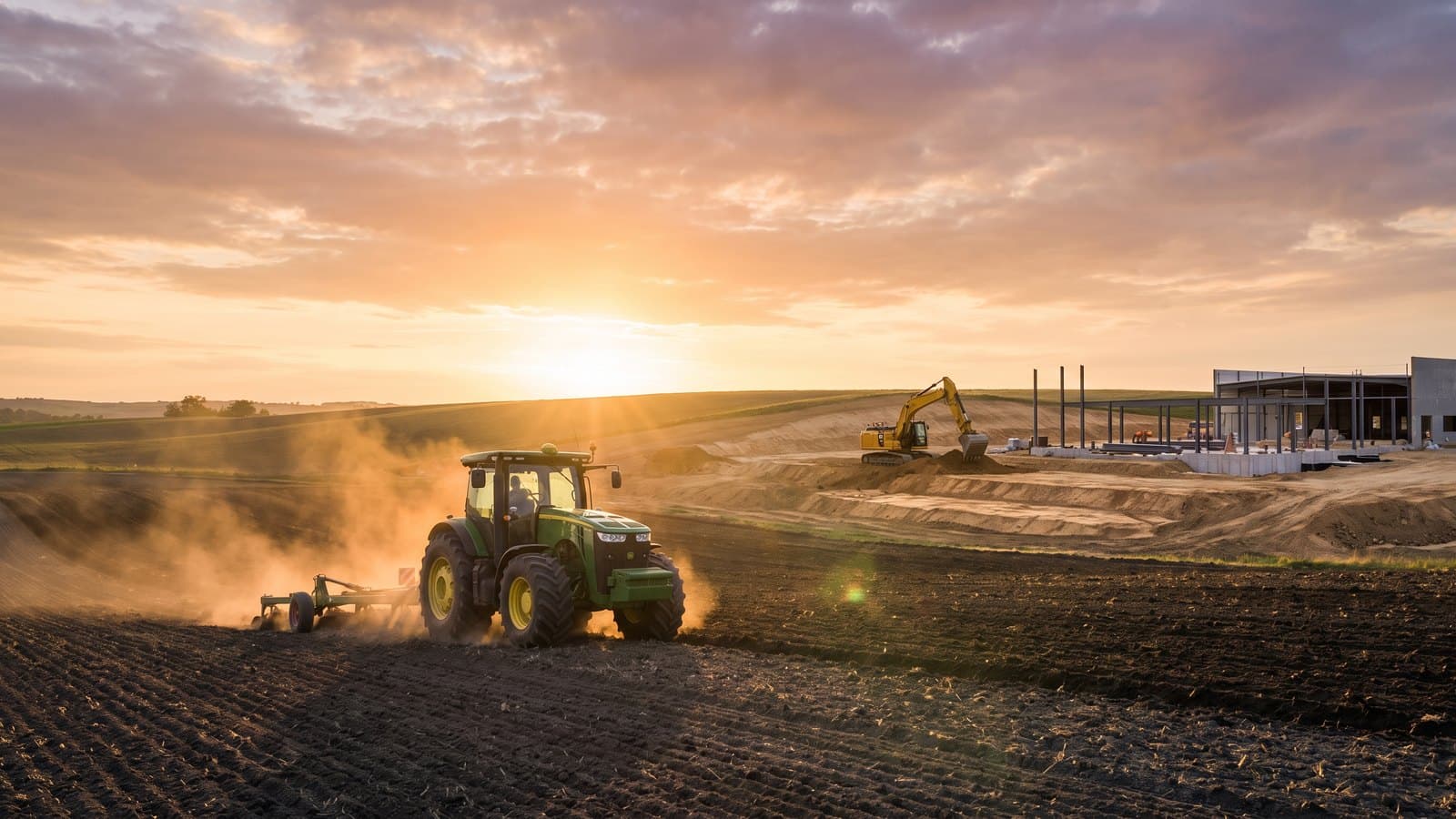
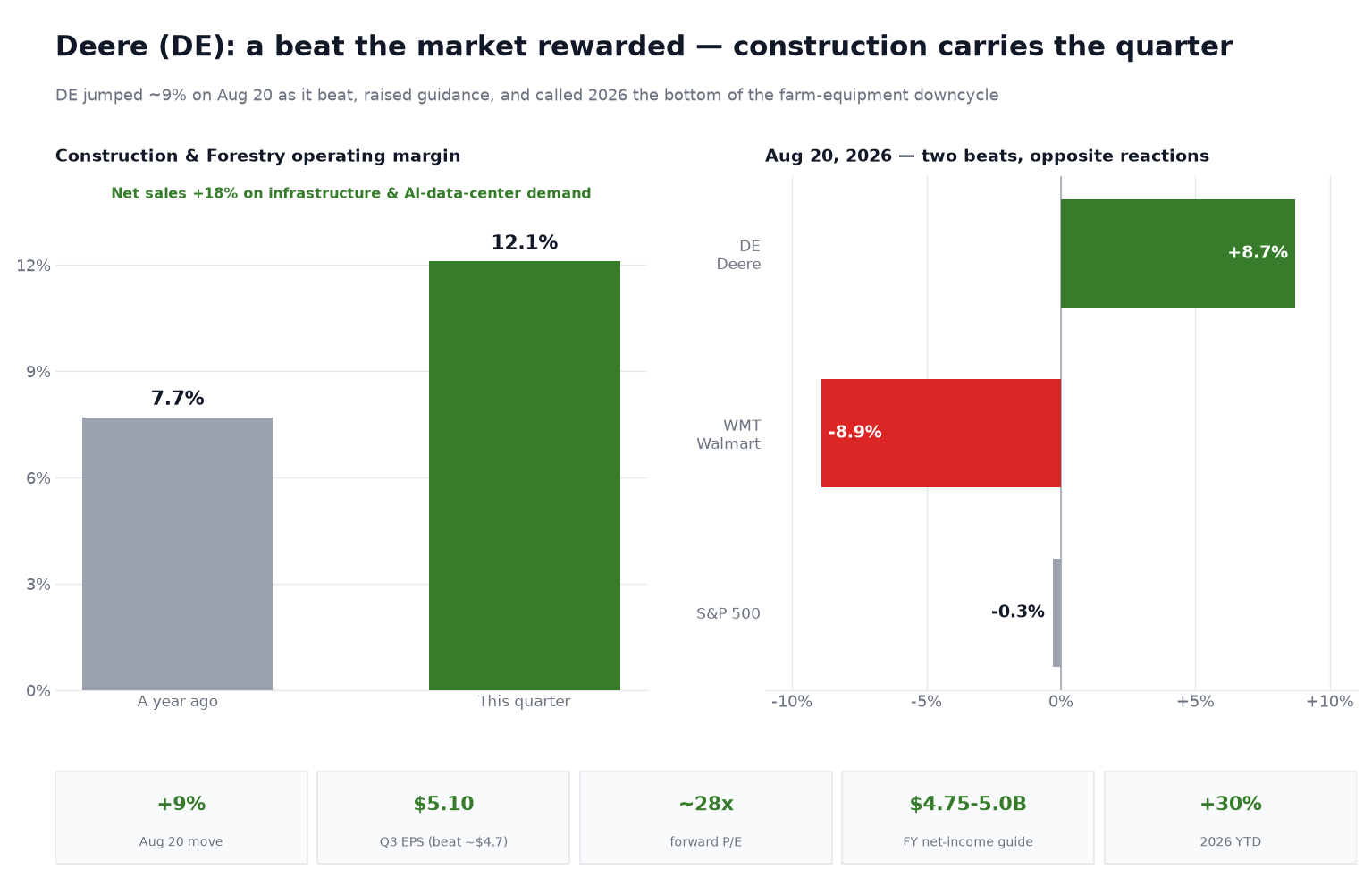
The quarter's profit engine was not agriculture but Construction & Forestry. That segment's net sales rose 18% year over year to about $3.6 billion, and its operating margin expanded sharply to 12.1% from 7.7% a year earlier, lifting segment operating profit to roughly $436 million [2]. The growth came on higher shipment volumes and favorable pricing, and Deere pointed to strong construction demand helped by infrastructure, data-center and energy-related projects [2]. That last piece connects to a theme this site has tracked from every other angle: building a data center takes enormous amounts of site preparation and earthmoving — the excavators, loaders and dozers Deere sells — so the AI build-out is one of several end markets filling construction order books, alongside conventional infrastructure and energy work. Small Agriculture & Turf chipped in as well, with sales up about 12% on higher volumes and pricing. In effect, a cyclical recovery signal in the core business arrived alongside real strength in construction — a combination the market found compelling.
Why the same beat helped Deere but hurt Walmart
The clearest lesson of August 20 is that earnings reactions are about expectations, not absolutes. Both Deere and Walmart beat on earnings per share; their stocks moved about 9% in opposite directions [8]. Walmart's beat, though, came alongside a miss on U.S. comparable-store sales and a softer-than-expected near-term outlook (even as it edged up its full-year view), and it went into the print richly valued and widely owned — so the report read as a warning and the stock was punished. Deere went in with a skeptical, mixed Street — nearly half of covering analysts rated it Hold — and a beaten-down farm cycle, so a beat plus a "we've bottomed" call was a genuine positive surprise and investors appeared to reward it. Same day, both beating on EPS, opposite reactions — a difference driven by what the market had already priced in.
Why it matters
Deere sits at the intersection of two of the market's biggest questions. The first is the farm economy: after a brutal downcycle, a credible bottom from the industry's bellwether is a signal that ripples across agriculture, from equipment peers to fertilizer and seed. The second is the AI build-out — and Deere is an unexpected, indirect way to play it. The picks-and-shovels of the data-center era are not only chips and power; they include literal earthmoving machines, and Deere's construction results are early evidence that data centers are becoming a visible end market for infrastructure equipment, one among several. A stock that jumps 9% on a farm-machinery earnings report is really the market recognizing both a cyclical turn and a durable construction tailwind at once.
How the day's two big beats traded
August 20 offered a clean natural experiment: two mega-cap companies reported earnings that both beat on the bottom line, and the market sent them about 9% in opposite directions [8]:
| Name (ticker) | Aug 20, 2026 (intraday) | Read-through |
|---|---|---|
| DE — Deere | ≈+8.7% | Beat, raised guidance, and called the ag-cycle bottom — a positive surprise to a skeptical, Hold-heavy Street [1][2] |
| WMT — Walmart | ≈−8.9% | Beat on EPS (and nudged up its full-year view) but missed on U.S. comparable sales and gave a softer-than-expected near-term outlook — disappointing a richly valued, widely owned stock [8] |
| S&P 500 | ≈−0.3% | A roughly flat market, underscoring that both moves were company-specific and earnings-driven [8] |
The split is a reminder that a "beat" only helps if it beats what the market already expected — and that positioning, not the raw number, drives the reaction [8].
What the Street did with it
Heading into the report, analysts were notably split. The consensus is a Buy with an average 12-month target near $645, but the rating breakdown was roughly evenly divided between Buys and Holds (about 13 buy-side ratings against 11 holds), and targets ranged widely from about $500 to $812 [7]. Some were outright cautious into the print — J.P. Morgan's Tami Zakaria carried a Hold and had trimmed her target to $570 — while others stayed constructive, such as Oppenheimer at $680 and DA Davidson at $685 [7]. Notably, Thursday's rally carried the stock to within about 2% of the ~$645 consensus target, so the question now is whether analysts raise their numbers to reflect the cycle-turn or wait for a recovery they have been slow to underwrite [7].
What to watch
- The fiscal-2027 order book. Deere called the bottom; the proof will be in early-order-program volumes for next year. Watch for signs the "order gap" risk is easing or building [2].
- Construction & Forestry momentum. Watch whether the 18% sales growth and 12%+ margin hold as infrastructure and data-center construction continue [2].
- Crop prices and farm income. The ag recovery ultimately depends on the economics of farming; watch commodity prices and used-equipment inventories [3].
- Analyst revisions. With the stock near the consensus target, watch whether the Hold-heavy Street upgrades. Moves are tracked on the DE stock page and the earnings calendar [7].
Illustrative valuation sensitivity
The scenarios below are a descriptive, author-weighted exercise — not a forecast, target, recommendation, or intrinsic fair-value calculation. They are anchored to Deere's forward earnings power (a forward P/E near 28× on next-year, fiscal-2027, estimates) and to the analyst target distribution (low ~$500, average ~$645, high ~$812), turning on whether the ag-cycle recovery arrives as management called it. The weights are the author's subjective assumptions and sum to 100%.
| Scenario | Illustrative price | Weight | Key drivers |
|---|---|---|---|
| Upside | ~$740 | 30% | The ag cycle inflects as called, fiscal-2027 orders firm, and Construction & Forestry keeps compounding on AI-infrastructure demand — earnings re-accelerate and the market pays up toward the Street-high [7]. |
| Middle | ~$645 | 45% | The bottom holds but the recovery is gradual; Deere consolidates its gains near the consensus target as investors wait for fiscal-2027 order confirmation [7]. |
| Downside | ~$520 | 25% | The ag recovery stalls or the 2027 order gap bites, earnings stay depressed, and a premium multiple on still-depressed earnings de-rates toward the low end of the target range [3][7]. |
Weighting those (0.30 × $740 + 0.45 × $645 + 0.25 × $520) gives an author-weighted reference value near $642, essentially in line with both the ~$645 consensus and the post-rally price [1] — a reminder that the market has already priced in a fair amount of the called-bottom optimism, leaving the fiscal-2027 order book as the swing factor. This is a Street-target-based scenario exercise and descriptive analysis of an earnings reaction, not investment advice.
DE data snapshot — August 20, 2026 (intraday)
| Figure | Value | As-of / source |
|---|---|---|
| Intraday quote | $634.22 (+9.23%); ~$630.97 (+8.7%) via the feed | Aug 20 — StockAnalysis / Change Feed [1] |
| Prior close | $580.63 | Wed, Aug 19, 2026 [1] |
| 52-week price change / range | ≈+30% over 52 weeks; range $433.00–$674.19 (~6% off the high) | As of Aug 20 [3] |
| Market cap / EV | ≈$171B (270M shares); enterprise value ≈$225B (financial-services debt) | Aug 20 — StockAnalysis [3] |
| Valuation | Forward P/E ≈28× (on fiscal-2027 estimates); trailing P/E ≈35× at the post-jump price | Aug 20 — StockAnalysis [3] |
| Financials (TTM) | Revenue ≈$47.9B (+8.3%); net income ≈$4.9B (EPS $17.99, down ~6% YoY); operating margin ≈13.6%; dividend yield ≈1.0% | TTM — StockAnalysis [3] |
| Volume | Heavy on the beat (feed: ~3.7× the expected pace); 20-day average ≈1.0M shares | Aug 20 — Change Feed / StockAnalysis [1] |
| The quarter (fiscal Q3) | EPS $5.10 (net income $1.379B, up from $1.289B a year ago), beat ~$4.70; equipment net sales ≈$11.0B vs ~$10.7–$10.8B consensus (~$12.6B total incl. financial services); FY net-income guide raised at the low end to $4.75–$5.00B; ~$110M tariff benefit aided results; management called 2026 the bottom of the ag-equipment cycle | Aug 20 — company [2] |
| Segment engine | Construction & Forestry net sales +18% YoY to ~$3.6B; operating margin 12.1% (from 7.7%), on higher volumes/pricing and strong infrastructure, data-center and energy demand; Small Ag & Turf sales +12% | Aug 20 — company [2] |
| Same-day contrast | DE ≈+8.7% vs Walmart ≈−8.9% (both beat on EPS; WMT missed on comps) with the S&P 500 ≈−0.3% | Aug 20 [8] |
| Analyst view (mostly pre-earnings) | Consensus Buy, avg target ≈$645 (range ~$500–$812); split ratings (~13 buy, 11 hold); JPMorgan Hold $570, Oppenheimer $680, DA Davidson $685 | Aug 2026 — market coverage [7] |
The August 20 figures are intraday snapshots that moved through the session, not closing prices.
The setup at a glance
| Question | Answer |
|---|---|
| Why did Deere stock jump on August 20? | It reported fiscal Q3 earnings of $5.10 a share, well ahead of the ~$4.70 consensus, raised the low end of its full-year net-income guidance to $4.75–$5.00 billion, and — most importantly — management called 2026 the bottom of the multi-year farm-equipment downcycle. A strong Construction & Forestry segment (net sales +18%, margin up to 12.1%) added a secular growth story. The stock rose ~9% [1][2]. |
| Why did Deere rise on its beat when Walmart fell on its beat the same day? | Expectations. Deere went in with a skeptical, Hold-heavy Street and a beaten-down cycle, so a beat plus a "we've bottomed" call was a genuine positive surprise. Walmart went in richly valued and widely owned, so slowing sales disappointed. Same day, opposite reactions — positioning, not the raw number, drove them [8]. |
| What is the AI-data-center angle? | Deere's Construction & Forestry segment makes the excavators, loaders and dozers used to prepare data-center sites and build infrastructure. Deere cited data centers as one source of strong construction demand — alongside broader infrastructure and energy projects — as segment sales rose 18% (on higher volumes and pricing) and operating margin expanded to 12.1%. It is an unexpected, indirect way a tractor maker touches AI spending, though not the sole driver of the segment [2]. |
| Is Deere stock expensive? | It is not cheap for a cyclical near a trough. After a ~30% run in 2026 to near its 52-week high, Deere trades around 28× next-year (fiscal-2027) earnings and roughly 35× trailing earnings that are still below year-ago levels — a multiple that prices in a recovery management has called but not yet delivered [3]. |
| What is the biggest risk? | Timing. "Calling the bottom" is not the same as a V-shaped recovery, and the fiscal-2027 early-order book could leave an "order gap." If the ag recovery stalls, a premium multiple on still-depressed trailing earnings has room to compress [3][7]. |
| What do analysts think? | Split. The consensus is a Buy with an average target near $645, but roughly as many analysts rate it Hold as Buy, and targets range from $500 to $812. The rally left the stock within about 2% of the consensus target, so the question is whether the cautious majority upgrades [7]. |
Deere (DE) stock FAQ
Why did Deere (DE) stock jump on August 20, 2026?
Deere reported fiscal third-quarter earnings of $5.10 a share (net income of $1.379 billion, up from $1.289 billion a year earlier), comfortably beating the roughly $4.70 consensus. Its equipment operations booked about $11.0 billion in net sales, modestly ahead of the roughly $10.7–$10.8 billion expected (the widely cited $12.6 billion figure is total net sales and revenues, which includes financial services). It raised the low end of its full-year net-income guidance to $4.75–$5.00 billion. But the biggest catalyst was strategic: CEO John May said the company believes 2026 will mark the bottom of the multi-year agricultural-equipment downcycle, the first clear signal that farm-machinery demand has stopped sliding. A strong Construction & Forestry segment added to the story, and the stock jumped about 9%.
Why did Deere rise on its earnings beat when Walmart fell on its beat the same day?
It comes down to expectations, not absolutes. Both companies beat on earnings per share on August 20, yet their stocks moved about 9% in opposite directions. Walmart's beat, though, came with a miss on U.S. comparable-store sales and a softer-than-expected near-term outlook (even as it edged up its full-year view), and it went into the report richly valued and widely owned — so the report read as a warning and the stock was punished. Deere went in with a skeptical, mixed Street — roughly half of covering analysts rated it Hold — and a beaten-down farm cycle, so a beat plus a credible 'we've bottomed' call was a genuine positive surprise. Same day, both beating on EPS, opposite reactions — because what matters is beating what the market already expected.
How is Deere an AI-data-center play?
Through its Construction & Forestry segment. Building a data center requires enormous amounts of site preparation, earthmoving and infrastructure work — the excavators, loaders and dozers that Deere sells. In the quarter, Construction & Forestry net sales rose 18% year over year (to about $3.6 billion) on higher volumes and pricing, and operating margin expanded to 12.1% from 7.7%; Deere pointed to strong demand from infrastructure, data-center and energy-related projects. So data centers are one visible end market among several — an unexpected, indirect way a farm-machinery maker touches the AI build-out, rather than the sole cause of the segment's strength.
What does 'the bottom of the ag cycle' mean for Deere?
Deere's core agricultural business is cyclical: when crop prices and farm incomes are low, farmers defer buying expensive new tractors and combines, and Deere's sales and profits fall. That has been the case through a multi-year downturn, with trailing-twelve-month earnings still down about 6% year over year (even though third-quarter net income itself rose from a year earlier). Management's statement that 2026 is the bottom — with executives pointing to improving early-order-program trends and shrinking used-equipment inventories — signals that demand has stopped deteriorating and should begin to recover. For a cyclical stock, the market pays for that inflection, which is why the 'bottom' call was worth a 9% move even with the trailing earnings picture still below its year-ago level.
Is Deere stock expensive after the jump?
It is far from cheap for a company near a cyclical trough. After climbing about 30% in 2026 to near its 52-week high, and then jumping about 9% on earnings, Deere trades at roughly 28 times next-year (fiscal-2027) earnings and about 35 times trailing earnings that are still below year-ago levels. That premium reflects optimism about the coming recovery and the Construction & Forestry growth story, but it also means the stock is pricing in a rebound that management has called but not yet delivered, which leaves limited margin for error if the ag recovery is slower than hoped. This is descriptive analysis, not a recommendation.
What do analysts think of Deere?
They are split. The consensus is a Buy with an average 12-month price target near $645, but the rating breakdown is roughly evenly divided between Buys and Holds — about 13 buy-side ratings against 11 holds — and price targets range widely, from about $500 to $812. Some analysts were cautious into the print (J.P. Morgan carried a Hold with a $570 target), while others were more constructive (Oppenheimer at $680, DA Davidson at $685). Notably, the stock's jump carried it to within about 2% of the ~$645 consensus target, so the near-term question is whether the cautious majority raises estimates to reflect the cycle-turn or waits for the recovery to prove itself.