Consumer
Walmart (WMT) Stock Falls ~9%: A Beat-and-Raise, Slowing Comps, and Tariff-Boosted Profit
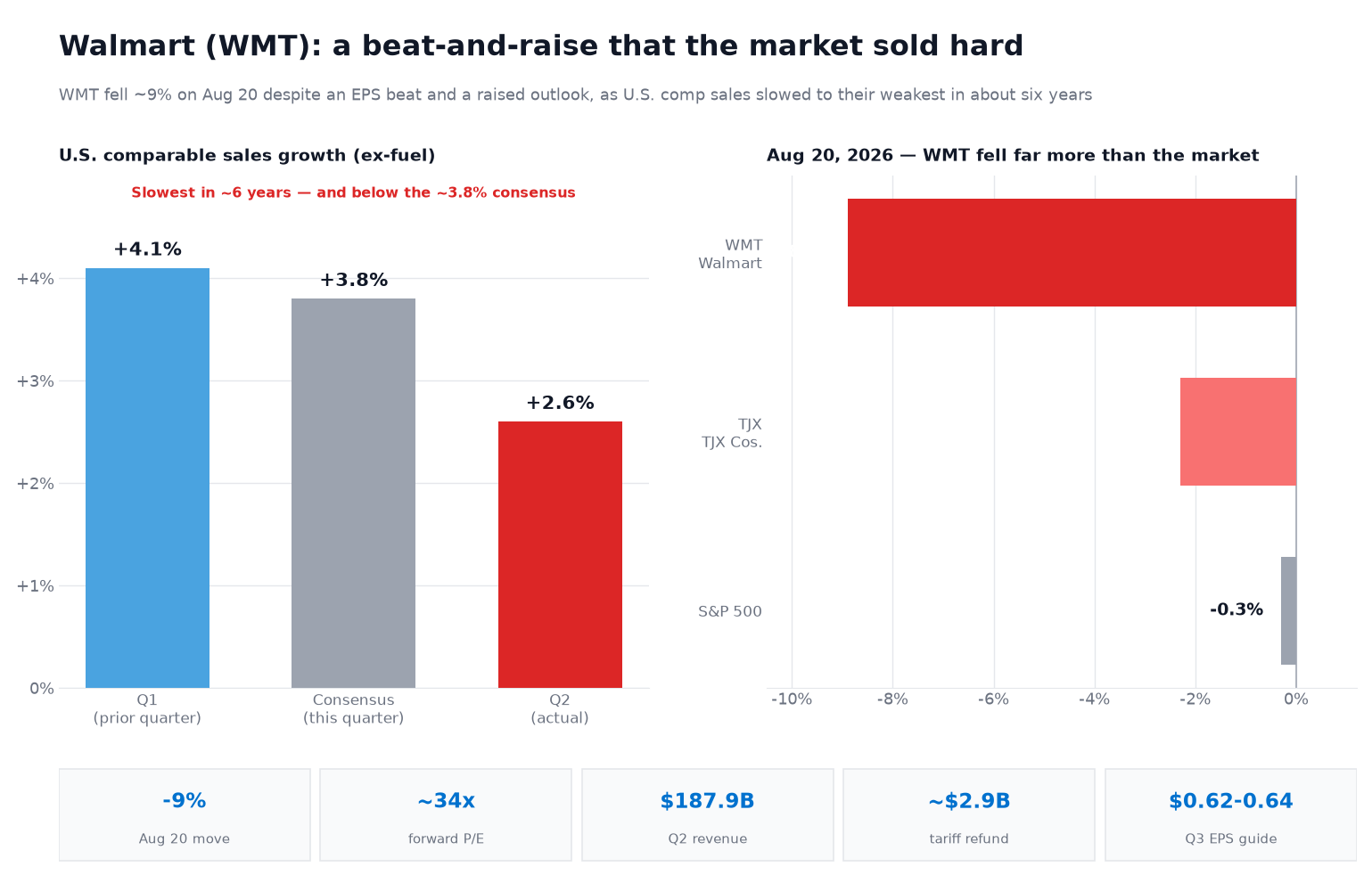
Walmart fell about 9% to roughly $104 on August 20 despite beating on earnings ($0.81 vs $0.74) and revenue and raising its full-year sales outlook — a classic 'beat-and-raise the market sold.' Three things drove it: U.S. comparable sales grew just 2.6% (the slowest in roughly six years and below the ~3.8% consensus), the profit beat got a one-time boost from a ~$2.9 billion tariff refund (though underlying operating profit still grew near the top of guidance), and Walmart guided third-quarter EPS lower ($0.62–$0.64) as it reinvests the windfall into lower prices. Against a demanding mid-30s forward multiple on a ~3%-net-margin retailer, that mix was too much — even as the broad market was barely changed on the day. It is also the market's clearest read that the U.S. consumer is cooling.

Why Walmart stock dropped — a beat-and-raise the market sold
On Thursday, August 20, 2026, Walmart (NYSE: WMT) fell about 9% to roughly $104, from a $114.30 prior close — its worst day in years and its lowest level in months [1]. What makes the drop notable is that, on the surface, the quarter looked good: Walmart beat on earnings and revenue and raised its full-year sales forecast. Adjusted earnings of $0.81 a share topped the $0.74 consensus, revenue of about $187.9 billion edged past estimates, and the company lifted its full-year outlook on both lines — raising constant-currency net-sales growth to 4–5% from 3.5–4.5% and adjusted EPS to $2.80–$2.87 from $2.75–$2.85 [2]. Normally that is the recipe for a higher stock. Instead, investors focused on what was underneath the headline — and sold.
The problem was sales momentum. U.S. comparable sales (excluding fuel) grew just 2.6%, down from 4.1% the prior quarter and short of the roughly 3.8% analysts expected — Walmart's slowest pace in roughly six years [2]. One mitigating detail softens that number: Walmart said pharmacy deflation tied to new "Maximum Fair Price" drug-pricing rules created about a 125-basis-point headwind to the comp; mechanically, adding that back would put the figure near 3.9% [2]. Even so, for a stock priced for steady, above-average growth, a headline deceleration like that is exactly what the market fears, and it reframed an apparent beat as a warning about the health of the American consumer.
The tariff twist: why the earnings beat was "low quality"
The second issue was how Walmart beat. Headline profitability received a sizable nonrecurring boost from roughly $2.9 billion of tariff refunds; Walmart said the net impact of the refunds and the related price investment added roughly 7.5 percentage points to its adjusted operating-income growth (which rose about 17.4% in total) in the quarter [2]. Underlying profit was still healthy — excluding the refund, adjusted operating income grew near the top of the company's prior 7–10% guidance range — but a large one-time item flattered the headline beat, and investors are rarely willing to pay a premium multiple for earnings partly delivered by refund [2].
Management then leaned into the tension. Rather than bank the windfall, Walmart is reinvesting the tariff benefit into lower prices — it flagged more than 11,000 rollbacks — which helps explain why its near-term profit guide stayed conservative: a soft third-quarter outlook of $0.62–$0.64 in adjusted EPS, below the roughly $0.68 the Street was modeling, with Q3 net-sales growth guided to about 3.0–3.75% (constant currency) [2]. Strategically, using scale to press on price is classic Walmart and may win share; financially, it means near-term margins get squeezed just as headline sales growth is cooling. That combination — decelerating comps, a refund-boosted beat, and a below-consensus profit guide — is what investors appeared to focus on, turning a beat-and-raise into a ~9% decline.
The valuation that left no margin for error
The reaction is easier to understand once you know how the stock was priced. Even after a flat year, and even after the drop to ~$104, Walmart trades at roughly 38× trailing and the mid-30s on forward earnings — an extraordinary multiple for a retailer that earns a net margin of about 3% [3]. That premium reflects a genuine bull case (scale, a fast-growing e-commerce and advertising business, and share gains from higher-income shoppers), but it also means the stock is priced for consistent execution. When comparable sales miss and management guides profit lower, a mid-30s multiple has a long way to fall — which is why a mixed report produced an outsized move.
Why it matters
Walmart is the single best real-time read on the American consumer, so a "slowest in roughly six years" comp number lands well beyond one stock. It arrived during a heavy week of retail earnings — Target reported the day before, Home Depot earlier — and it sharpened a question the whole market is asking: is the U.S. shopper finally slowing? Walmart's answer was nuanced. Demand is still growing and the company is gaining share, particularly among higher-income households and online, but the pace has cooled and Walmart is choosing to defend that share with price rather than protect margin. For a market that has bid consumer-staples and mega-cap "quality" names to rich multiples, a reminder that even the strongest retailer faces a decelerating consumer is a meaningful recalibration.
How the tape traded the same day
Walmart's decline was an idiosyncratic, earnings-driven move — it dramatically underperformed a broad market that was only modestly lower on the day [8]:
| Name (ticker) | Aug 20, 2026 (intraday) | Read-through |
|---|---|---|
| WMT — Walmart | ≈−8.9% | Beat and raised, but slowing comps, a tariff-flattered beat and a soft Q3 profit guide [1][2] |
| TJX — TJX Companies | ≈−2.3% | Off-price retailer under milder pressure amid the consumer-earnings-week caution [8] |
| S&P 500 | ≈−0.3% | The broad market was only slightly lower as yields rose, underscoring that Walmart's drop was company-specific [8] |
That Walmart fell nearly 9% while the index barely moved is the clearest sign this was about Walmart's quarter, not a market-wide risk-off [8].
What the Street did with it
Coming into the report, the analyst community was firmly constructive. The consensus is a Buy with an average 12-month target near $138 — roughly a third above the ~$104 price — with a wide range from about $81 to $155 [7]. Those marks, however, largely predate the quarter: Jefferies' $150 dates to June, Morgan Stanley's $140 to early August, and RBC's $137 to earlier reiterations, while Guggenheim trimmed to $135 from $137 just before the print (all Buy-rated) [7]. With the stock now well below that ~$138 consensus, the near-term question is whether analysts hold their pre-earnings numbers or begin to trim as they digest the softer consumer signal [7].
What to watch
- Comparable-sales trajectory. The 2.6% U.S. comp is the number that moved the stock; watch whether the deceleration is a one-quarter soft patch or a trend as the year progresses [2].
- Margins vs. price investment. Walmart is reinvesting the tariff benefit into lower prices; watch gross margin and operating margin against the soft Q3 EPS guide of $0.62–$0.64 [2].
- The e-commerce and advertising engine. Global online sales grew 23% (U.S. e-commerce up 24%); watch whether higher-margin digital and ad revenue can offset thinner retail margins [2].
- The consumer read-through. Watch Target, Home Depot and other retailers for confirmation of a broader slowdown. Moves are tracked on the WMT stock page and the earnings calendar [8].
Illustrative valuation sensitivity
The scenarios below are a descriptive, author-weighted exercise — not a forecast, target, recommendation, or intrinsic fair-value calculation. They are anchored to Walmart's forward earnings power (a forward P/E in the mid-30s, on roughly $3.05 of forward EPS) and to the analyst target distribution (low ~$81, average ~$138, high ~$155), turning on whether the consumer slowdown is temporary and how much multiple a decelerating retailer deserves. On that ~$3.05 of forward EPS, the scenario prices below imply roughly 46×, 38× and 30× forward earnings — a reminder of how much multiple is at stake. The weights are the author's subjective assumptions and sum to 100%.
| Scenario | Illustrative price | Weight | Key drivers |
|---|---|---|---|
| Upside | ~$140 | 30% | The comp slowdown proves a one-quarter blip, price investment drives share gains and a re-acceleration, and the market re-embraces the premium multiple toward the consensus target [7]. |
| Middle | ~$115 | 40% | Growth stays soft but positive; Walmart takes share while margins are pressured, and the stock recovers part of the drop but the multiple stays under review [3]. |
| Downside | ~$90 | 30% | The consumer keeps slowing, comps stay weak, and a mid-30s multiple on ~3% margins compresses toward the low end of the target range as analysts trim [3][7]. |
Weighting those (0.30 × $140 + 0.40 × $115 + 0.30 × $90) gives an author-weighted reference value near $115, above the ~$104 quote but well below the ~$138 consensus [1] — capturing both the Street's structural bullishness and the real risk that a premium multiple keeps compressing if the consumer stays soft. This is a Street-target-based scenario exercise and descriptive analysis of an earnings reaction, not investment advice.
WMT data snapshot — August 20, 2026 (intraday)
| Figure | Value | As-of / source |
|---|---|---|
| Intraday quote | $103.70 (−9.27%); ~$104.16 (−8.9%) via the feed | Aug 20 — StockAnalysis / Change Feed [1] |
| Prior close | $114.30 | Wed, Aug 19, 2026 [1] |
| 52-week price change / range | ≈+3% over 52 weeks; range $95.42–$135.16 (the drop took it near the low) | As of Aug 20 [3] |
| Market cap / EV | ≈$825B (7.96B shares); enterprise value ≈$888B | Aug 20 — StockAnalysis [3] |
| Valuation (at ~$104) | Trailing P/E ≈37.6×; forward P/E in the mid-30s (≈34×) | Aug 20 — StockAnalysis [3] |
| Margins (thin) | Gross ≈25%; operating ≈4.4%; net ≈3.0% | TTM — StockAnalysis [3] |
| Financials (TTM) | Revenue ≈$736B; net income ≈$22.1B (EPS $2.76); dividend yield ≈1.0% | TTM — StockAnalysis [3] |
| Volume | ≈31.2M vs ≈22.2M 20-day average (~1.4× — heavy on the earnings reaction) | Aug 20 — StockAnalysis [3] |
| The quarter (fiscal Q2 FY27) | Adjusted EPS $0.81 (beat $0.74); revenue ~$187.9B; U.S. comps ex-fuel +2.6% (miss ~3.8%, slowest in ~6 years; ~125 bps of pharmacy-pricing drag); global e-commerce +23% (U.S. +24%); FY guide raised to net sales +4–5% and EPS $2.80–$2.87 | Aug 20 — company [2] |
| The catch | ~$2.9B tariff refund; its net impact added ~7.5 pts to op-income growth (17.4% total; underlying still near the top of 7–10% guidance); soft Q3 EPS guide $0.62–$0.64 vs ~$0.68, reinvesting in price | Aug 20 — company / coverage [2] |
| Analyst view (mostly pre-earnings) | Consensus Buy, avg target ≈$138 (range ~$81–$155); Jefferies $150 (June), Morgan Stanley $140 (early Aug), RBC $137, Guggenheim $135 (trimmed Aug 17) | Aug 2026 — market coverage [7] |
The August 20 figures are intraday snapshots that moved through the session, not closing prices.
The setup at a glance
| Question | Answer |
|---|---|
| Why did Walmart stock fall if it beat earnings? | Because the market looked past the headline. U.S. comparable sales grew just 2.6% — the slowest in roughly six years and below the ~3.8% consensus — the profit beat ($0.81 vs $0.74) got a one-time lift from a ~$2.9 billion tariff refund (whose net impact added ~7.5 points to operating-income growth, though underlying profit still grew near the top of guidance), and Walmart guided third-quarter profit lower ($0.62–$0.64) to reinvest that windfall in lower prices. Against a mid-30s forward multiple, that mix was enough to send the stock down ~9% [1][2]. |
| Didn't Walmart raise its guidance? | Yes — it lifted its full-year net-sales growth outlook to 4–5% from 3.5–4.5%. But the market cared more about the quality of the beat and the near-term profit step-down: a soft Q3 EPS guide of $0.62–$0.64 as the company reinvests the tariff benefit into price [2]. |
| What is the tariff refund about? | Walmart received roughly $2.9 billion in tariff refunds that expanded its gross margin in the quarter, which is a big reason adjusted EPS beat. Because it is a one-time item rather than underlying retail strength, investors discounted the earnings beat — and the company is passing the benefit through to shoppers as lower prices [2]. |
| Is Walmart stock expensive? | By retail standards, very. Even after a roughly flat year and the 9% drop, it trades near 38× trailing and the mid-30s on forward earnings on a business with a ~3% net margin. That premium reflects scale, e-commerce and advertising growth, and share gains — but it leaves little room for error, which is why a comp miss produced such a large move [3]. |
| What does this say about the U.S. consumer? | Walmart is the best real-time gauge of American spending, and its slowest comp growth in roughly six years suggests the consumer is cooling — still growing, but at a slower pace. It came during a heavy retail-earnings week (Target, Home Depot), sharpening the market's question about a broader slowdown [2][8]. |
| What do analysts think? | Still bullish: a Buy consensus with an average target near $138 (about a third above the price) and a range of roughly $81 to $155. Most reiterated Buy ratings around the report (Jefferies $150, Morgan Stanley $140, RBC $137); Guggenheim trimmed slightly to $135 [7]. |
Walmart (WMT) stock FAQ
Why did Walmart (WMT) stock fall on August 20, 2026, if it beat earnings?
Because investors looked past the headline beat to the quality of the quarter. Walmart reported adjusted EPS of $0.81 (versus $0.74 expected) and revenue of about $187.9 billion, and it even raised its full-year sales outlook — but three things worried the market. First, U.S. comparable sales grew just 2.6%, down from 4.1% the prior quarter and short of the roughly 3.8% consensus, the slowest in roughly six years. Second, the profit beat leaned heavily on a roughly $2.9 billion one-time tariff refund, even though underlying operating profit still grew near the top of guidance. Third, Walmart guided third-quarter profit lower ($0.62–$0.64 in adjusted EPS) because it plans to reinvest that tariff benefit into lower prices. Against a rich mid-30s forward valuation, that combination sent the stock down about 9%.
Didn't Walmart raise its guidance?
Yes. Walmart lifted its full-year net-sales growth outlook to a range of 4–5%, up from 3.5–4.5%. But a top-line guidance raise was not enough to offset the market's concerns about the quality of the earnings beat and the near-term profit trajectory. The company's third-quarter adjusted-EPS guide of $0.62–$0.64 came in below what analysts were modeling, because Walmart is choosing to reinvest its tariff-refund windfall into lower prices rather than let it fall to the bottom line. Investors read that as decelerating growth plus compressed near-term margins.
What is the Walmart tariff refund, and why did it matter?
During the quarter Walmart received roughly $2.9 billion in tariff refunds, which expanded its gross margin and was a major reason its adjusted earnings beat expectations. The issue for investors is that a tariff refund is a one-time item, not a sign of underlying retail strength — so the market discounted the earnings beat as 'low quality.' Compounding that, Walmart said it will pass the benefit through to customers as lower prices in the second half, which supports its competitive position but pressures near-term profit, as reflected in the soft third-quarter EPS guidance.
Is Walmart stock expensive?
By the standards of a retailer, yes, and that is central to the story. Even after a roughly flat year and the 9% drop, Walmart trades at about 38 times trailing and the mid-30s on forward earnings, on a business that earns a net margin of only around 3%. That premium multiple reflects a real bull case — enormous scale, a fast-growing e-commerce and advertising business, and market-share gains including among higher-income shoppers — but it also prices in consistent, above-average execution. When comparable sales miss and management guides profit lower, a mid-30s multiple has a lot of room to compress, which is why a mixed report produced an outsized share-price move.
What does Walmart's quarter say about the U.S. consumer?
Walmart is widely considered the best real-time barometer of American consumer spending, so its slowest comparable-sales growth in roughly six years is a meaningful signal that the consumer is cooling. Importantly, it is a slowdown in the pace of growth, not an outright decline — demand is still rising, and Walmart is gaining share, especially online and among higher-income households. But the deceleration, arriving during a heavy week of retail earnings alongside Target and Home Depot, sharpened the market's question about whether the U.S. shopper is finally weakening after a long run of resilience. This is descriptive analysis, not a recommendation.
What do analysts think of Walmart after the drop?
Wall Street stayed structurally bullish. The consensus rating is a Buy with an average 12-month price target near $138 — roughly a third above the post-drop price — and a range from about $81 to $155. Most analysts reiterated their Buy ratings around the report, including Jefferies at $150, Morgan Stanley at $140 and RBC at $137, while Guggenheim trimmed its target slightly to $135. The key thing to watch is whether that bullishness holds or whether analysts begin cutting targets and estimates if the softer consumer signal persists into coming quarters.