Technology
Elastic (ESTC) Stock Soars ~23%: A Q1 Beat, 20% Cloud Growth, and an AI-Search Re-Rating
Elastic soared about 23% to roughly $103 on August 28 after a strong fiscal Q1: revenue rose 15% to $478 million, adjusted EPS of $0.70 beat the ~$0.58 consensus, Elastic Cloud revenue grew 20%, and management raised full-year guidance to roughly $2.0 billion in revenue. The nuance: the $0.70 is a non-GAAP figure — on a GAAP basis the quarter was a ~$0.16-per-share loss, and the ~29x trailing P/E some sites quote is deceptively low because trailing profit is almost entirely a prior-year one-time tax benefit. It was the mirror image of Marvell, which also beat and raised the same night but fell ~7% because investors had priced in more Google-AI upside, sooner — expectations, not the beat, drove the reactions. The surge carried Elastic to a 52-week high, above its ~$91 average analyst target, forcing bulls to scramble (Oppenheimer, Baird and Guggenheim into the $120s) while cautious desks stayed below.

Why Elastic stock soared — a Q1 beat, 20% cloud growth and a raised outlook
On Friday, August 28, 2026, Elastic N.V. (NYSE: ESTC) soared about 23% to roughly $103, from an $83.74 prior close [1]. The search-and-observability software company had reported fiscal first-quarter results the evening before, and they beat across the board: revenue rose about 15% to $478 million (ahead of the ~$470 million expected), adjusted earnings of $0.70 a share topped the ~$0.58 consensus, and — most importantly for the growth story — Elastic Cloud revenue grew 20% to $235 million [2]. Management then raised full-year guidance, lifting its revenue outlook to about $2.0 billion and adjusted EPS to $3.29–$3.37, both above Wall Street's estimates [2]. "Elastic delivered a strong start to fiscal 2027, beating our guidance across all key metrics," CEO Ash Kulkarni said [2].
Read the beat carefully: the $0.70 is adjusted, not GAAP
One distinction matters before taking the earnings figure at face value. The $0.70 that beat consensus is a non-GAAP number — about $73.5 million in adjusted profit; on a GAAP basis, Elastic actually posted a net loss of roughly $16.7 million, or about $0.16 a share, for the quarter [2]. That gap is normal for a scaling software company: the quarter's GAAP result carried roughly $77 million of stock-based compensation and payroll-tax items and about $20 million of restructuring charges — all of which the non-GAAP figure excludes — even as the adjusted business is profitable. A separate quirk cuts the other way on the trailing multiple. The roughly 29-times trailing price-to-earnings ratio you may see quoted for Elastic makes the shares look cheaper than the underlying earnings warrant, because its trailing GAAP net income (about $376 million) is almost entirely a one-time ~$435 million income-tax benefit Elastic booked a year ago, when it released a valuation allowance on deferred tax assets — a non-cash item with no bearing on operations; strip it out and the trailing result would be a loss [3]. So the trailing P/E is not a meaningful gauge in either direction. The cleaner way to frame Elastic's valuation is on forward, adjusted earnings (roughly 30 times the $3.33 guidance midpoint) or on sales (about six times), which is where a high-growth, roughly-GAAP-breakeven software name really trades [3]. None of this dilutes the quarter — the adjusted beat, the 20% cloud growth and the raised guidance are real — but it is worth knowing what the headline multiples do and do not represent.
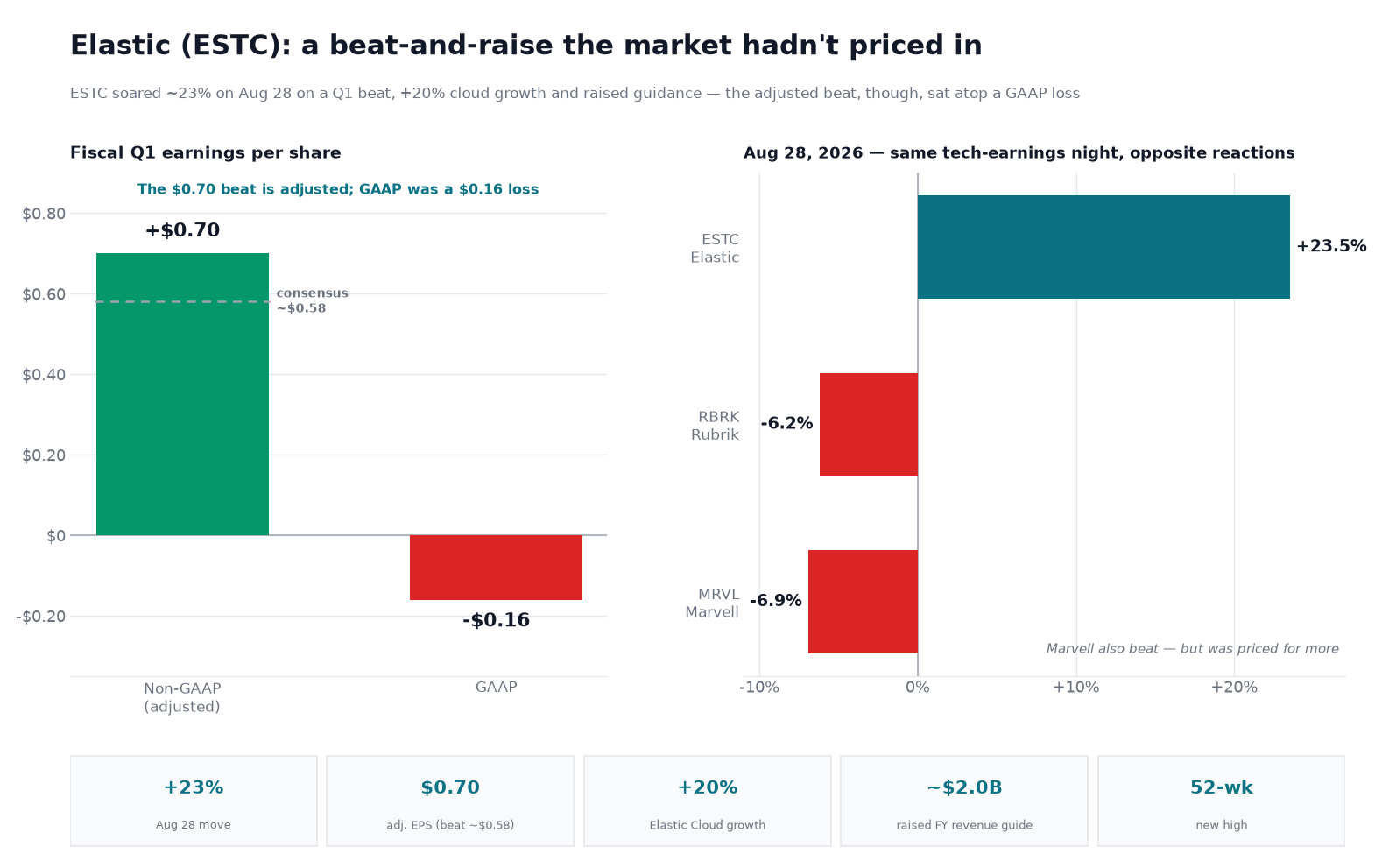
The same night, opposite reactions
Elastic's 23% surge is best understood next to the stock that fell the same evening. Marvell Technology also reported after the close, and it, too, beat and raised — revenue up 37% to $2.74 billion, adjusted EPS of $0.94, and a lifted outlook — yet its shares dropped about 7% [5]. The reason was not a weak forecast but the bar in front of it: investors had priced in even greater upside from Marvell's Google-related custom-AI business, and management signaled that much of that contribution was already embedded, with the larger benefit arriving later. Rubrik, another software name, fell about 6% [5]. Crucially, Elastic was not entering earnings with low expectations either — it had already rallied roughly 30% over the prior month into the print. The difference is that Elastic's beat-and-raise cleared its elevated bar more convincingly, while Marvell's — good as it was — fell short of an even loftier one. Two beats, a 30-point spread in the reactions: this earnings season keeps grading expectations, not the raw number.
Why it matters
Elastic is a clean read on one of software's most important questions: can incumbents turn the AI wave into revenue? Its core product, Elasticsearch, was built to search and analyze large volumes of data; the generative-AI era has made that capability suddenly central, because the same technology that finds a document can retrieve the right context for a language model. When Elastic's cloud business accelerates and management raises guidance, it is evidence that enterprises are not just experimenting with AI but paying for the infrastructure underneath it — and that a company founded on open-source search can monetize the shift. The 23% move is the market repricing Elastic from a steady, mid-teens-growth software vendor toward a faster-growing beneficiary of AI adoption. Whether that re-rating holds depends on the cloud-growth trajectory and on the gap between the adjusted profits the story rests on and the GAAP losses still on the page.
How the day's tech earnings traded
August 28 was a busy earnings morning, and the reactions sorted companies by expectations rather than by the raw beat [5]:
| Name (ticker) | Aug 28, 2026 (intraday) | Read-through |
|---|---|---|
| ESTC — Elastic | ≈+23% | Beat, 20% cloud growth, raised guidance — a surprise to a cautious Street [1][2] |
| MRVL — Marvell | ≈−7% | Also beat and raised, but investors had priced in more upside from its Google-related custom-AI business, sooner [5] |
| RBRK — Rubrik | ≈−6% | Another software name giving back gains [5] |
| S&P 500 | ≈flat | A roughly unchanged broad market, underscoring the stock-specific reactions [5] |
Two beats, a 30-point spread in the reactions: the market was grading expectations, not earnings [5].
What the Street did with it
Coverage was already Buy-tilted, and the print sent analysts scrambling to raise targets that the stock had blown past. Across roughly 31 analysts the consensus is a Buy (mostly buy and hold ratings, with no sells), but the pre-earnings average target — around $91 on StockAnalysis, and lower still (~$84) on some indexed feeds before Friday's revisions — now sits well below the post-gap price and is climbing quickly as post-earnings updates land, so treat it as a snapshot [6]. The bulls piled in Friday: Oppenheimer went to $118 (from $100, Outperform), and Baird, Guggenheim and Barclays all lifted targets into the $118–$120 range [6]. The more cautious desks moved up too but stayed lower: Wells Fargo raised to $100 (Equal-weight), and Scotiabank sits at a Sector-Perform-equivalent rating near $84 — below the stock [6]. When a stock trades above its average target and even the bulls are only now catching up, the market has moved faster than the models — which is either a sign of a genuine re-rating or of a crowded, overbought trade, depending on your view.
What to watch
- Elastic Cloud growth. The 20% cloud growth is the engine of the AI-search thesis. Watch whether it holds or accelerates as generative-AI workloads scale [2].
- GAAP vs adjusted. The story rests on adjusted profits while GAAP is still a loss. Watch the path toward GAAP profitability and the size of stock-based compensation [2].
- Guidance follow-through. Management raised the full-year outlook to ~$2.0 billion in revenue and $3.29–$3.37 adjusted EPS; watch the next quarter against that bar [2].
- The technical setup. After a 23% gap to a 52-week high on an overbought reading, watch whether the stock consolidates. Moves are tracked on the ESTC stock page [1].
Illustrative valuation sensitivity
Because Elastic's GAAP earnings are distorted by a prior tax benefit and current stock-based compensation, the scenarios below are anchored to its forward, adjusted earnings power (roughly 30× the $3.33 FY2027 guidance midpoint) and to the analyst target distribution (pre-earnings low ~$53, average ~$91, and post-earnings targets raised into the $120s), turning on whether cloud growth sustains the AI-search re-rating. They are a descriptive, author-weighted exercise — not a forecast, target, recommendation, or intrinsic fair-value calculation — with subjective weights that sum to 100%.
| Scenario | Illustrative price | Weight | Key drivers |
|---|---|---|---|
| Upside | ~$130 | 30% | Cloud growth accelerates on AI-search adoption, adjusted margins expand, and the market pays up toward the freshly raised bull targets [6]. |
| Middle | ~$103 | 40% | Growth stays in the high-teens-to-20% range and the stock consolidates its gap near current levels as the re-rating is digested [1]. |
| Downside | ~$78 | 30% | The overbought move unwinds, cloud growth cools, or GAAP losses draw scrutiny, and a ~30× forward multiple compresses toward the cautious targets [3][6]. |
Weighting those (0.30 × $130 + 0.40 × $103 + 0.30 × $78) gives an author-weighted reference value near $104, essentially at Friday's ~$103 [1] — a reflection of a genuinely strong quarter set against an overbought, above-target price. This is a Street-target-and-forward-earnings scenario exercise and descriptive analysis of an earnings reaction, not investment advice.
ESTC data snapshot — August 28, 2026 (intraday)
| Figure | Value | As-of / source |
|---|---|---|
| Intraday quote | ~$103 (+~23%); feed +23.47% | Aug 28 — StockAnalysis / Change Feed [1] |
| Prior close | $83.74 | Thu, Aug 27, 2026 [1] |
| 52-week range / change | $42.05–$108.00; a new 52-week high, more than double the low; ~+25% over 52 weeks (well above its ~$68 50-day and ~$64 200-day averages; RSI ≈79) | As of Aug 28 [3] |
| Market cap / EV | ≈$10.8B (105M shares); enterprise value ≈$10B; beta ≈1.0 | Aug 28 — StockAnalysis [3] |
| Valuation | Forward P/E ≈30× (on adjusted $3.33 guide); ≈6× sales; ≈5.3× forward sales. The ~29× trailing GAAP P/E is not meaningful — it looks artificially low because trailing GAAP net income (~$376M) is almost entirely a prior-year ~$435M one-time tax benefit | Aug 28 — StockAnalysis [3] |
| Financials (TTM) | Revenue ≈$1.8B (+16%); gross margin ≈76%; GAAP operating margin roughly breakeven (slightly negative); no dividend | TTM — StockAnalysis [3] |
| Volume | Heavy on the beat (early reading ~2.9M vs a ~2.5M 20-day average, rising through the session) | Aug 28 — StockAnalysis [1] |
| The quarter (fiscal Q1) | Revenue $478M (+15%, vs ~$470M); non-GAAP EPS $0.70 / ~$73.5M (beat ~$0.58) but a GAAP net loss of ~$16.7M (~$0.16/share); Elastic Cloud +20% to $235M; sales-led subscription $398.5M (+18%); FY guide raised to $1.998–$2.010B revenue (mid $2.004B) and $3.29–$3.37 adjusted EPS; Q2 revenue guided $486–$487M (vs ~$483M) | Aug 27 — company [2] |
| Same-day tech tape | ESTC ≈+23% (beat + raised guide) vs MRVL ≈−7% (also beat/raised, priced for more Google-AI upside) vs RBRK ≈−6%; S&P 500 ≈flat (~+0.05%) | Aug 28 [5] |
| Analyst view | ~31 analysts, consensus Buy (mostly buy/hold, no sells), avg target ≈$91 (now ~10% below the price and rising fast on revisions); post-earnings raises: Oppenheimer $118, Baird $120, Guggenheim $120, Barclays $118, Wells Fargo $100 (Equal-weight); Scotiabank ~$84 (Sector Perform) | Aug 2026 — StockAnalysis / market coverage [6] |
The August 28 figures are intraday snapshots that moved through the session, not closing prices.
The setup at a glance
| Question | Answer |
|---|---|
| Why did Elastic stock soar on August 28? | It reported fiscal Q1 results the evening before that beat and raised guidance: revenue up 15% to $478 million, adjusted EPS of $0.70 (versus ~$0.58 expected), Elastic Cloud revenue up 20%, and a lifted full-year outlook of about $2.0 billion in revenue and $3.29–$3.37 adjusted EPS. The strong beat-and-raise, on top of an AI-search growth story, sent the stock up about 23% [1][2]. |
| Was Elastic actually profitable? | On an adjusted basis, yes — the $0.70 that beat consensus is a non-GAAP figure (about $73.5 million). On a GAAP basis, Elastic posted a net loss of about $16.7 million, or ~$0.16 a share, driven mainly by stock-based compensation and restructuring charges. Separately, the ~29× trailing price-to-earnings ratio quoted on some sites looks deceptively low: Elastic's trailing GAAP profit is almost entirely a prior-year one-time ~$435 million tax benefit, so the stock is better judged on forward adjusted earnings (~30×) or sales (~6×) [2][3]. |
| Why did Elastic soar while Marvell fell on the same night? | Expectations. Marvell also beat and raised, but investors had priced in even more upside from its Google-related custom-AI business, sooner than management signaled it would arrive, so the shares fell about 7%. Elastic had also run hard into its print (up ~30% over the prior month, though still below its old high), but its beat-and-raise cleared that elevated bar more convincingly. A beat only helps when it clears the bar the market has already set [5]. |
| How is Elastic an AI play? | Its core product, Elasticsearch, is one of the default engines for vector search and retrieval-augmented generation — the technology that lets companies feed their own data to large language models. That has made Elastic's consumption-based cloud business (up 20% and now roughly half of revenue) a beneficiary of enterprise AI adoption, which is what the market is repricing [2]. |
| Is Elastic stock expensive after the jump? | It is priced for growth. After a 23% gap to a 52-week high, Elastic trades around 30 times forward adjusted earnings and six times sales while still posting GAAP losses, and it is technically overbought (RSI near 80) after a six-day run. The move even carried it above the average analyst target (~$91), so a lot of optimism is already reflected [3][6]. |
| What do analysts think? | Bullish, and scrambling to keep up. The consensus is Buy across about 31 analysts, but the ~$91 average target now sits below the price and is rising fast on post-earnings revisions. Oppenheimer, Baird, Guggenheim and Barclays raised targets into the $118–$120 range after the print, while more cautious desks stayed lower — Wells Fargo at Equal-weight $100 and Scotiabank at a Sector-Perform-equivalent near $84 [6]. |
Elastic (ESTC) stock FAQ
Why did Elastic (ESTC) stock soar on August 28, 2026?
Elastic reported fiscal first-quarter results the evening before that beat expectations and came with raised guidance. Revenue rose about 15% to $478 million (above the ~$470 million expected), adjusted earnings were $0.70 a share (versus a ~$0.58 consensus), and Elastic Cloud revenue — the consumption-based growth engine — grew 20% to $235 million. Management then raised its full-year outlook to about $2.0 billion in revenue and $3.29–$3.37 in adjusted EPS, both above Wall Street's estimates. The beat-and-raise, layered on an AI-search growth story, sent the stock up about 23%.
Was Elastic actually profitable in the quarter?
On an adjusted (non-GAAP) basis, yes — the $0.70 that beat consensus (about $73.5 million) excludes items like stock-based compensation. On a GAAP basis, Elastic posted a net loss of about $16.7 million, or $0.16 a share, for the quarter — a gap driven mainly by stock-based compensation and restructuring charges, and typical of a scaling software company. A separate quirk affects the trailing multiple: the roughly 29-times trailing price-to-earnings ratio quoted on some data sites looks deceptively low, because Elastic's trailing GAAP net income (about $376 million) is almost entirely a one-time ~$435 million income-tax benefit it booked a year earlier when it released a deferred-tax valuation allowance — strip it out and the trailing result would be a loss. So the stock is better judged on forward adjusted earnings (roughly 30 times the $3.33 guidance midpoint) or on sales (about six times), not the trailing P/E.
Why did Elastic soar while Marvell fell on the same earnings night?
It comes down to expectations. Marvell also reported after the close on August 27, and it, too, beat — revenue up 37% to $2.74 billion, adjusted EPS of $0.94 — and raised its outlook, yet its shares fell about 7%. The reason was not a weak forecast but a very high bar: investors had priced in even greater upside from Marvell's Google-related custom-AI business, and management signaled that much of that benefit would arrive later than hoped. Elastic was not a low-expectations name either — it had run about 30% over the prior month into the print — but its beat-and-raise cleared that elevated bar more convincingly, so it was rewarded with a 23% gain. The recurring lesson is that a beat only helps when it clears the bar the market has already set, which is why two beats produced a roughly 30-point spread in their reactions.
How is Elastic an artificial-intelligence play?
Through its core product, Elasticsearch, which is one of the default engines for vector search and retrieval-augmented generation (RAG) — the technology that lets companies feed their own proprietary data to large language models so the models can answer with relevant context. As enterprises build generative-AI applications, they increasingly rely on that search-and-retrieval layer, and it is showing up in Elastic's consumption-based cloud business, which grew 20% and is now roughly half of revenue. The 23% move reflects the market repricing Elastic from a steady mid-teens-growth vendor toward a faster-growing beneficiary of enterprise AI adoption.
Is Elastic stock expensive after the jump?
It is priced for growth. After a 23% gap to a fresh 52-week high, Elastic trades at roughly 30 times forward adjusted earnings and about six times sales while still posting GAAP losses, and it is technically overbought — a relative-strength index near 80 after six straight up days into the report. Notably, the surge carried the stock above its average analyst price target of about $91, which is a sign that a great deal of optimism is already reflected and that analysts' models were behind the move. This is descriptive analysis, not a recommendation.
What do analysts think of Elastic?
They are bullish and were scrambling to raise targets the stock had already blown past. The consensus is a Buy across about 31 analysts (mostly buy and hold ratings, with no sells), but the pre-earnings average target of about $91 now sits roughly 10% below the post-gap price and is climbing quickly as revisions land. After the print, Oppenheimer went to $118 (Outperform) and Baird, Guggenheim and Barclays lifted targets into the $118–$120 range, while more cautious desks moved up but stayed lower — Wells Fargo to $100 (Equal-weight) and Scotiabank at a Sector-Perform-equivalent rating near $84. When a stock trades above its average target and even the bulls are only now catching up, the market has moved faster than the models.