Corporate Actions
Honeywell After the HONA Spin-Off: What Changed for HON Shareholders
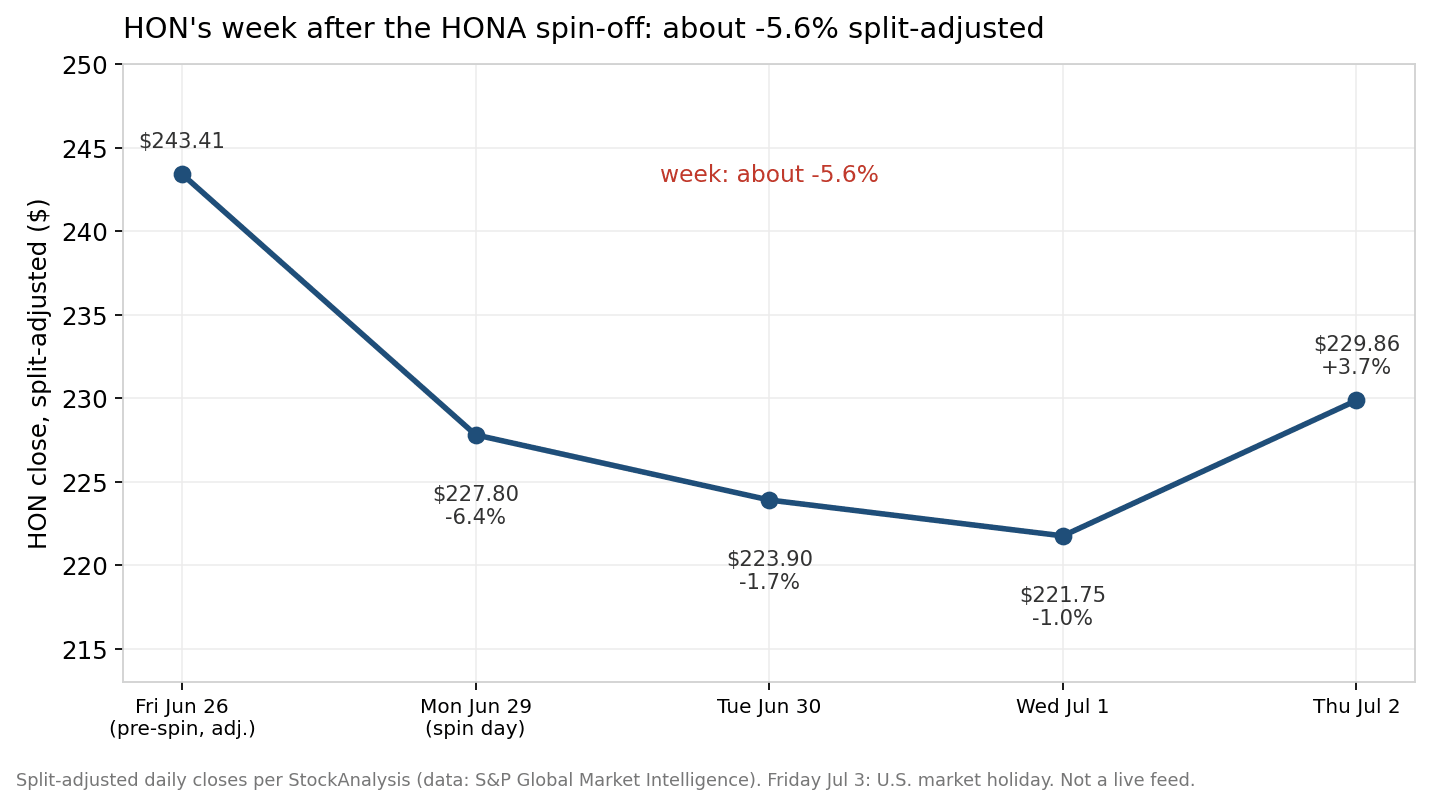
On June 29 Honeywell spun off Honeywell Aerospace (HONA) and executed a 1-for-2 reverse split. On a split-adjusted basis HON declined about 5.6% for the week as investors repriced the smaller Honeywell Technologies automation business.

Summary
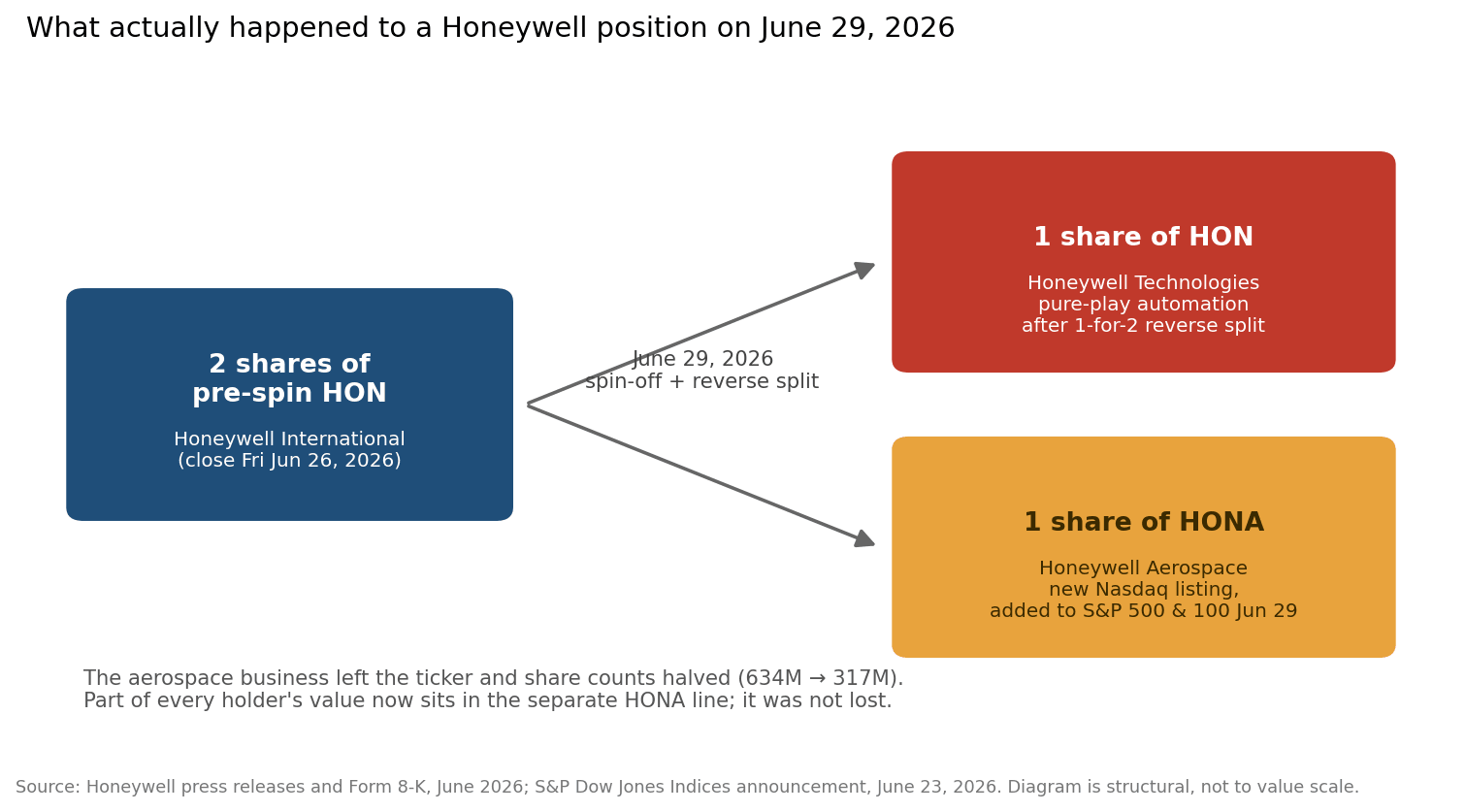
On June 29, 2026, Honeywell completed the spin-off of its aerospace business, now trading as Honeywell Aerospace (HONA), and executed a simultaneous 1-for-2 reverse split of its own stock [2][3]. Shareholders of record on June 15 received one HONA share for every two HON shares, with cash paid in lieu of fractional shares, and the reverse split cut shares outstanding from about 634 million to about 317 million [2][3]. The remaining company, renamed Honeywell Technologies, is a pure-play automation business that kept the HON ticker on Nasdaq [1]. On a split-adjusted basis, HON fell 6.4% on Monday to $227.80, drifted down to $221.75 by Wednesday, then recovered 3.7% on Thursday to close at $229.86 [6]. That is a decline of about 5.6% for the holiday-shortened week — a repricing of the smaller automation business, not a collapse.
What changed
Two corporate actions hit the same morning. The HONA distribution took effect at 12:01 a.m. New York time on June 29, and the reverse split followed one minute later [2]. Aerospace left the ticker and the share count halved at the same moment, so HON's quoted price reset and part of every holder's value now sits in the new HONA line in their account [3]. On the adjusted price series, Monday's decline from the prior close of $243.41 was 6.4% [6].
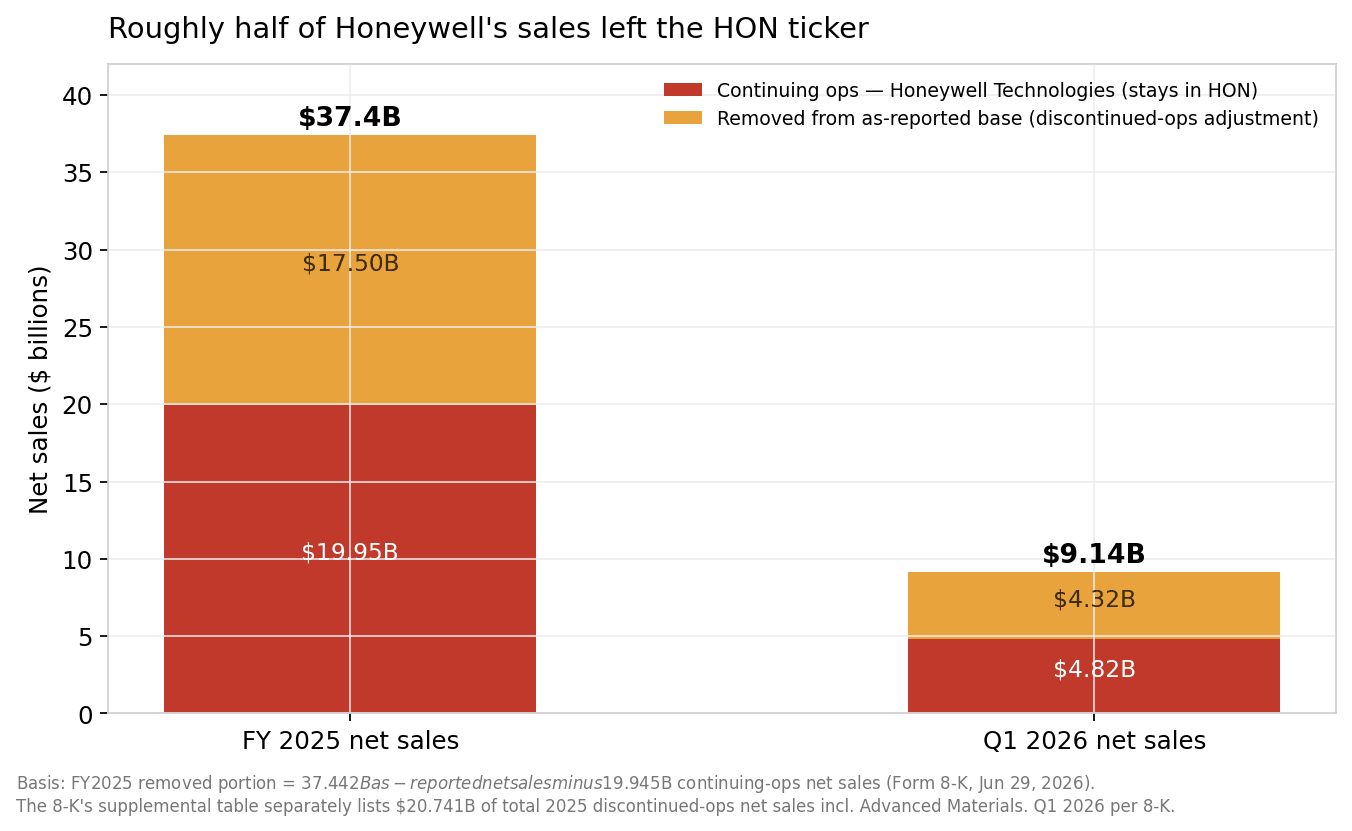
The selling had identifiable causes. Honeywell Aerospace was added to the S&P 500 and S&P 100 on June 29, replacing Conagra Brands in the S&P 500, and it replaces Honeywell itself in the S&P 100 effective before the open on June 30, while Honeywell Technologies remains in the S&P 500 [4]. Those changes force passive funds to re-weight both lines, and spin-offs also produce churn from holders who can't or won't keep one of the two pieces [8]. The market also began pricing what remains: James Currier left Honeywell to become CEO of the aerospace company [5][8], leaving Honeywell Technologies with a smaller base and stranded overhead to work through [8]. The new baseline, per the company's Form 8-K with recast historical financials: 2025 net sales from continuing operations of $19.945 billion, segment profit of $3.507 billion, and adjusted EPS of $3.23 [1]. In the first quarter of 2026, continuing operations did $4.823 billion in sales while discontinued operations did $4.320 billion [1] — nearly half the revenue walked out the door.
The new aerospace stock had a choppy start of its own. HONA rose about 7% intraday on debut day before fading to close down 0.4% at $220.19, on volume of about 8.5 million shares [5].
Why it matters
For anyone tracking the Honeywell (HON) stock page, the practical point comes first: the position did not shrink by the size of the price reset. Two old shares became one new HON share plus one HONA share, with fractions paid out in cash [3], shown as two separate lines in a brokerage account. Any judgment about the week should be made on the split-adjusted series and on both lines together.
For valuation, the anchor moves. Analysts are rebasing models on the recast continuing-operations figures — $3.23 in 2025 adjusted EPS on $19.9 billion of sales [1] — and on organic growth guided at 2% to 3% for 2026 [8]. Buildings, industrial automation, and energy solutions are steadier businesses than aerospace, but they don't carry the cycle tailwind that made the old conglomerate's crown jewel so well liked [5].
Index flows cut both ways. HONA's addition brings passive buying to the new stock while the S&P 100 substitution and related re-weightings generate selling and buying across both lines [4]. These flows are temporary, but they are large enough to set prices for days or weeks while they settle [8].
What to watch
The second-quarter report on July 23 (tracked on our earnings calendar), released before the market opens with a call at 8:30 a.m. EDT, is the first report after the spin-off — and, per the company's own notice, it will still include the former Aerospace Technologies segment, alongside a discussion of the 2026 outlook [7]. The first fully standalone quarter comes after that, so grade July's numbers against the recast supplemental financials in the separation 8-K rather than against stale pre-spin comparisons [1]. Beyond earnings, track how quickly index-driven volume in both HON and HONA fades toward normal [4], and watch the relative performance of the two stocks, because that spread is the market's running verdict on which side carried the old Honeywell premium. The thesis to keep in mind through all of it: last week was a roughly -5.6% split-adjusted move as investors repriced the smaller Honeywell Technologies business after the HONA spin-off and reverse split [6].
What happened to Honeywell (HON) stock on June 29, 2026?
Honeywell completed two corporate actions before the open on June 29, 2026: it spun off Honeywell Aerospace, which now trades on Nasdaq as HONA, and it executed a 1-for-2 reverse split of HON [2][3]. Shareholders of record on June 15 received one HONA share for every two HON shares, with cash in lieu of fractions, and HON's share count fell from about 634 million to about 317 million [2]. On a split-adjusted basis HON closed that day at $227.80, down 6.4%, and finished the week at $229.86, down about 5.6% from the pre-spin close [6].
Honeywell spin-off: quick answers
| Question | Correct answer |
|---|---|
| What changed? | HON spun off HONA and completed a 1-for-2 reverse split [2][3]. |
| What did holders receive? | 1 HONA share for every 2 old HON shares, plus 1 post-split HON share for every 2 old HON shares [2][3]. |
| What was HON's real weekly move? | About -5.6% on a split-adjusted basis [6]. |
| What should shareholders check? | Their brokerage account for both HON and HONA lines, plus cash-in-lieu for fractions [3]. |
Why did Honeywell stock fall this week?
- Index rebalancing: HONA was added to the S&P 500 and S&P 100 on June 29 and replaces HON in the S&P 100 from June 30, while HON remains in the S&P 500 — changes that force passive funds to re-weight both stocks [4].
- Spin-off churn: holders who couldn't or wouldn't keep one of the two pieces sold into the first sessions [8].
- A smaller, slower business: continuing operations did $19.9 billion in 2025 sales with organic growth guided at 2–3% for 2026, without aerospace's cash flows [1][8].
- Transition friction: James Currier's departure to lead the new aerospace company, and stranded overhead costs at the remaining one [5][8].
- The one-day move was -6.4% on Monday June 29, partially recovered by Thursday's $229.86 close [6].
Honeywell's week in numbers, baselines stated
| Measure | Value | Baseline / basis |
|---|---|---|
| Pre-spin close, split-adjusted (Fri Jun 26) | $243.41 | Adjusted daily series [6] |
| Close Mon Jun 29 (spin + reverse-split day) | $227.80 | -6.4% vs. adjusted prior close [6] |
| Close Tue Jun 30 | $223.90 | -1.7% vs. Jun 29 close [6] |
| Close Wed Jul 1 | $221.75 | -1.0% vs. Jun 30 close [6] |
| Close Thu Jul 2 | $229.86 | +3.7% vs. Jul 1 close; day range $220.22–$230.13 [6] |
| Real move for the week | ≈ -5.6% | Jul 2 close vs. Jun 26 adjusted close; Fri Jul 3 U.S. market holiday |
| Shares outstanding | 634M → 317M | 1-for-2 reverse split, effective 12:02 a.m. Jun 29 [2] |
All price figures use one adjusted daily series [6]; percentage changes are computed against the stated prior close.
What could move HON next?
With the separation done, the calendar drives the stock more than the chart does:
- July 23, 2026 — Q2 results, pre-open, call at 8:30 a.m. EDT: the first report after the spin-off. Per the company's notice it will still include the former Aerospace Technologies segment, along with the 2026 outlook discussion [7].
- The recast baseline: the separation 8-K's supplemental historical financials ($19.945B 2025 continuing-ops sales, $3.23 adjusted EPS) are the yardstick for standalone performance until a fully separated quarter prints [1].
- Index flows settling: volume in both HON and HONA normalizing as the S&P 500/100 re-weightings complete [4].
- HON vs. HONA relative performance: the running market verdict on which side carried the old Honeywell premium.
Honeywell stock FAQ
What happened to Honeywell stock on June 29, 2026?
Honeywell completed the spin-off of Honeywell Aerospace (HONA) and a simultaneous 1-for-2 reverse split. Shareholders of record on June 15 received one HONA share for every two HON shares, with cash in lieu of fractions. On a split-adjusted basis HON closed the day down 6.4% at $227.80.
What did HON holders receive in the spin-off?
One share of Honeywell Aerospace (HONA) for every two HON shares held as of the June 15, 2026 record date, plus one post-split HON share for every two old HON shares after the 1-for-2 reverse split. Fractional shares were paid out in cash.
What is Honeywell Technologies?
It is the renamed remaining company after the aerospace separation: a pure-play automation business serving building, industrial, and process customers, still trading on Nasdaq as HON. Its recast continuing operations did $19.9 billion in 2025 net sales with $3.23 in adjusted EPS.
Is Honeywell still in the S&P 500 and S&P 100?
Honeywell Technologies (HON) remains in the S&P 500 after the spin-off, per S&P Dow Jones Indices. Honeywell Aerospace (HONA) was added to the S&P 500 and S&P 100 on June 29, 2026, replacing Conagra Brands in the S&P 500, and it replaces HON in the S&P 100 effective June 30.
When does Honeywell Technologies report earnings?
Second-quarter 2026 results are due July 23, 2026, before the market opens, with a conference call at 8:30 a.m. EDT. It is the first report after the spin-off, and per the company's notice it will still include the former Aerospace Technologies segment — the first fully standalone quarter comes later.