Stock Analysis
Ionis (IONS) Drops ~24% After a Q3 Beat on a Halved TRYNGOLZA Forecast
Ionis Pharmaceuticals fell about 24% to roughly $29.80 on November 9 — and traded as low as $27.75, a fresh 52-week low — even though its third quarter beat: revenue of $243 million topped the roughly $178 million expected, and the GAAP loss of $0.66 a share was narrower than feared. The stock cratered on a guidance cut, not the quarter. Ionis roughly halved its full-year 2026 sales forecast for TRYNGOLZA, its homegrown drug for high triglycerides, to about $50 million from a prior $100–$110 million, citing a slower-than-expected launch ramp (third-quarter TRYNGOLZA sales were just $9 million). Because TRYNGOLZA is the centerpiece of Ionis's transition from a royalty-and-partnership company into one that sells its own drugs, halving its forecast dented the core thesis and pushed the company's path to sustained positive cash flow out about a year, toward 2029. Crucially, this was not a company-wide cut: Ionis left total 2026 revenue guidance unchanged at $875–$900 million, kept cash guidance steady (about $1.9 billion at quarter-end), and reaffirmed its other launched drug, DAWNZERA. The move was clearly company-specific — on the same day the RNA peer Alnylam was flat, the biotech ETF XBI rose about 2% and the S&P 500 rallied. Wall Street mostly treated it as a timing reset, reiterating Buy ratings and leaving an average target near $84, more than double the price. The whole debate is now the slope of the TRYNGOLZA sales line.
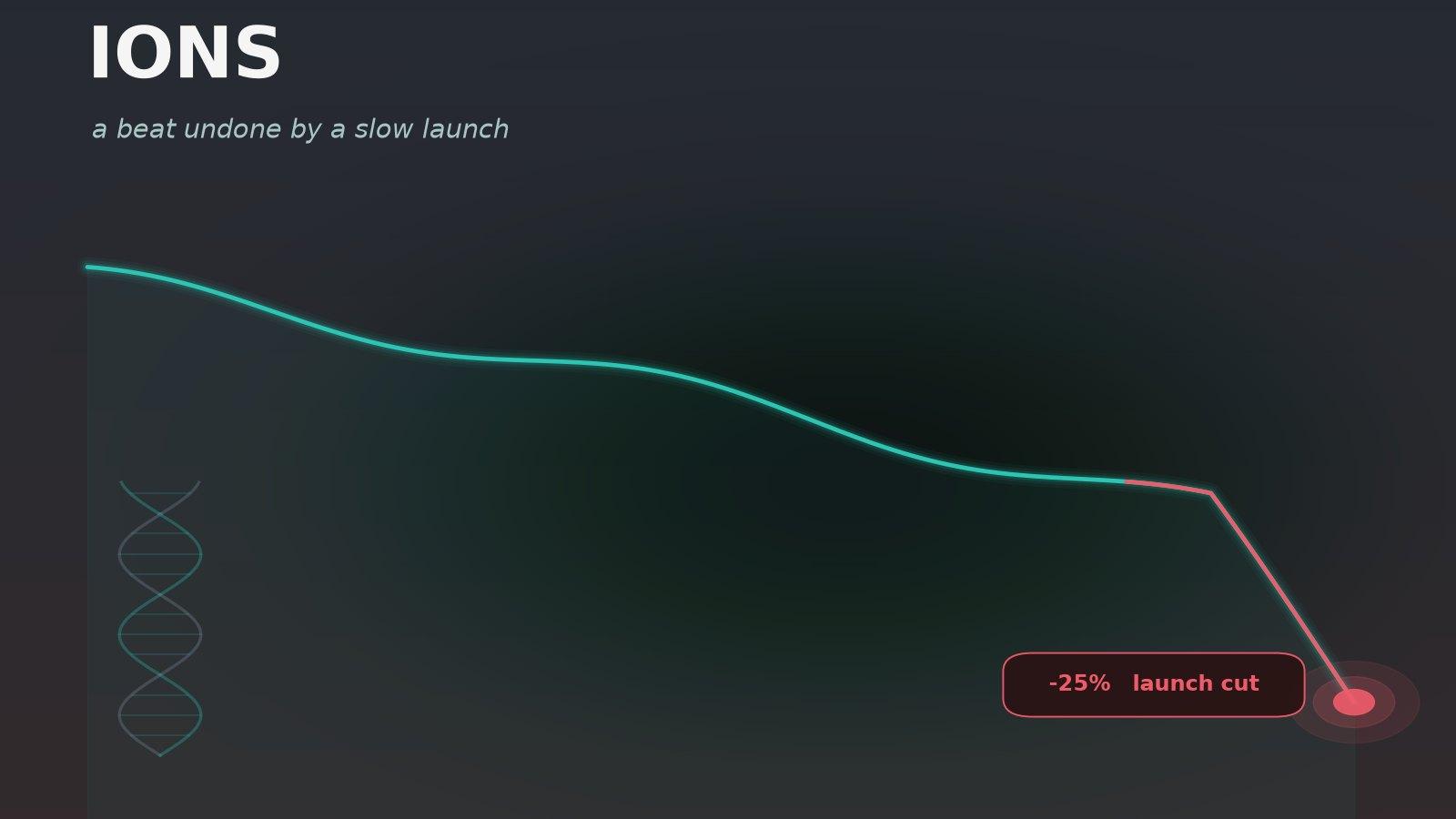
Why Ionis stock dropped — a beat undone by its flagship launch
On Monday, November 9, 2026, Ionis Pharmaceuticals (NASDAQ: IONS) fell about 24%, trading near $29.80 intraday after dropping as much as 30% to a fresh 52-week low of $27.75 earlier in the session [1]. The jarring part is that the quarter beat: Ionis reported third-quarter revenue of $243 million, well ahead of the roughly $178 million analysts expected, and a GAAP net loss of $0.66 a share that was narrower than the ~$1.22 loss feared [2]. But much of that revenue beat came from lumpy research-collaboration and royalty income — Ionis's own product sales were only about $48 million of the $243 million — so it was a lower-quality beat than the headline implied, and the stock did not fall on the quarter it just posted anyway [2]. It fell on what the quarter revealed about the future of its most important new drug.
The trigger was a guidance cut buried beneath the headline beat. Ionis roughly halved its full-year 2026 sales forecast for TRYNGOLZA — its homegrown drug that lowers triglycerides, first approved for the rare genetic disorder familial chylomicronemia syndrome and expanded in 2026 to the far larger severe-hypertriglyceridemia population — to about $50 million, down from a prior $100–$110 million, blaming "a more gradual launch ramp than we anticipated" [2]. That matters far more than one quarter's earnings, because TRYNGOLZA is the centerpiece of Ionis's transformation from a partnership-and-royalty company — one that discovered drugs and handed them to others to sell — into a biotech that commercializes its own medicines. Halving the forecast for that flagship launch, with third-quarter TRYNGOLZA sales of just $9 million, told investors the proof-of-concept for that transition is coming slower than promised [2].
What actually spooked investors — the launch, not the quarter
Three things did the damage, and none of them was the earnings line. First, the TRYNGOLZA cut itself: going from roughly $105 million at the midpoint to about $50 million is not a rounding error, it is a statement that the launch is tracking at perhaps half the pace management guided to just months ago — and because the drug had sold $41 million in the first nine months, the ~$50 million full-year figure implies only about $9 million in the fourth quarter, essentially flat with the third, so even the lowered forecast bakes in little near-term acceleration [2]. Second, and more worrying for long-term holders, the path to profitability slipped: the chief financial officer confirmed on the call that Ionis's timeline to sustained positive cash flow has moved out by about a year, from 2028 to 2029 — attributed to both the slower TRYNGOLZA ramp and setbacks in two late-stage partnered programs (eplontersen in a form of heart disease and pelacarsen for lipoprotein(a), both of which missed primary endpoints earlier in 2026) [2]. For a company that has promised investors it is finally nearing self-sufficiency after decades of losses, pushing that milestone out is the kind of thing that resets a valuation. Third, sentiment and positioning: the stock had already fallen more than 60% over the past year on pipeline setbacks, so it entered the report fragile, and a credible dent to the bull case was enough to send it to a new low [1].
Crucially, this was not a company-wide revenue cut. Ionis left its total 2026 revenue guidance unchanged at $875–$900 million, held its operating-loss and year-end cash guidance steady (cash and short-term investments were about $1.9 billion at quarter-end), and reaffirmed guidance for its other launched drug, DAWNZERA, for hereditary angioedema, which is selling well — about $37 million in the quarter and still gaining momentum, with new approvals in Europe and Canada [2]. In other words, the overall business is on track; it is specifically the flagship launch — the one the market was counting on to prove Ionis can sell drugs itself — that stumbled. That distinction is why the thesis, not the numbers, took the hit. Management framed the slow start as a reimbursement-and-access problem rather than weak demand — insurance coverage for the new severe-hypertriglyceridemia use was still building, many prescriptions required a medical exception, and Ionis was expanding a program to start patients on therapy while coverage was pending — and it kept its aspiration for more than $3 billion in eventual peak annual sales [2]. The market did not dispute the drug's long-term potential; it simply recalibrated how long the ramp will take, which for a pre-profit biotech is enough to reset the stock [2].
The valuation question
Ionis is not a stock you value on earnings — it still loses money, with a trailing net loss and no positive EPS to anchor a multiple [3]. After the drop its market value is about $4.9 billion, or roughly five times trailing revenue, against a balance sheet with about $1.9 billion of cash and a similar amount of debt — so ample liquidity, but not the fortress net-cash position of some peers [3]. The real valuation debate is not the multiple; it is the trajectory. The bull case has always been that Ionis's own launches plus a deep antisense pipeline carry it to durable, self-funded profitability, which is why analysts' average target sits far above the price. Today's cut does not break that case, but it widens the gap between the promise and the proof — and for a pre-profit biotech, the market pays for conviction about the trajectory, which is exactly what a halved flagship forecast erodes. The stock is cheap on revenue only if the revenue compounds as hoped; the launch stumble is the market questioning that "if."
Why it matters
Ionis is a test case for one of biotech's hardest transitions: going from a company that invents drugs and licenses them out to one that sells them itself. That shift is where the big, durable value is — a self-commercializing drugmaker keeps far more of each dollar than a royalty collector — but it is also where many discovery-stage companies stumble, because selling drugs is a different skill from making them. Today's reaction shows how unforgiving the market is about that specific risk: a revenue and earnings beat, an unchanged total-revenue outlook, and a healthy second product were all brushed aside because the flagship launch is ramping slowly. The read-through was contained to Ionis — on the same day, the RNA peer Alnylam was flat, the biotech sector was up more than 2%, and the broad market rallied, so this was a verdict on Ionis's execution, not on biotech or the tape [5]. The resolution will not come from the next earnings headline but from the TRYNGOLZA sales line over the coming quarters: if it inflects as the severe-hypertriglyceridemia opportunity opens, today looks like an overreaction to a slow start; if it keeps disappointing, the market will keep questioning whether Ionis can commercialize on its own.
The move, in one cross-section
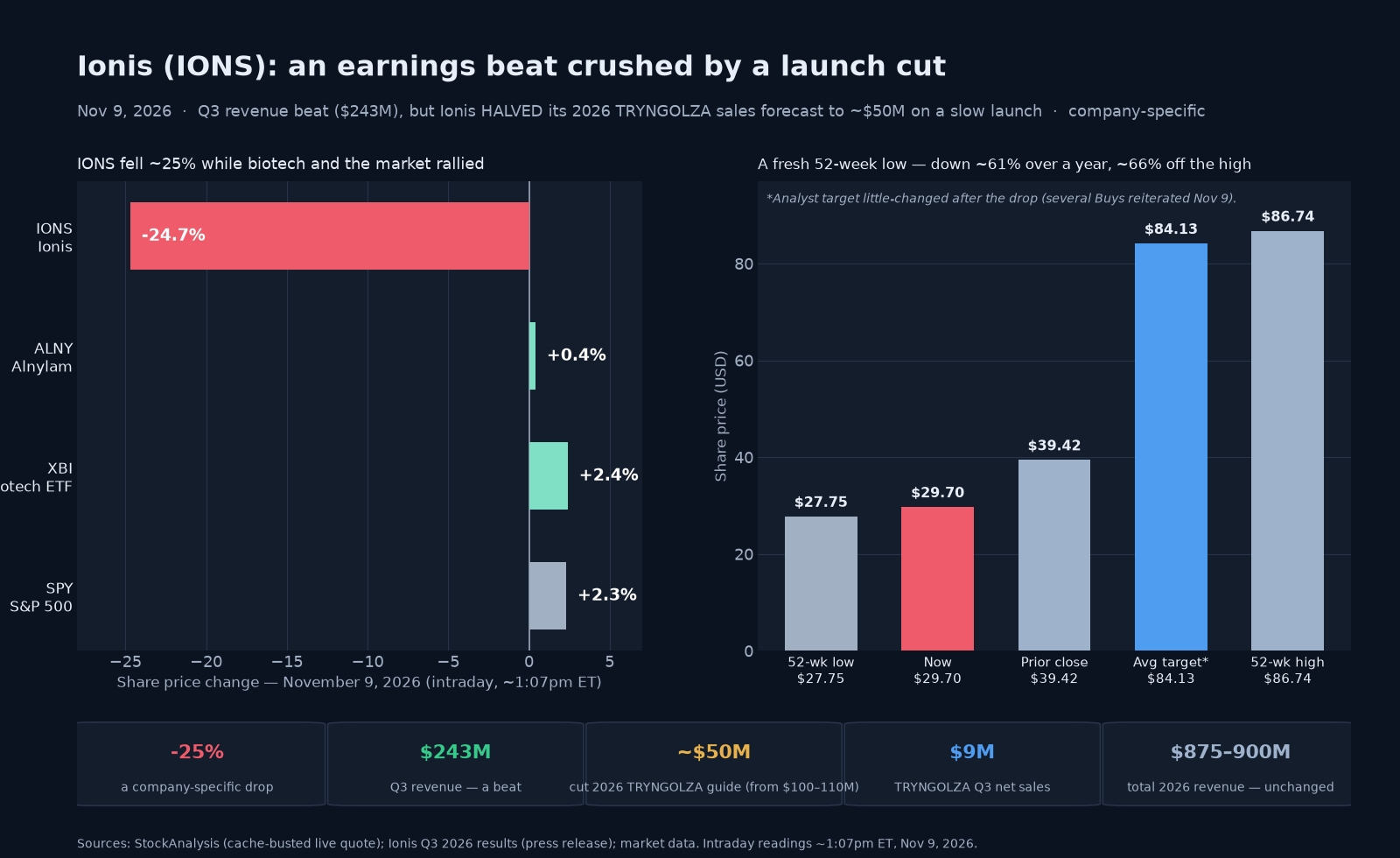
The same-session tape shows a clean company-specific drop on a strong up day for biotech and the market [5]:
| Name (ticker) | Nov 9, 2026 (intraday) | Read-through |
|---|---|---|
| IONS — Ionis | ≈−24% | The earnings name — crashed on a halved TRYNGOLZA forecast and a slower path to profit, despite a revenue and EPS beat [1][2] |
| ALNY — Alnylam | ≈+0.4% | RNA-medicines peer — essentially flat; no read-through from Ionis's launch stumble [5] |
| XBI — SPDR Biotech ETF | ≈+2.4% | The biotech sector was up — this was not a biotech sell-off [5] |
| SPY — S&P 500 (ETF) | ≈+2.3% | Broad market higher on a risk-on day — Ionis fell alone [5] |
Ionis down about 24% while its closest peer, the biotech sector and the market were all higher is the signature of a company-specific catalyst — here its own guidance cut, not a sector move [5].
What the Street thinks
Wall Street mostly treated this as a timing reset rather than a thesis break. The consensus rating remains a Buy from about 25 analysts, with an average 12-month target near $84 — well above the post-drop price — inside a range from roughly $58 to $105 [6]. Tellingly, the targets barely moved on the news: several analysts reiterated Buy ratings the same day, including price targets around $87 and $100, signaling a view that the slower TRYNGOLZA ramp delays but does not derail the story [6]. Even the lowest target on the Street sits at roughly twice the current share price, which captures the gap between how analysts model Ionis's longer-term drug portfolio and how the market is pricing the near-term execution risk [6]. The disagreement is not about whether the drugs can work; it is about how long the commercial ramp takes and whether the company reaches self-sufficiency on the timeline it has promised.
What to watch
- The TRYNGOLZA sales line. The single most important number next quarter — whether the ramp steepens toward the ~$50 million 2026 figure and accelerates into 2027 as the severe-hypertriglyceridemia opportunity opens [2].
- The path to profitability. Whether the self-sufficiency timeline (now pointed toward about 2029) holds or slips further, and how management funds the gap given roughly $1.9 billion of cash [2].
- DAWNZERA momentum. Whether the second launched drug keeps growing and its international rollout offsets the TRYNGOLZA shortfall [2].
- Pipeline catalysts. Upcoming antisense readouts and regulatory decisions that could re-rate the stock independent of the launch. Moves are tracked on the Ionis stock page [6].
Illustrative scenario sensitivity
Because the drop is a reaction to the TRYNGOLZA launch trajectory and the path to profitability rather than the quarter just reported, the scenarios below are anchored to how the flagship ramp and self-sufficiency timeline evolve rather than to a single valuation [6]. They are a descriptive, author-weighted exercise over roughly the coming six-to-twelve months as the sales line clarifies — not a forecast, target, recommendation, or trading advice — with subjective weights that sum to 100%.
| Scenario | Illustrative price | Weight | Key drivers |
|---|---|---|---|
| Launch inflects, sHTG scales | ~$55 | 25% | The TRYNGOLZA ramp steepens into 2027, the larger severe-hypertriglyceridemia opportunity builds, DAWNZERA keeps growing, and the stock re-rates toward the low end of analysts' little-changed target range [6]. |
| Cheap, but show-me | ~$33 | 45% | Total revenue grows and cash cushions the wait, but the market withholds a re-rating until the flagship sales line proves it is scaling; the stock stays cheap and range-bound near current levels [1]. |
| Launch keeps disappointing | ~$22 | 30% | TRYNGOLZA uptake stays sluggish, the self-sufficiency milestone slips again, and the de-rating continues as the market further discounts the commercial transition [2]. |
Weighting those (0.25 × $55 + 0.45 × $33 + 0.30 × $22) gives an author-weighted reference value near $35 — an illustrative, probability-weighted scenario output mechanically derived from the weights above, and not a price target, fair-value estimate, or prediction — a touch above Monday's ~$29.80 intraday price [1][6]. The modest premium reflects ample cash, a well-selling second drug and a Street that barely cut its targets, offset by a real, hard-to-size question about how fast the flagship launch scales; the wide dispersion between the scenarios is the honest signal that the outcome hinges on the TRYNGOLZA sales line far more than on this one quarter. This is a scenario exercise and descriptive analysis of a news-driven move, not investment advice.
Ionis data snapshot — November 9, 2026
| Figure | Value | As-of / source |
|---|---|---|
| Intraday quote | ~$29.80 (−~24%) — an intraday reading (the session was open); traded as low as $27.75, a fresh 52-week low (down ~30% at the worst) | Mon, Nov 9, 2026, ~1:11pm ET — StockAnalysis [1] |
| Prior close / open / range | $39.42 prior close; opened $32.27; day range $27.75–$32.58 | Nov 9, 2026 [1] |
| 52-week trend | 52-week range $27.75–$86.74; down ~61% over 52 weeks and ~66% off the high; beta ≈0.40 (low); 200-day average ≈$65.57 | As of Nov 9 [1] |
| Market cap | ≈$4.92B (≈166.2M shares); enterprise value ≈$5.21B; ~$1.88B cash vs ~$2.17B debt (roughly net-neutral) | Nov 9 — StockAnalysis [3] |
| Valuation | Loss-making (no positive EPS; trailing net loss ~$546M, EPS ~−$3.32); price-to-sales ≈5× on ~$960M trailing revenue — valued on the commercial transition, not current earnings | Nov 9 — StockAnalysis [3] |
| Q3 2026 results | Revenue $243M (beat ~$178M est; +55% ex a one-time Q2'25 upfront); GAAP net loss $110M, GAAP diluted LPS −$0.66 (beat −$1.22 est); non-GAAP net loss $67M; cash + short-term investments ~$1.9B | Nov 9 — Ionis Q3 2026 results [2] |
| Catalyst | Q3 earnings: a beat that cratered. Despite the beat, Ionis halved its 2026 TRYNGOLZA sales guide to ~$50M (from $100–110M) on a slower launch ramp (Q3 TRYNGOLZA sales just $9M) and signaled its path to sustained positive cash flow slipped ~a year (toward 2029). Total 2026 revenue guide unchanged ($875–900M); DAWNZERA (HAE) guidance reaffirmed (Q3 US sales $37M) | Nov 9, 2026 — company results + earnings call [2] |
| Same-day cross-section | ALNY +0.4% (RNA peer); XBI +2.4% (biotech ETF); SPY +2.3% (market) — IONS's ~24% drop was company-specific on an up day | Nov 9 intraday [5] |
| Analyst view | Consensus Buy, avg target ~$84 (low ~$58, median ~$85, high ~$105) from ~25 analysts — little-changed after the drop, with several Buys reiterated Nov 9 (e.g. ~$100 and ~$87) | Nov 9, 2026 — StockAnalysis / analyst notes [6] |
Ionis Pharmaceuticals (IONS) stock FAQ
Why did Ionis (IONS) stock drop on November 9, 2026?
Ionis fell about 24% to roughly $29.80 — and traded as low as $27.75, a fresh 52-week low — even though its third-quarter results beat expectations, which is the striking part. Revenue was $243 million (above the roughly $178 million expected) and the GAAP loss of $0.66 a share was narrower than the ~$1.22 feared. The stock dropped on a guidance cut, not the quarter: Ionis roughly halved its full-year 2026 sales forecast for TRYNGOLZA, its flagship homegrown drug for high triglycerides, to about $50 million from a prior $100–$110 million, citing a slower-than-expected launch ramp (third-quarter TRYNGOLZA sales were just $9 million). Because that drug is central to Ionis's transformation into a company that sells its own medicines, halving its forecast undercut the core investment thesis and pushed the company's path to sustained positive cash flow out about a year, toward 2029. In short, a good quarter was overwhelmed by evidence that the flagship launch is ramping far slower than promised.
If Ionis beat on earnings, why did the stock fall so much?
Because for a company like Ionis the market cares far more about the trajectory of its new drug launches than about a single quarter's earnings. The EPS 'beat' was a narrower-than-expected loss — Ionis still loses money — so it was never the main event. What investors were watching was proof that Ionis can successfully commercialize its own drugs after decades as a discovery-and-licensing company. TRYNGOLZA is the test of that, and halving its 2026 forecast is a direct signal that the launch is tracking at perhaps half the pace management guided to, which also delays the company's timeline to self-sufficiency. A beat on the backward-looking numbers could not offset a credible dent to the forward-looking story, so the stock repriced for a slower, less certain path.
What is TRYNGOLZA and why does its launch matter so much?
TRYNGOLZA (olezarsen) is one of Ionis's first drugs that it markets itself, rather than licensing to a partner. It lowers triglycerides and is central to Ionis's strategy of expanding from a rare condition into the much larger population of people with severe hypertriglyceridemia. It matters because Ionis has spent decades as a discovery engine that handed its drugs to other companies to sell; TRYNGOLZA is meant to prove Ionis can capture that value itself by building a commercial business. A self-commercializing drugmaker keeps far more of each dollar of sales than a royalty collector, so success here is worth a great deal to the long-term thesis. That is also why a slow start is punished so hard: the market is not just marking down 2026 sales, it is questioning how quickly — and how well — Ionis can execute the hardest part of its transformation.
Did Ionis cut its total revenue guidance?
No — and that is an important nuance. Ionis cut the forecast specifically for TRYNGOLZA (to about $50 million from $100–$110 million), but it left its total 2026 revenue guidance unchanged at $875–$900 million, held its operating-loss and year-end cash guidance steady (cash and short-term investments were about $1.9 billion at quarter-end), and reaffirmed guidance for its other launched drug, DAWNZERA, which treats hereditary angioedema and is selling well (about $37 million in the quarter). So the overall business is on track; the problem is concentrated in the single launch the market viewed as the proof point for Ionis's commercial transition. That is why the reaction was so severe despite steady company-wide numbers — the cut hit the thesis, not the near-term revenue total.
How did Ionis's drop compare with other biotech stocks that day?
The move was specific to Ionis. On the same day, the RNA-medicines peer Alnylam was essentially flat, the biotech ETF XBI rose more than 2%, and the S&P 500 rallied over 2% on a risk-on day. Ionis falling about 24% against that backdrop — a strong up day for both biotech and the broad market — is the classic signature of a company-specific catalyst, namely its own guidance cut, rather than a sector or market move. That isolation matters for interpretation: it tells you investors were repricing Ionis's execution in particular, not turning negative on biotech. It also means there is no easy sector explanation to fall back on; the market's verdict was squarely about the TRYNGOLZA launch and what it implies for Ionis's path to profitability.
What should investors watch next for Ionis?
Four things. First and most important, the TRYNGOLZA sales line — whether the ramp steepens toward the roughly $50 million 2026 figure and accelerates into 2027 as the larger severe-hypertriglyceridemia opportunity opens, which is the single clearest signal of whether the launch is a timing problem or a deeper one. Second, the path to profitability — whether the self-sufficiency timeline, now pointed toward about 2029, holds or slips further. Third, DAWNZERA's momentum and international rollout, which can partly offset the TRYNGOLZA shortfall. Fourth, pipeline catalysts — antisense readouts and regulatory decisions that could re-rate the stock independent of the launch. Because the debate is about commercial execution rather than the last quarter, the stock is likely to stay a show-me story until the flagship sales line proves which way it is heading. This is descriptive analysis, not investment advice.