Healthcare
McKesson (MCK) Rises as a Defensive Bid Meets a $2.25B Precision Medicine Deal
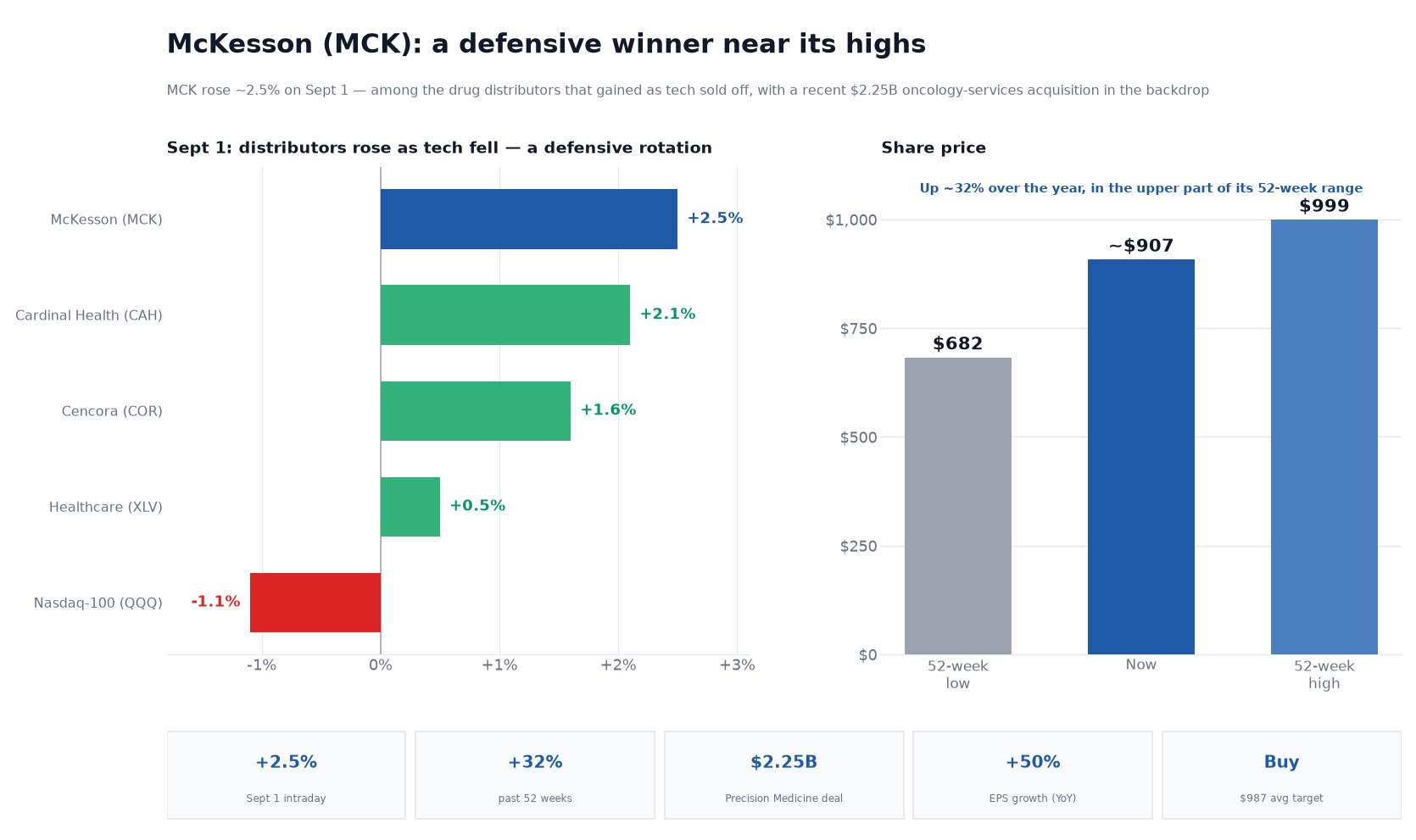
McKesson rose about 2.5% to near $907 (in the upper part of its 52-week range) on September 1, standing out as technology and semiconductors sold off. The move came amid a rotation away from technology and rate-sensitive growth, as defensive areas outperformed: with the Nasdaq-100 down more than 1%, low-beta healthcare gained, and the drug distributors were among the winners — Cardinal Health and Cencora also rose. McKesson had its own tailwinds, too. On August 25 it agreed to acquire Precision Medicine Group for about $2.25 billion, folding a clinical-research and commercialization business into its fast-growing Oncology & Multispecialty segment, and it paired that with a raised outlook and a 15% dividend increase — markers of a deliberate pivot from thin-margin drug distribution into higher-value oncology and specialty services. Even so, the stock trades at about 19 times forward earnings after growing EPS more than 50% over the past year. The catch: after a ~32% run, McKesson sits near the ~$987 average analyst target, so the valuation upside has narrowed. It is a high-quality, defensively-tilted compounder the market has already discovered.

Why McKesson stock rose — a defensive winner on a risk-off day
On Tuesday, September 1, 2026, McKesson (NYSE: MCK) rose about 2.5% to roughly $907 in intraday trading, well into the upper part of its 52-week range, up from an $885.32 close [1]. The move stood out because the broad market went the other way: with technology and semiconductors selling off — the Nasdaq-100 fell more than 1% — investors rotated into defensive healthcare, and drug distributors were among the day's gainers [5]. McKesson, a low-beta (0.31) giant whose business — getting medicines to pharmacies and providers — is about as non-discretionary as commerce gets, was among the biggest gainers, with peers Cardinal Health and Cencora also higher [5]. On a day investors wanted safety, McKesson was a place to hide — and it had its own tailwinds to boot.
More than a haven: a pivot to higher-value oncology
Behind the defensive appeal is a strategic story that has powered McKesson up about 32% over the past year. Its underlying business is enormous but thin-margin — trailing revenue of roughly $411 billion at an operating margin near 1.6% — so its growth increasingly comes from moving up the value chain into oncology and specialty services [3]. That is exactly what its latest deal does: on August 25, McKesson agreed to acquire Precision Medicine Group for about $2.25 billion, a Bethesda-based company spanning biomarker and lab services, a global clinical-research organization, market-access consulting and commercialization [2]. Once closed, it will fold into McKesson's Oncology & Multispecialty segment — the company's fastest-growing unit, which recently posted a roughly 33% revenue jump (partly acquisition-driven; underlying growth was closer to the mid-20s%) [2]. The deal caps a string of recent positives: in July McKesson lifted its quarterly dividend about 15% (to $0.94 a share), and with fiscal first-quarter results on August 5 it raised its full-year adjusted-EPS guidance [2]. Together — a July dividend hike, an August 5 guidance raise, and the August 25 acquisition — they depict a defensive distributor deliberately reshaping itself into a higher-margin healthcare-services platform. None of that is new on September 1, though; Tuesday's move was the rotation, with these developments as the backdrop [2]. Worth noting for completeness: the gain came despite a separate disclosure — on August 28 McKesson filed an 8-K reporting a cybersecurity incident it discovered on August 25, involving third-party applications and touching parts of its Oncology & Multispecialty and Medical-Surgical businesses; the company said it had not determined the incident to be material or reasonably likely to have a material impact [7].
Cheap on earnings, even after the run
What keeps the story from looking stretched is the valuation. Even after its run, McKesson trades at about 19 times forward earnings — undemanding for a business that just grew earnings per share more than 50% year over year (helped by operating leverage and steady buybacks) [3]. Distribution is a scale game measured in razor-thin margins on gigantic volumes, and McKesson's mix shift toward oncology and specialty is what lets a low-single-digit-margin business compound double-digit profit growth. The dividend yield is small (well under 1%), so the appeal is not income but the combination of defensive stability, double-digit earnings growth, and a reasonable multiple — an unusual trio that helps explain why a "boring" distributor keeps grinding higher.
Why it matters
McKesson's quiet climb captures two forces at once. The first is rotation: when high-multiple, rate-sensitive growth sells off — technology and consumer discretionary led the market's declines that day, while energy and defensive corners caught a bid — capital looks for earnings that show up regardless of the macro backdrop, and healthcare distribution (pharmacies still need their shipments, cancer patients still need their therapies) is a textbook destination. The second is the reinvention of the drug distributor. The big three — McKesson, Cencora and Cardinal Health — have spent years trying to escape the low-margin trap of moving pills, and the winning playbook has been to build higher-value services around oncology and specialty pharmaceuticals, where complexity commands better economics. The Precision Medicine Group deal is a clear marker of that strategy. McKesson's climb is not a euphoric growth-stock melt-up; it is the market rewarding a defensive business that has found a credible way to grow.
A defensive rotation, in one cross-section
The same-day tape makes the rotation unmistakable — distributors and healthcare up, tech down [5]:
| Name (ticker) | Sept 1, 2026 | Read-through |
|---|---|---|
| MCK — McKesson | ≈+2.5% | Biggest move of the three distributors; its own deal, guidance and dividend add to the defensive bid [1][2] |
| CAH — Cardinal Health | ≈+2.1% | The #3 distributor rode the same rotation [5] |
| COR — Cencora | ≈+1.6% | The #2 distributor also higher [5] |
| XLV — Health Care sector ETF | ≈+0.5% | Healthcare broadly caught a defensive bid [5] |
| QQQ — Nasdaq-100 ETF | ≈−1.1% | Tech and semiconductors led the market lower [5] |
Distributors up 1.6–2.5% while the tech-heavy index fell about 1% is the definition of a rotation into safety [5].
What the Street thinks
Coverage is broadly positive, though the stock's run has narrowed the upside. The consensus is a Buy, with an average 12-month target near $987 — only about 9% above the price after the rally — a median around $1,000 and a high of $1,080 [6]. Around the Precision Medicine Group announcement, several firms reiterated bullish calls: Bank of America's Allen Lutz stayed at Buy with a Street-high-adjacent $1,050, Morgan Stanley's Erin Wright kept a Buy at $977, and William Blair's Ryan Daniels reiterated an Outperform [6]. The cautious voice is RBC Capital's Ryan Halsted, who initiated at Sector Perform (a Hold-equivalent, $845), a target that sits below the share price [6]. That mix — mostly Buys, a low target roughly in line with the current price — captures a stock the market already prizes: high quality, fairly valued, limited margin of safety.
What to watch
- The deal's close. Whether the Precision Medicine Group acquisition clears regulatory review and integrates smoothly into the Oncology & Multispecialty segment [2].
- Oncology and specialty growth. The pace of the fastest-growing segment, the engine behind the earnings story [2].
- Reimbursement and pricing. Drug-pricing policy, generic deflation and reimbursement shifts, the perennial risks for distributors [3].
- Valuation versus targets. Whether earnings growth carries the stock past a consensus target it has nearly reached. Moves are tracked on the MCK stock page [1].
Illustrative valuation sensitivity
The scenarios below are anchored to McKesson's forward earnings power (about 19× forward earnings) and to the analyst target distribution (low $845, average ~$987, high $1,080) [6], turning on how the oncology/specialty pivot and margins play out. They are a descriptive, author-weighted exercise — not a forecast, target, recommendation, or intrinsic fair-value calculation — with subjective weights that sum to 100%. The three illustrative prices below ($1,080 upside, ~$980 middle, ~$820 downside) are the author's scenario values, not analyst targets — note the downside sits below the current Street-low target of $845.
| Scenario | Illustrative price | Weight | Key drivers |
|---|---|---|---|
| Upside | ~$1,080 | 30% | The oncology/specialty mix shift keeps compounding earnings, the deal proves accretive, and the multiple holds as the stock re-rates toward the bullish targets [6]. |
| Middle | ~$980 | 40% | Steady double-digit earnings growth carries the stock toward the average target, with the multiple roughly stable [6]. |
| Downside | ~$820 | 30% | The defensive bid fades, or reimbursement/pricing pressure and integration risk compress the multiple back toward the analyst low [3]. |
Weighting those (0.30 × $1,080 + 0.40 × $980 + 0.30 × $820) gives an author-weighted reference value near $962, close to Tuesday's ~$907 level and just under the ~$987 consensus [1][6] — reflecting a high-quality, defensively-tilted compounder that the market has already re-rated, with the debate now about how much further a fairly-valued winner can run. This is a Street-target-and-earnings-based scenario exercise and descriptive analysis of a news move, not investment advice.
MCK data snapshot — September 1, 2026
| Figure | Value | As-of / source |
|---|---|---|
| Intraday quote | ~$907 (+~2.5%), in the upper part of its 52-week range — an intraday reading (the session was still open) | Tue, Sep 1, 2026 — StockAnalysis [1] |
| Prior close / open / range | $885.32 prior close; opened $887.70; day range $886.83–$909.07 (ex-dividend date Sep 1) | Sep 1, 2026 [1] |
| 52-week range / trend | $682.35–$999.00; up ~32% over 52 weeks; above its ~$838 50-day and ~$842 200-day averages; RSI ≈61 | As of Sep 1 [3] |
| Market cap / EV | ≈$106B (116.6M shares); enterprise value ≈$112B; beta ≈0.31 (very defensive) | Sep 1 — StockAnalysis [3] |
| Valuation | Trailing P/E ≈24×; forward P/E ≈19×; ≈0.26× sales (distribution = thin margins on huge revenue); dividend yield ≈0.4% ($3.76) | Sep 1 — StockAnalysis [3] |
| Financials (TTM) | Revenue ≈$411B (+8.8%); net income ≈$4.6B (+45%); EPS $37.48 (+50%); operating margin ≈1.6% | TTM — StockAnalysis [3] |
| Recent catalysts (dated) | On Aug 25 McKesson agreed to acquire Precision Medicine Group for ~$2.25B (clinical research, biomarker/lab, market access, commercialization), to join its Oncology & Multispecialty segment; separately, it raised full-year guidance with Aug 5 fiscal-Q1 results and lifted its dividend ~15% (to $0.94, declared July; ex-div Sep 1) | Jul–Aug 2026 — company / coverage [2] |
| Volume | Running below its ~956K-share 20-day average by midday — a calm, deliberate bid rather than a surge | Sep 1 — StockAnalysis [1] |
| Same-day peers | CAH +2.1%, COR +1.6% (drug distributors); XLV +0.5% (healthcare); QQQ −1.1% (Nasdaq-100) — a defensive rotation | Sep 1 [5] |
| Analyst view | Consensus Buy, avg target ≈$987 (median $1,000, high $1,080, low $845) — only ~9% above the price; BofA $1,050, Morgan Stanley $977, William Blair Buy; RBC Sector Perform (Hold-equivalent) $845, below the price | Aug 2026 — StockAnalysis / analyst notes [6] |
The setup at a glance
| Question | Answer |
|---|---|
| Why did McKesson stock rise on September 1? | Mostly because of a defensive rotation. With technology and semiconductors selling off (the Nasdaq-100 fell more than 1%), investors moved into defensive healthcare, and drug distributors were among the gainers — McKesson rose about 2.5% to near $907, in the upper part of its 52-week range, with Cardinal Health and Cencora also higher. McKesson also has its own recent tailwinds: a $2.25 billion acquisition, a raised outlook and a 15% dividend increase [1][5]. |
| What is McKesson buying, and why? | On August 25, McKesson agreed to acquire Precision Medicine Group for about $2.25 billion. The Bethesda-based company provides biomarker and lab services, a global clinical-research organization, market-access consulting and commercialization support, and it will join McKesson's Oncology & Multispecialty segment. The logic is McKesson's long-running pivot from thin-margin drug distribution into higher-value oncology and specialty services, where its fastest growth is [2]. |
| Is McKesson a defensive stock? | Very much so. Its business — delivering medicines and medical products to pharmacies and providers — is non-discretionary, and its five-year beta is about 0.31, meaning it tends to move far less than the market. That is why it rose on a day risk assets fell: when investors want earnings that do not depend on the economy, healthcare distribution is a classic destination [3]. |
| Is McKesson stock expensive after its run? | Not especially. Even near its high, it trades at about 19 times forward earnings — undemanding for a company that grew EPS more than 50% over the past year. Distribution is a razor-thin-margin business on enormous revenue (about $411 billion), and the mix shift toward oncology and specialty is what drives its outsized profit growth. The catch is that after a ~32% run, the stock sits close to the average analyst target, so the valuation upside has narrowed [3][6]. |
| What is the biggest risk? | Two things. First, valuation and positioning: after a big run, the stock trades near consensus targets, so much of the good news is priced in and a fading defensive bid could pressure it. Second, the structural risks of a distributor — drug-pricing policy, generic deflation and reimbursement changes — plus the integration and regulatory risk of the pending acquisition. The business is stable, but the margin of safety after the run is thinner [3][6]. |
| What do analysts think? | They are broadly positive but note limited upside. The consensus is a Buy with an average 12-month target near $987 — only about 9% above the current price — with a median of $1,000, a high of $1,080 and a low of $845. Around the acquisition, Bank of America reiterated Buy at $1,050, Morgan Stanley at $977 and William Blair with an Outperform, while RBC Capital initiated at Sector Perform (a Hold-equivalent, $845), a target that sits below the share price. The takeaway: a high-quality, fairly valued winner rather than a bargain [6]. |
McKesson (MCK) stock FAQ
Why did McKesson (MCK) stock rise on September 1, 2026?
Primarily because of a defensive rotation. With technology and semiconductor stocks selling off — the Nasdaq-100 fell more than 1% — investors moved into defensive healthcare, and drug distributors were among the winners. McKesson rose about 2.5% to near $907 (in the upper part of its 52-week range), with peers Cardinal Health and Cencora also higher. McKesson also carried its own recent tailwinds: an agreement to acquire Precision Medicine Group for about $2.25 billion, a raised full-year outlook, and a 15% increase to its dividend.
What did McKesson agree to acquire, and why does it matter?
On August 25, 2026, McKesson signed an agreement to acquire Precision Medicine Group for approximately $2.25 billion. The Bethesda, Maryland-based company provides biomarker intelligence and lab services, a global clinical-research organization, market-access consulting and commercialization support, and it will become part of McKesson's Oncology & Multispecialty segment once the deal closes. It matters because it advances McKesson's multi-year strategy of moving beyond thin-margin drug distribution into higher-value oncology and specialty services — the company's fastest-growing area — deepening a pivot that has helped drive the stock higher.
Is McKesson a defensive stock?
Yes, distinctly so. McKesson's core business is delivering pharmaceuticals and medical products to pharmacies, hospitals and other providers — demand that does not rise and fall with the economic cycle. Its five-year beta is about 0.31, meaning the shares tend to move far less than the broader market. That defensive profile is why the stock rose on a day risk assets fell: when investors want earnings that are insulated from the macro backdrop, healthcare distribution is a classic haven, and McKesson is the largest of the big three distributors.
Is McKesson stock expensive after its run?
Not particularly, on an earnings basis. Even after its run, McKesson trades at roughly 19 times forward earnings, which is undemanding for a company that grew earnings per share more than 50% over the past year (helped by operating leverage and share buybacks). Distribution runs on razor-thin margins over enormous revenue — about $411 billion trailing — and the shift in mix toward oncology and specialty pharmaceuticals is what converts that into double-digit profit growth. The main caveat is that after a roughly 32% rally, the stock trades close to the average analyst target, so the valuation-driven upside has narrowed.
What is the biggest risk for McKesson now?
There are two. The first is valuation and positioning: after a large run, the stock sits near consensus price targets, so much of the good news is already reflected, and a reversal of the defensive rotation could pressure it. The second is structural: as a drug distributor, McKesson is exposed to drug-pricing policy, generic-price deflation and reimbursement changes, and its pending Precision Medicine Group acquisition adds regulatory-review and integration risk. The underlying business is highly stable, but the margin of safety after the run is thinner than it was earlier in the run.
What do analysts think of McKesson stock?
Coverage is broadly positive but flags limited near-term upside. The consensus is a Buy, with an average 12-month price target near $987 — only about 9% above the current price after the rally — a median of $1,000, a high of $1,080 and a low of $845. Around the Precision Medicine Group announcement, Bank of America's Allen Lutz reiterated Buy at $1,050, Morgan Stanley's Erin Wright kept a Buy at $977 and William Blair's Ryan Daniels reiterated an Outperform, while RBC Capital's Ryan Halsted initiated coverage at Sector Perform (a Hold-equivalent, $845), a target below the share price. The overall message is that McKesson is a high-quality, fairly valued compounder rather than a bargain.