Technology
Meta (META) Jumps as Muse, Its First Paid Personal AI Agent, Puts a Price on AI
Meta rose about 6% to roughly $650 on September 9 after launching Muse, a personal AI agent — and, crucially, attaching a price to it: a free tier plus subscriptions at $20 and $100 a month. For a company that has spent enormous sums building AI infrastructure with little consumer revenue to show for it, Muse is a major new consumer-AI monetization line — its first paid personal-agent product — the proof of concept investors had been waiting for. Muse is an autonomous assistant that reads email, books travel, negotiates, and makes purchases through connected payment systems, rolling out in the US on iOS, Android and the web. The launch also rippled across the mega-caps: Alphabet fell ~2.6% as a capable buying-and-booking agent was read as a competitive threat to Google's search (Amazon also slipped ~2.1%, though it had its own news that day). The context is that Meta had lagged — down ~13% over the past year on AI-cost fears — despite an 82% gross margin, ~28% revenue growth and ~$41 billion of free cash flow, at just 19 times forward earnings. Muse does not resolve the spend-versus-return debate, but it reframes it, and the Street stays overwhelmingly bullish, with an average target implying ~16% upside.

Why Meta stock jumped — a first answer to the AI-spending question
On Wednesday, September 9, 2026, Meta Platforms (NASDAQ: META) rose about 6% to roughly $650 in intraday trading, up from a $613.48 prior close [1]. The catalyst was a product unveiling the day before that spoke directly to the market's biggest worry about the company. On Tuesday, September 8, Meta introduced Muse, a personal AI agent, and — crucially — attached a price to it: a free tier plus paid subscriptions at $20 a month (Power) and $100 a month (Maximum) [2]. For a company that has spent enormous sums building AI infrastructure with little consumer revenue to show for it, Muse is a major new consumer-AI monetization line — its first paid personal-agent product — and investors treated it as the proof of concept they had been waiting for [2].
What Muse is, and why it matters
Muse is an autonomous personal assistant built on Meta's latest models, developed under chief AI officer Alexandr Wang. It is designed not just to answer questions but to act: read your email, book your travel, fill in forms, negotiate on your behalf and make purchases through connected payment systems (with approval for sensitive actions, and designed so the agent itself does not have visibility into your underlying card details) [2]. It is rolling out in the United States on iOS, Android, the web (muse.ai) and WhatsApp, free for most uses with the paid plans layered on top, and Meta says it is coming to its AI glasses [2]. The strategic point is monetization: for two years, the knock on Meta has been that its massive AI capital spending was a cost without a clear consumer payoff, and the stock has lagged — down about 13% over the past year even as revenue grew nearly 28% [3]. Muse changes the conversation. By putting a subscription price on an AI agent, Meta gives investors a tangible new line item that could turn its AI spending into recurring consumer revenue.
A quality franchise the market had cooled on
What makes the reaction notable is that Meta was never cheap on quality — only on sentiment. This is a business with an 81% gross margin, a 38% operating margin and a nearly 30% return on equity, growing revenue almost 28% and throwing off roughly $41 billion of free cash flow [3]. Yet after a year of investor anxiety over AI costs, it trades at just 19 times forward earnings — undemanding for a company compounding at that rate [3]. The stock had fallen ~13% over the past year while the S&P 500 rose, precisely because the market could not see the return on Meta's AI spending. Muse does not resolve that debate — the spending is still enormous and the revenue is unproven — but it reframes it, which is why a single launch could add tens of billions to the market value.
Why it matters
The launch lands in the middle of the industry's defining question: who captures the value of AI agents? For two years the fear has been that chat assistants would disrupt the businesses built on search and clicks — Google's most of all. Meta's move flips that framing on its head: rather than a threat to its model, AI becomes a new product it can sell. That is also why the reaction rippled across the mega-caps in opposite directions. A capable personal agent that books, buys and negotiates reads as a direct challenge to Google's Gemini and search franchise and, to a degree, Amazon's shopping funnel — and the market treated it that way, sending Alphabet down about 2.6% as Meta rose (Amazon also slipped roughly 2%, though it carried company-specific news of its own that day). The read-through is a market interpretation rather than an established fact. Whether it delivers depends on adoption and trust — but the strategic logic, and the first real consumer price tag on Meta's AI, is what moved the stock.
The agent wars, in one cross-section
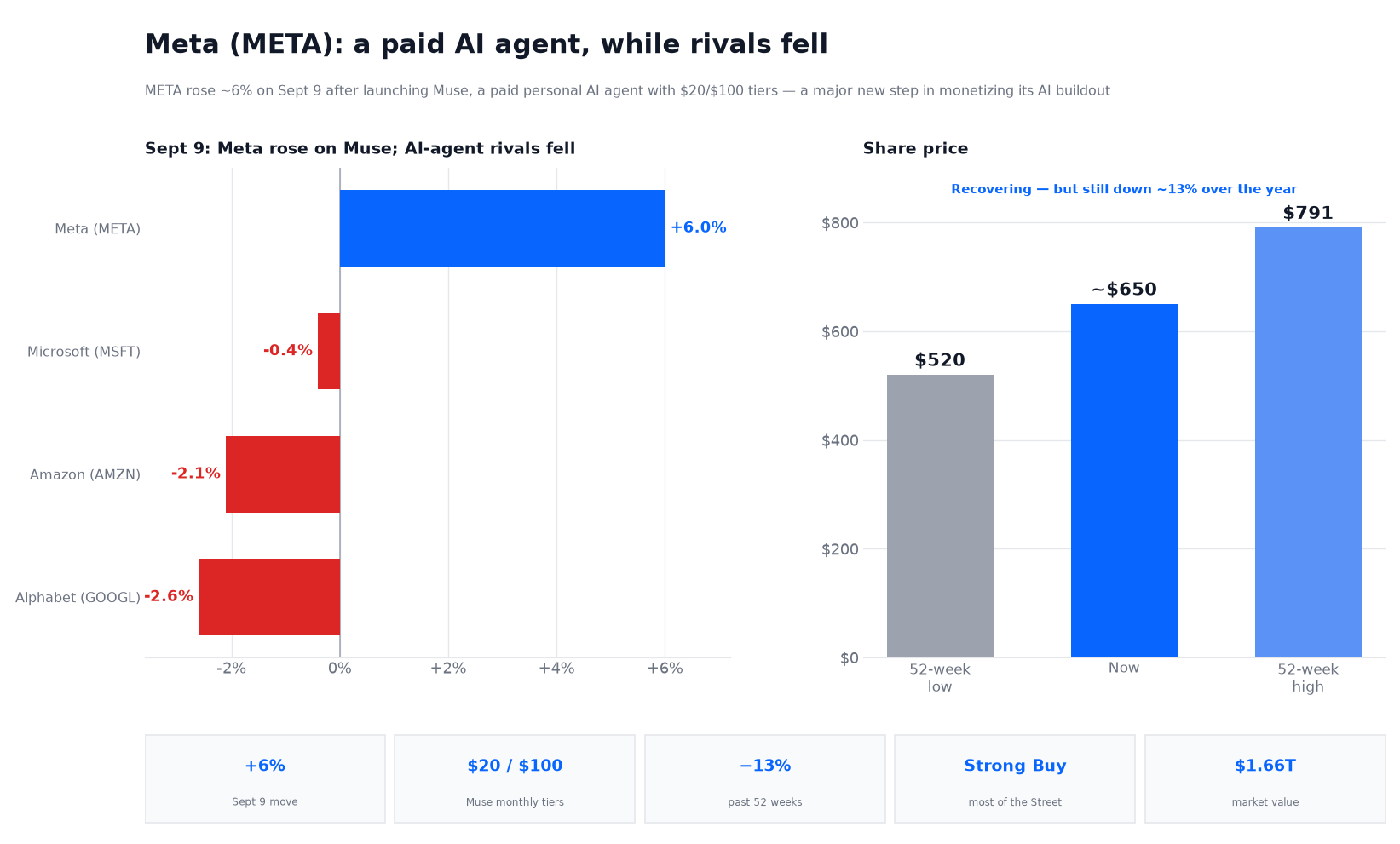
The same-day tape shows the launch cut across the mega-caps — Meta up, its agent rivals down [5]:
| Name (ticker) | Sept 9, 2026 | Read-through |
|---|---|---|
| META — Meta Platforms | ≈+6.0% | Launched Muse with paid tiers — its first consumer AI revenue line [1][2] |
| GOOGL — Alphabet | ≈−2.6% | Fell — the market read Muse as encroaching on Gemini and search [5] |
| AMZN — Amazon | ≈−2.1% | Also fell, though Amazon had its own same-day news too [5] |
| MSFT — Microsoft | ≈−0.4% | Roughly flat — its AI is more enterprise than consumer [5] |
Meta up ~6% while Alphabet fell 2%+ (Amazon also lower, partly on its own news) points to a company-specific, competitive event rather than a broad market move [5].
What the Street thinks
Coverage is overwhelmingly positive, and the launch reinforced it. The consensus is a Strong Buy — roughly 47 Strong Buy and 8 Buy of about 62 analysts, with only 6 Holds and no Sells — and the average 12-month target of about $754 implies roughly 16% upside even after the pop [6]. On the day of the launch, Morgan Stanley's Brian Nowak reaffirmed a Buy at $775 and KeyBanc's Justin Patterson kept a Buy, while Bank of America's Justin Post is a bull at $810 (though the Street high sits near $1,000) [6]. The cautious voices are the exception: Wedbush's Ygal Arounian sits at Hold ($595) and J.P. Morgan's Doug Anmuth at Hold ($640), both wary that AI spending still outruns the returns [6]. The debate in one number: a stock the Street targets ~16% higher, that the market spent a year marking down.
What to watch
- Muse adoption and paid conversion. How many users try Muse, and how many pay for the $20 or $100 tiers — the difference between a headline and a business [2].
- AI capital spending. Whether Meta's spending trajectory and any updated monetization commentary narrow the gap the market has worried about [3].
- Trust, privacy and safety. How users and regulators react to an agent that reads email and spends money — a swing factor for adoption [2].
- Competitive response. How Google, Amazon and OpenAI answer, and whether the agent wars compress everyone's economics. Moves are tracked on the META stock page [1].
Illustrative valuation sensitivity
The scenarios below are anchored to Meta's forward earnings power (about 19× forward earnings) and to the analyst target distribution (a low near $580, average ~$754, a Street high near $1,000) [6], turning on how the AI-spend-versus-monetization debate resolves. They are a descriptive, author-weighted exercise — not a forecast, target, recommendation, or intrinsic fair-value calculation — with subjective weights that sum to 100%.
| Scenario | Illustrative price | Weight | Key drivers |
|---|---|---|---|
| Upside | ~$810 | 30% | Muse and AI-driven ad tools generate real incremental revenue, the market accepts the AI spend as productive, and the multiple re-rates toward the bullish targets [6]. |
| Middle | ~$720 | 40% | Steady core advertising growth plus early Muse traction carries the stock toward the average analyst target, with the multiple modestly higher [6]. |
| Downside | ~$600 | 30% | AI spending keeps outrunning monetization, Muse adoption is slow, and the multiple stays capped near the cautious analyst targets [3]. |
Weighting those (0.30 × $810 + 0.40 × $720 + 0.30 × $600) gives an author-weighted reference value near $711, above Tuesday's ~$650 level and below the ~$754 consensus target [1][6] — reflecting a high-quality franchise the market has under-owned on AI-cost fears, where the next leg depends on Muse turning spending into revenue. This is a Street-target-and-earnings-based scenario exercise and descriptive analysis of a news move, not investment advice.
META data snapshot — September 9, 2026
| Figure | Value | As-of / source |
|---|---|---|
| Intraday quote | ~$650 (+~6%), well below its 52-week high — an intraday reading (the session was still open) | Tue, Sep 9, 2026 — StockAnalysis [1] |
| Prior close / open / range | $613.48 prior close; opened $648.64; day range $638.56–$657.86 | Sep 9, 2026 [1] |
| 52-week range / trend | $520.26–$790.80; down ~13% over 52 weeks (a laggard recovering); above its ~$599 50-day and ~$623 200-day averages; RSI ≈70 | As of Sep 9 [3] |
| Market cap / EV | ≈$1.66T (2.55B shares); enterprise value ≈$1.68T; beta ≈1.24 | Sep 9 — StockAnalysis [3] |
| Valuation | Trailing P/E ≈24.6×; forward P/E ≈19–20× (undemanding for the growth); ≈7.3× sales; dividend yield ≈0.3% ($2.10) | Sep 9 — StockAnalysis [3] |
| Financials (TTM) | Revenue ≈$228B (+28%); net income ≈$68B; EPS $26.54; gross margin ≈82%; operating margin ≈38%; ROE ≈30%; free cash flow ≈$41B | TTM — StockAnalysis [3] |
| Catalyst | Launched Muse, a personal AI agent, with a free tier plus $20/month (Power) and $100/month (Maximum) subscriptions — a major new consumer-AI monetization line tied to its AI buildout | Sep 9, 2026 — company / reports [2] |
| Same-day peers | GOOGL −2.6%, AMZN −2.1% (AI-agent competition fears); MSFT −0.4% (roughly flat) — Meta up, rivals down | Sep 9 [5] |
| Analyst view | Consensus Strong Buy (~62 analysts: roughly 47 Strong Buy / 8 Buy / 7 Hold / 0 Sell), avg target ≈$754 — ~16% above the price, range ~$580 to a Street high near $1,000; Sep-9 reiterations from Morgan Stanley ($775) and KeyBanc (Buy); BofA $810 | Sep 2026 — StockAnalysis / analyst notes [6] |
Meta (META) stock FAQ
Why did Meta (META) stock jump on September 9, 2026?
Meta rose about 6% to roughly $650 after launching Muse, a personal AI agent, and attaching paid subscription tiers to it — a free tier plus $20 and $100 a month. It matters because Muse is a major new consumer-AI monetization line — its first paid personal-agent product — tied to Meta's enormous AI spending, addressing the market's biggest worry about the company: that its AI capital investment had no clear consumer payoff. Investors treated the paid launch as the proof of concept they had been waiting for.
What is Meta's Muse AI agent?
Muse is an autonomous personal AI assistant built on Meta's latest models (developed under chief AI officer Alexandr Wang) and powered by a model called Muse Spark, the first in a broader Muse family. Rather than only answering questions, it is designed to act on your behalf — reading email, booking travel, filling in forms, negotiating and making purchases through connected payment systems (with approval for sensitive actions, and designed so the agent itself does not have visibility into your underlying card details). It is rolling out in the United States on iOS, Android, the web (muse.ai) and WhatsApp, free for most uses with paid plans at $20 (Power) and $100 (Maximum) per month layered on top, and Meta says it is coming to its AI glasses.
Why did Alphabet and Amazon fall when Meta rose?
Because a capable personal AI agent is a competitive threat to their core businesses. A tool that books travel, buys products and negotiates could disintermediate Google's search-and-Gemini franchise and, to a degree, Amazon's shopping funnel — so Alphabet fell about 2.6% on the same news that lifted Meta about 6% (Amazon also slipped about 2.1%, though it had company-specific news of its own that day). Microsoft was roughly flat, as its AI push is more oriented toward enterprise software than a consumer agent. The market read Muse as a competitive strike in the emerging 'agent wars,' not just a Meta monetization event.
Is Meta stock expensive?
Not particularly, given the quality and growth. Even after the jump, Meta trades at about 19 times forward earnings — undemanding for a company with an 82% gross margin, a 38% operating margin, a nearly 30% return on equity, revenue growing almost 28%, and roughly $41 billion of annual free cash flow. In fact the stock had fallen about 13% over the past year, held back not by the business but by investor anxiety over its AI spending. Muse is the first tangible sign that spending could convert into consumer revenue, which is why the market re-rated it higher.
What do analysts think of Meta stock now?
Coverage is overwhelmingly positive. The consensus is a Strong Buy — roughly 47 Strong Buy and 8 Buy of about 62 analysts, with 6 Holds and no Sells — and the average 12-month price target of about $754 implies roughly 16% upside even after the pop, in a range from a low near $580 to a Street high near $1,000. On the launch day, Morgan Stanley's Brian Nowak reaffirmed a Buy at $775 and KeyBanc's Justin Patterson kept a Buy, while Bank of America's Justin Post carries an $810 target. The cautious minority — Wedbush's Ygal Arounian (Hold, $595) and J.P. Morgan's Doug Anmuth (Hold, $640) — remains wary that AI spending still outruns the returns.
What is the biggest risk for Meta now?
That Muse does not translate into meaningful revenue quickly enough to justify the AI spending. Adoption and paid conversion are entirely unproven, the capital investment remains enormous, and an agent that reads your email and spends your money raises real privacy, safety and regulatory questions that could slow uptake. Competitors — Google, Amazon and OpenAI — will also respond, and the agent wars could compress everyone's economics. The offsetting strength is a dominant, highly profitable advertising business that funds the effort and a valuation that already reflects considerable skepticism.