Stock Analysis
Why Did Middleby (MIDD) Stock Drop 22% on Screens? The Midera Spin-Off Explains Most of It
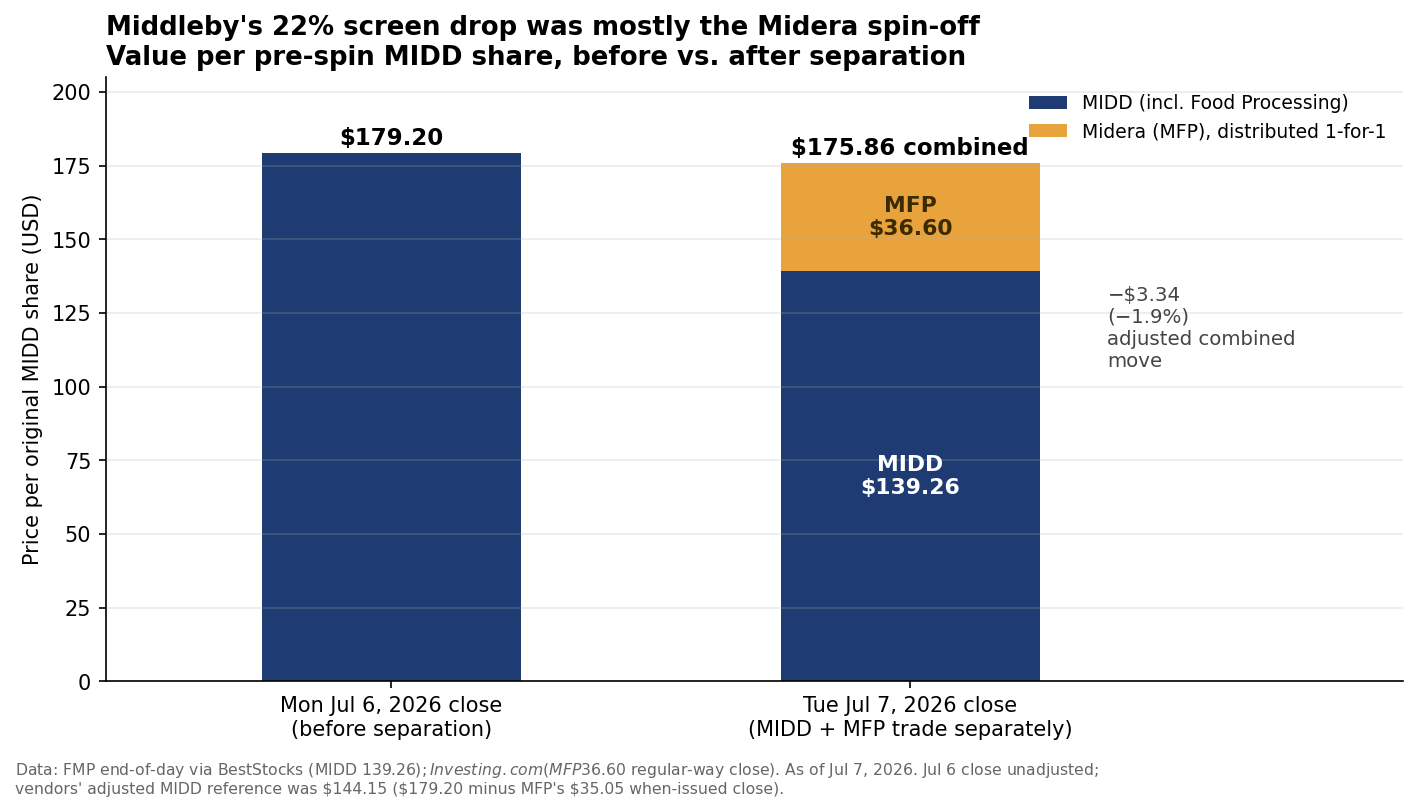
MIDD closed 22.3% below Monday's unadjusted price — but shareholders received one Midera (MFP) share per MIDD share. The adjusted combined move was about −1.9%.

Summary
The Middleby Corporation (NASDAQ: MIDD) closed at $139.26 on Tuesday, July 7, 2026 — 22.3% below Monday's unadjusted close of $179.20, and one of the sharpest screen moves flagged by BestStocks' change feed for the session [4]. The headline figure overstates what happened. Effective July 6, Middleby completed the spin-off of its Food Processing business, Midera Food Processing, Inc. (NASDAQ: MFP), distributing one Midera share for every Middleby share held at the June 26 record date [1]. Midera's first regular-way session on July 7 ended at $36.60 [3]. Add the two pieces together — $139.26 plus $36.60 — and a pre-spin Middleby share was worth $175.86 at Tuesday's close, an adjusted combined decline of about 1.9%. Vendors that adjusted the July 6 close for the distribution showed MIDD down 3.4% from a $144.15 adjusted reference price [3][4]. Most of the apparent drop was value moving to a new ticker, not value being destroyed.
What changed
Middleby announced completion of the separation on Monday, July 6, with the distribution effective at 12:01 a.m. Eastern Time that day and Midera shares set to begin “regular way” trading on Nasdaq at Tuesday's open [1]. Because Monday's $179.20 close still included the Food Processing business, price feeds that did not adjust the prior close showed Middleby gapping down more than 20% at Tuesday's open. Feeds that did adjust subtracted MFP's $35.05 when-issued close, setting a $144.15 reference against which MIDD's official decline was 3.4% [3][4]. BestStocks' intraday scan flagged the move at 10:38 a.m. ET as a 19.86% decline and linked it to the July 6 8-K [4] — a filing that is the spin-off completion press release itself, not a new adverse disclosure [1].
Trading behavior supports the mechanical explanation. Early-session volume in MIDD ran at roughly 0.69x the expected pace, per BestStocks' detection data — below the volume profile that accompanies genuine capitulation [4]. Midera traded in a wide first-day range of $34.65 to $40.04 before settling at $36.60 [3].
After adjusting for the distribution, the residual move still needs an explanation. Part of it likely reflects the weaker tape: July 7 saw renewed selling in semiconductors after Samsung's results failed to satisfy elevated AI-chip expectations and reports that DeepSeek is developing its own AI chip. The S&P 500 fell 0.45% and the Nasdaq dropped 1.16%, with AMD, Micron, and Broadcom among the decliners [9].
Why it matters
For holders, the account now shows two securities, so the adjusted combined value matters more than the raw MIDD price change. The separation is the culmination of a strategy shift that gathered pace after Ed Garden's Garden Investments built a stake that reached 6.7% by early 2026, per its 13D filings [8], and after the February 2025 announcement that the Food Processing business would be separated [5].
Middleby now describes itself as a pure-play commercial foodservice leader under CEO Tim FitzGerald [1], though it retains a 49% interest in its former Residential Kitchen business after selling a 51% stake to 26North [6]. Midera starts life with more than 30 brands, an installed base above 100,000 units, roughly 2,800 employees, and a new $1 billion five-year credit facility [2], and it was added to the S&P SmallCap 600 effective July 8 [7]. Index-tracking funds may need to add MFP exposure around the effective date, while some MIDD holders and funds whose mandates exclude small caps may sell the spun shares — a common source of early spin-off volatility.
The episode is also a caution about data hygiene. Unadjusted charts will show a 22% one-day drop on July 7 that never happened economically; screeners will flag a 30-day low; and stale analyst targets will overstate upside until estimates are rebuilt for the smaller company.
What to watch
First, Midera's price discovery. First-day trading spanned $34.65 to $40.04 [3], and selling from index-constrained holders can pressure spin-offs for weeks before the shareholder base resets — with the S&P SmallCap 600 addition pulling in the other direction [7]. Second, Middleby's next earnings report, estimated for August 5, 2026 [4]: the reported quarter will largely cover the pre-spin period, so the items to focus on are recast guidance and post-spin segment framing. Middleby's most recent quarter, reported May 7, delivered first-quarter 2026 adjusted EPS of $2.16 against a $1.94 consensus [10][11]. Third, analyst re-initiations: the $200 FMP consensus target predates the separation, other aggregators sit near $192–$196, and all of them should be treated as stale until post-spin models are published [4]. Finally, watch Midera's first standalone quarter and any early deal activity — management pointed to a robust M&A pipeline, on a platform built through more than 30 acquisitions since 2005 [2].
Did Middleby (MIDD) stock really fall 22% on July 7, 2026?
No — the 22.3% figure compares Tuesday's $139.26 close with Monday's $179.20 close, which still included the Food Processing business that was distributed to shareholders as Midera (MFP) stock [1][4]. Measured against the $144.15 distribution-adjusted reference, MIDD fell 3.4%; counting the $36.60 MFP shares holders received, the combined decline was about 1.9% [3].
Why did Middleby stock drop?
- Spin-off distribution. Middleby distributed one Midera (MFP) share per MIDD share, effective July 6; MFP's value left MIDD's share price when regular-way trading began July 7 [1].
- Unadjusted price feeds. Screens comparing Tuesday's close with the unadjusted $179.20 prior close showed a 22.3% drop that overstates the economic move [4].
- A modest real decline. On the distribution-adjusted basis, MIDD fell 3.4% — and about 1.9% combined with MFP [3][4].
- A weak tape. July 7 was a down session led by semiconductors, with the Nasdaq off 1.16% [9].
The July 7 move in numbers, baselines stated
Every figure below states its baseline — the difference between the scary number and the real one is which baseline a screen uses.
| Measure | Value | Baseline / note |
|---|---|---|
| MIDD close, Mon Jul 6 | $179.20 | Unadjusted; still includes Food Processing [4] |
| MFP when-issued close, Jul 6 | $35.05 | Value vendors subtracted for adjustment [3] |
| MIDD adjusted reference | $144.15 | $179.20 − $35.05 [4] |
| MIDD close, Tue Jul 7 | $139.26 | −22.3% vs. unadjusted close; −3.4% vs. adjusted reference [4] |
| MFP regular-way close, Jul 7 | $36.60 | First-day range $34.65–$40.04 [3] |
| Combined value per pre-spin share | $175.86 | −1.9% vs. Monday's $179.20 [3][4] |
| S&P 500 / Nasdaq, Jul 7 | −0.45% / −1.16% | Semiconductor-led decline [9] |
What could move MIDD next?
The next scheduled test is the second-quarter earnings report, estimated for August 5, 2026, followed by a 10-Q filing estimated mid-August [4]. Between now and then, watch for analyst re-initiations with post-spin models, vendor data adjustments that clean up MIDD's price history, recast segment reporting and guidance for the pure-play commercial foodservice business, and early trading dynamics in Midera around its S&P SmallCap 600 addition [7].
Middleby stock FAQ
Why did Middleby (MIDD) stock drop 22% on July 7, 2026?
Because Middleby completed the spin-off of Midera Food Processing (MFP) and unadjusted price feeds compared the new ex-distribution price with the $179.20 pre-spin close. On a distribution-adjusted basis MIDD fell 3.4%.
Did Middleby shareholders lose money in the drop?
Mostly no. Holders received one Midera (MFP) share per MIDD share; MIDD's $139.26 close plus MFP's $36.60 close equals $175.86 per pre-spin share, about 1.9% below Monday's $179.20 close.
What did Middleby shareholders receive in the Midera spin-off?
One share of Midera Food Processing (MFP) common stock for every Middleby share held as of the June 26, 2026 record date. The distribution was effective at 12:01 a.m. ET on July 6, and MFP began regular-way Nasdaq trading on July 7.
What is Midera Food Processing (MFP)?
The former Middleby Food Processing segment — a pure-play food processing technology company with more than 30 brands, an installed base above 100,000 units, roughly 2,800 employees, and a $1 billion credit facility. It was added to the S&P SmallCap 600 effective July 8, 2026.
When is Middleby's next earnings report?
Estimated for August 5, 2026. The reported quarter will largely cover the pre-spin period, so recast guidance and post-spin segment reporting are the items to watch.
Is the $200 analyst price target for MIDD still valid?
Treat it as stale. The $200 FMP consensus predates the separation, other aggregators sit near $192–$196, and targets will only become comparable again once analysts publish post-spin models.