Financials
PayPal (PYPL) Stock Drops ~13% as Stripe-Advent Abandon a $53B Buyout Bid
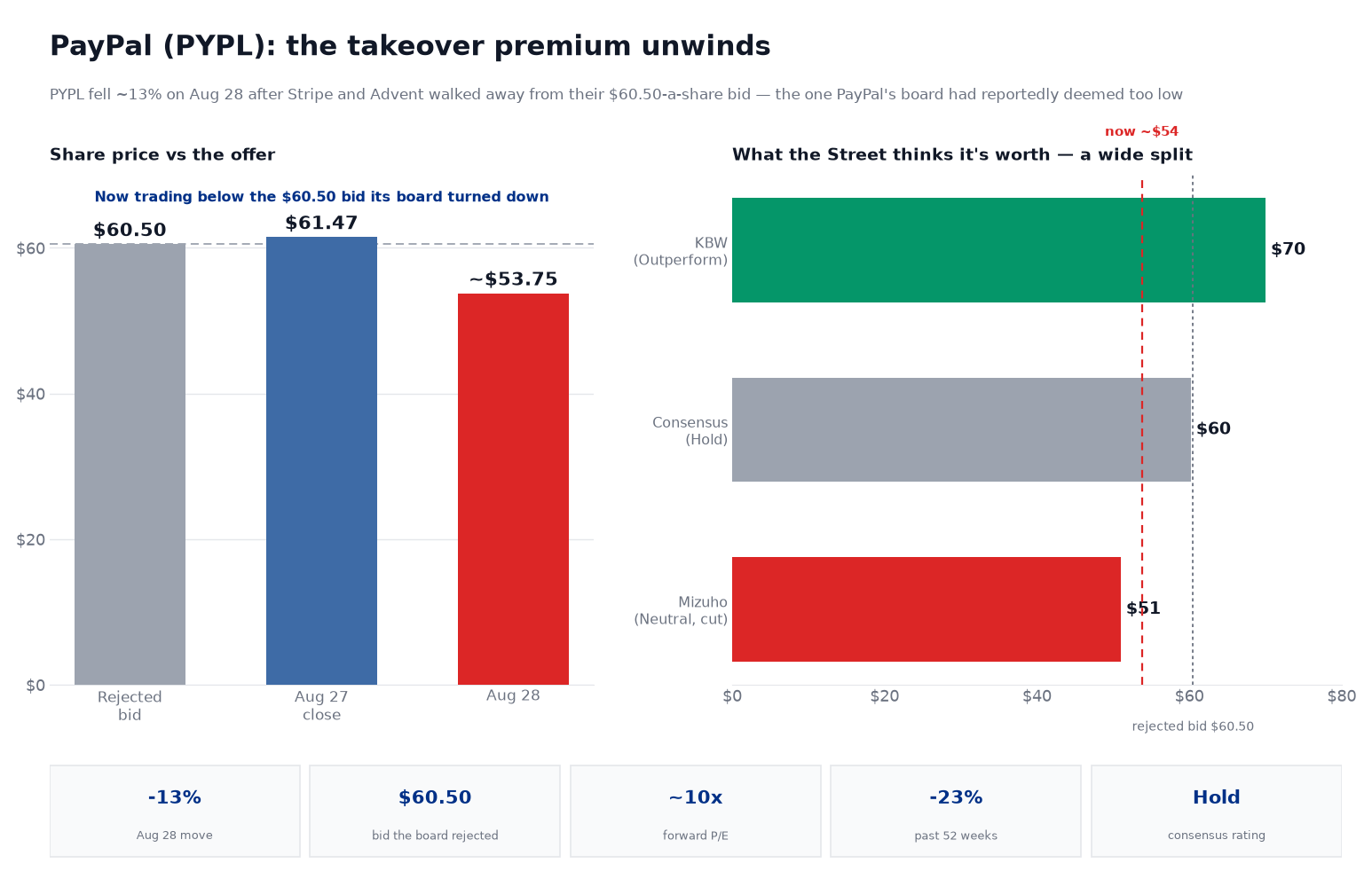
PayPal fell about 12.5% to roughly $53.75 on August 28 after Bloomberg reported that the Stripe and Advent International consortium abandoned its pursuit of the company. The group had bid $60.50 a share (more than $53 billion) in mid-July — an offer PayPal's board reportedly deemed too low — and the stock had traded above the bid on expectations of a higher offer. With the buyers gone, the takeover premium round-tripped: PayPal fell back to its 50-day average, below the very price it had turned down. The debate now is whether the board saved value or squandered it: KBW's Sanjay Sakhrani kept Outperform at $70, while Mizuho's Dan Dolev cut to $51. Underneath the deal drama, PayPal is a cheap (~10x earnings), profitable, but out-of-favor fintech — down ~23% over the past year, rated Hold — that must now prove its case without an acquirer to settle it.
Why PayPal stock dropped — the takeover is off
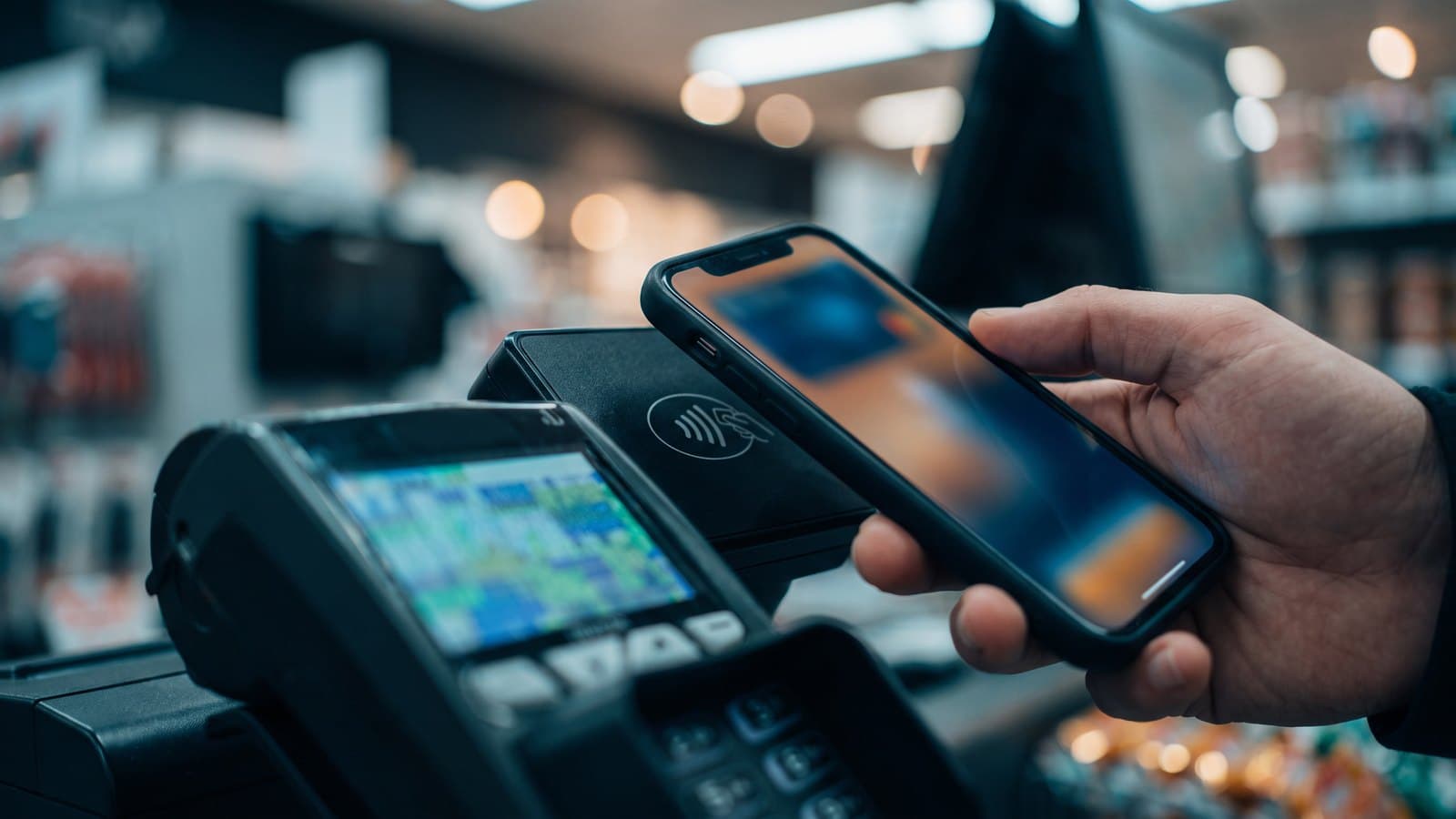
On Friday, August 28, 2026, PayPal Holdings (NASDAQ: PYPL) fell about 12.5% to roughly $53.75 (an intraday reading), from a $61.47 prior close [1]. The trigger was a Bloomberg report that the consortium of Stripe and Advent International has abandoned its pursuit of PayPal [2]. That group had offered $60.50 a share — more than $53 billion — in mid-July, an offer PayPal's board had reportedly deemed too low. This site covered the jump that offer produced at the time; Friday was the other side of that trade. With the buyers now walking away, the takeover premium that had propped the stock up simply unwound.
A round-trip below the price it turned down
The awkward math is what makes this move sting. PayPal closed Thursday at $61.47 — above the $60.50 bid, because the market had been betting on a higher, potentially sweetened offer after reports that PayPal and the bidders were discussing price [1]. Instead the consortium left the table, and the stock fell straight back down to about $53.75 — roughly its 50-day average, and below the very price it had turned down [3]. In effect, PayPal has round-tripped: the deal speculation lifted it into the low $60s, and its collapse dropped it back into the low $50s, wiping out the premium in a single session on volume running roughly 2.8 times normal [1]. Near-term, that is an uncomfortable look — the shares now trade about 11% under the bid the company deemed inadequate.
Did the board save value or squander it?
That is the real debate under the price move. PayPal's directors reportedly turned down $60.50 as undervaluing the company — a bet that PayPal is worth more on its own than a private-equity-led consortium was willing to pay [2]. The bulls agree: KBW's Sanjay Sakhrani kept an Outperform rating and a $70 target, arguing the suitors were trying to buy PayPal cheaply [6]. The skeptics see it differently. With the stock now below the rejected bid, the board has, at least for now, delivered shareholders less than the deal would have — and the structural questions that made PayPal a target in the first place have not gone away. Mizuho's Dan Dolev cut his target to $51 (from $60) and stayed Neutral, flagging the commoditization of PayPal's branded checkout, share-loss risk in Germany, and prospective competition from X Money against Venmo [6]. The gap between a $70 bull and a $51 bear — on a stock trading near $54 — is the whole argument in miniature.
Why it matters
The failed buyout is a window into two larger stories. The first is PayPal's own predicament: a former fintech darling, cheap enough to attract a $53 billion bid, yet unable to convince its own shareholders — or a Hold-heavy Street — that its growth problem is fixed. The very fact that a consortium was willing to pay a premium says the assets are undervalued; the fact that the board turned it down says management thinks so too; the fact that the stock now sits below the offer says the market is not yet convinced either can prove it. The second is consolidation pressure across payments, where scale increasingly wins and incumbents like PayPal face commoditization at the checkout from Apple, Shopify, Stripe and others. A deal that would have taken PayPal private to fix it away from the quarterly spotlight is now off the table, so the turnaround has to happen in public — and the market just repriced how hard that will be.
A fintech tape that split on the news
PayPal's plunge stood out against a quiet market and a strong day elsewhere in fintech [5]:
| Name (ticker) | Aug 28, 2026 (intraday) | Read-through |
|---|---|---|
| PYPL — PayPal | ≈−12.5% | Takeover premium unwound as Stripe and Advent walked away [1][2] |
| AFRM — Affirm | ≈+13% early (paring to ~+5%) | Soared in early trading on what it called its most profitable quarter ever, before giving back most of the gain — the opposite fintech story [5] |
| S&P 500 | ≈flat | A roughly flat broad market, underscoring that PayPal's move was entirely deal-specific [5] |
Same day, same sector, opposite directions — a reminder that this was a PayPal-specific event, not a payments-wide selloff [5].
What the Street thinks now
Coverage was cautious even before the collapse and stayed that way. Across more than 40 analysts the consensus is a Hold, with an average 12-month target near $60 (about 12% above Friday's level) and a strikingly wide range — from about $36 to a wild high near $147 — reflecting deep disagreement about PayPal's trajectory [6]. The rating split is hold-heavy, with roughly two-thirds of analysts on the sidelines [6]. The two clearest post-collapse reactions frame the debate: KBW reiterated Outperform at $70, while Mizuho cut to $51 (Neutral) [6]. That a Hold-rated, out-of-favor stock still drew a $53 billion bid is the puzzle at the center of PayPal — and the reason the shares can swing this hard on a single headline.
What to watch
- Whether another suitor emerges. The deal is off, but the logic that made PayPal a target — cheap, cash-generative, undervalued — remains. Watch for renewed interest [2].
- Branded checkout. The core question is whether PayPal can defend its checkout button against Apple Pay, Shop Pay and Stripe. Watch branded-checkout volume trends [6].
- Capital returns. With no deal, watch whether management leans harder into buybacks at a depressed price to support the stock [3].
- The next print. PayPal now has to make its case in the numbers. Watch the next quarterly report and any updated targets. Moves are tracked on the PYPL stock page [1].
Illustrative valuation sensitivity
With the deal off the table, PayPal trades on its standalone fundamentals again, so the scenarios below are anchored to its forward earnings power (a forward P/E near 10×) and to the analyst target distribution (low ~$36, average ~$60, high well above), turning on whether PayPal can stabilize branded-checkout growth. They are a descriptive, author-weighted exercise — not a forecast, target, recommendation, or intrinsic fair-value calculation — with subjective weights that sum to 100%.
| Scenario | Illustrative price | Weight | Key drivers |
|---|---|---|---|
| Upside | ~$70 | 30% | Branded checkout stabilizes, buybacks compound the cheap multiple, and the market (or a renewed suitor) re-rates PayPal toward the bullish KBW view [6]. |
| Middle | ~$58 | 40% | PayPal grinds along as a cheap, slow-growth cash generator; the stock recovers toward the ~$60 consensus but no re-rating catalyst arrives [6]. |
| Downside | ~$45 | 30% | Checkout share erodes to Apple, Shopify and Stripe, growth stalls, and — with no deal floor — the multiple compresses toward the low end of the range [6]. |
Weighting those (0.30 × $70 + 0.40 × $58 + 0.30 × $45) gives an author-weighted reference value near $57.70, above Friday's ~$53.75 and near the ~$60 consensus [1][6] — reflecting a cheap, cash-generative franchise weighed against a genuine and unresolved growth question, now with no acquirer to settle it. This is a Street-target-based scenario exercise and descriptive analysis of a news move, not investment advice.
PYPL data snapshot — August 28, 2026 (intraday)
| Figure | Value | As-of / source |
|---|---|---|
| Intraday quote | ~$53.75 (−~12.5%); feed −12.55% (traded as low as ~$52.6) | Aug 28 — StockAnalysis / Change Feed [1] |
| Prior close | $61.47 (above the $60.50 bid) | Thu, Aug 27, 2026 [1] |
| 52-week range / change | $38.46–$79.22; down ~23% over 52 weeks; the drop returned it to its ~$54 50-day average (above the ~$51 200-day); RSI ≈35 | As of Aug 28 [3] |
| Market cap / EV | ≈$46B (855M shares); enterprise value ≈$49B; beta ≈1.3 | Aug 28 — StockAnalysis [3] |
| Valuation | Trailing P/E ≈10× at the ~$53.75 price (≈11.6× on the $61.47 prior close); forward P/E ≈10×; ≈1.4× sales; dividend yield ≈1.0% ($0.56) | Aug 28 — StockAnalysis [3] |
| Financials (TTM) | Revenue ≈$34.1B (+5.7%); net income ≈$4.9B (EPS ≈$5.29, up double digits on buybacks); operating margin ≈17.6%; gross margin ≈40% | TTM — StockAnalysis [3] |
| Volume | ~27M shares vs a ~9.5M 20-day average (~2.8×, very heavy) | Aug 28 — StockAnalysis [1] |
| The catalyst | Bloomberg reported the Stripe + Advent International consortium abandoned its pursuit of PayPal; its more-than-$53B / $60.50-per-share bid (mid-July) had reportedly been deemed too low by PayPal's board, and the stock had traded above the bid on expectations of a higher offer | Aug 28 — Bloomberg / market coverage [2] |
| Same-day fintech tape | PYPL ≈−12.5% (deal dead) vs AFRM ≈+13% in early trading, paring to ~+5% (strong quarter) vs S&P 500 ≈flat | Aug 28 [5] |
| Analyst view | More than 40 analysts, consensus Hold, avg target ≈$60 (range ~$36–$147); ratings skew heavily to Hold (roughly two-thirds); KBW's Sanjay Sakhrani Outperform $70, Mizuho's Dan Dolev Neutral $51 (cut from $60) | Aug 2026 — StockAnalysis / market coverage [6] |
The August 28 figures are intraday snapshots that moved through the session, not closing prices.
The setup at a glance
| Question | Answer |
|---|---|
| Why did PayPal stock drop on August 28? | Because its takeover fell through. Bloomberg reported that the Stripe and Advent International consortium abandoned its pursuit of PayPal. The group had offered $60.50 a share (more than $53 billion) in mid-July, which PayPal's board reportedly deemed too low; with the buyers now gone, the premium that had lifted the stock unwound, and PayPal fell about 12.5% to roughly $53.75 [1][2]. |
| Why is the stock now below the offer it rejected? | Because it had traded above the offer on deal hopes. PayPal closed Thursday at $61.47 — above the $60.50 bid — as investors bet on a higher, sweetened offer after reports that PayPal and the bidders were discussing price. When the consortium walked away, the stock round-tripped down to about $53.75, roughly its 50-day average and below the very bid it had turned down. That is why the collapse stings near-term [1][3]. |
| Did PayPal's board make the right call? | It is the central debate. The board reportedly turned down $60.50 as undervaluing the company, betting PayPal is worth more standalone — a view KBW shares, keeping Outperform at $70. Critics note the stock now trades below the rejected bid, so shareholders are worse off for now, and the growth questions remain; Mizuho cut its target to $51. The gap between a $70 bull and a $51 bear captures the disagreement [2][6]. |
| Is PayPal cheap? | Yes, by the numbers — that is why it drew a bid. Even before the drop it traded around 11 times earnings, at about 1.4 times sales, with a mid-teens net margin, double-digit EPS growth (helped by buybacks) and a ~1% dividend. But the low multiple reflects real doubts: PayPal is down ~23% over the past year and carries a Hold consensus, because the market questions whether it can defend branded checkout [3]. |
| What is the biggest risk now? | That the deal was the floor. With no acquirer to force a re-rating, PayPal has to prove its case in public — defending its checkout button against Apple Pay, Shop Pay and Stripe. If growth stalls, a cheap multiple can get cheaper, which is the essence of a value trap. Mizuho's downgrade flags exactly those competitive risks [6]. |
| What do analysts think? | Divided and cautious. The consensus is a Hold with an average target near $60 (about 12% above the current price), but the range is enormous ($36 to ~$147) and the ratings skew to Hold (roughly two-thirds of analysts). KBW's Sanjay Sakhrani is the clearest bull at $70 (Outperform); Mizuho's Dan Dolev is the clearest post-collapse bear, cutting to $51 (Neutral) [6]. |
PayPal (PYPL) stock FAQ
Why did PayPal (PYPL) stock drop on August 28, 2026?
Because its takeover collapsed. Bloomberg reported that the consortium of Stripe and Advent International abandoned its pursuit of PayPal. The group had offered $60.50 a share — more than $53 billion — for the company in mid-July, an offer PayPal's board reportedly deemed too low. The stock had been trading above that bid on expectations of a higher, sweetened offer, so when the buyers walked away, the takeover premium unwound and PayPal fell about 12.5% to roughly $53.75.
Why is PayPal now trading below the offer it rejected?
Because it had risen above the offer on deal speculation. PayPal closed on August 27 at $61.47 — above the $60.50 bid — as investors bet the consortium would raise its price, after reports that PayPal and the bidders were discussing a higher figure. When Stripe and Advent instead walked away, the stock round-tripped: it fell back to about $53.75, roughly its 50-day moving average, which is below the very bid PayPal's board had turned down. That is why the collapse is awkward in the near term — the market is temporarily valuing the standalone company below the rejected deal price.
Did PayPal's board make the right decision to reject $60.50?
That is the central debate, and it will not be settled for a while. The board reportedly turned down the offer because it judged that $60.50 undervalued the company — a bet that PayPal is worth more on its own than a private-equity-led consortium was willing to pay. KBW's Sanjay Sakhrani agrees, keeping an Outperform rating and a $70 target and suggesting the suitors were trying to buy PayPal cheaply. The skeptics counter that the stock now trades below the rejected bid, so shareholders are worse off for now, and the structural growth questions that made PayPal a target remain unresolved; Mizuho's Dan Dolev cut his target to $51. The wide gap between those views captures the uncertainty.
Is PayPal stock cheap?
By conventional measures, yes — which is a big part of why it attracted a bid. PayPal traded at about 11 times earnings before the drop and closer to 10 times at the post-drop price, at roughly 1.4 times sales, with a mid-teens net margin, double-digit earnings-per-share growth (helped by large share buybacks) and a dividend yielding around 1%. But that low multiple reflects genuine skepticism, not just a bargain: PayPal is down about 23% over the past year and carries a Hold consensus, because investors question whether it can defend its branded checkout against Apple Pay, Shop Pay, Stripe and others. It is a classic value-versus-value-trap debate.
What is the biggest risk for PayPal now that the deal is dead?
That the takeover was effectively the floor under the stock. A buyout would have taken PayPal private to fix its problems away from the quarterly spotlight; with the deal gone, the turnaround has to happen in public, and there is no acquirer to force the market to re-rate the shares. The core risk is competitive: PayPal must defend its checkout button against Apple Pay, Shopify's Shop Pay and Stripe, among others. If branded-checkout share erodes and growth stalls, a cheap multiple can compress further — the definition of a value trap. Mizuho's downgrade to $51 flags exactly those risks.
What do analysts think of PayPal?
They are divided and, on balance, cautious. Across more than 40 analysts the consensus is a Hold, with an average 12-month price target near $60 (about 12% above the post-drop price), but the range is extraordinarily wide — from about $36 to a high near $147 — and the ratings skew heavily to Hold, with roughly two-thirds of analysts on the sidelines. The two clearest post-collapse reactions frame the argument: KBW's Sanjay Sakhrani reiterated Outperform with a $70 target, viewing the rejected bid as a lowball, while Mizuho's Dan Dolev cut his target to $51 and stayed Neutral, citing the commoditization of branded checkout and competitive risks. That a Hold-rated, out-of-favor stock still drew a takeover bid of more than $53 billion is the puzzle at the heart of PayPal.