Utilities
PG&E (PCG) Stock Falls 7.5% as California Lawmakers Block a Wildfire-Liability Plan
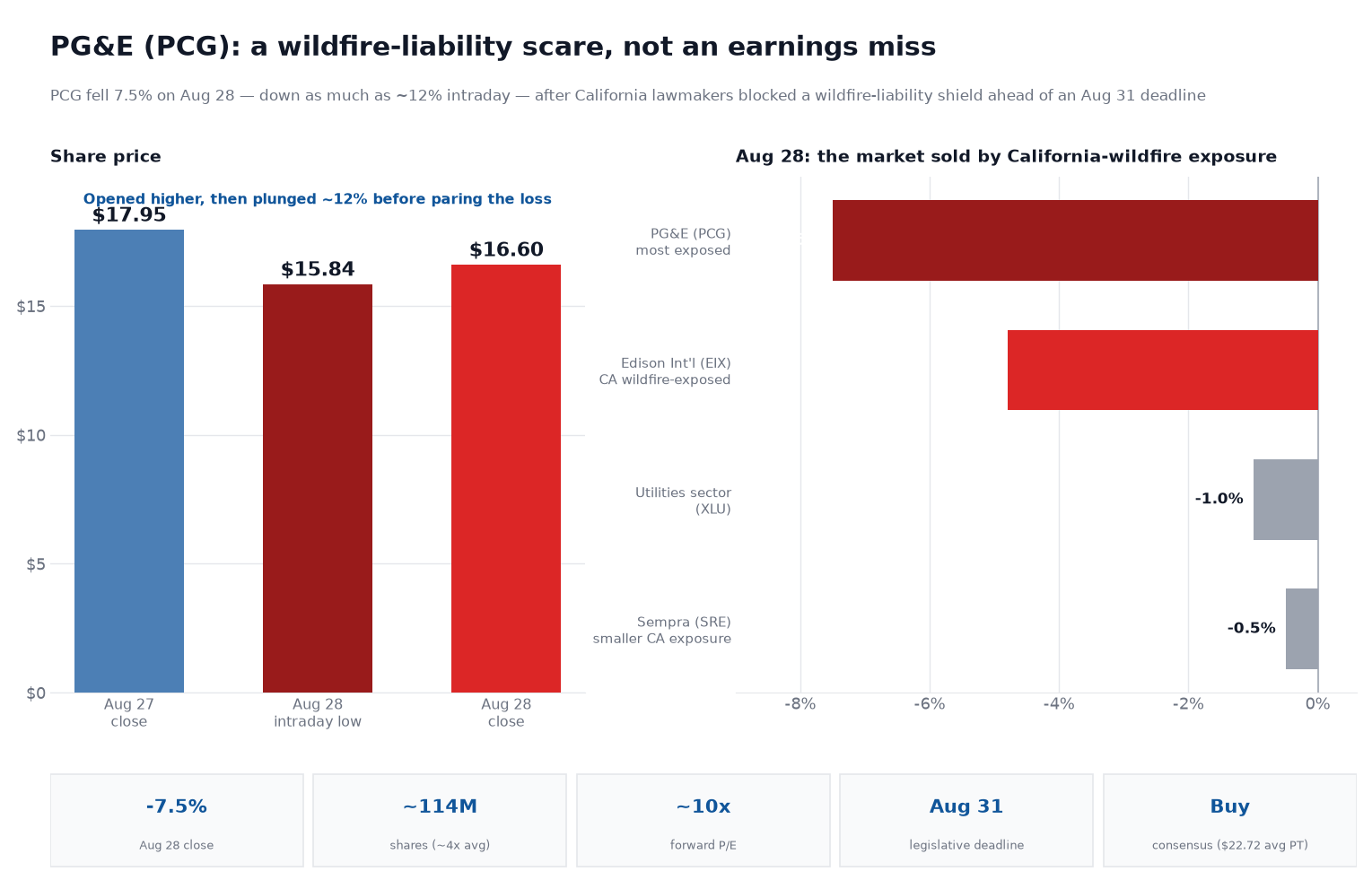
PG&E fell 7.52% to $16.60 on August 28 — down as much as 12% intraday on nearly four times its average volume — after California lawmakers blocked a wildfire-liability reform. In closed-door talks that broke down late on August 27, days before the August 31 legislative deadline, lawmakers derailed Governor Newsom's push to eliminate or sharply curtail 'subrogation,' the process that lets insurers recover wildfire losses from utilities. That revived the catastrophic-liability fear from the 2017–2018 fires that forced PG&E into bankruptcy in early 2019. The move was a wildfire-exposure sell-off, not a sector one: Edison International fell nearly 5%, while diversified Sempra and the broad utilities ETF barely moved. PG&E trades at only ~10x forward earnings — a steep discount to the ~17–18x of the broader U.S. utilities sector — precisely because of this tail risk. Analysts, whose Buy consensus and ~$22.72 average target pre-date the vote, see 37% upside if the tail stays dormant; the market's $16.60 price reflects the risk it just repriced.
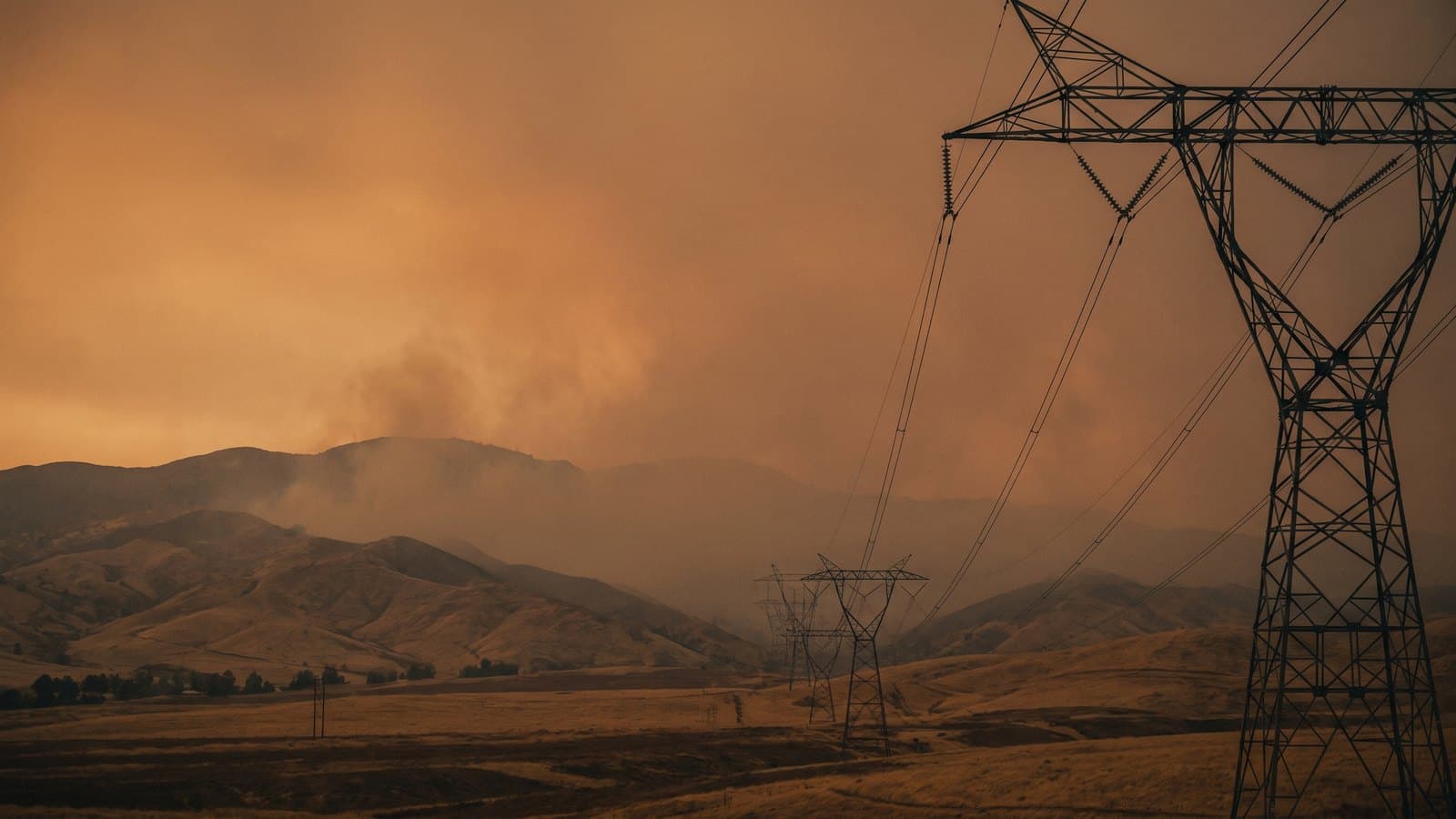
Why PG&E stock dropped — a wildfire-liability scare, not an earnings miss
On Friday, August 28, 2026, PG&E Corporation (NYSE: PCG) fell 7.52% to close at $16.60, down from a $17.95 close the day before [1]. The move was violent: the stock actually opened higher, at $18.22, then plunged as much as ~12% to an intraday low of $15.84 before paring the loss, on about 114 million shares — nearly four times its 20-day average of roughly 29 million [1]. Nothing about the quarter changed; this was a legislative shock. In Sacramento, lawmakers had blocked a wildfire-liability reform that utilities had been counting on, days before an August 31 legislative deadline [2].
What Sacramento did — and why it matters so much
At the center of the sell-off is an arcane but pivotal legal term: subrogation. When a utility's equipment sparks a wildfire, insurers that pay out claims to homeowners and businesses can then recover those losses from the utility — a process called subrogation. It was a major component of the wildfire liabilities that the company said could exceed $30 billion — from the 2017 Northern California fires and the 2018 Camp Fire — that drove PG&E into bankruptcy in early 2019; the company later agreed to about $11 billion to settle insurers' subrogation claims from those fires. Governor Gavin Newsom had pushed to eliminate or sharply curtail subrogation — effectively shielding utilities from those insurer claims after a catastrophic fire [2]. But in closed-door negotiations that broke down late Thursday, August 27, lawmakers blocked the effort, after insurance executives warned that shifting the liability onto insurers would push property-insurance premiums higher across the state [2]. By Friday, the state had signaled there was no path forward this year on the structural subrogation reform itself, even as talks continued on a narrower wildfire package (faster victim payments, executive-pay limits) — so the shield utilities wanted was effectively off the table, and the market repriced PG&E accordingly.
A defensive utility that isn't defensive
This is what makes PG&E unusual. On paper it looks like a classic defensive utility: a beta of just 0.28, growing earnings (EPS up about 29% over the past year), and a valuation of only about 10 times forward earnings — a steep discount to the roughly 17–18 times forward earnings of the broader U.S. utilities sector [3]. But that discount is not a bargain hiding in plain sight; it is the market's standing price for catastrophic-wildfire-liability tail risk. Newsom's proposed shield was the catalyst that could have narrowed the gap. Its collapse did the opposite: it reminded investors that, for now, a single major fire traced to PG&E equipment could once again expose it to the kind of catastrophic wildfire liability that bankrupted the company seven years ago. That is why a stock with a 0.28 beta can fall 12% in an afternoon.
Why it matters
The reaction is a reminder that for California's investor-owned utilities, the biggest variable is not operations or rates — it is liability law. PG&E has spent years rebuilding after bankruptcy: hardening lines, burying cable, standing up a state wildfire fund, and restoring a (small) dividend. Yet a single vote in Sacramento can undo more market value in an afternoon than a quarter of operational progress adds, because the framework that governs who pays for a catastrophic fire is existential, not incremental. The failure of subrogation reform also matters for the whole sector: Edison International, whose equipment is under scrutiny in Southern California, fell nearly 5% on the same news, while more geographically diversified Sempra and the broad utility group barely moved. The market, in other words, is not repricing utilities — it is repricing California wildfire liability, and PG&E is its most concentrated bet.
A California-wildfire sell-off, not a sector one
The cross-section on August 28 makes the driver unmistakable — the losses tracked wildfire exposure, not the utility label [5]:
| Name (ticker) | Aug 28, 2026 | Read-through |
|---|---|---|
| PCG — PG&E | −7.5% | The most concentrated California wildfire-liability exposure; prior bankruptcy history [1][2] |
| EIX — Edison International | −4.8% | Heavy Southern California exposure; equipment under scrutiny in past fires [5] |
| XLU — Utilities sector ETF | −1.0% | The broad utility group barely moved — this was not a rates or sector story [5] |
| SRE — Sempra | −0.5% | Smaller California footprint, diversified into Texas and LNG — largely spared [5] |
A textbook cross-section: the more California-wildfire liability a name carries, the harder it fell [5].
What the Street thought — before the vote
PG&E's analyst coverage is constructive, but note the timing: the ratings below were set before the August 28 legislative news, and reflect the operating base case rather than the liability shock [6]. The consensus is a Buy, with an average 12-month target of about $22.72 — roughly 37% above Friday's close — a median of $22, a high of $28 and a low of $19 [6]. Recent actions include UBS's Gregg Orrill (Buy, $22, August 25), Barclays' Nicholas Campanella (Buy, $23, late July) and Truist's Richard Sunderland (Buy, target trimmed to $21, early August), while Morgan Stanley's David Arcaro is at Equal-weight, a Hold-equivalent ($22) [6]. The gap between that ~$23 average target and the ~$16.60 price is the wildfire discount in a single number — the upside analysts see if the tail stays dormant, set against the risk the market just repriced.
What to watch
- The August 31 deadline. Whether any form of liability relief or subrogation reform is revived before the legislative session ends — or is definitively dead for the year [2].
- Fire season. California's peak wildfire risk runs through autumn; any major ignition tied to utility equipment is the tail the market fears [2].
- The state wildfire fund. Watch commentary on the adequacy of California's wildfire fund and PG&E's safety-certification status, which cap and condition liability [3].
- Analyst resets. Whether the Street trims targets to reflect the failed reform. Moves are tracked on the PCG stock page [1].
Illustrative valuation sensitivity
PG&E's earnings are real and growing, so the scenarios below are anchored to its forward earnings power (about 10× forward earnings today) and the analyst target distribution (low $19, average ~$22.72, high $28) [6], but the swing factor is the wildfire tail, which no multiple fully captures. They are a descriptive, author-weighted exercise — not a forecast, target, recommendation, or intrinsic fair-value calculation — with subjective weights that sum to 100%.
| Scenario | Illustrative price | Weight | Key drivers |
|---|---|---|---|
| Upside | ~$23 | 30% | Liability relief is revived, or fire season passes quietly, and the discount narrows toward the analyst targets and the peer multiple [6]. |
| Middle | ~$19 | 40% | The overhang persists: earnings keep growing but the wildfire discount stays, and the stock recovers only part of the drop toward the low end of the target range [3]. |
| Downside | ~$13 | 30% | A catastrophic ignition tied to PG&E equipment during the unshielded window revives subrogation and financing fears, and the stock falls below its recent range [2]. |
Weighting those (0.30 × $23 + 0.40 × $19 + 0.30 × $13) gives an author-weighted reference value near $18.40, above Friday's $16.60 close but well below the ~$22.72 average target [1][6] — the gap reflecting a cheap, growing utility discounted for a low-probability, high-severity liability risk that the failed reform left unhedged. This is a Street-target-and-scenario exercise and descriptive analysis of a news move, not investment advice.
PCG data snapshot — August 28, 2026
| Figure | Value | As-of / source |
|---|---|---|
| Close | $16.60 (−7.52%); after-hours ~$16.64 | Fri, Aug 28, 2026 — StockAnalysis [1] |
| Prior close / open / range | $17.95 prior close; opened higher at $18.22; day range $15.84–$18.35 (intraday low ~−11.8%) | Aug 27–28, 2026 [1] |
| Volume | ~114M shares vs a ~29M 20-day average (~3.9×, very heavy) | Aug 28 — StockAnalysis [1] |
| 52-week range / trend | $14.34–$19.16; up ~10% over 52 weeks; the drop broke below its ~$17.4 50-day and ~$16.8 200-day averages; RSI ≈39 | As of Aug 28 [3] |
| Market cap / EV | ≈$36.6B (2.20B shares); enterprise value ≈$100B (heavy debt); beta ≈0.28 | Aug 28 — StockAnalysis [3] |
| Valuation | Trailing P/E ≈12×; forward P/E ≈9.8× (vs ~17–18× for the broader U.S. utilities sector); ≈1.4× sales; ≈1.1× book; dividend yield ≈1.2% ($0.20) | Aug 28 — StockAnalysis [3] |
| Financials (TTM) | Revenue ≈$25.8B (+5.7%); net income ≈$3.06B (+30%); EPS $1.39 (+28.6%); operating margin ≈22% | TTM — StockAnalysis [3] |
| The catalyst | In closed-door talks that broke down late Aug 27, California lawmakers blocked Gov. Newsom's push to eliminate or sharply curtail "subrogation" (which lets insurers recover wildfire losses from utilities), days before the Aug 31 deadline — reviving catastrophic-wildfire-liability fears | Aug 27–28 — market coverage [2] |
| Same-day peers | EIX −4.8%, SRE −0.5%, XLU (utilities ETF) −1.0% — losses tracked California-wildfire exposure | Aug 28 [5] |
| Analyst view (pre-vote) | 17 analysts, consensus Buy, avg target ≈$22.72 (median $22, high $28, low $19); UBS $22, Barclays $23, Truist $21, Morgan Stanley Equal-weight $22 — all set before the Aug 28 news | Jul–Aug 2026 — StockAnalysis / analyst notes [6] |
The setup at a glance
| Question | Answer |
|---|---|
| Why did PG&E stock drop on August 28? | Not because of earnings — because of a legislative setback. In closed-door talks that broke down late on August 27, California lawmakers blocked a wildfire-liability reform, derailing Governor Newsom's push to eliminate or sharply curtail "subrogation," the process that lets insurers recover wildfire losses from utilities. Days before the August 31 legislative deadline, that revived fears about PG&E's exposure to catastrophic fire liability, and the stock fell 7.52% to $16.60 — down as much as ~12% intraday — on nearly four times its average volume [1][2]. |
| What is subrogation, and why does it matter? | Subrogation is the process by which insurers, after paying wildfire claims to homeowners and businesses, recover those losses from the utility whose equipment sparked the fire. It was a major component of wildfire liabilities that the company said could exceed $30 billion — from the 2017 Northern California fires and the 2018 Camp Fire — that forced PG&E into bankruptcy in early 2019 (the company later agreed to about $11 billion to settle insurers' subrogation claims from those fires). Eliminating or capping it would have shielded utilities; blocking that reform leaves PG&E exposed to the same machinery again [2]. |
| Why is a low-beta utility this volatile? | Because its risk is binary, not gradual. PG&E's day-to-day business is stable (a 0.28 beta), but it carries a catastrophic, low-probability tail risk: a single major fire tied to its equipment can create tens of billions in liability. Legislation that caps or shifts that liability is therefore existential, so a headline about it can move the stock far more than any quarterly result — which is exactly what happened [2][3]. |
| Is PG&E stock cheap? | By utility standards, strikingly so — about 10 times forward earnings versus the roughly 17–18 times of the broader U.S. utilities sector, with earnings up nearly 30% over the past year. But that discount is the market's price for wildfire-liability tail risk, not a free lunch. Whether it is 'cheap' depends entirely on your view of that tail: dormant, and the stock looks undervalued; live, and the discount can widen further [3]. |
| What is the biggest risk now? | A catastrophic wildfire tied to PG&E equipment during California's fire season, while no liability shield is in place. That is the scenario — echoing 2018–2019 — that could revive subrogation claims and financing fears and push the stock below its recent range. The failed reform is what put that risk back in the headlines [2]. |
| What do analysts think? | Coverage is constructive but pre-dates the vote. The consensus is a Buy with an average 12-month target near $22.72 — about 37% above the current price — with a range of $19 to $28. UBS ($22), Barclays ($23) and Truist ($21) carry Buy-equivalent ratings, while Morgan Stanley is at Hold ($22). Those targets reflect the operating base case; watch whether the Street trims them to account for the failed liability reform [6]. |
PG&E (PCG) stock FAQ
Why did PG&E (PCG) stock drop on August 28, 2026?
Because of a legislative setback, not earnings. California lawmakers moved to block a wildfire-liability reform, rejecting Governor Gavin Newsom's proposal to end 'subrogation' — the legal process that lets insurers recover wildfire losses from the utility whose equipment sparked a fire. Coming just days before the August 31 legislative deadline, that revived fears about PG&E's exposure to catastrophic wildfire liability. The stock fell 7.52% to $16.60, having dropped as much as roughly 12% intraday to $15.84, on about 110 million shares — nearly four times its average volume.
What is subrogation and why is it so important to PG&E?
Subrogation is the process by which insurance companies, after paying wildfire claims to homeowners and businesses, recover those payouts from the utility whose equipment is found to have caused the fire. It was a major component of wildfire liabilities that the company said could exceed $30 billion — from the 2017 Northern California fires and the 2018 Camp Fire — that forced PG&E into bankruptcy in early 2019; the company later agreed to about $11 billion to settle insurers' subrogation claims from those fires. Governor Newsom's push to eliminate or sharply curtail subrogation would have shielded utilities from those insurer claims; lawmakers blocking it leaves PG&E exposed to the same machinery, which is why the stock reacted so sharply.
Why is a low-beta utility like PG&E so volatile?
Because its risk profile is binary rather than gradual. PG&E's underlying business — delivering electricity and gas to northern and central California — is stable, reflected in a five-year beta of just 0.28. But layered on top is a catastrophic, low-probability tail risk: a single major wildfire traced to its equipment can generate tens of billions in liability. Anything that changes how that liability is capped or shared — like the failed subrogation reform — is existential, so a legislative headline can move the stock far more than a quarterly earnings report. That is why a 0.28-beta stock fell about 12% in an afternoon.
Is PG&E stock cheap?
By the numbers, strikingly so: PG&E trades at roughly 10 times forward earnings, versus the 17 to 18 times of the broader U.S. utilities sector, and its earnings grew nearly 30% over the past year. But that discount is not a free lunch — it is the market's standing price for catastrophic-wildfire-liability tail risk. Whether the stock is genuinely cheap depends entirely on your view of that tail: if it stays dormant, PG&E looks undervalued relative to peers; if a major fire hits while no liability shield is in place, the discount can widen further. The failed reform is what put that question back at the center.
What is the biggest risk for PG&E now?
A catastrophic wildfire tied to PG&E's equipment during California's fire season while no liability shield is in place. That is the scenario — echoing 2018 and 2019 — that could revive large subrogation claims and the solvency and financing fears that drove the company into bankruptcy. With lawmakers having blocked the reform that would have limited that exposure, and the peak fire season running through autumn, this tail risk is exactly what the market repriced on August 28. Secondary risks include the adequacy of California's state wildfire fund and PG&E's safety-certification status.
What do analysts think of PG&E stock?
Coverage is constructive, but the ratings pre-date the August 28 vote and reflect the operating base case rather than the liability shock. The consensus is a Buy, with an average 12-month price target of about $22.72 — roughly 37% above the post-drop price — a median of $22, a high of $28 and a low of $19. Recent actions include UBS's Gregg Orrill (Buy, $22), Barclays' Nicholas Campanella (Buy, $23) and Truist's Richard Sunderland (Buy, $21), while Morgan Stanley's David Arcaro is at Equal-weight ($22). The gap between that roughly $23 average target and the ~$16.60 price is essentially the wildfire discount; the key question is whether analysts trim their targets to reflect the failed reform.