Technology
Pinterest (PINS) Stock Falls 6% After CFO Julia Donnelly Resigns
Pinterest fell about 6% to around $21.73 on August 31 after disclosing that CFO Julia Brau Donnelly is resigning to join a private, early-stage company. She will stay until October 30 for an orderly transition, with a finance executive named interim CFO and an external search underway; the company said the exit is not due to any disagreement. Still, losing a CFO whose tenure the CEO credited with 11 straight quarters of double-digit revenue growth rattled a stock already down ~41% over the past year and trading at just ~11x forward earnings. The move was company-specific: the same day, ad peers Snap and The Trade Desk actually rose, while Meta and Alphabet fell only modestly. Analysts are constructive but split — a Buy consensus with a ~$29 average target, yet a cluster of Holds near the price — leaving the CFO exit to reopen, rather than settle, the debate over whether Pinterest's growth story holds.

Why Pinterest stock dropped — the CFO is leaving
On Monday, August 31, 2026, Pinterest (NYSE: PINS) fell about 6% to around $21.73 in intraday trading, down from a $23.19 close on Friday [1]. The catalyst was a leadership change rather than a number: Chief Financial Officer Julia Brau Donnelly is resigning, a departure Pinterest disclosed in a securities filing on August 28, two days after Donnelly submitted her resignation [2]. Donnelly is leaving to join a private, early-stage company after about three years in the role, and will stay on until October 30 to help with the transition; Pinterest named finance executive Vikram Naidu as interim principal financial officer and launched an external search for a permanent successor [2]. The company was explicit that the exit is not the result of any disagreement over operations, policies, or accounting [2]. The stock, which had already slipped as much as about 4% in Friday's after-hours session, extended the decline on Monday.
A confidence question, not a numbers problem
What unsettled the market is timing and symbolism. Donnelly is a well-regarded operator: chief executive Bill Ready credited her tenure with 11 consecutive quarters of double-digit revenue growth, and losing that steady hand — even in an orderly, no-disagreement exit — raises questions about financial-leadership continuity and near-term guidance at a delicate moment for digital advertising [2]. Pinterest is not a company with room for error in the market's eyes: the stock is down about 41% over the past year, sits just below both its 50-day and 200-day moving averages, and trades at only about 11 times forward earnings — a valuation that already prices in real skepticism about its growth durability [3]. Into that fragile setup, an unexpected CFO exit is the kind of headline that tips sentiment, which is why an orderly-sounding transition produced a 6% drop.
Company-specific, not a sector move
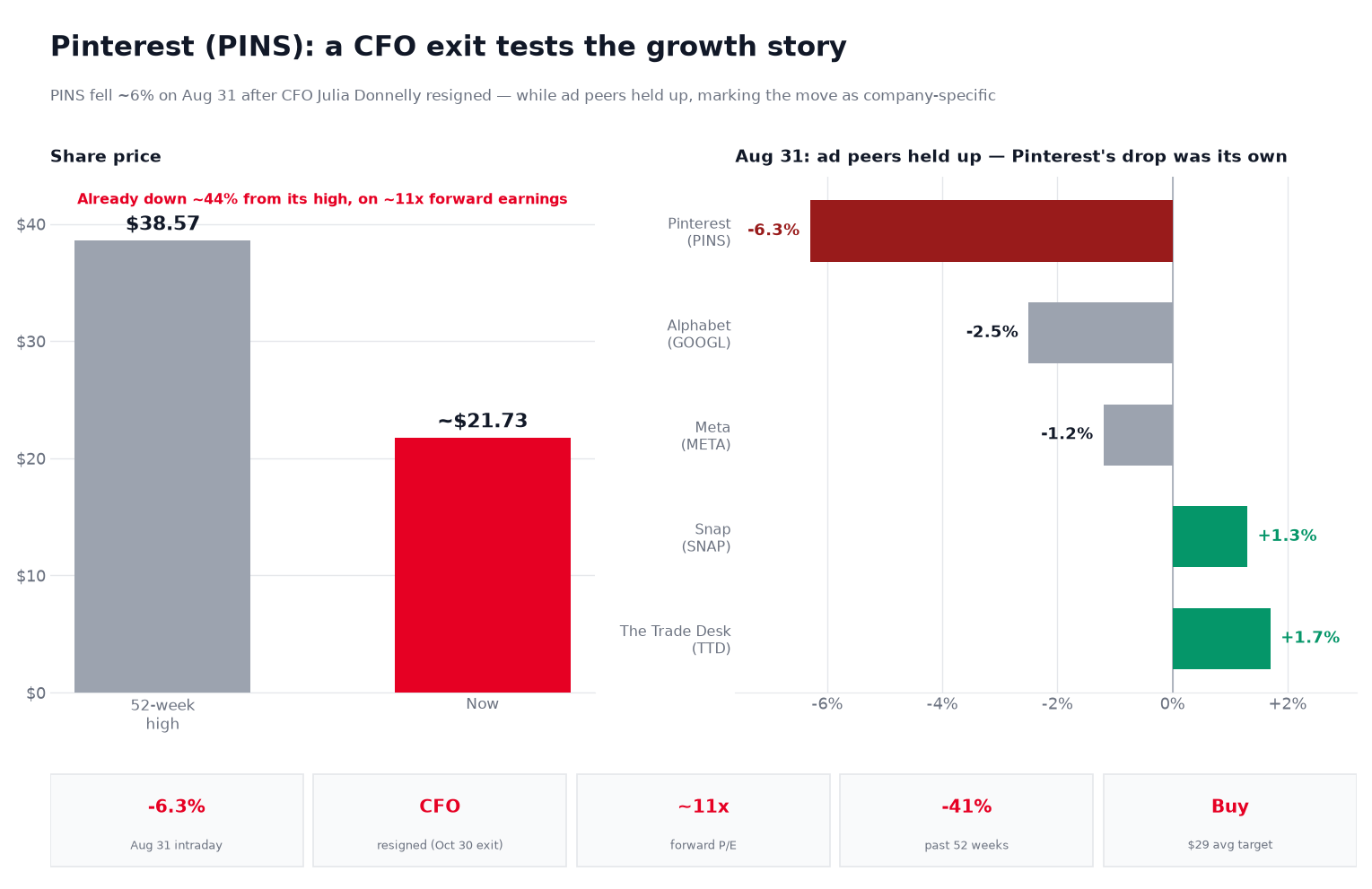
The cleanest evidence that this was about Pinterest — not digital advertising broadly — is how its peers traded the same day. While Pinterest dropped about 6%, its closest social-media-advertising rival Snap actually rose about 1%, ad-tech platform The Trade Desk gained more than 1%, and the mega-cap platforms moved only modestly (Meta down about 1%, Alphabet down about 2% on its own AI-model concerns) [5]. It was a mildly risk-off session — the S&P 500 was down a few tenths of a percent — but Pinterest fell several times as much as its peers and the broad market, which points to a company-specific reaction rather than a digital-ad-sector selloff. Here, that reaction is overwhelmingly about the loss of a trusted CFO and the uncertainty it injects into a turnaround that was already on a short leash.
Why it matters
Pinterest's drop is a case study in how fragile sentiment amplifies governance news. At a beloved, expensive stock, an orderly CFO exit might be shrugged off; at a distrusted, beaten-down one, it becomes a referendum on whether management can execute. It also lands on a live debate in online advertising: whether platforms built on visual discovery and shopping intent — Pinterest's core — can defend their niche as generative AI reshapes how people search and get recommendations. None of that was decided by a CFO resignation, but the resignation gave the skeptics a fresh reason to press, and the bulls little to counter with until the next set of results. For a stock this cheap, the swing factor is no longer profitability or even growth in the abstract; it is confidence, and confidence just took a hit.
What the Street thinks
Coverage is constructive on paper but nearly evenly divided. The consensus across covering analysts is a Buy, with an average 12-month target near $29 — about 34% above the current price — a median around $28.50 and a high near $42 [6]. But the split is unusually close — roughly 19 buy-equivalent ratings against 20 holds — and the cautious camp is well represented: Argus's John Staszak is at Hold, and after the CFO exit Baird's Colin Sebastian reiterated a Neutral at $26, while J.P. Morgan's Doug Anmuth ($27) and Roth MKM's Rohit Kulkarni ($25) also sit on the sidelines; on the bullish side, Bernstein's Mark Shmulik ($28) and Wells Fargo's Alec Brondolo (Overweight, $31) keep buy-equivalent ratings [6]. That spread — Holds clustered near the price, Buys well above it — is the growth debate in a nutshell, and the CFO news pulls the cautious camp's argument forward.
What to watch
- The CFO search. Who Pinterest hires as permanent CFO — an external heavyweight would reassure; a prolonged vacancy would not [2].
- Guidance continuity. Whether the next results and outlook are consistent with the trajectory Donnelly leaves behind, or signal any reset [2].
- Ad-revenue and engagement trends. The real test of the growth story — monthly active users and ad monetization — matters far more than the CFO headline [3].
- The multiple. Whether an ~11x forward multiple attracts value buyers or keeps compressing. Moves are tracked on the PINS stock page [1].
Illustrative valuation sensitivity
Because Pinterest's trailing earnings are distorted by volatile, recently depressed GAAP earnings, the scenarios below are anchored to its forward earnings power (about 11× forward earnings today) and to the analyst target distribution (low ~$22, average ~$29, high ~$42) [6], turning on whether the growth story and leadership transition steady. They are a descriptive, author-weighted exercise — not a forecast, target, recommendation, or intrinsic fair-value calculation — with subjective weights that sum to 100%.
| Scenario | Illustrative price | Weight | Key drivers |
|---|---|---|---|
| Upside | ~$29 | 30% | A credible CFO is hired, ad growth and engagement hold, and the cheap stock re-rates toward the analyst average as the overhang clears [6]. |
| Middle | ~$24 | 40% | The transition passes without incident, but the growth debate lingers; the stock recovers part of the drop and drifts within its recent range [3]. |
| Downside | ~$18 | 30% | Leadership churn, softer ad trends, or AI-driven pressure on discovery weigh further, and the multiple compresses toward the 52-week low [3]. |
Weighting those (0.30 × $29 + 0.40 × $24 + 0.30 × $18) gives an author-weighted reference value near $23.70, above Monday's ~$21.73 level but below the ~$29 consensus [1][6] — reflecting a cheap, still-growing, high-margin platform weighed against a confidence hit and an unresolved growth question. This is a Street-target-and-scenario exercise and descriptive analysis of a news move, not investment advice.
PINS data snapshot — August 31, 2026
| Figure | Value | As-of / source |
|---|---|---|
| Intraday quote | ~$21.73 (−~6%), an intraday reading (the session was still open) | Mon, Aug 31, 2026 — StockAnalysis [1] |
| Prior close / open / range | $23.19 prior close; opened $22.09; day range $21.51–$22.50 (extends a ~3.8% after-hours drop on Aug 28) | Aug 28–31, 2026 [1] |
| 52-week range / trend | $13.84–$38.57; down ~40% over 52 weeks; just below its ~$23 50-day and ~$22 200-day averages; momentum rolling over | As of Aug 31 [3] |
| Market cap / EV | ≈$12.3B (566M shares); enterprise value ≈$12.2B; beta ≈0.91 | Aug 31 — StockAnalysis [3] |
| Valuation | Forward P/E ≈11×; ≈2.7× sales (≈2.5× forward); the trailing P/E is not meaningful (GAAP earnings have been volatile and recently depressed, with a GAAP loss in the first half of 2026); no dividend | Aug 31 — StockAnalysis [3] |
| The catalyst | CFO Julia Brau Donnelly resigned (disclosed in an Aug 28 filing) to join a private, early-stage company; she stays until Oct 30 for an orderly transition; Vikram Naidu named interim principal financial officer; external search underway; the company said the exit is not due to any disagreement | Aug 28 — company filing / coverage [2] |
| Financials (TTM) | Revenue ≈$4.56B (+16.6%); ~80% gross margin; operating margin ≈6.3%; positive free cash flow | TTM — StockAnalysis [3] |
| Volume | ~10.8M shares by early afternoon vs a ~10.4M 20-day average (roughly average intraday; the full session likely runs heavier) | Aug 31 [1] |
| Same-day peers | SNAP +1.3%, TTD +1.7% (both up); META −1.2%, GOOGL −2.5% — ad peers held up or rose | Aug 31 [5] |
| Analyst view | Consensus Buy, avg target ≈$29 (median $28.50, high $42, low $22); split ratings — Argus, Baird, J.P. Morgan and Roth MKM at Hold/Neutral; Bernstein ($28) and Wells Fargo ($31) at Buy | Aug 2026 — StockAnalysis / analyst notes [6] |
The setup at a glance
| Question | Answer |
|---|---|
| Why did Pinterest stock drop on August 31? | Because its chief financial officer is leaving. Pinterest disclosed on August 28 that CFO Julia Brau Donnelly resigned to join a private, early-stage company; she will remain until October 30 for an orderly transition, with a finance executive named interim CFO and an external search underway. The market read the departure of a well-regarded finance chief as a hit to leadership continuity and confidence, and the stock fell about 6% to around $21.73, extending an after-hours drop from Friday [1][2]. |
| Is the CFO leaving because something is wrong? | Pinterest says no. The company explicitly stated the resignation is not the result of any disagreement over its operations, policies, or accounting, and that Donnelly is leaving to join a private, early-stage company after about three years. CEO Bill Ready credited her tenure with 11 consecutive quarters of double-digit revenue growth. The concern is less about a hidden problem than about losing a trusted operator at a delicate moment and the uncertainty that creates [2]. |
| Why did an orderly CFO exit move the stock 6%? | Because sentiment was already fragile. Pinterest is down about 41% over the past year, trades at only ~11x forward earnings, and sits amid a debate about whether AI-driven discovery threatens its niche. At a distrusted, beaten-down stock, an unexpected leadership change becomes a referendum on execution — so a transition the company framed as orderly still tipped sentiment and produced an outsized move [3]. |
| Was this a digital-advertising sector selloff? | No — it was company-specific. On the same day Pinterest fell about 6%, its closest peer Snap rose about 1% and ad-tech platform The Trade Desk gained close to 2%, while Meta and Alphabet fell only modestly (Alphabet on its own AI-model concerns). Peers holding up or rising while Pinterest dropped is the clearest sign the move was about the CFO news, not the ad market [5]. |
| Is Pinterest stock cheap? | By forward earnings, yes: it trades at about 11 times forward earnings, roughly 2.5 times forward sales, with about 80% gross margins, mid-teens revenue growth and positive free cash flow. (Its trailing P/E looks extreme only because GAAP earnings have been volatile and recently depressed, with a GAAP loss in the first half of 2026.) But the low multiple reflects genuine doubt about growth durability, so 'cheap' depends on whether Pinterest can keep growing and defend its niche [3]. |
| What do analysts think? | They are constructive but nearly evenly divided — roughly 19 buy-equivalent ratings against 20 holds. The consensus is a Buy with an average target near $29 — about 34% above the price — and a range from about $22 to $42. Several firms sit on the sidelines: Argus's John Staszak is at Hold, and after the CFO exit Baird's Colin Sebastian reiterated Neutral at $26, with J.P. Morgan ($27) and Roth MKM ($25) also cautious, while Bernstein ($28) and Wells Fargo's Alec Brondolo (Overweight, $31) stay positive. The Holds cluster near the current price; the Buys sit well above it [6]. |
Pinterest (PINS) stock FAQ
Why did Pinterest (PINS) stock drop on August 31, 2026?
Because its chief financial officer is leaving. Pinterest disclosed in a securities filing on August 28 that CFO Julia Brau Donnelly resigned to join a private, early-stage company. She will remain until October 30 to support an orderly transition, and Pinterest named finance executive Vikram Naidu as interim principal financial officer while it searches externally for a permanent successor. The market treated the loss of a well-regarded finance chief as a hit to leadership continuity and confidence, and the stock fell about 6% to around $21.73, extending a decline that had begun in Friday's after-hours session.
Is Pinterest's CFO leaving because something is wrong at the company?
Pinterest says no. The company stated explicitly that Donnelly's resignation is not the result of any disagreement over its operations, policies, or practices, including accounting, and that she is departing to join a private, early-stage company after roughly three years in the role. CEO Bill Ready credited her tenure with 11 consecutive quarters of double-digit revenue growth. The market's concern is therefore less about a hidden problem and more about losing a trusted operator at a sensitive time and the near-term uncertainty a leadership change creates.
Why did a routine CFO resignation move Pinterest stock 6%?
Because sentiment around the stock was already fragile. Pinterest is down about 41% over the past year, trades at only around 11 times forward earnings, sits just below its 50- and 200-day moving averages, and is caught in a debate about whether AI-driven discovery could erode its shopping-and-search niche. At a distrusted, beaten-down stock, an unexpected leadership change becomes a referendum on whether management can execute — so a transition the company framed as orderly still tipped sentiment and produced an outsized reaction.
Was Pinterest's drop part of a digital-advertising selloff?
No — it was company-specific. On the same day Pinterest fell about 6%, its closest social-media-advertising peer Snap actually rose about 1%, ad-tech platform The Trade Desk gained close to 2%, and the mega-cap platforms moved only modestly (Meta down about 1%, Alphabet down about 2% on its own AI-model concerns). When a stock falls several times as much as its peers with no sector-wide shock, the market is repricing that company — here, the loss of its CFO — rather than the industry.
Is Pinterest stock cheap after the drop?
By forward earnings, it screens cheap: Pinterest trades at about 11 times forward earnings and roughly 2.5 times forward sales, with about 80% gross margins, mid-teens revenue growth and positive free cash flow. Its trailing price-to-earnings ratio looks extreme only because GAAP earnings have been volatile and recently depressed, with a GAAP loss in the first half of 2026, so the forward multiple is the cleaner gauge. But that low multiple reflects genuine skepticism about Pinterest's growth durability, so whether it is truly cheap depends on whether the company can keep growing and defend its niche against AI-driven competition.
What do analysts think of Pinterest stock?
They are constructive on balance but nearly evenly divided — roughly 19 buy-equivalent ratings against 20 holds. The consensus is a Buy, with an average 12-month price target near $29 — about 34% above the current price — a median around $28.50 and a high near $42. Argus's John Staszak is at Hold; after the CFO exit, Baird's Colin Sebastian reiterated Neutral at $26; and J.P. Morgan (Hold, $27) and Roth MKM (Hold, $25) are also cautious, while Bernstein (Buy, $28) and Wells Fargo's Alec Brondolo (Overweight, $31) are positive. The Holds cluster near the current price and the Buys sit well above it, which captures the unresolved debate over Pinterest's growth.