Technology
Rubrik (RBRK) Stock Falls 13% Despite a Q2 Earnings Beat-and-Raise
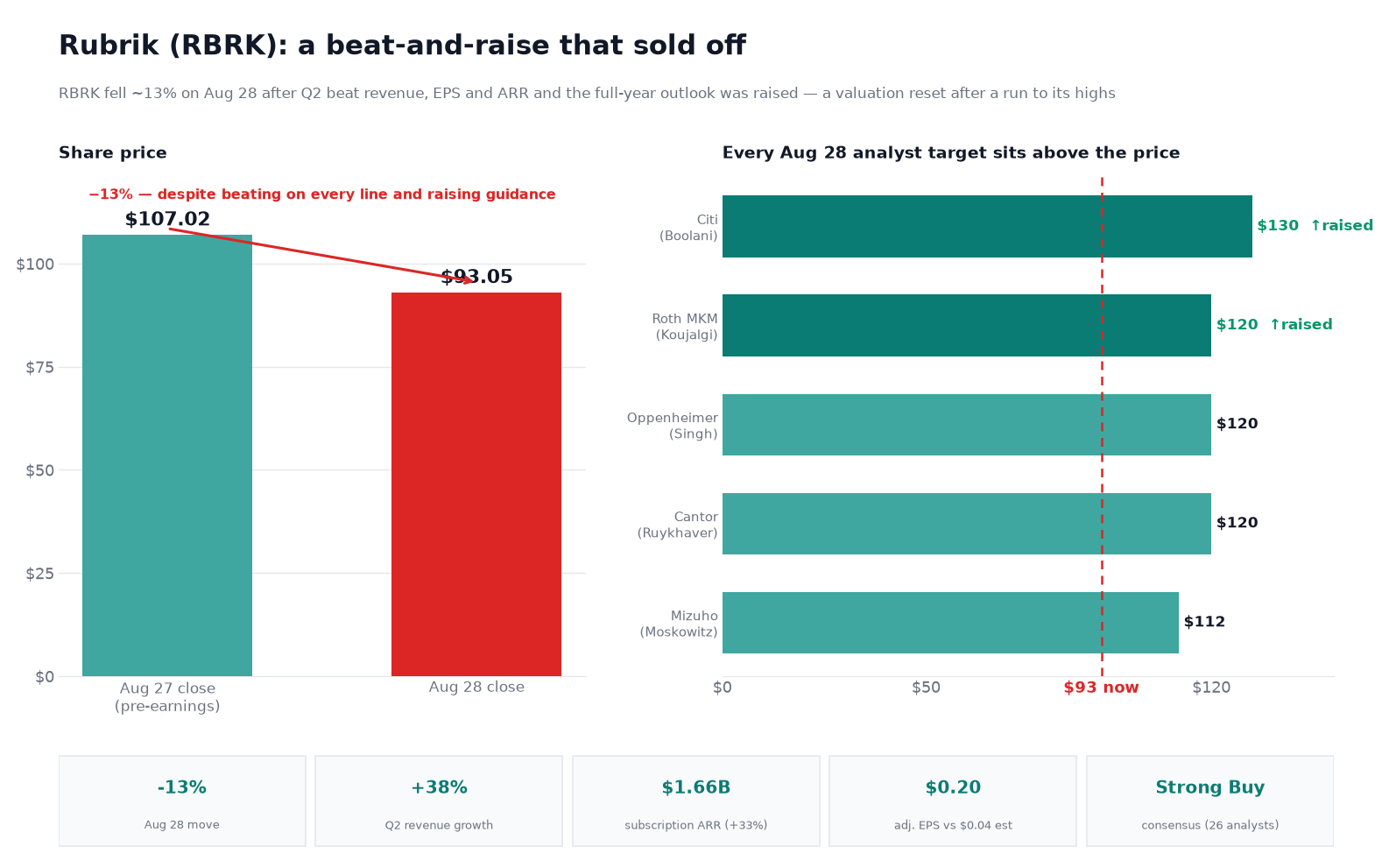
Rubrik fell 13.05% to $93.05 on August 28 after reporting fiscal Q2 2027 results — even though the quarter was a clear beat-and-raise. Revenue rose about 38% to $427 million, non-GAAP EPS of $0.20 crushed the ~$0.04 estimate, subscription ARR reached $1.66 billion (up 33%), and management raised full-year guidance across revenue, ARR, free cash flow and profit. The stock fell anyway because it had surged about 48% during August to near its 52-week high on roughly 14 times sales — so a strong beat still wasn't the blow-out the price demanded, a classic 'sell-the-news' valuation reset (subscription ARR growth actually held roughly steady at 33%, and Q3 guidance beat). The Street read it as an entry, not an exit: as the shares dropped, Citi raised its target to $130 and Roth MKM to $120, and the Street kept a Strong Buy consensus near $116. The debate is about the multiple, not the business — a fast-growing, ~80%-gross-margin, cyber-resilience leader that is now profitable on an adjusted basis but still lossmaking on GAAP.

Why Rubrik stock dropped — a beat-and-raise that wasn't enough
On Friday, August 28, 2026, Rubrik (NYSE: RBRK) fell 13.05% to close at $93.05, down from a $107.02 close the day before [1]. The trigger was the data-security company's fiscal second-quarter results, reported after the close on August 27 [2]. On the surface the print was strong: revenue of $427.3 million rose about 38% year over year and beat estimates, non-GAAP earnings of $0.20 a share crushed the roughly $0.04 consensus, subscription annual recurring revenue (ARR) reached $1.66 billion, up 33%, and management raised its full-year outlook across revenue, ARR, free cash flow and profit [2]. Chief Executive Bipul Sinha called it the company's tenth straight quarter of outperformance as a public company [2]. And the stock dropped anyway.
A valuation reset, not a broken quarter
The decline is best read as a "sell-the-news" valuation reset rather than a verdict on the business. Rubrik had surged roughly 48% during August into the report, closing the prior session at $107.02 — just under its 52-week high of $107.91 — on a rich multiple of about 14 times trailing sales [3]. When a stock has run that hard into a print the market already expected to be strong, even a clear beat can disappoint, because the bar embedded in the price was higher still; the natural response is to take profits. The quarter itself gave the bears little: subscription ARR growth actually held roughly steady (33%, versus 32% the prior quarter), and third-quarter revenue guidance of about $429–$431 million came in above consensus [2]. The subtler things investors could point to were secondary — adjusted net-new cloud ARR growth of roughly 20% and free-cash-flow margins a touch softer sequentially. Notably, even after the drop the stock still sits above its 50-day (~$85) and 200-day (~$68) moving averages — this was a sharp run being digested, not a trend breaking [3].
Why a strong quarter still sold off
Three things collided. First, positioning: the stock had run about 48% in a month into a print the market already expected to be strong, so the good news was largely in the price. Second, the multiple: at roughly 12 times sales even after the drop — about 14 times before it — for a business still unprofitable on a GAAP basis (a trailing net loss of about $254 million), a beat has to be a blow-out, not merely a beat, to push the stock higher [3]. Third, the details beneath the headline: adjusted net-new cloud ARR grew about 20% and free-cash-flow margins were a little softer sequentially — not weak, but enough to give a richly valued stock an excuse to take profits [2]. None of that is a thesis break; it is the market repricing how much future growth it is willing to pay for today.
Why it matters
Rubrik's reaction is a clean case study in how the market treats high-multiple software after a big run. The company did almost everything right — beat, raised, turned profitable on an adjusted basis, generated cash — and still lost an eighth of its value in a session, because expectations, not results, set the near-term price. It is also a read on demand for data security and cyber-resilience, a category that has held up as enterprises treat ransomware recovery and data protection as non-discretionary. The takeaway is not that growth is faltering; it is that the market is re-rating how much it will pay for that growth after a very sharp run-up. For a cohort of richly valued software names, that recalibration — beat-and-raise, sell the stock — has become the defining pattern of the season.
A soft software tape, but the move was Rubrik's own
Data-security and high-growth software names were broadly lower on August 28, but none fell remotely as far as Rubrik — underscoring that this was an earnings-specific reset, not a sector event [5]:
| Name (ticker) | Aug 28, 2026 | Read-through |
|---|---|---|
| RBRK — Rubrik | −13.1% | Valuation reset after a beat-and-raise from near its highs [1][2] |
| CVLT — Commvault | −2.8% | Rubrik's closest data-protection peer fell only modestly — no read-across panic [5] |
| S — SentinelOne | −5.0% | Growth-security names drifted with the group [5] |
| CRWD — CrowdStrike | −4.2% | The cyber bellwether softened but held up far better [5] |
| PANW — Palo Alto Networks | −2.9% | Large-cap security was only mildly lower [5] |
A weak group tape may have amplified the move, but a 13% drop against peers down 2–5% is a company-specific repricing [5].
What the Street did
The analyst response was uniformly constructive. Across roughly 28 analysts the consensus is a Strong Buy, with an average 12-month target near $116 (about 25% above the post-drop price) and a range of about $90 to $135 [6]. Every firm that updated on August 28 kept a Buy with a target well above the $93 close, and two raised: Citi's Fatima Boolani lifted hers to $130 (from $96) and Roth MKM's Imtiaz Koujalgi to $120 (from $107), while Cantor Fitzgerald's Jonathan Ruykhaver ($120), Oppenheimer's Param Singh ($120) and Mizuho's Gregg Moskowitz ($112) reiterated (their own raises had come earlier in August) [6]. When the sell side raises targets into a double-digit drop, it is telling you it views the selloff as an entry, not an exit — though the same analysts are, of course, the ones whose lofty targets set the bar the stock just failed to clear.
What to watch
- ARR growth. The single most important number is net-new and total subscription ARR. Steady growth supports the multiple; a sharper slowdown — especially in net-new cloud ARR, already running near 20% — would validate the derating [2].
- The path to GAAP profitability. Rubrik is profitable on an adjusted basis and free-cash-flow positive; watch how quickly stock-based compensation and the loss narrow toward GAAP breakeven [2].
- The multiple. At ~11x forward sales the stock needs continued execution; watch whether it re-rates back toward its highs or consolidates [3].
- Follow-through. Whether the Street's target hikes translate into buying. Moves are tracked on the RBRK stock page [1].
Illustrative valuation sensitivity
Rubrik is unprofitable on a GAAP basis, so a price-to-earnings frame is not meaningful; the scenarios below are anchored instead to a forward sales multiple (about 11× forward revenue today) and to the analyst target distribution (low ~$90, average ~$116, high ~$135) [6], turning on whether ARR growth holds or fades. They are a descriptive, author-weighted exercise — not a forecast, target, recommendation, or intrinsic fair-value calculation — with subjective weights that sum to 100%.
| Scenario | Illustrative price | Weight | Key drivers |
|---|---|---|---|
| Upside | ~$130 | 30% | ARR growth stays in the low-30s, free cash flow expands, and the market re-rates the multiple back toward the bullish Citi/Roth view [6]. |
| Middle | ~$105 | 40% | Growth moderates gracefully; the stock recovers part of the drop and drifts toward the average target as the multiple stabilizes [6]. |
| Downside | ~$80 | 30% | ARR deceleration accelerates or the software tape stays soft, and the forward-sales multiple compresses below the analyst low [3]. |
The middle and upside cases sit within the Street's $90–$135 range, while the downside case deliberately assumes a valuation de-rating below the current analyst low. Weighting those (0.30 × $130 + 0.40 × $105 + 0.30 × $80) gives an author-weighted reference value near $105, above Friday's $93.05 close [1][6] — reflecting a high-quality, fast-growing franchise whose debate is entirely about the multiple, not the business. This is a Street-target-and-multiple-based scenario exercise and descriptive analysis of an earnings move, not investment advice.
RBRK data snapshot — August 28, 2026
| Figure | Value | As-of / source |
|---|---|---|
| Close | $93.05 (−13.05%); after-hours ~$92.95 | Fri, Aug 28, 2026 — StockAnalysis [1] |
| Prior close / open / range | $107.02 prior close; opened $98.95; day range $93.00–$107.37 | Aug 27–28, 2026 [1] |
| Run-up into the print | Rose ~48% during August to near its 52-week high ($107.91) before the report — the setup for profit-taking | Aug 2026 — Barron's / market data [2] |
| 52-week range / trend | $42.25–$107.91; ~flat-to-+6% over 52 weeks; still above its ~$85 50-day and ~$68 200-day averages; RSI ≈51 | As of Aug 28 [3] |
| Market cap / EV | ≈$19.2B (205.8M shares); enterprise value ≈$18.5B; beta ≈1.17 | Aug 28 — StockAnalysis [3] |
| Valuation | GAAP unprofitable (no meaningful P/E); ≈12× trailing sales now (≈14× at the $107 pre-drop peak), ≈11× forward sales; ~$1.1B convertible debt, ~$1.75B cash & short-term investments | Aug 28 — StockAnalysis / company [3] |
| Q2 FY2027 results | Revenue $427.3M (+37.9%, vs ~$396M est); non-GAAP EPS $0.20 (vs ~$0.04 est); subscription ARR $1.66B (+33%); net-new subscription ARR ~$96M; cloud ARR $1.48B (+39%); ~78% GAAP / ~81% non-GAAP gross margin | Reported Aug 27 — company [2] |
| Raised FY2027 guidance | Subscription ARR $1.88–1.885B; revenue $1.685–1.693B; free cash flow $323–333M; non-GAAP EPS $0.47–0.53 | Aug 27 — company [2] |
| Volume | ~9.4M shares vs a ~3.7M 20-day average (~2.6×, very heavy) | Aug 28 — StockAnalysis [1] |
| Same-day peers | CVLT −2.8%, CRWD −4.2%, PANW −2.9%, S −5.0%, ZS −1.6%, DDOG −2.5% | Aug 28 [5] |
| Analyst view | ~28 analysts, consensus Strong Buy, avg target ≈$116 (range ~$90–$135); on Aug 28 Citi raised to $130 and Roth MKM to $120, while Cantor, Oppenheimer and Mizuho reiterated Buys at $112–$120 | Aug 2026 — StockAnalysis / analyst notes [6] |
The setup at a glance
| Question | Answer |
|---|---|
| Why did Rubrik stock drop on August 28? | Because a strong quarter still fell short of very high expectations. Rubrik reported fiscal Q2 results after the close on August 27 that beat on revenue (up ~38%), adjusted EPS ($0.20 vs ~$0.04) and subscription ARR ($1.66B, up 33%), and it raised full-year guidance — but the stock had run to near its 52-week high on a rich multiple, and the shares fell 13.05% to $93.05 in a classic "sell-the-news" reset [1][2]. |
| If the quarter beat, why did the stock fall? | Positioning and price. Rubrik had surged about 48% during August to near its 52-week high, trading at roughly 14 times sales into the print, so a strong result was already expected — and priced in. With the bar that high, a solid beat-and-raise simply wasn't the blow-out the valuation demanded, so investors took profits. Subscription ARR growth actually held roughly steady (33% versus 32% the prior quarter) and Q3 revenue guidance came in above consensus, so this was a valuation reset, not an earnings disappointment [2][3]. |
| Is the drop a warning about the business? | The Street doesn't think so. Not one covering analyst turned negative; several raised targets on the day of the drop, and the consensus stayed a Strong Buy near $116. Rubrik reached non-GAAP profitability earlier than expected, guided free cash flow firmly positive, and grew ARR 33% with ~80% gross margins. The debate is about valuation, not deterioration [6]. |
| Is Rubrik profitable? | On an adjusted basis, increasingly yes — it posted $0.20 in non-GAAP EPS and guided full-year non-GAAP EPS of $0.47–$0.53 with $323–$333M of free cash flow. On a GAAP basis it is still lossmaking (a trailing net loss of about $254M), which is why a price-to-earnings multiple isn't meaningful and the stock is valued on sales and ARR instead [2][3]. |
| What is the biggest risk now? | The multiple. At roughly 11 times forward sales, with GAAP profits still absent, the stock discounts years of continued flawless execution. A slowdown in net-new cloud ARR (already running near 20%), a softer software tape, or the $1.1B convertible-debt overhang could compress the multiple further — the flip side of owning a fast compounder at a premium price after a big run [3]. |
| What do analysts think? | Overwhelmingly bullish. Across about 28 analysts the consensus is a Strong Buy, with an average target near $116 (about 25% above the post-drop price) and a range of about $90 to $135. On the day of the drop, Citi raised its target to $130 and Roth MKM to $120, while Cantor, Oppenheimer and Mizuho reiterated Buys at $112–$120 [6]. |
Rubrik (RBRK) stock FAQ
Why did Rubrik (RBRK) stock drop on August 28, 2026?
Because a strong quarter still fell short of very high expectations. Rubrik reported fiscal second-quarter 2027 results after the close on August 27 that beat across the board — revenue up about 38% to $427 million, non-GAAP EPS of $0.20 versus roughly $0.04 expected, and subscription ARR of $1.66 billion, up 33% — and it raised full-year guidance. But the stock had surged about 48% during August to near its 52-week high on a rich multiple of about 14 times sales, so the good news was already priced in. With the bar that high, a solid beat-and-raise wasn't the blow-out the valuation demanded, and the shares fell 13.05% to $93.05 in a classic 'sell-the-news' valuation reset.
If the quarter beat, why did the stock fall?
Positioning and price. Rubrik had run about 48% during August to near its 52-week high, trading at roughly 14 times sales going into the report, which means a strong beat was already expected. With the bar that high, a solid beat-and-raise simply wasn't the upside surprise the valuation demanded, so investors took profits. The quarter itself gave the bears little — subscription annual recurring revenue growth held steady at 33% (versus 32% the prior quarter) and third-quarter revenue guidance came in above consensus. Investors could point to softer details, such as adjusted net-new cloud ARR growth of about 20% and slightly softer sequential cash-flow margins, but this was a valuation reset on a richly priced stock, not an earnings disappointment.
Is the sell-off a warning about Rubrik's business?
The analyst community does not think so. Not a single covering analyst turned negative on the day of the drop, and several actually raised their price targets; the consensus stayed a Strong Buy near $116. Rubrik reached non-GAAP profitability earlier than expected, guided free cash flow firmly positive ($323–$333 million for the year), and continued to grow ARR 33% with about 80% gross margins. The debate is about how much to pay for that growth, not whether the growth is real.
Is Rubrik profitable?
It depends on the measure. On an adjusted (non-GAAP) basis, increasingly yes — Rubrik posted $0.20 of non-GAAP EPS in the quarter and guided to $0.47–$0.53 for the full year, with $323–$333 million of free cash flow. On a GAAP basis it is still lossmaking, with a trailing net loss of roughly $254 million driven largely by stock-based compensation. That is why a price-to-earnings ratio is not meaningful for Rubrik, and investors value it on sales and ARR instead.
What is the biggest risk for Rubrik stock now?
The valuation. At roughly 11 times forward sales, with GAAP profitability still absent, the stock prices in years of continued flawless execution. A slowdown in net-new cloud ARR growth (already running near 20%), a prolonged soft patch for high-growth software, or pressure from its roughly $1.1 billion of convertible debt could compress the multiple further. That is the trade-off of owning a fast-growing, category-leading compounder at a premium price after a sharp run — the business can do well while the stock still de-rates.
What do analysts think of Rubrik?
They are overwhelmingly bullish. Across about 28 analysts, Rubrik carries a Strong Buy consensus with an average 12-month target near $116 (about 25% above the post-drop price) and a range of roughly $90 to $135. On the very day the stock fell 13%, Citi's Fatima Boolani raised her target to $130 and Roth MKM's Imtiaz Koujalgi to $120, while Cantor Fitzgerald, Oppenheimer and Mizuho reiterated Buy ratings at targets of $112 to $120 — a clear signal the Street reads the drop as a valuation reset rather than a deterioration.