Stock Analysis
SiTime Stock (SITM) Falls 14.6% in a Chip Rout: What Actually Changed
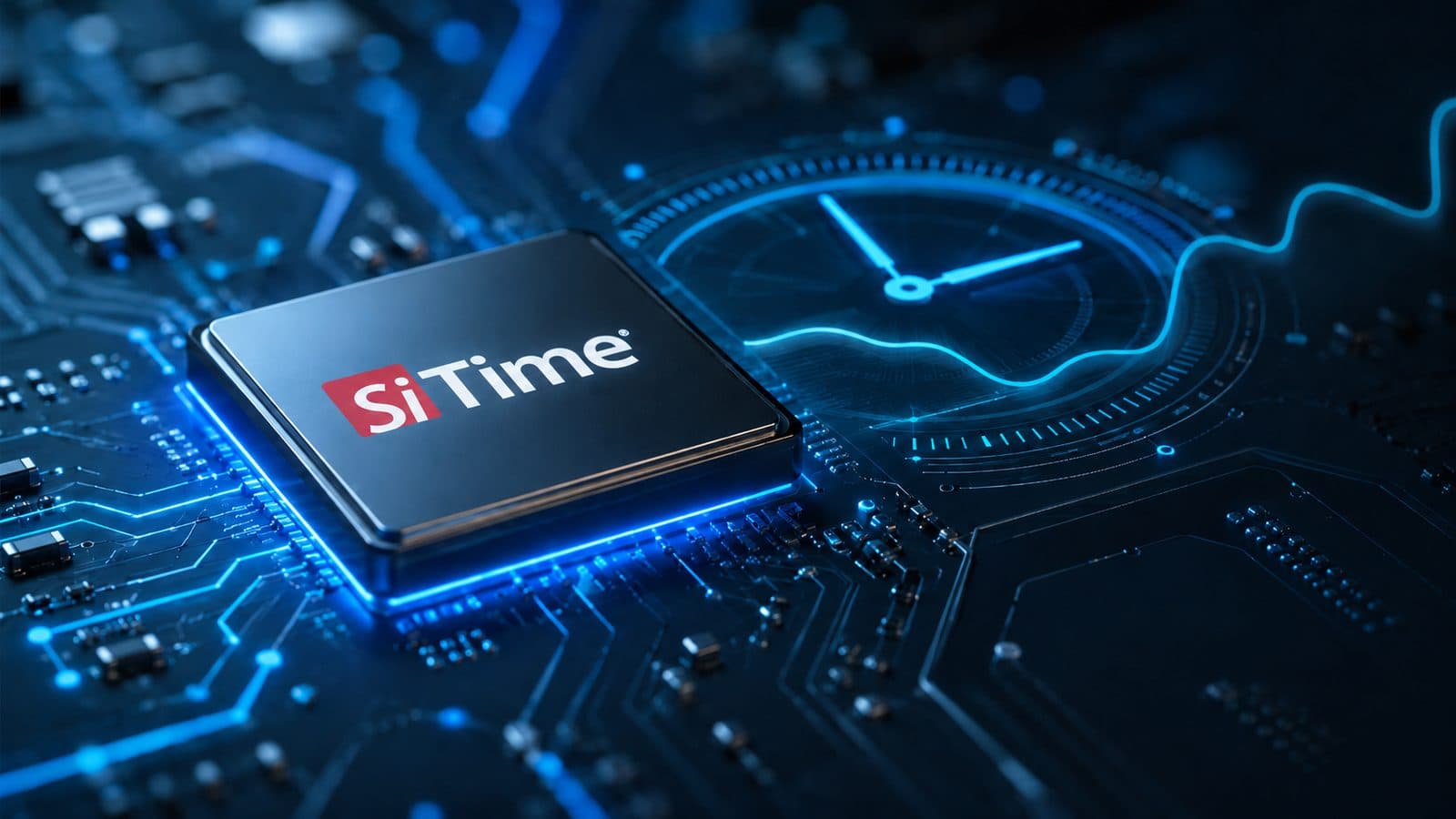
SiTime stock fell 14.6% on July 2, dragged down by a semiconductor selloff one day after completing its Renesas timing acquisition. The move says more about positioning and valuation than about the business.
Why did SiTime stock drop 14.6%?
SiTime stock (SITM) dropped 14.6% on July 2, 2026, closing at $601.66, because a macro-driven selloff hit semiconductor stocks and punished high-multiple names hardest — not because of negative company news [1][2].
There was no earnings report or downgrade on July 2, but the session wasn't news-free either: SiTime had completed its acquisition of Renesas' timing business one day earlier, on July 1, and filed an 8-K disclosing the final consideration and related financing [6][7]. Still, the main force was the sector: the VanEck Semiconductor ETF (SMH) lost 4.4%, the worst industry group of the day, while the Nasdaq 100 dropped 1.9% and the Dow set a record high [2].
The trigger was macro. June nonfarm payrolls came in at 57,000, roughly half the 113,000 consensus, with inflation still running at 4.2%. An awkward mix for a market bracing for a possible Fed hike, and high-multiple chip names took the brunt [2].
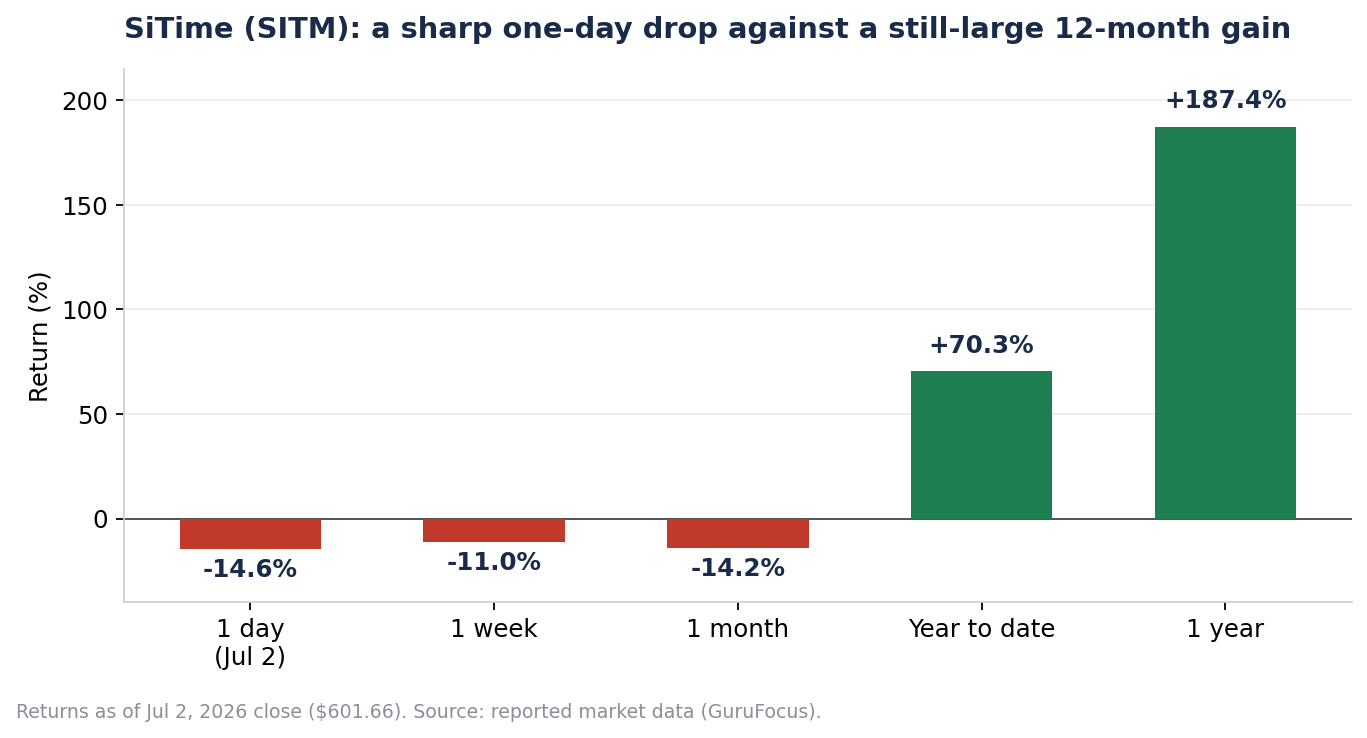
Even after the drop, SITM is up 70.3% year to date and 187.4% over twelve months [1].
What changed for SITM on July 2?
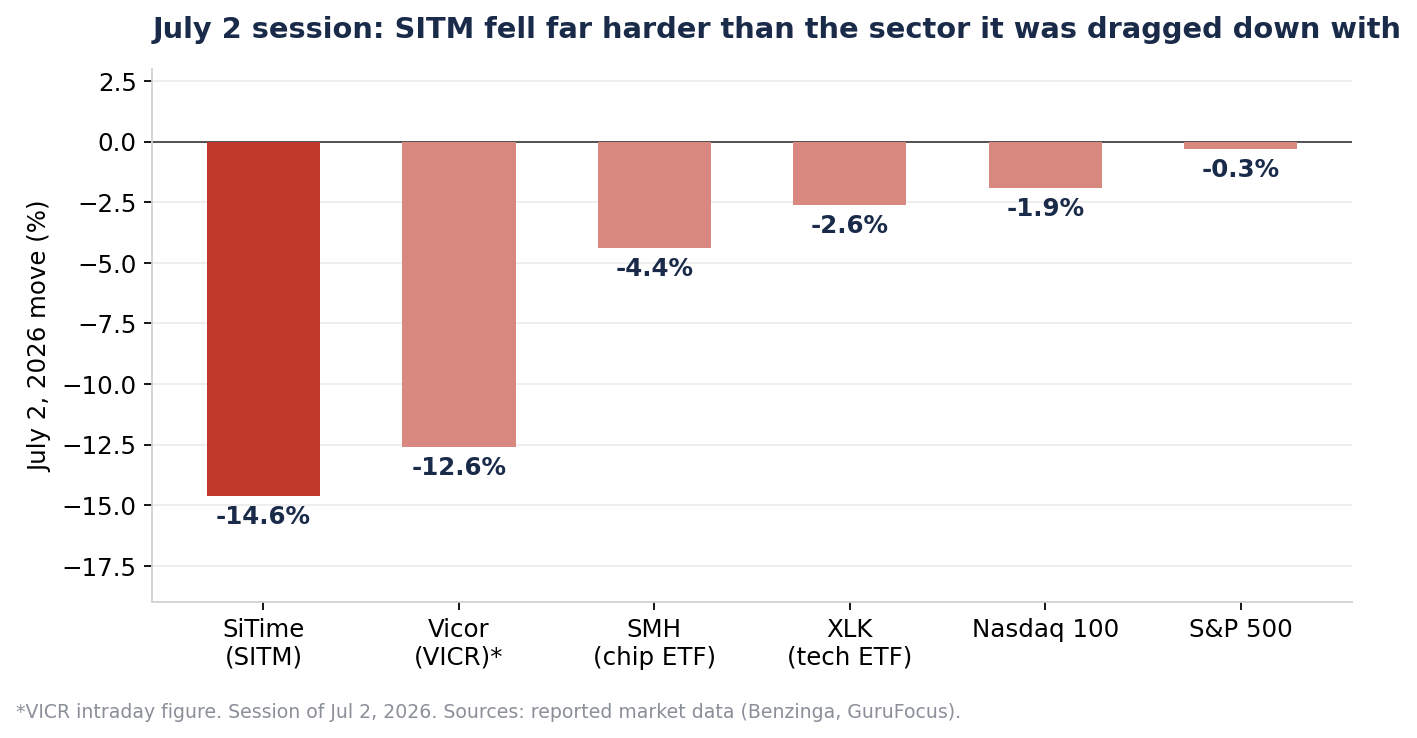
The July 2 session was a sector event that hit SiTime harder than the sector. SMH fell 4.4%, the tech sector fund XLK lost 2.6%, the Nasdaq 100 dropped 1.9%, and the S&P 500 slipped just 0.3% [2]. SITM fell 14.6% [1]. Micron, KLA and Lam Research were all sharply lower too, but the steepest losses in the group belonged to smaller, higher-multiple names [2].
This also wasn't the first down day. The stock is off 11.0% over the past week and 14.2% over the past month [1], so momentum had been cooling for a while before Thursday's rout made it obvious.
The pullback follows a very strong run. Q1 2026 results on May 6 showed revenue of $113.6 million and non-GAAP EPS of $1.44 [3], and a Barclays upgrade the next day helped send the shares up about 28% on May 7, to a close of $797.31 [8]. The 52-week range tells you how wide the swings have been: a low of $186.49 and a high of $901.81 [1].
Why the drop matters for SiTime stock
For holders, the useful question is whether Wednesday revealed anything new about SiTime. On the operating side, it didn't. The Q1 numbers were strong, and the Elite 2 Super-TCXO, a timing product aimed at synchronization inside AI data centers, is sampling now with commercial production planned for Q3 2026 [3]. The AI data-center demand story that drove the rally is intact.
What the drop does expose is how much sensitivity has built up around the stock. Three things amplify moves like this one. First, valuation: even after the decline, a P/S ratio near 47.6x leaves little room for disappointment [4]. Second, the balance sheet is busier than it used to be. SiTime completed the Renesas timing acquisition on July 1, paying roughly $1.5 billion in cash plus 3,558,691 newly issued shares [7], and it carries $1.35 billion of zero-coupon convertible notes issued to help fund the deal [4]. Dilution and integration are now live items, not pending ones. Third, the market has punished SiTime for capital raises before: shares fell after the company announced a $350 million public offering, on dilution concerns [5].
None of these items is new. A day like July 2 just reprices how much investors are willing to pay to hold them.
What to watch next for SITM
Near term, the sector matters more than the company. Watch whether SMH stabilizes or keeps sliding; SiTime has amplified sector moves in both directions all year, including a 28% single-day gain in May [8] and a double-digit drop in March.
On the macro side, the Fed path is the live variable. After the payrolls miss, odds of a September rate hike fell to roughly 50% from about 64% a day earlier, and Fed Chair Kevin Warsh has signaled little urgency to tighten further [2]. Softer rate expectations would help high-multiple names like this one; hotter inflation prints would do the opposite.
Company-specific markers to track now center on Renesas integration: the acquired business's revenue contribution against management's target of at least $300 million in its first twelve months [6], its effect on gross margins, and how the dilution from the deal shares and the convertible-note debt load flow through per-share numbers. Beyond the deal, watch the Q3 2026 production ramp of the Elite 2 product line, the next earnings report and whether management's AI and data-center demand commentary holds its tone, and the pace of insider selling. If the fundamentals keep delivering while the multiple compresses, the risk profile of the stock changes even if the business doesn't.
Did SiTime stock fall because of the Renesas deal?
Mostly no: the July 2 drop tracked a sector-wide semiconductor selloff, and the Renesas closing had been announced in February and expected for months [2][7]. The deal matters mainly as an amplifier — the 3,558,691 newly issued shares and the convertible debt make SITM more sensitive on risk-off days [4][7].
Why did SITM fall harder than other chip stocks?
- Valuation left no cushion. Roughly 47.6x sales versus a semiconductor industry average of 8.8x [4].
- Crowded momentum ownership. The stock was up 187.4% over twelve months going into the session, so it carried a large base of gains to protect [1].
- Dilution became concrete. The Renesas closing on July 1 issued 3,558,691 new shares and finalized deal financing [7].
- Insider selling removed a support signal. $367 million sold over the prior three months, with no reported buying [1].
- High-beta names led the losses. Vicor fell about 12.6% intraday in the same session; smaller high-multiple chip names dropped far more than the group [2].
SITM vs chip peers and benchmarks on July 2, 2026
The comparison shows how concentrated the damage was: the further out the risk curve, the harder the fall.
| Name | July 2 move | Baseline | What it is |
|---|---|---|---|
| SiTime (SITM) | −14.6% | Prior close → $601.66 close [1] | MEMS precision-timing chips |
| Vicor (VICR) | ~−12.6% | Intraday, as reported [2] | Power modules |
| SMH | −4.4% | Full session [2] | Semiconductor sector ETF |
| XLK | −2.6% | Full session [2] | Technology sector ETF |
| Nasdaq 100 | −1.9% | Full session [2] | Large-cap tech index |
| S&P 500 | −0.3% | Full session [2] | Broad market index |
Figures per cited reporting; approximate where marked (~). Baselines are stated per row; the SITM figure is close-to-close, the VICR figure was reported intraday.
What could move SITM next?
- Q2 2026 earnings (expected early August, not yet scheduled). The first report to include any Renesas contribution; Q1 was reported May 6 [3].
- Elite 2 Super-TCXO volume production (Q3 2026). The AI data-center timing product moves from sampling to commercial production [3].
- The Fed's September decision. Hike odds sat near 50% after the payrolls miss; a shift either way repriced high-multiple chip names all year [2].
- Renesas integration milestones. Progress against management's target of at least $300 million of revenue from the acquired business in its first twelve months [6].
- Insider filings. Whether the recent pace of selling continues or slows [1].
SiTime stock FAQ
What does SiTime do?
SiTime (NASDAQ: SITM) is a Santa Clara-based semiconductor company that designs MEMS-based precision timing products — oscillators, clocks and resonators that synchronize signals in AI data centers, communications networks, industrial systems and other electronics.
Did SiTime report bad news on July 2, 2026?
No. There was no earnings report or downgrade. The 14.6% drop tracked a sector-wide semiconductor selloff triggered by a weak June payrolls print. One day earlier, on July 1, SiTime completed its previously announced acquisition of Renesas' timing business.
What did SiTime pay for Renesas' timing business?
At the July 1, 2026 closing, SiTime paid approximately $1.5 billion in cash plus 3,558,691 newly issued shares of its common stock, per the company's 8-K filing.
Is SiTime stock still up in 2026?
Yes. Even after the July 2 decline to $601.66, SITM was up 70.3% year to date and 187.4% over the trailing twelve months, per reported market data as of that close.
When are SiTime's next earnings?
SiTime reported Q1 2026 results on May 6, 2026. Q2 2026 results are expected around early August 2026 based on the company's usual cadence, but the date had not been officially announced as of this writing.