AI Infrastructure
Lumentum (LITE) Stock Jump: The Optical AI Blowout That Lit Up the Group
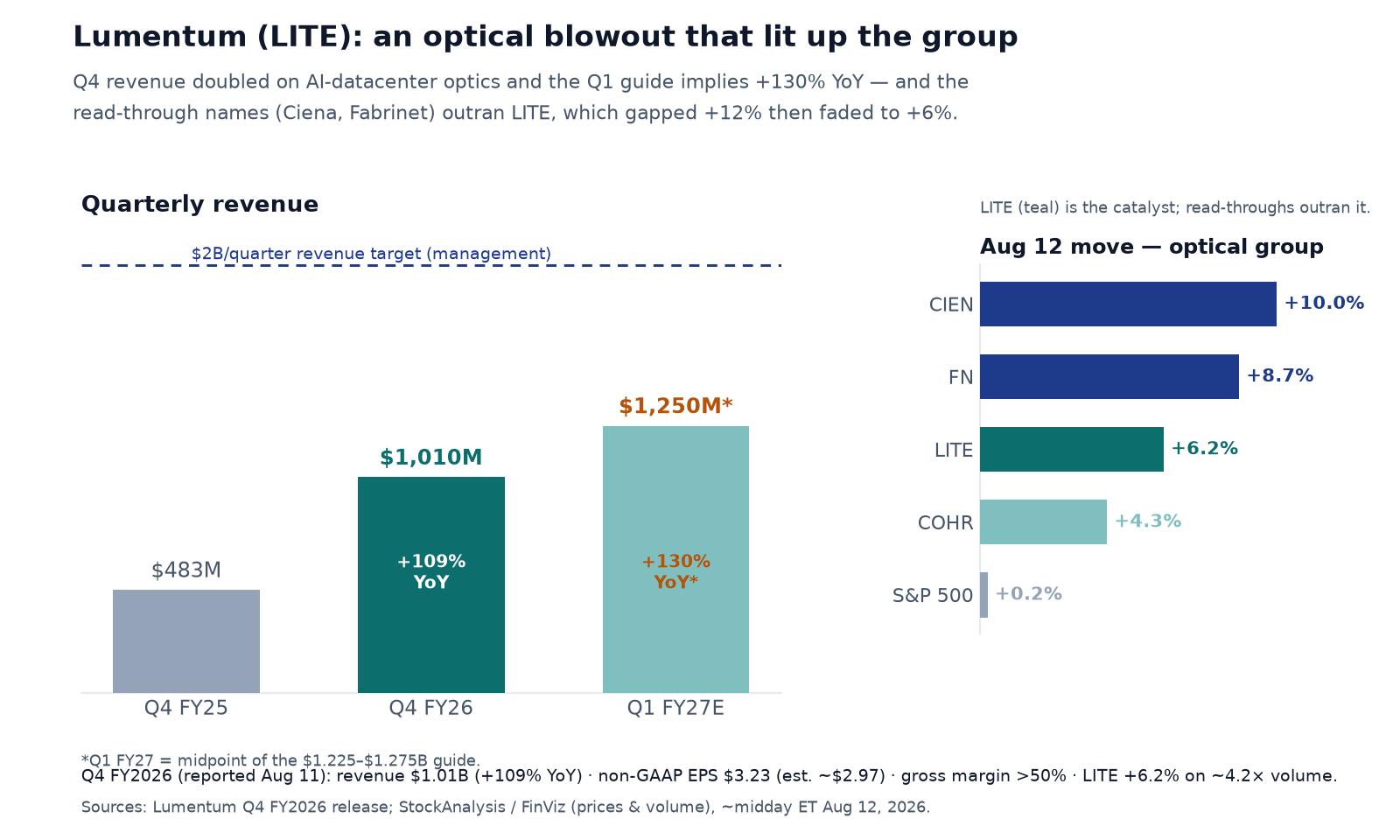
Lumentum jumped ~6% to ~$871 after a fiscal Q4 blowout: revenue $1.01B (+109% YoY), non-GAAP EPS $3.23, and a fiscal-Q1 guide raised to ~130% YoY growth on AI data-center optics. The print lit up the whole optical complex — Ciena +10%, Fabrinet +9%, Coherent +4% — but LITE gapped up ~12% at the open and faded to +6% on heavy volume. A durable AI-optics leader, or a lot already in the price?

Summary
On Tuesday, August 12, 2026, Lumentum (NASDAQ: LITE) rose about 6% to roughly $871 from an $820.59 prior close, after reporting a blowout fiscal fourth quarter the evening before [1][3]. Revenue hit $1.01 billion, up 109% year over year, non-GAAP EPS of $3.23 beat a ~$2.97 consensus, and — the part that moved the tape — management raised fiscal-Q1 guidance to $1.225–$1.275 billion, a ~130% year-over-year jump at the midpoint [1][2]. The print lit up the entire optical complex: Ciena jumped ~10% and Fabrinet ~9% — both outrunning Lumentum itself, which gapped up as much as 12% at the open and then faded. This was a sector melt-up in AI-datacenter optics, ignited by one company's numbers — and the fade is the tell worth reading.
What changed
Lumentum makes the lasers and optical components that move data inside and between data centers, and AI is bending that curve vertically. The quarter was the clearest statement yet of it [1][2]:
- Revenue $1.01B, up 109% year over year, at the high end of guidance [1].
- Non-GAAP EPS $3.23 vs a ~$2.97 consensus, with non-GAAP gross margin above 50% [1].
- Fiscal-Q1 2027 guidance raised to $1.225–$1.275B — a midpoint up ~130% year over year and a double-digit sequential step up [1][2].
- Management pointed to a longer-term $2 billion-per-quarter revenue target, framing the current ramp as early [2].
- Growth is led by cloud and AI data-center optics — datacenter optical links, optical circuit switching (OCS) and a scaling cloud-module business as hyperscalers turn to optics for AI connectivity [2].
The gap-and-fade
Here is the nuance the headline "+6%" hides. Lumentum opened at $899 (up ~9.6%) and traded as high as $918.89 (up ~12%) before giving back roughly half of that to sit near $871 by midday [3]. A blowout that fades intraday is a classic sell-the-news signature — and it fits a stock that had already risen ~135% year to date into the print [4]. Tellingly, the money rotated: the read-through names with no news of their own — Ciena (+10%) and Fabrinet (+9%) — closed the morning ahead of Lumentum, as traders reached for the optical exposure that hadn't already run as far [9][10].
Why it matters
Optics is becoming the connective tissue of AI compute. As clusters scale, the bottleneck shifts from the chips to the links between them — and copper runs out of reach, so hyperscalers move to optical interconnects, pluggable transceivers, and now optical circuit switching to wire GPUs together. Lumentum sits at the component layer of that shift, which is why a single print re-rated the whole group. It echoes the AI-networking demand we tracked at Arista and the datacenter-optics ramp at Applied Optoelectronics — the same tailwind, one layer down in the stack. The question the fade raises is not whether the demand is real, but how much of it the market has already paid for.
How the peers and sector traded the same day
This was unambiguously a group move. With the S&P 500 up just 0.25%, the optical names ran several times the market — but Lumentum, the one with the actual catalyst, brought up the rear [7]:
| Name (ticker) | Aug 12 move | Note |
|---|---|---|
| CIEN — Ciena | +10.0% | ~$426; read-through, no own catalyst [9] |
| FN — Fabrinet | +8.7% | ~$572; optical contract manufacturer, read-through [10] |
| LITE — Lumentum | +6.2% | ~$871; the catalyst — gapped +12%, faded [1][3] |
| COHR — Coherent | +4.3% | ~$343; optical components peer [11] |
| S&P 500 (index) | +0.25% | Broad market modestly higher [7] |
When the read-throughs outrun the catalyst, it usually means the catalyst was more anticipated — Lumentum was the expected winner, so the incremental buying went to the optical names that hadn't yet re-rated. That is bullish for the theme and a yellow flag for chasing the leader.
What to watch
- Whether the +130% guide is beaten — Lumentum set a high bar for fiscal Q1; a beat-and-raise sustains the multiple, an in-line print into ~40x forward may not [1].
- Gross-margin trajectory toward and past 50% — the AI-optics mix is lifting margins; holding the gain as volume scales is the profitability proof [1].
- The $2B-quarter path — management's long-term target only supports the valuation if OCS, cloud modules and datacenter links keep layering in on schedule [2].
- Hyperscaler capex signals — Lumentum is a derivative of AI infrastructure spend; any pause in cloud capex would hit the optical group fast, and it is up a lot [2].
- Whether the group holds the gains — a melt-up where read-throughs outrun the catalyst can round-trip; watch CIEN, FN and COHR on the earnings calendar and the LITE stock page [9].
Illustrative valuation scenarios
The scenarios below are a descriptive, probability-weighted price-anchor exercise — not a forecast or a recommendation. The high end is anchored to named analyst targets (the ~$1,130 average; Raymond James $1,036); the low end reflects a multiple reset. Probabilities are the author's own illustrative estimates and sum to 100%.
| Scenario | Price anchor | Prob. | Key drivers |
|---|---|---|---|
| Bull | ~$1,140 | 35% | AI-optics demand compounds, the ~130% Q1 guide proves conservative, margins hold above 50%, and the $2B-quarter target comes into view; LITE holds a premium multiple on rising estimates and closes the gap to consensus. Anchored to the ~$1,130 average target [8]. |
| Base | ~$960 | 40% | Strong growth continues but the stock consolidates after a ~135% year and a blowout that already faded, holding ~40x forward on rising estimates without fully closing the gap to targets. Near Bank of America's $1,000 [6]. |
| Bear | ~$650 | 25% | An AI-capex or optical-order digestion, or a hyperscaler pause, hits the whole group; the premium multiple compresses and the melt-up round-trips. Well below the target range but far above the 52-week low ($111) [3]. |
Blending those (0.35 × $1,140 + 0.40 × $960 + 0.25 × $650) gives a probability-weighted anchor near $945, versus the ~$866 intraday price and the ~$1,130 average target [3][8]. The anchor sits above the price but below consensus — the beat was real and the demand is durable, but a stock that gapped +12% and gave back half is telling you a lot is already in the price. This is descriptive analysis of a corporate event, not investment advice.
Why is Lumentum (LITE) stock up today?
Lumentum rose about 6% to ~$871 on August 12, 2026 after reporting fiscal fourth-quarter results the prior evening: revenue of $1.01 billion (up 109% year over year), non-GAAP EPS of $3.23 versus a ~$2.97 consensus, and raised fiscal-Q1 guidance of $1.225–$1.275 billion (a ~130% year-over-year midpoint) on surging AI data-center optical demand [1][2]. The print lifted the whole optical group — Ciena +10%, Fabrinet +9%, Coherent +4% — though Lumentum itself gapped up ~12% at the open and faded to ~+6% [3][9].
LITE data snapshot — August 12, 2026 (timestamped)
| Figure | Value | As-of / source |
|---|---|---|
| Prior close | $820.59 | Mon, Aug 11, 2026 [3] |
| Open (Aug 12) | $899.00 (~+9.6%) | 9:30 a.m. ET [3] |
| Intraday high | $918.89 (~+12.0%) | Aug 12 session [3] |
| Primary intraday quote | $871.31 (+6.18%) | ≈ midday ET — StockAnalysis [3] |
| Corroborating quotes | $866.45 (+5.59%) | FinViz, ~midday [4] |
| Volume vs average | ≈ 3.5M by midday vs ~5.31M full-day avg — a pace-adjusted ~4.2x relative volume | Aug 12 — FinViz [4] |
| 52-week range | $111.20 – $1,085.68 | As of Aug 12 [3] |
| Market cap | ≈ $67.5B (~77.8M shares) | At the intraday quote, Aug 12 [3] |
| Valuation | ≈ 40x forward; trailing GAAP n/a (net loss) | Aug 12 — StockAnalysis / FinViz [3][4] |
Each figure is valid only at its stated time; the intraday quote comes from a fast-moving, gap-and-fade session, and two independent feeds (StockAnalysis and FinViz) agree on both the ~$866–871 price and the ~+6% move.
The quarter at a glance
| Question | Answer |
|---|---|
| What did Lumentum report? | Fiscal Q4 2026 (reported Aug 11): revenue $1.01B (+109% YoY, high end of guide), non-GAAP EPS $3.23 vs ~$2.97, non-GAAP gross margin above 50% [1]. |
| What drove the stock? | Mostly the guidance: fiscal-Q1 2027 revenue raised to $1.225–$1.275B, a ~130% YoY midpoint, on AI data-center optical demand [1][2]. |
| Why did it fade intraday? | It gapped up ~12% then gave back half — a sell-the-news move after a ~135% year-to-date run; read-through peers (CIEN +10%, FN +9%) outran the catalyst [3][9]. |
| Was it a sector move? | Yes. The optical complex rallied together while the S&P rose just 0.25%, so this was a group melt-up ignited by Lumentum's print [7]. |
| What did analysts do? | Mostly bullish: Raymond James to $1,036 (Outperform), Stifel named it a Top Pick; but BofA's Arya trimmed to $1,000 (Hold). Average target ~$1,130 vs ~$866 [5][6][8]. |
Lumentum (LITE) stock FAQ
Why did Lumentum (LITE) stock jump on August 12, 2026?
Lumentum rose about 6% to roughly $871 after reporting fiscal fourth-quarter 2026 results the prior evening: revenue of $1.01 billion (up 109% year over year), non-GAAP EPS of $3.23 versus a ~$2.97 consensus, and — most importantly — raised fiscal-Q1 2027 guidance of $1.225–$1.275 billion, a roughly 130% year-over-year midpoint, driven by AI data-center optical demand.
Why did the stock fade after gapping up?
Lumentum opened around $899 (up ~9.6%) and traded as high as $918.89 (up ~12%) before giving back about half of the gain to sit near $871 by midday. That gap-and-fade is a classic sell-the-news pattern, and it fits a stock that had already risen about 135% year to date into the print. Read-through peers with no news of their own — Ciena (+10%) and Fabrinet (+9%) — actually outran Lumentum on the day.
Was this a sector move or company-specific?
Both, but mostly a sector move. Lumentum's own blowout was the catalyst, but it lit up the entire optical complex: Ciena rose ~10%, Fabrinet ~9%, and Coherent ~4%, while the S&P 500 gained just 0.25%. When the read-through names outrun the company that reported, it signals the catalyst was widely anticipated and the incremental buying rotated into the peers that hadn't yet re-rated.
Why does optical networking matter for AI?
As AI compute clusters scale, the bottleneck shifts from the chips to the links between them. Copper interconnects run out of reach at high speeds and distances, so hyperscalers turn to optical links, pluggable transceivers and optical circuit switching to connect GPUs. Lumentum supplies the lasers and optical components for that shift, so its revenue scales with AI-infrastructure build-outs.
Was the move on strong volume?
Yes. Unlike a thin momentum pop, Lumentum traded roughly 3.5 million shares by midday against a full-day average near 5.3 million — about 4.2x relative volume — indicating heavy, real institutional participation in the move even as the stock faded from its highs.
Is LITE stock expensive after the run?
It is richly valued. The stock is up about 135% year to date and trades near 40x forward earnings; on a GAAP basis Lumentum is unprofitable over the trailing year (weighed down by large non-cash items), so it is valued on non-GAAP and forward estimates. At roughly $866 it sits below the ~$1,130 average analyst target, but the intraday fade suggests much of the near-term upside is already priced. This is descriptive analysis, not investment advice.