Technology
Snowflake (SNOW) Jumps 16% on a Q2 Beat-and-Raise as a Software Pop Fades
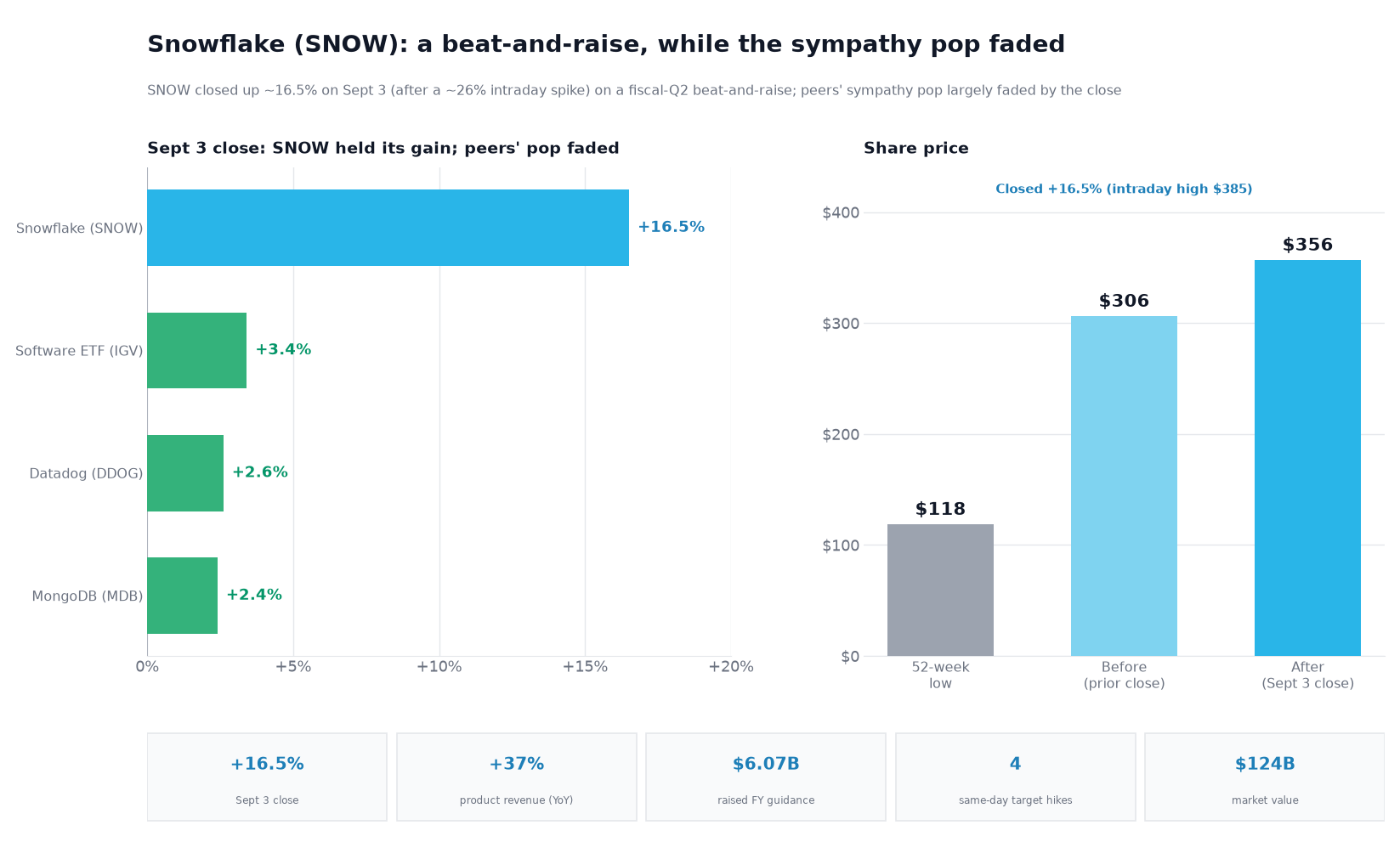
Snowflake jumped as much as 26% intraday to a 52-week high of $384.56, then pared the gain to close up about 16.5% at $356.47, after reporting fiscal second-quarter results the evening before that beat and — the part that moves stocks — raised full-year guidance. Product revenue re-accelerated to about 37% growth ($1.49 billion), adjusted earnings of about $0.62 topped the ~$0.45 expected, and management lifted its full-year product-revenue target to roughly $6.07 billion while widening its margin outlook. The beat-and-raise sparked a sympathy surge across software — Datadog and MongoDB edged higher — on the idea that AI is a tailwind rather than a threat, but that broader enthusiasm largely faded by the close, leaving both peers up only about 2.5% while Snowflake held its gain. The catch is the price: after a ~55% year, Snowflake trades near 15 times forward sales and is still GAAP-unprofitable on heavy stock comp, though it closed somewhat below the average analyst target even after a wave of same-day target increases.

Why Snowflake stock surged — a beat-and-raise to a 52-week high
On Thursday, September 3, 2026, Snowflake (NYSE: SNOW) jumped as much as 26% intraday to a 52-week high of $384.56, then pared the gain to close up about 16.5% at $356.47, from a $305.84 prior close [1]. The catalyst was concrete and freshly dated: after the close the evening before, Snowflake reported fiscal second-quarter results that beat on both revenue and earnings and, crucially, raised full-year guidance [2]. It was the kind of clean beat-and-raise the market had been waiting for from a high-multiple software name — and it sparked a sympathy surge across enterprise-software stocks, though much of that broader enthusiasm faded by the close [5].
Inside the quarter: re-accelerating growth
The headline was growth that sped up rather than slowed. Product revenue — the core measure of Snowflake's consumption business — rose about 37% year over year to roughly $1.49 billion, an acceleration and the company's second consecutive quarter of record sequential dollar growth; total revenue was about $1.55 billion, up ~35% [2]. Adjusted (non-GAAP) earnings came in near $0.62 a share, well ahead of the roughly $0.45 analysts expected [2]. Management then did the thing that moves stocks most: it raised the full-year product-revenue outlook to about $6.07 billion (from roughly $5.84 billion in May) and lifted its adjusted operating-margin target to about 14.5% [2]. Profitability is improving alongside growth — non-GAAP operating margin expanded more than 400 basis points to about 15% — and the AI story is showing tangible adoption, with Snowflake's AI coding agent reaching roughly 9,100 accounts, up about 2,000 in the quarter [2]. Growth, margins and AI traction all moving the right way at once is what sent the shares soaring.
Priced for a lot
The bull case still has to contend with the price. Even before Thursday, Snowflake had climbed about 55% over the past year, and the earnings-day gain left it trading at roughly 15 times forward sales — a demanding multiple, and one that assumes years of 25%-plus growth [3]. The company is still unprofitable on a GAAP basis (a trailing net loss of about $1.1 billion, weighed down by heavy stock-based compensation), though that understates the cash economics: Snowflake generates roughly $1.2 billion of free cash flow a year at a 67% gross margin [3]. Even after the jump, the shares closed somewhat below the average analyst price target near $395 (captured that session, and climbing as firms raised targets), so the Street still sees room — the debate is whether re-accelerating growth and expanding margins justify paying such a premium multiple.
Why it matters
Snowflake's jump is about more than one quarter. For two years, the fear hanging over software has been that generative AI would disrupt incumbent platforms — that AI could hollow out the value of databases, analytics and SaaS tools. September 3 was, for a session, the market voting the other way: Snowflake's beat-and-raise sparked a sympathy surge across data-software names — Datadog and MongoDB edged higher — on the idea that AI is a tailwind, not a threat, since enterprises adopting AI need more data infrastructure, more observability and more managed databases, not less. But that broader enthusiasm largely faded by the close; it was Snowflake's own numbers that held. Snowflake, whose whole pitch is to be the place enterprise data lives and where AI models are fed, is a natural bellwether for the AI-tailwind thesis — and holding a ~16.5% gain while peers managed only small gains was the clearest sign that its blowout quarter, more than the sector narrative, was the durable signal.
Snowflake held; the sympathy pop faded, in one cross-section
The same-day tape shows Snowflake held its earnings gain while the sympathy surge in its peers largely faded by the close [5]:
| Name (ticker) | Sept 3, 2026 | Read-through |
|---|---|---|
| SNOW — Snowflake | ≈+16.5% (close) | Fiscal-Q2 beat-and-raise; product revenue +37%, guidance lifted — held its gain [1][2] |
| DDOG — Datadog | ≈+2.6% (close) | A modest sympathy gain 14 rose only single digits intraday, gave part back [5] |
| MDB — MongoDB | ≈+2.4% (close) | Revenue up ~30% to ~$772M, but its intraday pop also faded [5] |
| IGV — Software ETF | ≈+3.4% | The broad software group finished up modestly [5] |
Snowflake closing up ~16.5% on its own beat-and-raise while the peers that rose in sympathy finished up only ~2.5% is the signal: the durable move was company-specific, and the broader AI-software enthusiasm proved thin outside the name that actually delivered [5].
What the Street thinks
The sell side rushed to raise targets. The consensus is a Strong Buy, and even after the pop the average 12-month target of about $395 — captured that session, and rising as firms lifted estimates — sat about ~11% above the closing price, in a wide range from a low near $110 to a high of $525 [6]. On the morning after the print, a wave of firms lifted their targets: Scotiabank's Patrick Colville to $440 (from $320), Cantor Fitzgerald's Thomas Blakey to $430 (from $405), Raymond James's Adam Tindle to $425 (from $275), and Deutsche Bank's Brad Zelnick to $400 (from $350), while William Blair's Jason Ader reiterated a Buy [6]. That the average target still sits just above the price, even after those increases, is the tension in a single number: analysts love the story but the stock has already moved a long way to meet them.
What to watch
- Consumption trends. Whether product-revenue growth holds in the mid-30s%, the clearest signal that AI workloads are driving usage [2].
- Margins and stock comp. Continued non-GAAP margin expansion, and whether GAAP losses narrow as stock-based compensation moderates [3].
- AI monetization. Adoption of Snowflake's AI features and agents, the proof that the "AI tailwind" translates into paid consumption [2].
- Valuation versus targets. Whether growth can carry a stock that already trades near consensus and at ~16x sales. Moves are tracked on the SNOW stock page [1].
Illustrative valuation sensitivity
The scenarios below are anchored to Snowflake's growth and margin trajectory and to the analyst target distribution (low near $110, average ~$395, high $525) [6], turning on how durably the AI-data thesis drives consumption. They are a descriptive, author-weighted exercise — not a forecast, target, recommendation, or intrinsic fair-value calculation — with subjective weights that sum to 100%.
| Scenario | Illustrative price | Weight | Key drivers |
|---|---|---|---|
| Upside | ~$490 | 30% | Growth holds above 30% as AI workloads compound, margins keep expanding, and the multiple stays rich as the stock re-rates toward the bullish targets [6]. |
| Middle | ~$400 | 40% | Strong but decelerating growth carries the stock toward the average target, with the multiple roughly stable as it consolidates the earnings gains [6]. |
| Downside | ~$300 | 30% | The AI-software enthusiasm cools or growth slows, and a ~16x forward-sales multiple compresses back toward pre-earnings levels [3]. |
Weighting those (0.30 × $490 + 0.40 × $400 + 0.30 × $300) gives an author-weighted reference value near $397, above Thursday's ~$356 close and roughly in line with the ~$395 consensus target [1][6] — reflecting a high-growth franchise the market has just re-rated on a strong quarter, with the debate now about how much of the AI-data upside is already priced. This is a Street-target-and-growth-based scenario exercise and descriptive analysis of a news move, not investment advice.
SNOW data snapshot — September 3, 2026
| Figure | Value | As-of / source |
|---|---|---|
| Close | $356.47, up ~16.5% on the day (after an intraday high of $384.56, a 52-week high) — settled close | Thu, Sep 3, 2026 — StockAnalysis [1] |
| Prior close / open / range | $305.84 prior close; gapped open $379.23; day range $370.30–$384.00 | Sep 3, 2026 [1] |
| 52-week range / trend | $118.30–$384.00; up ~55% over the past year; well above its ~$296 50-day and ~$219 200-day averages; RSI ≈71 (overbought) | As of Sep 3 [3] |
| Market cap / EV | ≈$124B at the close (346.6M shares); enterprise value ≈$124B; beta ≈1.33 | Sep 3 — StockAnalysis [3] |
| Valuation | ≈23× trailing sales (≈15× forward) at the close; GAAP-unprofitable (trailing net loss ≈$1.1B on heavy stock comp), but ~$1.2B free cash flow; gross margin ≈67% | Sep 3 — StockAnalysis [3] |
| Q2 results (reported Sep 2, after close) | Product revenue ≈$1.49B (+37% YoY); total revenue ≈$1.55B (+35%); adjusted EPS ≈$0.62 vs ~$0.45 est; non-GAAP operating margin ≈15% (+400bps YoY) | Fiscal Q2 FY2027 — company [2] |
| Guidance | Raised full-year product-revenue outlook to ≈$6.07B (from ~$5.84B in May); Q3 product-revenue guide ≈$1.59B; FY adjusted operating margin ≈14.5% | Sep 2, 2026 — company [2] |
| Same-day peers (close) | DDOG +~2.6%, MDB +~2.4% (single-digit intraday highs, partly faded); IGV software ETF +~3.4% — a modest sympathy lift; SNOW vastly outperformed | Sep 3 [5] |
| Analyst view | Consensus Strong Buy (35 Strong Buy / 10 Buy / 7 Hold of 52), avg target ≈$395 — ~6% above the price, range ~$110–$525; same-day target raises from Scotiabank ($440), Cantor ($430), Raymond James ($425), Deutsche Bank ($400) | Sep 2026 — StockAnalysis / analyst notes [6] |
Snowflake (SNOW) stock FAQ
Why did Snowflake (SNOW) stock surge on September 3, 2026?
Snowflake jumped as much as 26% intraday to a 52-week high of $384.56, then pared the gain to close up about 16.5% at $356.47, after reporting fiscal second-quarter results after the close the evening before that beat on revenue and earnings and raised full-year guidance. Product revenue re-accelerated to about 37% growth (roughly $1.49 billion), adjusted earnings of about $0.62 a share topped the roughly $0.45 expected, and management lifted its full-year product-revenue outlook to about $6.07 billion. The beat-and-raise sparked a sympathy surge across software stocks intraday, though much of that broader move faded by the close.
What were the key numbers in Snowflake's fiscal Q2?
Product revenue rose about 37% year over year to roughly $1.49 billion (an acceleration and a second straight quarter of record sequential dollar growth), and total revenue was about $1.55 billion, up ~35%. Adjusted (non-GAAP) earnings were about $0.62 a share versus the roughly $0.45 analysts expected. Non-GAAP operating margin expanded more than 400 basis points to about 15%. Management raised its full-year product-revenue target to about $6.07 billion (from roughly $5.84 billion in May) and guided Q3 product revenue to about $1.59 billion.
Why did other software stocks like Datadog and MongoDB also rise?
Snowflake's beat-and-raise sparked a sympathy surge across enterprise-software names intraday, on the idea that AI is a tailwind rather than a threat — enterprises deploying AI need more data infrastructure, observability and managed databases. Datadog and MongoDB (whose revenue rose ~30% to ~$772 million) rose only modestly. But that broader enthusiasm largely faded through the session: Datadog and MongoDB closed up only about 2.6% and 2.4%, while Snowflake held a ~16.5% gain on its own results — a sign the durable move was company-specific rather than a lasting sector re-rating.
Is Snowflake profitable?
It depends on the measure. Snowflake is profitable on an adjusted (non-GAAP) basis and generates roughly $1.2 billion of annual free cash flow at a gross margin near 67%. But it remains unprofitable on a GAAP basis, with a trailing net loss of about $1.1 billion, largely because of heavy stock-based compensation. The improving non-GAAP operating margin — up more than 400 basis points year over year to about 15% — is a big part of the bull case, but the GAAP losses and stock comp are a key part of the bear case.
Is Snowflake stock expensive after the jump?
By most measures, yes. After a roughly 55% gain over the past year and a 16.5% earnings-day close, Snowflake trades at about 15 times forward sales — a demanding multiple that assumes years of 25%-plus growth. It closed somewhat below the average analyst price target of about $395 (even after a wave of same-day target increases), so the Street still sees modest upside. The bull case rests on durable, AI-driven consumption growth and expanding margins justifying the premium; the bear case is that the price already reflects near-flawless execution, and the fact that the small, fading sympathy lift in peers hints the broader enthusiasm was thin.
What do analysts think of Snowflake stock now?
Coverage is overwhelmingly bullish. The consensus is a Strong Buy — 35 Strong Buy and 10 Buy of 52 analysts, with 7 Holds and no Sells — and the average 12-month target is about $395, in a range from a low near $110 to a high of $525. After the quarter, several firms raised targets, including Scotiabank's Patrick Colville (to $440), Cantor Fitzgerald's Thomas Blakey (to $430), Raymond James's Adam Tindle (to $425) and Deutsche Bank's Brad Zelnick (to $400). Notably, even after those increases the average target sits only about 6% above the post-earnings price.