Stock Analysis
Sysco (SYY) Falls ~4% as It Prices a $1 Billion Stock Sale to Help Fund Its $29 Billion Jetro Deal
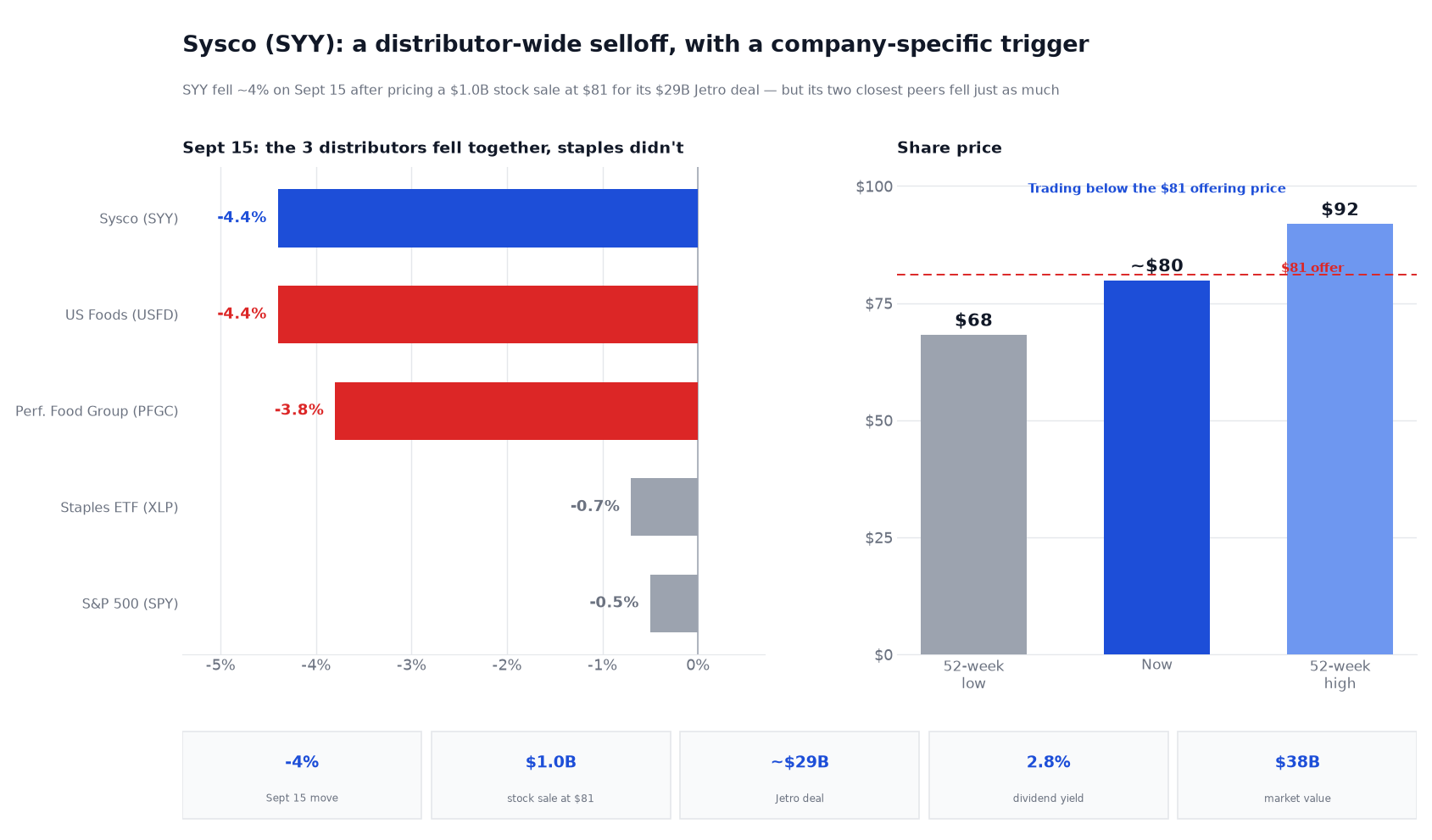
Sysco fell about 4.4% to roughly $80 on September 15 after pricing a $1.0 billion common-stock offering at $81.00 a share — below the prior close — to help fund the cash portion of its pending, roughly $29 billion acquisition of Jetro Restaurant Depot. The stock did what freshly issued equity often does, drifting toward and then below the offer price. One honest caveat: this was not a Sysco-only move — direct peers US Foods (−4.4%) and Performance Food Group (−3.8%) fell just as hard, while consumer staples barely budged, so the raise is best read as the trigger inside a wider foodservice-distribution derating. The $1 billion is the equity slice of a mostly debt-funded deal (~$21 billion of new borrowings), issued to limit the added leverage and defend an already-levered balance sheet; the larger dilution is the 91.5 million new shares (about 19% as the March terms estimated) still to go to Jetro's owners. Sysco is a defensive Dividend King trading near 16 times forward earnings, and the Street's targets still sit above the price — but the market wants the transformational deal financed and integrated before it re-rates.

Why Sysco stock dropped — a $1 billion equity sale, priced below the market
On Tuesday, September 15, 2026, Sysco Corporation (NYSE: SYY) fell about 4.4%, trading near $79.84 intraday, down from a $83.54 prior close [1]. The trigger was a financing event: the food-distribution giant priced a $1.0 billion offering of common stock at $81.00 a share — below the prior close — to help pay for its pending $29.1 billion acquisition of Jetro Restaurant Depot [2]. The stock did what freshly issued equity often does: it gravitated toward, and then below, the offering price, closing the day's gap between the deal price and where the shares had been trading.
One honest caveat up front: this was not a Sysco-only move. Its two closest competitors fell just as hard on the day — US Foods (USFD) −4.4% and Performance Food Group (PFGC) −3.8% — while the broad consumer-staples group barely budged [5]. Sysco had a clear company-specific catalyst in the equity pricing, but a simultaneous, industry-wide selloff in foodservice distributors complicates attributing the whole 4.4% to its own raise — the two coincided, and the peer weakness was not caused by Sysco's offering.
Why issue equity — and why it pressures the stock
The Jetro deal, announced back in March, is being funded mostly with debt: roughly $21 billion of new and hybrid borrowings, plus about $1 billion of cash and equity, against a $21.6 billion cash component and 91.5 million Sysco shares paid to Jetro's owners [2]. This $1 billion stock sale is the equity slice of that structure. Issuing shares when you are already heavily leveraged — Sysco carries roughly $13 billion of net debt, an enterprise value ($51.5 billion) well above its market cap ($38.3 billion) — is a way to limit the added leverage and support the investment-grade rating as it layers on $21 billion of new debt for the deal. This equity slice was part of the deal's financing plan from the outset, not an emergency response; Sysco has pointed to roughly 4.5x leverage at closing and deleveraging within about two years [3].
But equity has a cost of its own: dilution. The $1 billion sale is a modest ~2.6% of Sysco's ~480 million shares; the far larger dilution is still to come — the 91.5 million shares that will go to Jetro's owners when the deal closes. The March terms pegged that at about 19% of the enlarged share count, leaving Jetro's owners with roughly 16% of Sysco — a touch lower (nearer 15.7%) once this equity sale is counted [2]. A secondary offering also adds mechanical pressure: new supply has to clear, and the stock tends to settle near the price at which the deal was sold. That the shares traded below the $81.00 offer price suggests demand cleared at a discount — never a confident sign [1].
A defensive compounder taking on a transformational deal
Sysco is about as steady as large-cap equities get: a Dividend King with a 2.8% yield and more than 55 years of consecutive increases, a low 0.63 beta, and a stock that was essentially flat over the past year before this drop [3]. It moves roughly $84.5 billion of revenue at a thin ~2% net margin — the economics of distribution — and converts that into roughly $2 billion of free cash flow (operating cash flow less capital spending) [3]. After the drop it trades near 16 times forward earnings, a discount to its own history and undemanding for a defensive staple [3]. The Jetro acquisition is a departure from that placid profile: at roughly $29 billion (its value at announcement, with the stock portion floating with Sysco's share price) it is Sysco's largest-ever deal, pushing the company into cash-and-carry — the warehouse, self-service model that serves independent restaurants and small operators, a channel Sysco's broadline trucks do not reach well. The strategic logic (a bigger addressable market, a new customer base) is real; so is the risk of digesting a $29 billion, debt-heavy acquisition in a low-margin business.
Why it matters
The episode is a clean illustration of how the market prices a large, equity-and-debt-funded acquisition in real time. When Sysco announced the Jetro deal in March, the market reacted to the strategy; on the day the equity actually prices, it reacts to the mechanics — the dilution, the new share supply, the offer-price discount. It is also a reminder that even a defensive Dividend King is not immune to a financing-driven drop, and that the whole foodservice-distribution group can derate at once: US Foods and Performance Food Group fell in near-lockstep with Sysco, well beyond anything in staples or the broad market — a concurrent sector move that makes it hard to pin Tuesday's full decline on Sysco's raise alone. Whether that group derating sticks depends on how the Jetro integration and the added leverage play out — the strategy will be judged over years, but the capital structure is being priced now.
The selloff, in one cross-section
The same-day tape shows a foodservice-distribution move, not a market one — the three big distributors fell together, far more than staples or the S&P 500 [5]:
| Name (ticker) | Sept 15, 2026 | Read-through |
|---|---|---|
| SYY — Sysco | ≈−4.4% | Priced a $1.0B stock offering at $81 to help fund the $29.1B Jetro deal [1][2] |
| USFD — US Foods | ≈−4.4% | Direct peer — fell as much as Sysco with no company catalyst [5] |
| PFGC — Performance Food Group | ≈−3.8% | Direct peer — also down sharply on the read-through [5] |
| XLP — Consumer Staples ETF | ≈−0.7% | The broad staples group barely moved [5] |
| SPY — SPDR S&P 500 ETF | ≈−0.5% | The market was only modestly lower [5] |
The three distributors falling ~4% together while staples and the market slipped less than 1% points to a concurrent foodservice-distribution selloff alongside Sysco's own equity-supply catalyst, rather than a purely Sysco-specific event — the peer weakness was not caused by Sysco's raise [5].
What the Street thinks
Coverage stayed constructive, and the targets predate the offering. The consensus rating is a Buy, with an average 12-month target near $90 — roughly 13% above the current price, in a range from a low near $78 to a high near $100 [6]. The most recent notes cluster above the tape: Wells Fargo's Edward Kelly and J.P. Morgan's John Ivankoe both carry Buys at $100, UBS's Mark Carden a Buy at $95, and Guggenheim's John Heinbockel a Buy at $90, with Argus Research's John Staszak the cautious exception at Hold [6]. None were issued in response to the pricing — an equity raise rarely moves targets — so they represent the standing view against which the market is weighing the deal's dilution and leverage. The gap between a ~$90 average target and a stock in the $80s is the debate: the Street likes the franchise and the discounted multiple; the market wants to see the Jetro deal financed and integrated first.
What to watch
- The offer-price overhang. Whether the stock reclaims the $81.00 offering price once the new supply clears, or stays below it [1].
- Deal financing and leverage. How the ~$21 billion of new debt is priced and what it does to Sysco's leverage ratios and credit rating [2].
- Jetro integration. Whether Sysco can run a low-margin cash-and-carry model alongside its broadline business and hit the deal's synergy math [2].
- The dividend. Whether the added debt and dilution pressure Sysco's long streak of increases — the core of its appeal. Moves are tracked on the SYY stock page [1].
Illustrative valuation sensitivity
The scenarios below are anchored to Sysco's forward earnings power (about 16× forward earnings) and to the analyst target distribution (a low near $78, average ~$90, a high near $100) [6], turning on how the market absorbs the offering and how the Jetro deal's leverage and integration play out. They are a descriptive, author-weighted exercise — not a forecast, target, recommendation, or intrinsic fair-value calculation — with subjective weights that sum to 100%.
| Scenario | Illustrative price | Weight | Key drivers |
|---|---|---|---|
| Upside | ~$95 | 30% | The offering overhang clears, the Jetro deal is financed smoothly and framed as accretive, and the multiple re-rates back toward the analyst targets on a defensive dividend grower [6]. |
| Middle | ~$85 | 40% | The stock recovers part of the drop toward the consensus as the dilution is absorbed, but the multiple stays modest while the leverage and integration are unproven [3]. |
| Downside | ~$76 | 30% | Deal leverage and integration concerns weigh, the distributor group stays derated, and the shares drift toward the low end of the analyst range [3]. |
Weighting those (0.30 × $95 + 0.40 × $85 + 0.30 × $76) gives an author-weighted reference value near $85, above Tuesday's ~$80 level and below the ~$90 consensus target [1][6] — reflecting a defensive, cash-generative franchise whose next leg depends on financing and integrating a transformational deal, not on the health of the base business. This is a Street-target-and-earnings-based scenario exercise and descriptive analysis of a news move, not investment advice.
SYY data snapshot — September 15, 2026
| Figure | Value | As-of / source |
|---|---|---|
| Intraday quote | ~$79.84 (−~4.4%), below the $81.00 offering price — an intraday reading (the session was still open) | Tue, Sep 15, 2026, ~1:24pm ET — StockAnalysis [1] |
| Prior close / open | $83.54 prior close; opened $82.12; traded through the day toward and below the $81 deal price | Sep 15, 2026 [1] |
| Volume vs average | ≈8.4M shares by early afternoon vs a ≈2.77M 20-day average for a full session — about 3× normal | Sep 15 — StockAnalysis [1] |
| 52-week range / trend | $68.19–$91.85; roughly flat over 52 weeks; near its ~$80 200-day and below its ~$83 50-day average | As of Sep 15 [3] |
| Market cap / EV | ≈$38.3B (≈480M shares); enterprise value ≈$51.5B (≈$13B net debt); beta ≈0.63 | Sep 15 — StockAnalysis [3] |
| Valuation | Trailing P/E ≈21.8× at the current price (≈22.8× at the prior close); forward P/E ≈16× on ~$5.08 FY27 adjusted EPS; ≈0.46× sales; dividend yield ≈2.8% (payout ~60%) | Sep 15 — StockAnalysis [3] |
| Financials (TTM) | Revenue ≈$84.6B (+3.9%); net income ≈$1.76B; GAAP EPS $3.66; gross margin ≈18.5%; operating margin ≈3.7% GAAP (≈4.3% adjusted); free cash flow ≈$2B (operating cash flow less capex); a Dividend King (55+ years of increases) | TTM — StockAnalysis / company [3] |
| Catalyst | Priced a $1.0B common-stock offering at $81.00/share (~12.3M shares; +$150M over-allotment; closes Sep 16) to help fund the cash portion of its pending ~$29B (at announcement) acquisition of Jetro Restaurant Depot | Announced & priced ~Sep 14; shares reacted Sep 15, 2026 — company release [2] |
| Same-day peers | USFD −4.4%, PFGC −3.8% (direct distributors); XLP −0.7% (staples); SPY −0.5% (market) — a sector-wide distributor derating | Sep 15 [5] |
| Analyst view | Consensus Buy, avg target ≈$90 (~13% above the price), range ~$78 to ~$100; standing pre-offering targets: Wells Fargo $100, J.P. Morgan $100, UBS $95, Guggenheim $90, Argus Hold | Aug–Sep 2026 — StockAnalysis / analyst notes [6] |
Sysco (SYY) stock FAQ
Why did Sysco (SYY) stock drop on September 15, 2026?
Sysco fell about 4.4% to roughly $80 after it priced a $1.0 billion offering of common stock at $81.00 a share — below the prior close — to help fund the cash portion of its pending $29.1 billion acquisition of Jetro Restaurant Depot. Newly issued equity tends to pull a stock toward its offer price as the new supply clears, and here the shares fell below the $81 deal price. It was not a purely company-specific move, though: direct peers US Foods and Performance Food Group fell just as much on the day with no offering of their own — a concurrent, industry-wide foodservice-distribution selloff that makes it hard to attribute the whole decline to Sysco's raise.
Why would Sysco issue stock if it dilutes shareholders?
Because the alternative — funding the entire $29.1 billion Jetro deal with debt — would strain an already-leveraged balance sheet and its credit rating. Sysco is funding the deal mostly with debt (roughly $21 billion of new and hybrid borrowings), and this $1 billion equity slice helps limit the leverage it adds. Issuing equity dilutes existing holders, but for a company carrying about $13 billion of net debt already, protecting the balance sheet and rating can be worth the dilution. The larger dilution is still ahead: about 91.5 million new shares will go to Jetro's owners when the deal closes — roughly 19% of the enlarged share count as the March terms estimated (a touch lower, nearer 15.7% of the company for Jetro's owners, once this equity sale is counted).
What is Sysco buying with the Jetro Restaurant Depot deal?
Jetro Restaurant Depot is the leading cash-and-carry foodservice supplier in the United States — a warehouse, self-service model where independent restaurants and small operators buy in bulk, rather than having product delivered by truck. The roughly $29 billion deal — its value at announcement, made up of about $21.6 billion in cash plus 91.5 million Sysco shares, so the headline figure floats with Sysco's stock — pushes Sysco into a channel its broadline delivery business does not serve well, expanding its addressable market and customer base. The strategic upside is real, but so is the challenge of running a very different, low-margin model and digesting a large, debt-heavy acquisition.
Did Sysco's stock fall only because of its own news?
No — and it is worth being precise about this. Sysco had a clear company-specific catalyst (pricing its $1 billion equity offering), but its two closest competitors fell just as hard on the same day: US Foods dropped about 4.4% and Performance Food Group about 3.8%, with no offering of their own. Meanwhile the broad consumer-staples group (the XLP ETF) fell only about 0.7% and the S&P 500 about 0.5%. So the accurate read is that Sysco had its own clear catalyst — the equity offering — at the same time as an industry-wide foodservice-distribution selloff; that concurrence complicates attributing the full move to Sysco alone, and the peer declines were not caused by Sysco's raise.
Is Sysco stock cheap after the drop?
On the multiple, it is undemanding. After the fall Sysco trades near 16 times forward earnings — a discount to its own history and reasonable for a defensive Dividend King with a 2.8% yield, more than 55 years of consecutive dividend increases, a low 0.63 beta, and roughly $2 billion of annual free cash flow. The catch is the Jetro deal: it adds substantial leverage to an already-levered balance sheet and brings integration risk in a low-margin business, so the discounted multiple partly reflects the market's wait-and-see stance on the transaction rather than a cheap base business.
What do analysts think of Sysco stock now?
Coverage is constructive, with targets set before the offering. The consensus rating is a Buy, and the average 12-month price target sits near $90 — roughly 13% above the post-drop price — in a range from about $78 to $100. Recent notes cluster above the price: Wells Fargo's Edward Kelly and J.P. Morgan's John Ivankoe both at $100, UBS's Mark Carden at $95, and Guggenheim's John Heinbockel at $90, with Argus Research's John Staszak the cautious exception at Hold. An equity raise rarely changes price targets, so these represent the standing bullish view against which the market is weighing the deal's dilution and leverage.