Automotive
Tesla (TSLA) Stock Jumps as Nevada Approves Up to 5,000 Robotaxis, Feeding the Autonomy Premium
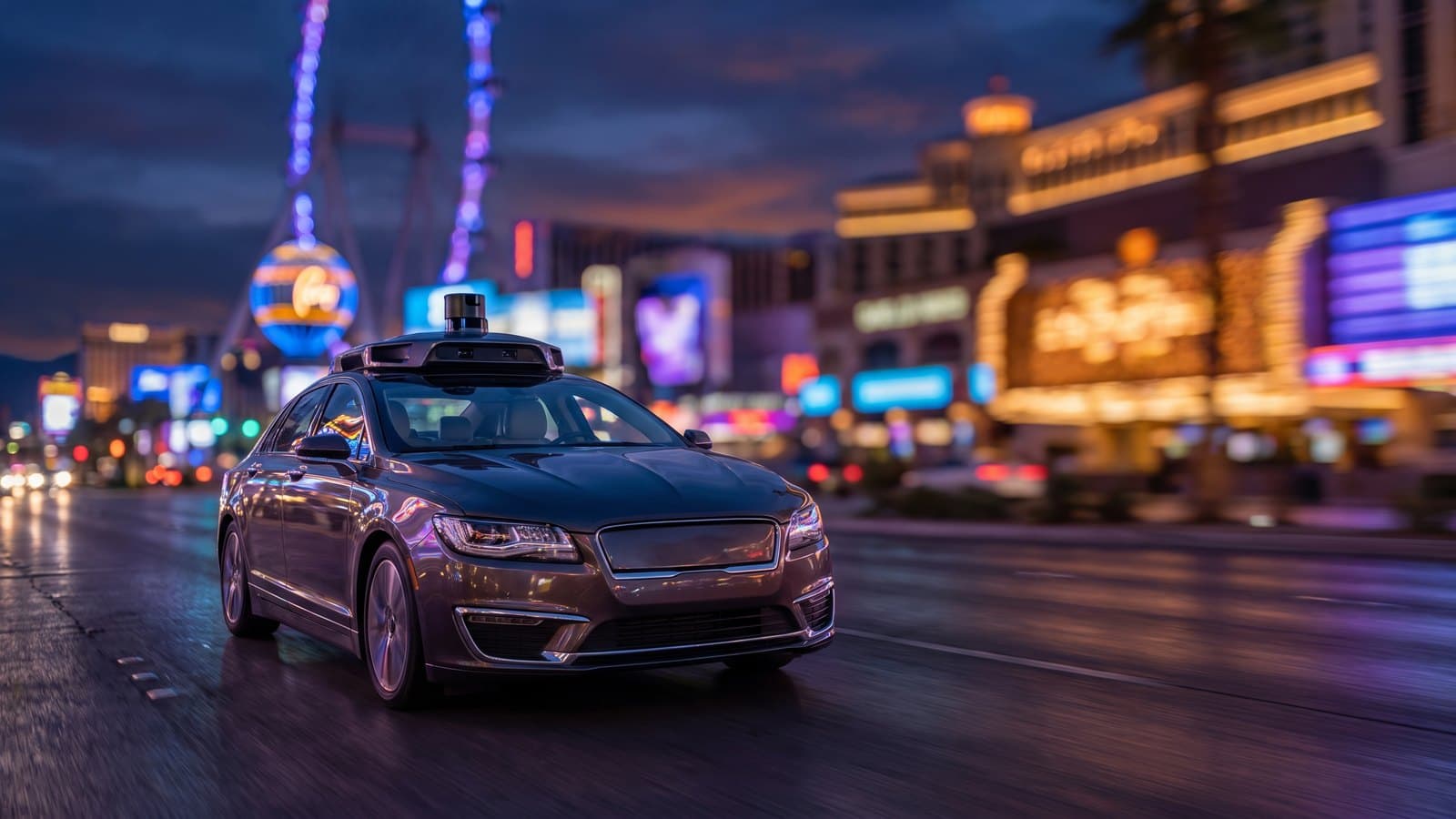
Tesla rose about 4.5% to roughly $360 on August 21 (as much as ~5.5% intraday) after the Nevada Transportation Authority unanimously cleared it to operate up to 5,000 paid robotaxis in the Las Vegas area — up from a 10-vehicle cap days earlier. It matters because Tesla is priced as an autonomy platform, not a carmaker: net income is down ~35% year over year on a ~4% trailing operating margin, yet the stock trades near 358x trailing and 181x forward earnings. The same approval moved Uber under 2% (cleared for 1,000) and was immaterial to Alphabet's Waymo — the size of Tesla's reaction is the autonomy premium in action. Wall Street is split like almost no other mega-cap: an average target near $395 but a range from about $25 (GLJ's Gordon Johnson, Sell) to $600 (the Street high). It is a permit, not paid rides — one catalyst among several, and a real step forward with a long way still to travel.
Why Tesla stock jumped — Nevada approved up to 5,000 robotaxis
On Friday, August 21, 2026, Tesla (NASDAQ: TSLA) rose about 4.5% — and, at its late-morning peak, as much as ~5.5% — to roughly $360, from a $345.13 prior close [1]. A key catalyst was concrete and dateable: a day earlier, the Nevada Transportation Authority unanimously approved permits that clear Tesla to operate up to 5,000 paid robotaxis in Clark County — home to Las Vegas — over the next year, a dramatic step up from the 10-vehicle cap the state had set just days before [2]. For a stock priced as an autonomy platform rather than a carmaker, a permit to put thousands of driverless cars on the road is exactly the kind of news that moves the needle.
Two caveats keep the story honest. First, the approval was not Tesla-exclusive: the same authority also cleared Uber and Waymo to run about 1,000 robotaxis each [2]. Second, it is a permit, not a launch — Tesla still has to complete inspections, insurance and fare filings before carrying a paying passenger, with no official start date set [2]. A third, softer tailwind came from CEO Elon Musk, who replied on X that he expected Tesla (and SpaceX) to exceed a five-year revenue-growth estimate — an offhand comment rather than formal company guidance — as the stock headed toward a third straight weekly gain [3]. The permit clearly coincided with the rally, but Tesla had other headlines that day and the broad market was higher, so it is one catalyst among several rather than the sole cause.
Priced for the robotaxi, not the car
To understand why a robotaxi permit is worth a 4.5% move in a $1.4 trillion company, look at how Tesla is valued. Its profitability is, right now, shrinking: trailing-twelve-month net income of about $3.8 billion is down roughly 35% year over year, earnings per share have fallen a similar amount to about $1.08, and the trailing operating margin has compressed to roughly 4% — only about 1.4% in the latest quarter — as price cuts and softer demand bite [4]. Yet the stock trades at about 358 times trailing and, by StockAnalysis's measure, 181 times forward earnings — multiples many times the S&P 500's and far above a legacy automaker's single-digit ratio [4]. That gap only makes sense if you believe Tesla is not really being priced as a car company at all, but as a bet on full self-driving software, a robotaxi network and humanoid robots. On that view, regulatory permission to actually deploy robotaxis is not a sideshow — it is the thesis being validated, one city at a time.
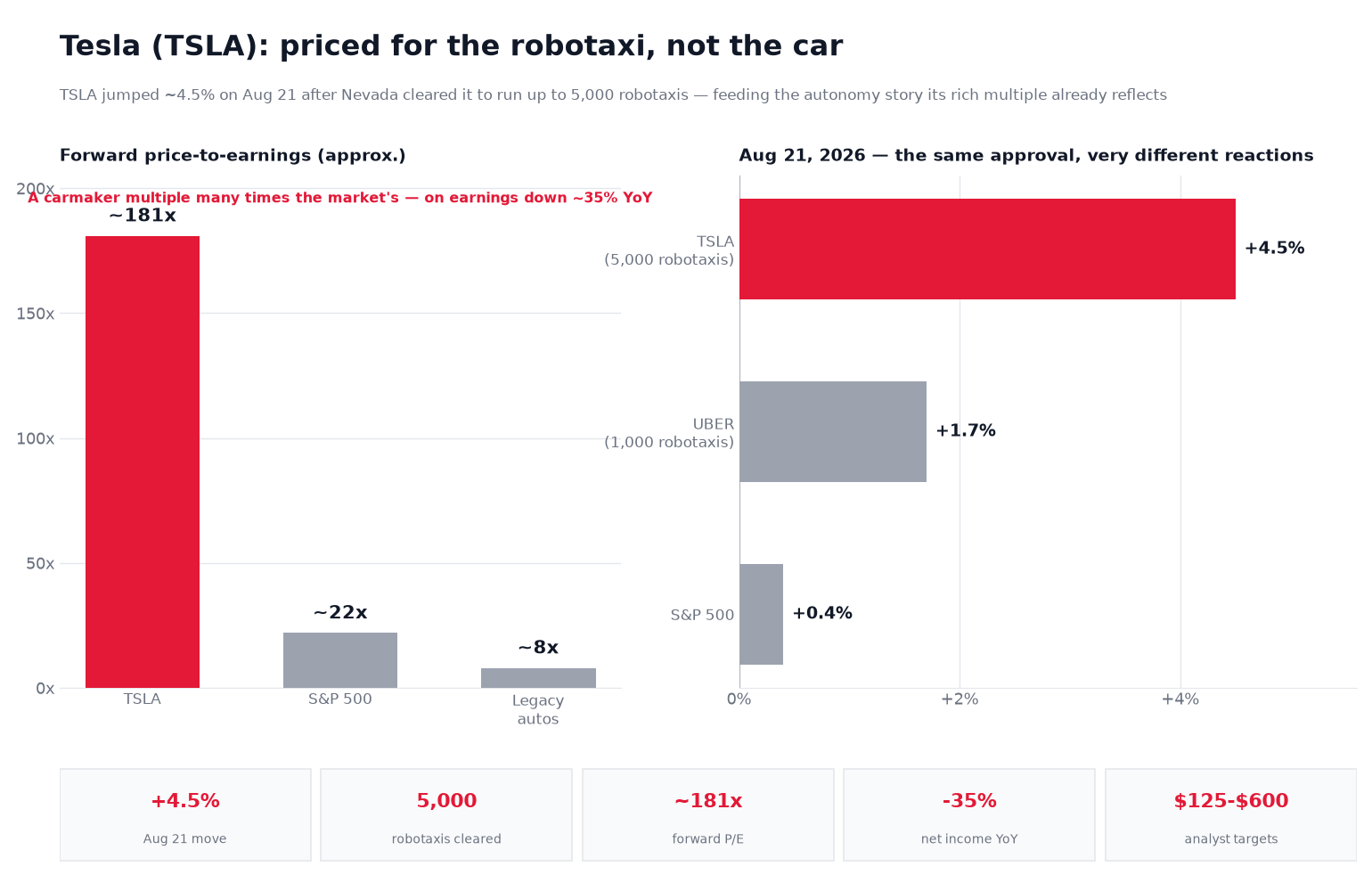
The same approval, very different reactions
The clearest evidence that this is about narrative, not just news, is how differently the three approved companies traded on August 21. Tesla, cleared for the largest fleet at 5,000 vehicles, jumped about 4.5%; Uber, cleared for 1,000, rose under 2%; and Alphabet's Waymo — also cleared for about 1,000 — was a rounding error inside a trillion-dollar parent, while the S&P 500 added about 0.4% [5]. The same regulatory event, filtered through very different expectations: for Uber, robotaxis are one channel inside a profitable ride-hailing business; for Tesla, they are the centerpiece of the story that supports the entire valuation. So the same permit that barely registered elsewhere was a headline event for Tesla.
Why it matters
Tesla is the market's purest referendum on autonomous driving as a business. Its trillion-dollar-plus valuation is not underwritten by the cars it sells today — those earnings are shrinking — but by the possibility that it turns self-driving into a software-and-services machine. That makes each regulatory milestone a data point in a very expensive hypothesis, and it explains why a permit in one U.S. metro can add tens of billions to the market cap. The Nevada decision is genuinely a step forward: it moves Tesla from a 10-vehicle novelty to a potential 5,000-vehicle commercial fleet in a major city. But it also underscores the distance still to travel — from permit to inspection to paid rides to a network large and profitable enough to justify the multiple — and the fact that Tesla is racing Uber, Waymo and others to get there. For investors, the robotaxi story is now less about whether it will happen than about how fast, how profitably, and how much of that is already in the price.
How the day's autonomy trade lined up
The three companies Nevada cleared on the same day are a natural experiment in expectations [5]:
| Name (ticker) | Aug 21, 2026 (intraday) | Robotaxi allocation / read-through |
|---|---|---|
| TSLA — Tesla | ≈+4.5% | Cleared for up to 5,000 — the centerpiece of a valuation built on autonomy [1][2] |
| UBER — Uber | ≈+1.7% | Cleared for ~1,000 — one channel inside an already-profitable ride-hailing business [5] |
| S&P 500 | ≈+0.4% | A modestly higher broad market on a Friday risk rebound [5] |
Alphabet's Waymo was also cleared for about 1,000 robotaxis, but the news was immaterial to a company its size [2]. The size of Tesla's reaction, relative to the others, is the autonomy premium in action [5].
What the Street thinks
Coverage is broad and deeply divided. Across 47 analysts the consensus is a Buy with an average 12-month target near $395 (about 9% above Friday's level) and a median near $415, but StockAnalysis's displayed target range is vast — from about $125 to $600, with the most bearish independent call sitting below even that [6]. The rating split tells the same story: roughly 23 buy-side ratings against 19 holds and 5 sells, including three outright strong sells [6]. On the bull end, the $600 that tops the range is the target Dan Ives set at Wedbush before leaving the firm in July 2026 (carried forward as the panel high); on the bear end, GLJ Research's Gordon Johnson rates the stock Sell with a target of just $24.86, while Barclays' Dan Levy sits in the middle at Hold with a $370 target [6]. Rarely does a mega-cap carry anything like a gap this wide between its most bullish and most bearish price targets — a measure of how much of Tesla's value rests on a future that has not happened yet.
What to watch
- From permit to paid rides. Nevada cleared up to 5,000 vehicles, but Tesla must still pass inspections and file insurance and fares before launch. Watch for the first commercial rides and how quickly the fleet scales [2].
- The core auto business. Robotaxis are the story, but earnings still come from selling cars — and those profits are down ~35% year over year on a ~4% margin. Watch whether deliveries and margins stabilize [4].
- The autonomy race. Uber and Waymo got the same Nevada clearance; watch how Tesla's rollout compares on safety, scale and cost [5].
- Regulatory expansion. The thesis needs city after city. Watch which metros approve Tesla next. Moves are tracked on the TSLA stock page [2].
Illustrative valuation sensitivity
Tesla's valuation is unusually reflexive — it depends less on this year's earnings than on the market's confidence in the autonomy story — so the scenarios below are anchored to the analyst target distribution (low ~$125, average ~$395, high ~$600) and turn on how fast the robotaxi network scales. They are a descriptive, author-weighted exercise, not a forecast, target, recommendation, or intrinsic fair-value calculation; the weights are the author's subjective assumptions and sum to 100%.
| Scenario | Illustrative price | Weight | Key drivers |
|---|---|---|---|
| Upside | ~$500 | 30% | Robotaxi approvals multiply city by city, full self-driving monetization ramps, and the market pays up for a scaling autonomy platform toward the bullish targets [6]. |
| Middle | ~$395 | 40% | Autonomy progresses but slowly; the stock holds near the consensus target as investors wait for robotaxi revenue to show up in the numbers [6]. |
| Downside | ~$250 | 30% | Robotaxi scaling disappoints or auto earnings keep sliding, and a ~180x-forward multiple on falling profits de-rates toward the bearish targets [4][6]. |
Weighting those (0.30 × $500 + 0.40 × $395 + 0.30 × $250) gives an author-weighted reference value near $383, a touch above Friday's ~$360 and just below the ~$395 consensus [1][6] — a reminder that at this valuation the stock is priced for the autonomy story to keep advancing, leaving little room for disappointment. This is a Street-target-based scenario exercise and descriptive analysis of a news move, not investment advice.
TSLA data snapshot — August 21, 2026 (intraday)
| Figure | Value | As-of / source |
|---|---|---|
| Intraday quote | ~$359–$360 (+~4.5%; feed +4.49% to $359.06); reached as high as ~$364 (+5.5%) late morning | Aug 21 — StockAnalysis / Change Feed [1] |
| Prior close | $345.13 | Thu, Aug 20, 2026 [1] |
| 52-week range / change | $297.38–$498.83; ~+11% over 52 weeks (~28% below the high; below its 50-day ~$366 and 200-day ~$403 averages) | As of Aug 21 [4] |
| Market cap / EV | ≈$1.43T (3.95B shares); enterprise value ≈$1.40T; beta ≈1.8 | Aug 21 — StockAnalysis [4] |
| Valuation | Trailing P/E ≈358×; forward P/E ≈181× (per StockAnalysis); ≈13× sales; ≈16× book | Aug 21 — StockAnalysis [4] |
| Financials (TTM) | Revenue ≈$103.6B (+11.8%); net income ≈$3.8B (EPS $1.08, down ~35% YoY); operating margin ≈4.1% TTM (~1.4% in the latest quarter); no dividend | TTM — StockAnalysis [4] |
| Volume | ~22M shares traded by late morning (11 a.m. ET) vs a ~33M full-day 20-day average — too early to judge the full session | Aug 21 — StockAnalysis [4] |
| The catalyst | Nevada Transportation Authority unanimously cleared Tesla to operate up to 5,000 robotaxis in Clark County (vs ~1,000 each for Uber and Waymo), up from a 10-vehicle cap; a permit, not a launch (inspections/insurance/fares pending, no official date); plus an offhand Musk comment on X about beating a 5-year revenue-growth estimate | Aug 20–21 — market coverage [2][3] |
| Same-day autonomy trade | TSLA ≈+4.5% (5,000) vs UBER ≈+1.7% (1,000) vs S&P 500 ≈+0.4%; Waymo (Alphabet) immaterial to its parent | Aug 21 [5] |
| Analyst view | 47 analysts, consensus Buy, avg target ≈$395 (median ≈$415; aggregated range ~$125–$600); 17 strong buy / 6 buy / 19 hold / 2 sell / 3 strong sell; $600 tops the displayed range (Ives's former Wedbush target), GLJ Sell $24.86 (below range), Barclays Hold $370 | Aug 2026 — StockAnalysis / market coverage [6] |
The August 21 figures are intraday snapshots that moved through the session, not closing prices.
The setup at a glance
| Question | Answer |
|---|---|
| Why did Tesla stock jump on August 21? | The Nevada Transportation Authority unanimously approved permits clearing Tesla to operate up to 5,000 paid robotaxis in the Las Vegas area over the next year — up from a 10-vehicle cap days earlier. For a stock priced on its autonomy potential, that is a meaningful proof point, and it rose about 4.5% (helped by an offhand comment from Elon Musk on X about beating a five-year revenue-growth estimate) [1][2]. |
| Was the approval just for Tesla? | No. The same Nevada authority cleared Uber and Waymo (Alphabet) for about 1,000 robotaxis each; Tesla got the largest allocation at 5,000. And it is a permit, not a launch — Tesla still needs inspections, insurance and fare filings before carrying paying passengers, with no official start date set [2]. |
| Why did Tesla move so much more than Uber on the same news? | Expectations. For Uber, robotaxis are one channel inside a profitable ride-hailing business, so the stock added under 2%. For Tesla, autonomy is the centerpiece of a valuation that its shrinking earnings cannot support on their own, so the same permit was a headline event and the stock rose about 4.5% [5]. |
| Is Tesla stock expensive? | By conventional measures, extremely. Tesla trades at roughly 358 times trailing and 181 times forward earnings — many times the market's multiple — even though its net income is down about 35% year over year and its trailing operating margin is only about 4% (and just ~1.4% last quarter). The valuation reflects autonomy and AI expectations, not current profits, which leaves little room for disappointment [4]. |
| What is the biggest risk? | That the autonomy story scales slower than the price implies. Robotaxis are still permits and pilot fleets, not revenue; profitability is shrinking; and at ~180 times forward earnings there is little margin for error. The bear case — GLJ Research's Sell rating and a $24.86 target — reflects exactly that [4][6]. |
| What do analysts think? | They disagree more than on almost any other mega-cap. The consensus is Buy with an average target near $395, but StockAnalysis's displayed range spans about $125 to $600 (with GLJ's separately reported $24.86 falling below it), and the ratings include 3 strong sells alongside 17 strong buys. The $600 that tops the range is the target Dan Ives set at Wedbush before leaving the firm in July; GLJ Research's Gordon Johnson holds the bear case with a Sell and a $24.86 target [6]. |
Tesla (TSLA) stock FAQ
Why did Tesla (TSLA) stock jump on August 21, 2026?
Tesla rose about 4.5% (and as much as ~5.5% at its late-morning peak) to roughly $360 after the Nevada Transportation Authority unanimously approved permits clearing the company to operate up to 5,000 paid robotaxis in Clark County, home to Las Vegas, over the next year — a dramatic increase from the 10-vehicle cap the state had set just days earlier. Because Tesla is valued largely on its autonomy potential rather than its current car sales, a permit to deploy thousands of robotaxis is a meaningful proof point. A softer tailwind came from CEO Elon Musk, who replied on X that he expected Tesla (and SpaceX) to exceed a five-year revenue-growth estimate — an offhand comment, not formal guidance — as the stock headed toward a third straight weekly gain. The permit was one catalyst among several: Tesla had other headlines that day and the broad market was higher.
Was the Nevada robotaxi approval exclusive to Tesla?
No. The Nevada Transportation Authority cleared three companies on the same day: Tesla for up to 5,000 robotaxis, and Uber and Alphabet's Waymo for about 1,000 each. Tesla received the largest allocation. Importantly, the approval is a permit, not a launch — Tesla still must complete vehicle inspections and file insurance and fares before it can carry paying passengers, and no official start date has been set. So the news validates the robotaxi roadmap without yet producing revenue.
Why did Tesla move so much more than Uber on the same news?
It comes down to expectations. For Uber, robotaxis are one channel inside an already-profitable ride-hailing business, so news of a 1,000-vehicle permit lifted the stock under 2%. For Tesla, autonomy is the centerpiece of a valuation that its shrinking earnings cannot support on their own — so the same regulatory event was a headline catalyst and the stock rose about 4.5%. Alphabet's Waymo was also cleared for about 1,000 robotaxis, but the news was immaterial to a company its size. The gap in reactions is the 'autonomy premium' in action.
Why is Tesla stock so expensive relative to its earnings?
Because the market is not pricing Tesla as a car company. Its trailing-twelve-month net income of about $3.8 billion is down roughly 35% year over year, earnings per share are about $1.08, and its trailing operating margin has compressed to around 4% (only about 1.4% in the latest quarter) amid price cuts and softer demand. Yet the stock trades at about 358 times trailing and, by StockAnalysis's measure, 181 times forward earnings — many times the S&P 500's multiple and far above a legacy automaker's single-digit ratio. That premium reflects expectations for full self-driving software, a robotaxi network and humanoid robots (Optimus), not today's profits. The risk is that it leaves very little room for disappointment.
How does the Nevada approval fit Tesla's robotaxi strategy?
It is an incremental but real step. Tesla's autonomy thesis requires regulatory approval city by city, and Nevada moving Tesla from a 10-vehicle novelty to a potential 5,000-vehicle commercial fleet in a major metro is a meaningful expansion. But it also highlights how far there is still to travel — from permit to inspection to paid rides to a network large and profitable enough to justify the valuation — and that Tesla is racing Uber, Waymo and others to get there. The market's question is now less whether robotaxis will happen than how fast, how profitably, and how much is already priced in.
What do analysts think of Tesla?
They disagree more than on almost any other mega-cap. Across 47 analysts the consensus is a Buy with an average 12-month price target near $395 (about 9% above the August 21 level) and a median near $415, but StockAnalysis's displayed range runs from roughly $125 to $600 — and GLJ's separately reported bear target falls below even that. The ratings split is wide too: about 23 buy-side ratings against 19 holds and 5 sells, including three strong sells. The $600 that tops the range is the target Dan Ives set at Wedbush before he left the firm in July 2026 (carried forward as the panel high); GLJ Research's Gordon Johnson holds the bear case with a Sell and a $24.86 target, while Barclays' Dan Levy sits in the middle at Hold ($370). That gap captures a market that cannot agree whether Tesla is a carmaker that got ahead of itself or a robotics platform just getting started.