Stock Analysis
Why did Vertex Pharmaceuticals (VRTX) stock jump to an all-time high on August 10, 2026?
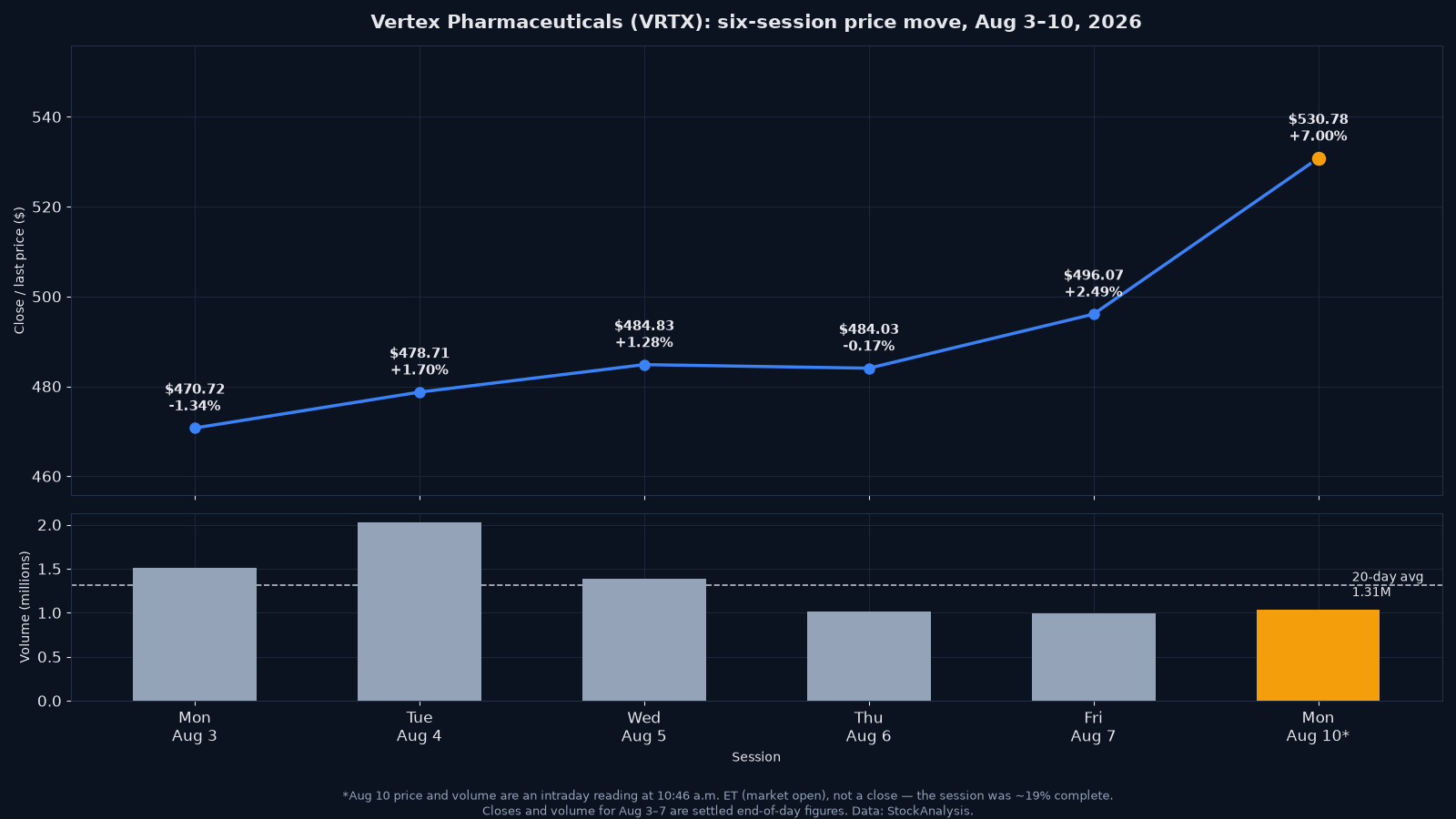
VRTX traded up 7.00% at $530.78 by 10:46 a.m. ET, touching a fresh all-time high of $546.17. Named analyst price-target actions are dated August 4-5, three to four sessions earlier — but at 7:00 a.m. ET the same morning, competitor Sionna Therapeutics disclosed that its SION-719 cystic-fibrosis trial, dosed alongside Vertex's own therapy, missed its endpoint and would not advance. Sionna's program had been flagged as a real threat to Vertex's CF franchise days earlier; no source found here states the causal link outright, but the timing is hard to read as coincidence.

Summary
Vertex Pharmaceuticals Incorporated (NASDAQ: VRTX) traded at $530.78, up $34.71 or 7.00% from Friday's $496.07 close, as of 10:46 a.m. ET on Monday, August 10, 2026 [1]. The session was still open at publication; every August 10 figure in this article is an intraday reading, and nothing here is called a close. Intraday, the stock traded as high as $546.17 — a fresh all-time high, above the $540.93 fifty-two-week high the vendor was still displaying at the same snapshot [1][9]. A separate wire report independently confirmed the all-time-high milestone at a slightly different intraday moment ($539.99) [10]. This site's own change-event record for the session cites the earnings beat and analyst sentiment as reasons without identifying the Sionna news below [11].
The move caps a steady five-session climb that followed second-quarter results released after the close on Monday, August 3. The stock actually fell 1.34% the day of the release (before the numbers were out), then rose in three of the next four sessions — Aug 4 (+1.70%), Aug 5 (+1.28%), Aug 6 (-0.17%), Aug 7 (+2.49%) — before Monday's 7.00% gain, the largest single-session move of the stretch [2].
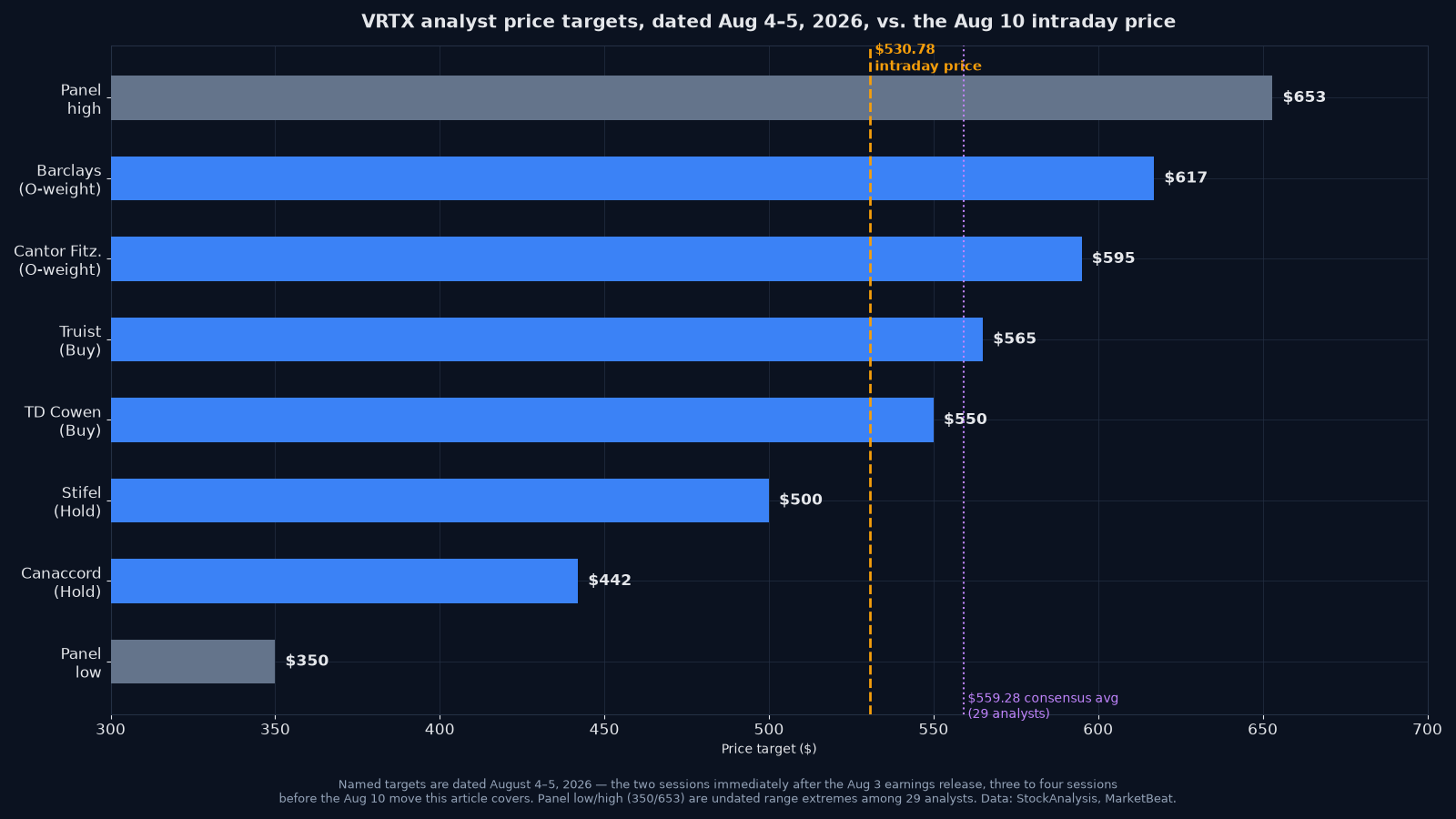
The dated, named analyst price-target actions on the post-earnings panel cited here are all dated August 4 or 5 — the two sessions immediately after the earnings release, three to four sessions before today's jump — so they explain the week's drift higher, not Monday's acceleration specifically [6]. What does line up with today is a competitor's clinical setback: at 7:00 a.m. ET, before the market opened, Sionna Therapeutics disclosed that its Phase 2a trial of SION-719 — a drug being tested as an add-on to Vertex's own Trikafta-based standard of care for cystic fibrosis — missed its primary endpoint, and said it would not advance the drug in that combination [16]. Sionna's readout had been flagged by name as a real overhang on Vertex's dominant CF franchise in coverage published as early as August 4 [18]. Its failure removed a live competitive threat hours before Vertex's own stock accelerated to a fresh all-time high, which is the most plausible reading of the day's specific catalyst — though no source found here states the causal link outright, and this article does not claim to prove it. No confirmed Vertex-issued catalyst — no filing, contract, trial readout or company announcement of its own — is dated August 10.
VRTX timeline: Q2 results to the August 10 high
| When | What happened |
|---|---|
| Mon Aug 3, during session | Stock fell 1.34% to $470.72 ahead of the after-close print [2] |
| Mon Aug 3, after the close | Q2 2026 results: revenue $3.33bn (+12% y/y), non-GAAP EPS $4.73, full-year revenue guidance raised to $13.1bn–$13.2bn [7] |
| Tue Aug 4 | +1.70% to $478.71; TD Cowen, Stifel, Cantor Fitzgerald and Canaccord Genuity price-target actions dated this session [2][6] |
| Wed Aug 5 | +1.28% to $484.83; Truist, Barclays and Weiss Ratings actions dated this session [2][6] |
| Thu Aug 6 | -0.17% to $484.03 [2] |
| Fri Aug 7 | +2.49% to $496.07; separately, a Motley Fool piece framed Sionna Therapeutics, a competing CF-drug developer, as a multi-year risk to Vertex [2][12] |
| Mon Aug 10, 7:00 a.m. ET | Sionna Therapeutics reported its Phase 2a SION-719 cystic-fibrosis trial missed its primary endpoint and said it would not advance the drug as an add-on to Vertex's standard-of-care therapy [16] |
| Mon Aug 10, 10:46 a.m. ET | VRTX $530.78, up 7.00% intraday, a fresh all-time high of $546.17 reached in the session [1] |
What did Vertex report on August 3?
| Measure | Q2 2026 | Year over year | Note |
|---|---|---|---|
| Total revenue | $3.33bn | +12.4%, from $2.96bn | beat the $3.22bn consensus by ~3.4% [8] |
| CF-franchise revenue | $3,207.9m | — | above a ~$3.19bn consensus cited by TD Cowen [5] |
| CASGEVY revenue | $76.4m | +151%, +78% q/q | gene-edited therapy for sickle cell disease and beta thalassemia [7] |
| JOURNAVX revenue | $49.6m | more than 4x, +71% q/q, from $29m in Q1 | non-opioid acute-pain therapy [3] |
| Non-GAAP diluted EPS | $4.73 | +4.6%, from $4.52 | vs. consensus of $4.75 (24/7 Wall St.) or $4.70 (TD Cowen's cited figure) — a narrow miss on one basis, a narrow beat on the other [8][5] |
| FY26 revenue guidance | $13.1bn–$13.2bn | raised | commits to ≥$500m from non-CF products this year [7] |
| Guided gross margin | "just under 86%" | — | company language, as product mix shifts toward CASGEVY [3] |
The three revenue lines reconcile closely using the company's exact figures: CF revenue of $3,207.9m plus CASGEVY's $76.4m and JOURNAVX's $49.6m totals $3,333.9m against the $3.33bn reported total [7][5][3]. Management's framing on the earnings call leaned on the cystic fibrosis franchise's staying power — ALYFTREK now covers roughly 75% of eligible patients aged 12 and older in the carrier range, and management said "the bar for new CF therapies is exceptionally high" — while pointing to CASGEVY and JOURNAVX as the accelerating, still-small pieces of the growth story [3].
Why did the stock jump specifically on August 10?
Two separate stories are stacked on top of each other here, and keeping their dates straight is the whole ballgame.
The sell side's response to the earnings print is on the record, but it is not same-day evidence for Monday's move. The MarketBeat panel cited in this article shows seven dated post-earnings entries, all landing August 4 or 5: TD Cowen to $550 from $525 (Buy), Stifel to a $500 target (Hold), Cantor Fitzgerald to $595 from $590 (Overweight) and Canaccord Genuity to $442 from $436 (Hold) on August 4; Truist to $565 from $560 (Buy), Barclays to $617 from $615 (Overweight) and a Weiss Ratings upgrade to Buy(B) from Buy(B-), which carries no price target, on August 5 [6]. Not one of those seven actions is dated the same session as today's 7.00% move, and MarketBeat's panel is one dated source among several sell-side feeds, not the exhaustive universe of coverage — the point that matters is that the actions on it are dated Aug 4-5, not that the list is complete. A separate BofA target of $605 (from $600, Buy) turned up in search results with no confirmed date and is not counted among the seven [6].
What is dated August 10 is a development at a different company. At 7:00 a.m. ET, before the market opened, Sionna Therapeutics — a roughly $2.2bn clinical-stage biotech — reported topline data from its Phase 2a PreciSION CF trial: SION-719, dosed on top of Vertex's own Trikafta-based standard of care in 15 cystic-fibrosis patients, produced a placebo-adjusted sweat-chloride change of just -1.0 mmol/L (p=0.7), statistically indistinguishable from placebo, and the company said it would not advance SION-719 as an add-on therapy [16]. Sionna's stock fell roughly 90-92% in pre-market trading on the news [16][17]. That result matters to Vertex because Sionna's CF program had been publicly flagged as a real threat to Vertex's dominant franchise: coverage published August 4, before the print, quoted a Raymond James analyst saying the Sionna readout "looms large" over Vertex, while UBS was less concerned, arguing Vertex's own newer ALYFTREK already showed comparable improvements [18]. Multiple outlets covering Sionna's August 10 collapse independently described it as removing a "data overhang" that had been weighing on Vertex shares [16][19].
No source located here explicitly states that Vertex's rally was caused by Sionna's failure — that specific causal sentence was not found despite a dedicated search, and this article does not claim to have proven it. But the timing is hard to read as coincidence: a company-named competitive risk to Vertex's core franchise failed its key trial hours before Vertex stock accelerated to a fresh all-time high, on top of a week that was already trending higher on the post-earnings re-rating. No Vertex-issued filing, contract, trial result or announcement of its own is dated August 10; the most plausible reading of the day's specific catalyst is the Sionna readout, not a Vertex-issued item.
How much of this was Vertex, and how much was the sector?
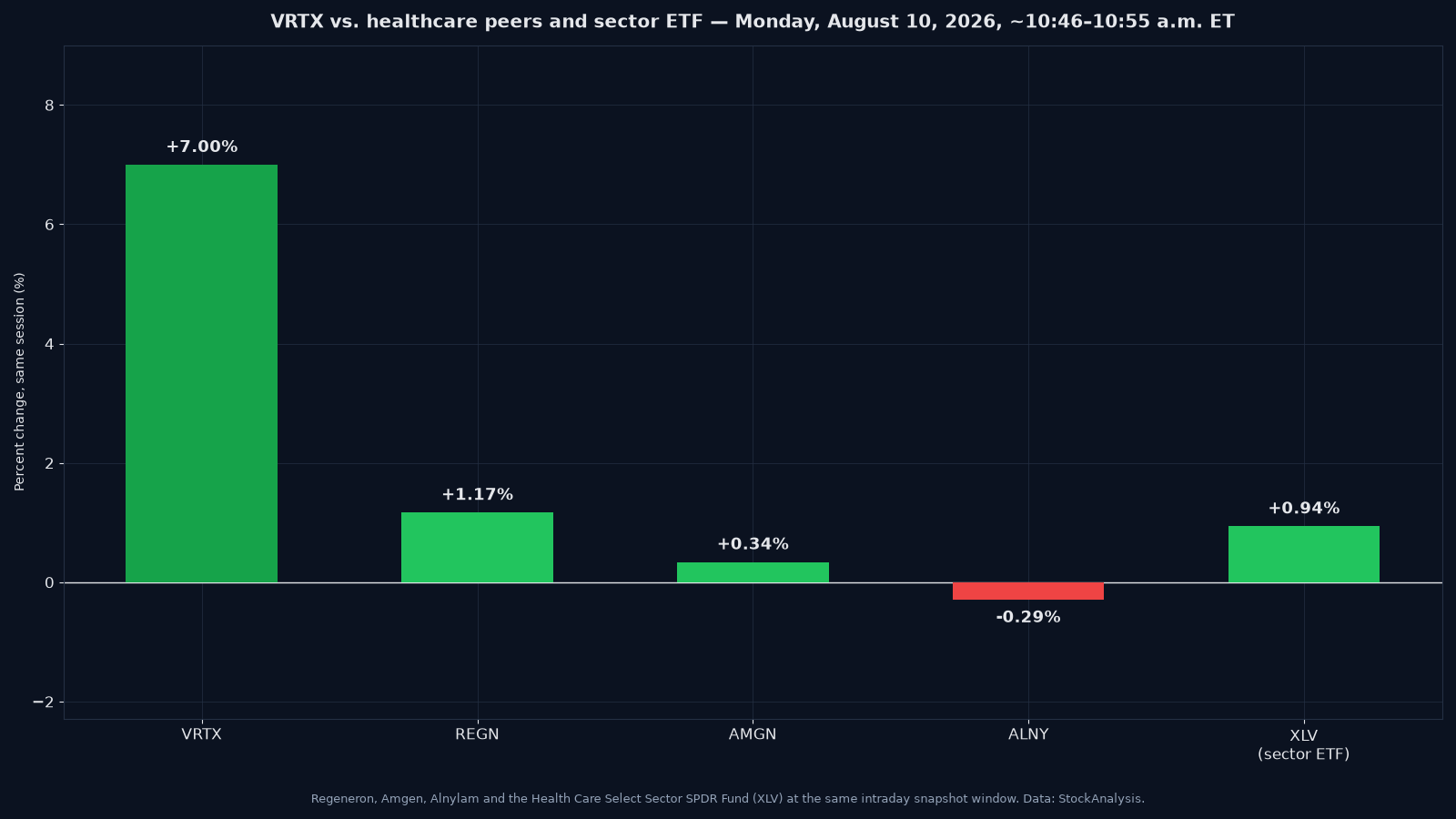
Almost entirely Vertex-specific, on the same-morning cross-section. At 10:46–10:55 a.m. ET, Regeneron was up 1.17% to $793.50, Amgen was up 0.34% to $412.34, Alnylam was down 0.29% to $218.56, and the Health Care Select Sector SPDR Fund (XLV) was up 0.94% [1][13][14][15]. Vertex outperformed the sector ETF by 6.06 percentage points and its nearest large-cap biotech comparables by 5.8-7.3 points. That gap establishes the move as company-specific rather than a sector rotation; it does not decompose it, and this article does not claim to identify who was buying.
How heavy was the volume?
Heavier than the headline "below average" framing some coverage used, once the clock is accounted for.
By 10:46 a.m. ET, roughly 76 of the session's 390 minutes had elapsed — about 19.5% — and 1,034,271 shares had traded [1]. The 20-day average for a full session was 1,313,416 shares at the same snapshot [9]. That means the stock had already transacted about 0.79 of a full average day's volume in under a fifth of the day — a front-loaded, above-average pace, not the "0.7x average, below-average participation" read an earlier automated summary of this site's own event page produced without adjusting for how little of the session had elapsed. Short interest, on the latest reported data, is modest at 4.99 million shares — 2.00% of a 249.79 million-share free float — so the available evidence does not point to a short squeeze as an explanation [9]; that figure carries its own settlement-date lag and is not a live August 10 reading.
Valuation scenarios
What follows is an illustrative weighted price-anchor exercise, not a valuation model and not a price forecast. The probabilities are the author's own illustrative weights, they sum to 100%, and each price is anchored to a published, dated analyst target rather than to a model.
| Scenario | Price anchor | Illustrative weight | Valuation basis | Conditions associated with it |
|---|---|---|---|---|
| High | $617 | 30% | Barclays, Overweight, dated Aug 5 [6] | The CF franchise (ALYFTREK) holds its near-monopoly pricing, CASGEVY and JOURNAVX keep compounding near their current triple-digit / multi-fold growth rates, the Crinetics acquisition closes on schedule and adds a genuine fifth pillar without integration setbacks, and gross margin holds near the guided ~86% |
| Middle | $559 | 50% | StockAnalysis consensus average, 29 analysts, as of Aug 9 [9] | Revenue growth continues broadly along the $13.1bn-$13.2bn guided path, but the multiple does not re-rate further after a 44.8% one-year run and a fresh all-time high |
| Low | $442 | 20% | Canaccord Genuity, Hold, dated Aug 4 [6] | CF pricing or reimbursement pressure emerges from a source other than Sionna's now-discontinued SION-719 program — Sionna's earlier-stage SION-451 combination or another developer still poses a longer-term risk [16] — the non-CF ramp falls short of the ≥$500m commitment, or the ~$8.8bn net cost of the pending Crinetics deal pressures returns without a near-term payback |
| Weighted | ~$553 | 100% | Author's weights | 4.2% above the $530.78 intraday price |
Two caveats belong with that table. The weights are a judgement, not a derivation: 20% on the low anchor reflects that the CF-competitive risk from Sionna and similar developers is still years from a regulatory decision, not a view that Canaccord's Hold is the likely outcome. And the middle anchor is a consensus that a second aggregator puts about $4 higher across a smaller panel, which would move the blend by well under a dollar — the real disagreement between compilers is at the low end, not the average [6][9].
Why it matters
Vertex is trying to do something unusual for a company this size: layer a second and third growth engine — CASGEVY's gene-edited therapies and JOURNAVX's non-opioid pain franchise — on top of a cystic fibrosis business that still supplies roughly 96% of revenue, while simultaneously financing an $8.8bn-net acquisition of Crinetics Pharmaceuticals to add a fourth pillar in rare endocrine disease [7][4]. That deal, announced July 6 and expected to close in the third quarter of 2026, is financed with cash on hand plus $4.5bn of committed bridge financing from Bank of America and Morgan Stanley, and it has not closed as of this writing [4].
The near-term numbers support the growth case: CASGEVY revenue is up 151% year over year and 78% sequentially, and JOURNAVX has more than quadrupled year over year, though both remain small in absolute terms — $76.4m and $49.6m respectively against $3.33bn of total quarterly revenue [7][3]. The question of whether the CF franchise itself stays uncontested got materially less urgent on August 10: Sionna Therapeutics' most advanced near-term challenger, SION-719, failed the trial that would have supported using it alongside Vertex's own Trikafta-based therapy, and the company said it would not pursue that combination further [16]. That is not the end of competitive risk to the franchise — Sionna's earlier-stage SION-451 dual-combination program, evaluated in healthy volunteers, cleared its Phase 1 safety and tolerability objectives the same day and continues in development, and other CF-focused developers exist beyond Sionna [16] — but the single most-discussed near-term threat, flagged by name as an overhang as recently as August 4, did not clear its bar [18]. At a trailing P/E near 29 and a stock up 44.8% over the past year, the market is pricing continued execution across the CF franchise, the newer product lines and the pending Crinetics deal all at once.
What to watch
Whether the Crinetics acquisition closes as guided. The deal is expected to close in Q3 2026 (by September 30) and is not yet closed [4]. A clean close on schedule supports the "fifth pillar" framing management used on the earnings call; delay or a financing surprise would be a fresh, dateable data point.
Whether CASGEVY and JOURNAVX keep compounding at their current rates. The ≥$500m full-year commitment from non-CF products implies continued acceleration from a combined $126.0m in this quarter alone [7]. A deceleration in either franchise's sequential growth rate would be the first concrete sign the bull case is slowing.
The next dated round of analyst actions, and whether any respond directly to the Sionna news. Seven named actions on the cited panel landed between August 4 and 5, all holding or raising into the print, with targets from $442 to $617 [6]. Whether the panel shifts toward Barclays' $617 or drifts back toward Canaccord's $442 — and whether any dated action explicitly cites the removal of the Sionna overhang as a reason — is the more informative signal than today's level alone.
Whether Sionna's remaining CF program, or another developer, re-emerges as a threat. SION-719 specifically failed as an add-on to Trikafta, but Sionna's earlier-stage SION-451 dual-combination program continues, and the broader question of whether any competitor eventually erodes Vertex's CF pricing power is not closed by one Phase 2a readout [16].
Frequently asked questions
Why did Vertex Pharmaceuticals (VRTX) stock jump on August 10, 2026?
The most plausible catalyst is a competitor's clinical setback, not a Vertex-issued announcement. At 7:00 a.m. ET, before the market opened, Sionna Therapeutics reported that its Phase 2a trial of SION-719 — dosed on top of Vertex's own Trikafta-based therapy — missed its primary endpoint, and that it would not advance the drug as an add-on. Sionna's CF program had been named as a real competitive overhang on Vertex's franchise in coverage as early as August 4. No source found here explicitly states the causal link, but the timing lines up: VRTX traded up 7.00% intraday to $530.78, touching a fresh all-time high of $546.17, capping a five-session climb that began after Q2 2026 earnings on August 3. Named analyst price-target actions are dated August 4-5, three to four sessions earlier, so they explain the week's drift higher rather than Monday's specific acceleration.
Did analysts raise their price targets on Vertex today?
No — the named, dated analyst actions found (TD Cowen, Stifel, Cantor Fitzgerald, Canaccord Genuity, Truist, Barclays, and a Weiss Ratings upgrade) are all dated August 4 or 5, 2026, the two sessions immediately after Vertex's Q2 earnings release. None is dated August 10. They are evidence of how the sell side responded to the print, not an explanation of the specific day the stock made its largest single-session move of the stretch.
Did a competitor's drug trial affect Vertex's stock on August 10?
Likely, though no source found in reporting states this explicitly as fact. Sionna Therapeutics, a roughly $2.2 billion clinical-stage biotech, announced at 7:00 a.m. ET on August 10 that its SION-719 add-on therapy failed to beat placebo in a Phase 2a cystic-fibrosis trial (a placebo-adjusted sweat-chloride change of just -1.0 mmol/L, p=0.7), and that it would not pursue that combination further. SION-719 had been publicly flagged as a real threat to Vertex's dominant CF franchise days earlier. Sionna's stock fell roughly 90-92% in pre-market trading. Vertex's own rally to a fresh all-time high began the same morning, after Sionna's announcement.
What did Vertex Pharmaceuticals report in Q2 2026?
Total revenue of $3.33 billion ($3,333.9m precisely), up 12.4% year over year, beating a $3.22 billion consensus. Non-GAAP diluted EPS of $4.73 came in essentially in line with estimates — a narrow miss against one compiler's $4.75 consensus, a narrow beat against another's $4.70. CASGEVY revenue reached $76.4 million (+151% year over year), and JOURNAVX revenue reached $49.6 million (more than quadrupling). Vertex raised full-year revenue guidance to $13.1-$13.2 billion and committed to at least $500 million from non-CF products this year.
What is Vertex Pharmaceuticals' price target?
Two aggregators disagree modestly on the average but more sharply at the low end. StockAnalysis shows a consensus average of $559.28 across 29 analysts, a range of $350 to $653, and a Buy rating, as of August 9, 2026. MarketBeat shows $563.50 across 24 analysts (1 Strong Buy, 20 Buy, 3 Hold, 0 Sell), a range of $442 to $641, and a Moderate Buy rating. The named, dated targets behind those figures range from Canaccord Genuity's $442 (Hold) to Barclays' $617 (Overweight), both set in the days immediately after the Q2 print.
Was Vertex's move part of a broader healthcare rally?
Not on the same-morning evidence. Between roughly 10:46 and 10:55 a.m. ET on August 10, Regeneron was up 1.17%, Amgen was up 0.34%, Alnylam was down 0.29%, and the Health Care Select Sector SPDR Fund (XLV) was up 0.94% — all far below Vertex's 7.00% gain. That gap indicates the move was company-specific rather than sector-wide, though a same-instant cross-section does not decompose the cause.
What should investors watch next on Vertex?
Whether the pending $10 billion Crinetics Pharmaceuticals acquisition closes as guided in Q3 2026; whether CASGEVY and JOURNAVX keep compounding toward the company's at-least-$500-million non-CF commitment for the year; whether the next round of dated analyst actions lands closer to Barclays' $617 or Canaccord's $442, and whether any explicitly cite the Sionna news; and whether Sionna's earlier-stage SION-451 program, or another CF-focused developer, re-emerges as a competitive question now that SION-719 specifically has failed as an add-on to Vertex's therapy.