Technology
Apple (AAPL) Rises as Ternus Takes Over and the Sept. 9 iPhone Event Nears
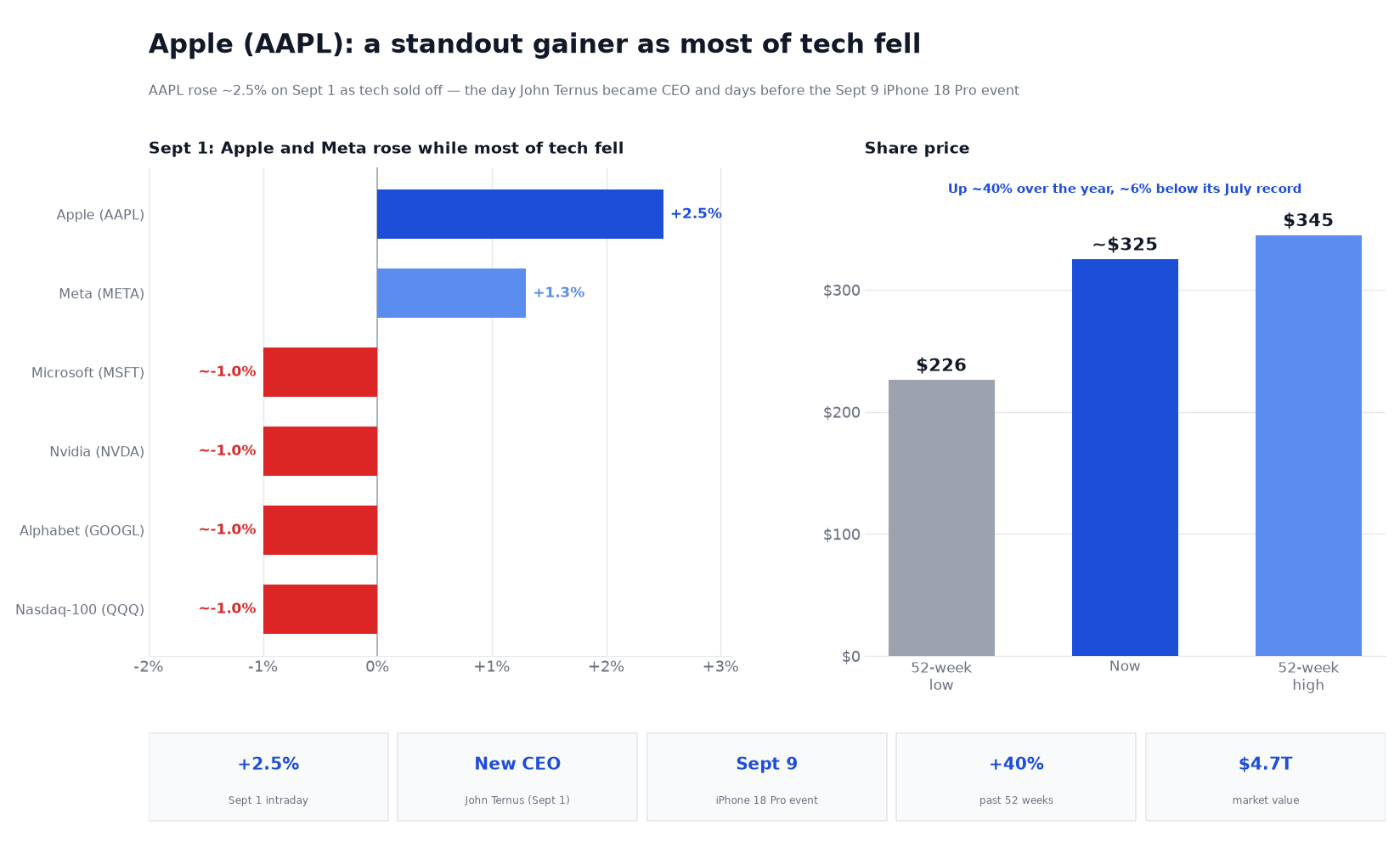
Apple rose about 2.5% to roughly $325 on September 1, and the striking part was the company it kept: on a risk-off day driven by rising Treasury yields, Apple was one of the very few large-caps to rise — Meta also gained — while Microsoft, Nvidia and Alphabet slipped alongside the Nasdaq-100. The day carried two milestones. A long-planned leadership handover took effect: John Ternus, the hardware engineer behind the iPhone and Vision Pro, became CEO, with Tim Cook — chief executive since 2011 — moving to executive chairman; the succession was announced back in April, so this was the orderly handover, not fresh news. And Apple's September 9 event, expected to unveil the iPhone 18 Pro and a first foldable, is days away. The catch is valuation: at about 36 times earnings, after a ~40% run, the stock sits right at its average analyst target and about 6% below its late-July record — and the Street is split, with a Bernstein $370 bull case against a rare Jefferies bearish call (an Underperform near $264).
Why Apple stock rose — a rare mega-cap bid on a risk-off day
On Tuesday, September 1, 2026, Apple (NASDAQ: AAPL) rose about 2.5% to roughly $325 in intraday trading, up from a $316.85 prior close [1]. What made the move stand out was the company it kept: on a risk-off session driven by rising Treasury yields, technology and semiconductors sold off broadly, and Apple was one of the very few large-caps to rise. Among the megacaps only Meta also gained; Microsoft, Nvidia and Alphabet each slipped around 1%, and the tech-heavy Nasdaq-100 fell about the same (intraday readings) [5]. When investors want to stay in technology but reach for safety, they reach for Apple — a fortress balance sheet, around $137 billion of annual free cash flow and a return on equity near 150% [3]. And on this particular day, Apple had two milestones of its own.
Two milestones: a new CEO and the September 9 iPhone event
September 1 was the day a long-planned leadership transition took effect. John Ternus — the engineer who had run hardware for the iPhone, iPad, Mac, Apple Watch and Vision Pro — became Apple's chief executive, while Tim Cook, CEO since 2011, moved to executive chairman of the board [2]. This was not a surprise: Apple announced the succession back on April 20, 2026, describing it as the result of a long-term, board-approved planning process, so Tuesday was the orderly handover rather than fresh news [2]. The symbolism is hard to miss — a hardware chief takes the top job just as the company prepares its biggest hardware moment of the year. Apple has confirmed a product event for September 9, tagged "Surprise and shine," with invitations sent on August 26; it is expected to unveil the iPhone 18 Pro and Pro Max and, by many accounts, Apple's first foldable iPhone [4]. A calm succession plus a marquee product catalyst days away made Apple a natural place to hide on a day the rest of tech fell.
Priced for quality
The debate about Apple is rarely about the business and almost always about the price. The shares trade at roughly 36 times trailing earnings (about 35 times forward) [3] — a premium multiple for a company whose revenue grows at a mid-teens pace, though one the market has long been willing to pay for Apple's ecosystem, margins (gross margin near 49%) and cash generation. The catch is that after a ~40% run over the past year, the stock sits right at the average analyst price target and still about 6% below its late-July record of $344.57 [1][6]. In other words, Apple is a high-quality compounder trading at a full price — which is precisely why it behaves like a safe harbor on a turbulent day, and also why the upside from here is a genuine debate.
Why it matters
Apple's quiet gain on a loud down-day says two things. First, it is a reminder of Apple's role as a defensive mega-cap — when rates rise and speculative tech wobbles, the market's instinct is to rotate toward the highest-quality balance sheet in the index, and Apple, despite being a technology company, increasingly trades like a blue-chip haven. Second, it underscores how much rides on the next product cycle. Apple is handing the wheel to a hardware engineer at a moment when the iPhone franchise needs a spark and the company is widely seen as a step behind in generative AI. The September 9 event — a new Pro line and, potentially, Apple's first foldable — is the first real test of the Ternus era. Tuesday's move was the market voting, calmly, that the transition is a non-event and the catalyst is worth waiting for.
Bucking the selloff, in one cross-section
The same-day tape isolates how unusual Apple's gain was — most of the megacaps fell, with only Meta joining it higher [5]:
| Name (ticker) | Sept 1, 2026 | Read-through |
|---|---|---|
| AAPL — Apple | ≈+2.5% | A standout gainer; new CEO takes over, iPhone event days away [1][2] |
| META — Meta Platforms | ≈+1.3% | The other large-cap higher on the day [5] |
| MSFT — Microsoft | ≈−1% | Slipped with the broad tech tape [5] |
| NVDA — Nvidia | ≈−1% | Semiconductors weighed on the market [5] |
| GOOGL — Alphabet | ≈−1% | Mega-cap growth broadly soft [5] |
| QQQ — Nasdaq-100 ETF | ≈−1% | Rising Treasury yields pressured high-multiple tech [5] |
Apple up about 2.5% while most of its mega-cap peers and the Nasdaq-100 slipped is the signature of a stock moving on its own catalysts, not the market's mood [5].
What the Street thinks
Coverage is positive on balance but genuinely divided, and the stock's run has closed most of the gap to consensus. The average 12-month target of about $324 sits essentially on top of the current price, with a range that runs from a low near $215 to a high around $400 [6]. The calls capture the spread: Bernstein's Mark Newman carries a Buy at $370, and J.P. Morgan's Samik Chatterjee keeps a Buy at $340 [6]. On the cautious side, Rosenblatt's Barton Crockett holds at $303 — below the current price — D.A. Davidson's Gil Luria is at Neutral with a $270 target, and, most strikingly, Jefferies' Edison Lee carries an Underperform (a Sell-equivalent) near $264 [6]. A live bearish call on a mega-cap is unusual; it captures the central question — whether the next product cycle can justify the multiple.
What to watch
- The September 9 event. The iPhone 18 Pro lineup and a potential first foldable — the first product test of the Ternus era, and the near-term catalyst [4].
- The upgrade cycle. Whether the new iPhones and a foldable drive a genuine replacement wave, or land as an incremental refresh [4].
- Apple's AI roadmap. Progress on generative AI and Siri, the area where Apple is most often seen as behind, and a key swing factor for the multiple [3].
- Valuation versus targets. Whether earnings growth can push a stock already at its average target back toward its record. Moves are tracked on the AAPL stock page [1].
Illustrative valuation sensitivity
The scenarios below are anchored to Apple's earnings power and to the analyst target distribution (low near $215, average ~$324, high $370) [6], turning on how the new product cycle and the AI roadmap play out. They are a descriptive, author-weighted exercise — not a forecast, target, recommendation, or intrinsic fair-value calculation — with subjective weights that sum to 100%.
| Scenario | Illustrative price | Weight | Key drivers |
|---|---|---|---|
| Upside | ~$370 | 30% | The iPhone 18 Pro and a first foldable spark a real upgrade cycle, services keep compounding, and the multiple holds as the stock re-rates toward the bullish targets [4]. |
| Middle | ~$335 | 40% | A solid but in-line product cycle carries the stock modestly higher toward the bullish end of consensus, with the multiple roughly stable [6]. |
| Downside | ~$270 | 30% | The cycle underwhelms or the foldable stays niche, AI progress lags, and a ~36x multiple compresses toward the bearish targets [6]. |
Weighting those (0.30 × $370 + 0.40 × $335 + 0.30 × $270) gives an author-weighted reference value near $326, essentially at Tuesday's ~$325 level and the ~$324 consensus target [1][6] — reflecting a premier franchise the market has already re-rated to a full price, with the debate now about whether the next cycle can take it to fresh highs. This is a Street-target-and-earnings-based scenario exercise and descriptive analysis of a news move, not investment advice.
AAPL data snapshot — September 1, 2026
| Figure | Value | As-of / source |
|---|---|---|
| Intraday quote | ~$325 (+~2.5%), about 6% below its 52-week high — an intraday reading (the session was still open) | Tue, Sep 1, 2026 — StockAnalysis [1] |
| Prior close / open / range | $316.85 prior close; opened $316.98; day range $314.73–$327.30 | Sep 1, 2026 [1] |
| 52-week range / trend | $225.95–$344.57 (record $344.57 on Jul 29); up ~40% over 52 weeks; above its ~$313 50-day and ~$283 200-day averages; RSI ≈61 | As of Sep 1 [3] |
| Market cap / EV | ≈$4.74T (14.59B shares); enterprise value ≈$4.68T; beta ≈1.09 | Sep 1 — StockAnalysis [3] |
| Valuation | Trailing P/E ≈36×; forward P/E ≈35×; ≈10× sales; dividend yield ≈0.3% ($1.08) | Sep 1 — StockAnalysis [3] |
| Financials (TTM) | Revenue ≈$467B (+14%); net income ≈$129B; EPS $8.72; gross margin ≈49%; operating margin ≈33%; ROE ≈149%; free cash flow ≈$137B | TTM — StockAnalysis [3] |
| Catalyst 1 — CEO | Planned leadership handover took effect Sept 1: John Ternus (ex-hardware chief) became CEO; Tim Cook moved to executive chairman. Announced April 20, 2026 | Apr 20 / Sep 1, 2026 — company [2] |
| Catalyst 2 — event | iPhone 18 Pro event confirmed for Sept 9 ("Surprise and shine"; invites Aug 26); iPhone 18 Pro / Pro Max and a potential first foldable expected | Aug 26 / Sep 9, 2026 — company / reports [4] |
| Volume | ≈34.7M shares by intraday against a ~38.4M-share 20-day average — roughly average participation | Sep 1 — StockAnalysis [1] |
| Same-day peers | META +~1.3% also rose; MSFT, NVDA and GOOGL each slipped ~1% and QQQ fell ~1% (intraday) — Apple a standout gainer | Sep 1 [5] |
| Analyst view | Consensus Buy (23 Strong Buy / 7 Buy / 16 Hold / 1 Sell / 1 Strong Sell of 48), avg target ≈$324 — on top of the price, range ~$215–$400; Bernstein $370, JPMorgan $340; Rosenblatt Hold $303, D.A. Davidson Neutral $270, Jefferies Underperform ~$264 | Aug–Sep 2026 — StockAnalysis / analyst notes [6] |
Apple (AAPL) stock FAQ
Why did Apple (AAPL) stock rise on September 1, 2026?
Apple rose about 2.5% to roughly $325, and the notable part was that it was among the very few large-caps to gain on a day the broader market sold off (Meta also rose). On a risk-off session driven by rising Treasury yields, Microsoft, Nvidia and Alphabet each slipped about 1% alongside the Nasdaq-100, while Apple attracted a flight-to-quality bid. The day also carried two Apple-specific milestones: a long-planned CEO handover to John Ternus took effect, and Apple's September 9 iPhone 18 Pro event is days away.
Who is Apple's new CEO, and when was the change announced?
John Ternus became Apple's chief executive on September 1, 2026, succeeding Tim Cook, who moved to executive chairman of the board. Ternus is the engineer who previously ran hardware for the iPhone, iPad, Mac, Apple Watch and Vision Pro. The change was not a surprise: Apple announced the succession on April 20, 2026, describing it as the result of a long-term, board-approved planning process, so September 1 was the orderly effective date of a transition the market had long anticipated.
What is Apple expected to announce at its September 9 event?
Apple has confirmed a product event for September 9, 2026, tagged "Surprise and shine," with invitations sent on August 26. It is widely expected to unveil the iPhone 18 Pro and iPhone 18 Pro Max and, by many accounts, Apple's first foldable iPhone (sometimes referred to as an iPhone Ultra or Fold). The more affordable standard iPhone 18 is reportedly being held for a spring 2027 launch. The event is the first major product test of the new Ternus era.
Is Apple stock expensive?
It trades at a premium. Apple changes hands at roughly 36 times trailing earnings (about 35 times forward), a rich multiple for a company growing revenue at a mid-teens pace — though one the market has long paid for Apple's ecosystem, gross margin near 49%, and roughly $137 billion of annual free cash flow. After a ~40% run over the past year, the stock sits right at the average analyst price target and still about 6% below its late-July record of $344.57, so the valuation-driven upside from here is a genuine debate rather than an obvious bargain.
What do analysts think of Apple stock now?
Coverage is positive on balance but unusually divided for a mega-cap. The consensus is a Buy — 23 Strong Buy and 7 Buy of 48 analysts — but there are also 16 Holds and, rarely, a live bearish call, and the average 12-month target of about $324 sits essentially on top of the current price (in a range from about $215 to about $400). The bulls include Bernstein's Mark Newman (Buy, $370) and J.P. Morgan's Samik Chatterjee (Buy, $340); the cautious camp includes Rosenblatt's Barton Crockett (Hold, $303), D.A. Davidson's Gil Luria (Neutral, $270) and Jefferies' Edison Lee, who carries an Underperform (a Sell-equivalent) targeting about $264.
What is the biggest risk for Apple now?
Valuation meeting a merely-good product cycle. At about 36 times earnings and already at its average analyst target, Apple needs the iPhone 18 Pro and its first foldable to spark a real upgrade wave; an incremental refresh could leave the multiple exposed, especially with the company widely seen as a step behind in generative AI. The CEO transition, while long-planned and orderly, is also a genuine change at the top. The franchise itself — scale, margins, cash flow and a compounding services business — remains exceptionally strong.