Stock Analysis
Hims & Hers (HIMS) Drops ~18% as Q3 Gross Margin Craters on the GLP-1 Shift
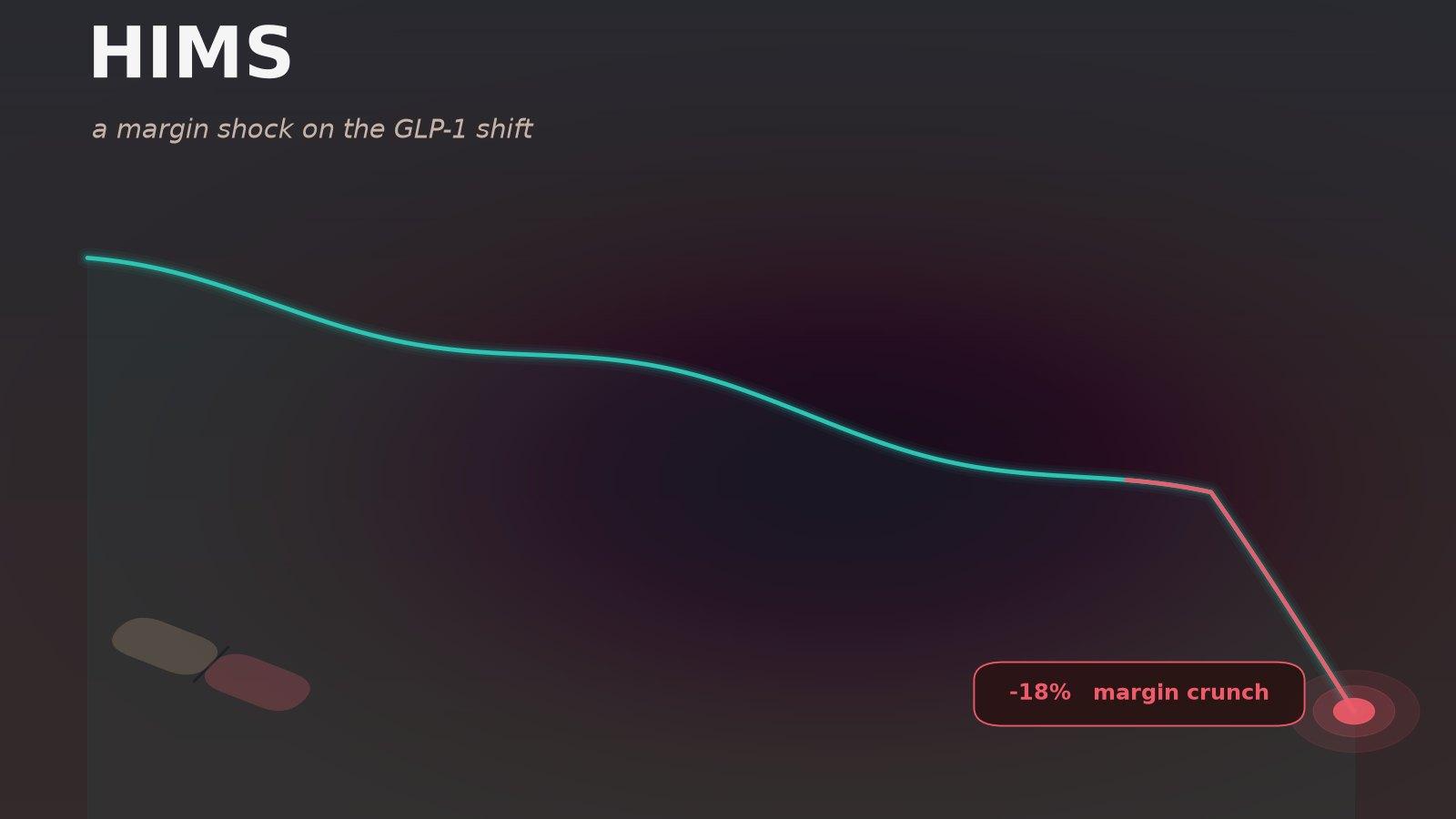
Hims & Hers fell about 18% to roughly $18.76 on November 10 — a seven-month low — after third-quarter results that grew revenue 49% to about $890 million but exposed a margin problem underneath. Gross margin collapsed to about 57% from 74% a year earlier, the company swung to a $33 million GAAP net loss (about $0.14 a share, versus a profit expected) even as adjusted EBITDA stayed positive, and it cut its full-year adjusted-EBITDA guidance to roughly $257–$277 million, from $275–$325 million — its third reduction this year. The culprit is the same thing that made HIMS a market darling: weight-loss drugs. As the era of cheap compounded GLP-1 medications wound down, Hims pivoted to selling branded drugs, which are a low-margin, pass-through business, so the mix shift that keeps revenue growing — led by its international rollout — is compressing margins. (A just-announced deal to distribute Eli Lilly's Zepbound, unveiled after the quarter closed, lifted the stock Friday but postdates these results.) Subscribers also disappointed, rising 13% to about 2.79 million but below the roughly 3.04 million expected and down about 100,000 sequentially, with management flagging more weakness. The move was company-specific: telehealth peers were roughly flat, the market barely moved, and Eli Lilly, the drug supplier, actually rose. Wall Street is lukewarm — a Hold consensus, with brokers cutting targets toward the mid-$20s on the print, though still above the price. After a 50%-plus decline the stock trades at under two times sales, which looks cheap only if margins and subscribers stabilize — the very things that just deteriorated.
Why Hims & Hers stock dropped — Q3 growth masked a gross-margin squeeze
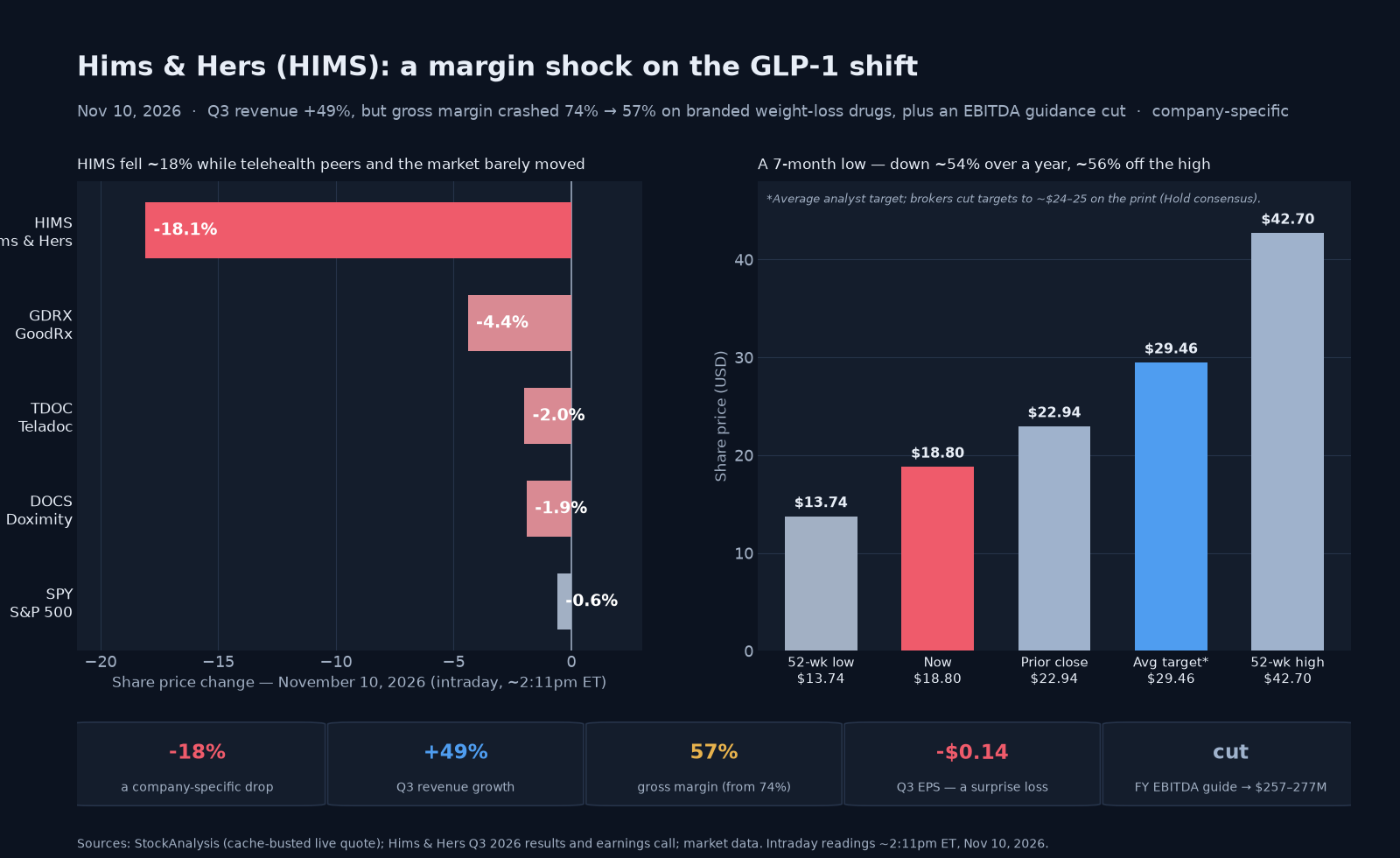
On Tuesday, November 10, 2026, Hims & Hers Health (NYSE: HIMS) fell about 18%, trading near $18.76 intraday — a seven-month low — after the telehealth company's third-quarter results, released the evening before, landed badly [1]. The paradox is that the top line was strong: revenue rose 49% to about $890 million. The problem was underneath it. Gross margin collapsed to about 57%, from 74% a year earlier, the company swung to a $33 million net loss (about $0.14 a share, versus a small profit expected and a profit a year ago), and it cut its full-year profit guidance [2]. Fast growth that destroys margins is exactly what a market does not want to see, and it sold the stock hard.
The culprit is the same thing that made HIMS a market darling in the first place: weight-loss drugs. Hims built an explosive growth engine partly by offering GLP-1 medications, and as the era of cheap compounded versions wound down, it pivoted to selling branded weight-loss drugs. Branded drugs are a low-margin, pass-through business: HIMS buys them and resells them, keeping far less of each dollar than it earns on its high-margin subscription services or on the compounded drugs it used to sell. On the earnings call, management said the quarter's margin drop came principally from scaling these lower-margin branded weight-loss products, especially in its fast-growing international business [2]. (A separate, just-announced deal to distribute Eli Lilly's branded Zepbound — unveiled on November 6, after the quarter closed — had lifted the stock about 8% the prior Friday, but it postdates these results and did not cause them.) So the GLP-1 mix shift that keeps revenue growing is simultaneously compressing margins — the central tension this quarter laid bare [2].
What actually spooked investors — margins, subscribers and a guidance cut
Three things drove the sell-off, and none was the revenue line. First, the margin collapse: gross margin has slid all year — about 74%, then 72%, 64% and now 57% — and the 17-point year-over-year drop pushed the company to a GAAP net loss. (Notably, its adjusted EBITDA stayed positive and even edged higher, about $82 million versus $78 million a year earlier, so the deterioration showed up in the margin and in GAAP profitability, not in adjusted operating profit, which stayed positive) [2]. Second, subscribers disappointed: Hims ended the quarter with about 2.79 million subscribers, up 13% from a year ago but below the roughly 3.04 million analysts expected and down about 100,000 from the prior quarter — a sequential decline the company blamed partly on pulling back U.S. marketing, with the finance chief warning of another quarter of subscriber headwinds [2]. For a subscription business, a shrinking subscriber base is the one number you cannot explain away. Third, the guidance cut: Hims lowered its full-year adjusted-EBITDA outlook to roughly $257–$277 million, from $275–$325 million — its third reduction to that profit target this year — and guided fourth-quarter revenue to about $875–$895 million, well short of the roughly $954 million the Street had modeled [2].
Put together, the quarter told a coherent and unwelcome story: Hims is still growing fast, but the growth is coming from a lower-margin product mix while its highest-value metric — paying subscribers — is stalling. Management framed some of the profit pressure as timing (delayed recognition of weight-loss membership revenue) and investment (planned international pricing and marketing), which could prove temporary [2]. But the market, already wary of how volatile the weight-loss business makes this company, chose to reprice HIMS for the worse: from a high-margin subscription-telehealth story into a lower-margin seller of other companies' drugs with an uncertain subscriber trajectory. That the move was HIMS-specific was clear in the tape — telehealth peers barely budged, the broad market was roughly flat, and Eli Lilly, the branded-drug supplier, actually rose [5].
The valuation question
HIMS is no longer the richly valued growth story it was a year ago — the stock is down more than 50% over that span [1]. After the drop its market value is about $4.4 billion, or roughly 1.9 times trailing sales (and closer to 1.5 times forward sales given the growth), which is not demanding for a company still compounding revenue near 50% [3]. The catch is that the quality of that revenue has changed: a dollar of branded-drug sales is worth far less than a dollar of subscription revenue, so the same sales multiple implies lower profits than it used to. On earnings there is nothing to value — HIMS is loss-making on a trailing GAAP basis — though its adjusted EBITDA is positive and it generates positive operating cash flow, so this is not a solvency question, it is a margin-and-growth-quality question [3]. One more feature shapes the stock's behavior: HIMS is heavily shorted, with short interest around a quarter of its tradable shares, which is why it can lurch 8% higher on a drug deal one day and 18% lower on an earnings miss the next [1]. The valuation looks reasonable on sales, but only if margins and subscribers stabilize — the very things that just deteriorated.
Why it matters
Hims & Hers is the clearest public test of whether a consumer-health platform can turn the weight-loss-drug boom into durable profit. The GLP-1 wave handed HIMS enormous growth, but this quarter exposed the trap: as the business shifts from high-margin compounded drugs and subscriptions toward reselling branded medications, revenue can keep climbing while profitability goes the other way. The episode is a lesson in revenue quality — the market cares not just how fast a company grows but how much of each dollar it keeps, and a 49% revenue gain was worthless to investors once it came with a 17-point margin cut and a profit warning. The read-through was contained to HIMS: telehealth peers were roughly flat and Eli Lilly, whose drugs HIMS now resells, rose, underscoring that the pain sits specifically with the reseller, not the sector or the drug maker [5]. The resolution will not come from the next revenue headline but from the margin and subscriber lines: if Hims can use low-margin weight-loss drugs to acquire customers and then migrate them to higher-margin services, today looks like a painful transition; if margins stay compressed and subscribers keep slipping, the market will keep treating it as a lower-quality business than it once was.
The move, in one cross-section
The same-session tape shows a clean company-specific drop on a roughly flat day [5]:
| Name (ticker) | Nov 10, 2026 (intraday) | Read-through |
|---|---|---|
| HIMS — Hims & Hers | ≈−18% | The earnings name — crashed on a gross-margin collapse, a subscriber miss and an EBITDA guidance cut, despite 49% revenue growth [1][2] |
| GDRX — GoodRx | ≈−4.4% | Digital-health peer — down modestly, a fraction of HIMS's move [5] |
| TDOC — Teladoc | ≈−2.0% | Telehealth peer — little changed; no read-through from HIMS's margin problem [5] |
| DOCS — Doximity | ≈−1.9% | Digital-health peer — barely moved [5] |
| SPY — S&P 500 (ETF) | ≈−0.6% | Broad market roughly flat — HIMS fell alone [5] |
HIMS down about 18% while its peers and the market were roughly flat — and Eli Lilly, the branded-drug supplier, was higher — is the signature of a company-specific catalyst: its own results, not a sector move [5].
What the Street thinks
Wall Street was already lukewarm, and the quarter cooled it further. The consensus rating is a Hold, not a Buy — unusual for a fast grower — from about 15 analysts, with an average 12-month target near $29, inside a wide range from about $23 to $42 [6]. Crucially, brokers moved on the print: several cut their targets into the mid-$20s the same day — for example to about $24–$25 — reflecting the margin and subscriber concerns, even as those targets still sit above the post-drop price [6]. That combination — a Hold consensus, freshly cut targets, but targets still above the price — captures the ambivalence: analysts see value in the growth and cash generation but are no longer willing to pay up for a business whose margins just deteriorated and whose subscriber trend turned negative. Unlike a high-conviction stock bought on every dip, HIMS is now a show-me story even to the Street [6].
What to watch
- Gross margin. Whether the slide to 57% stabilizes or keeps falling as the branded weight-loss mix grows — the single most important number next quarter [2].
- Subscribers. Whether the sequential decline reverses or the flagged "additional quarter of headwinds" turns into a trend [2].
- Cross-sell. Whether Hims can migrate weight-loss customers to higher-margin services, the key to making the GLP-1 strategy profitable rather than dilutive to margins [2].
- Guidance stability. Whether the EBITDA outlook holds after three cuts this year, or is reduced again. Moves are tracked on the Hims & Hers stock page [6].
Illustrative scenario sensitivity
Because the drop is a reaction to margin and subscriber quality rather than the growth rate, the scenarios below are anchored to how gross margin and the subscriber base evolve through the weight-loss-drug transition rather than to a single valuation [6]. They are a descriptive, author-weighted exercise over roughly the coming six-to-twelve months as those trends clarify — not a forecast, target, recommendation, or trading advice — with subjective weights that sum to 100%.
| Scenario | Illustrative price | Weight | Key drivers |
|---|---|---|---|
| Margins stabilize, subscribers recover | ~$26 | 25% | Gross margin bottoms, the subscriber base returns to growth, cross-selling lifts the mix, and the stock re-rates toward analysts' cut-but-still-higher targets [6]. |
| Cheap on sales, but show-me | ~$19 | 45% | Revenue keeps growing but the market withholds a re-rating until margins and subscribers prove they have stabilized; the stock stays cheap and volatile near current levels [1]. |
| Margin erosion persists | ~$14 | 30% | The branded-drug mix keeps compressing margins, subscribers keep slipping, guidance is cut again, and the stock drifts toward its 52-week low [2]. |
Weighting those (0.25 × $26 + 0.45 × $19 + 0.30 × $14) gives an author-weighted reference value near $19 — an illustrative, probability-weighted scenario output mechanically derived from the weights above, and not a price target, fair-value estimate, or prediction — essentially in line with Tuesday's ~$18.76 intraday price [1][6]. The near-identity reflects a genuinely balanced but wide-dispersion setup: a fast-growing, cash-generative platform trading cheaply on sales, offset by a real, unresolved question about whether the weight-loss-drug shift has permanently lowered its margins and stalled its subscriber growth. This is a scenario exercise and descriptive analysis of a news-driven move, not investment advice.
Hims & Hers data snapshot — November 10, 2026
| Figure | Value | As-of / source |
|---|---|---|
| Intraday quote | ~$18.76 (−~18%) — an intraday reading (the session was open); a seven-month low; day range $18.40–$22.47 | Tue, Nov 10, 2026, ~2:15pm ET — StockAnalysis [1] |
| Prior close / open | $22.94 prior close; opened $22.12 (had risen ~8% Friday on an Eli Lilly Zepbound distribution deal, then gave it back) | Nov 10, 2026 [1] |
| 52-week trend | 52-week range $13.74–$42.70; down ~54% over 52 weeks and ~56% off the high; beta ≈2.50 (high); short interest ≈23% of shares (~25% of float) | As of Nov 10 [1] |
| Market cap | ≈$4.41B (≈234M shares); enterprise value ≈$5.26B; ~$712M cash vs ~$1.56B debt (net debt ≈$849M) | Nov 10 — StockAnalysis [3] |
| Valuation | Loss-making on a trailing basis (net loss ttm ≈−$191M, EPS ttm ≈−$0.83; no P/E) but cash-generative (free cash flow ttm ≈$32M); price-to-sales ≈1.9× on ~$2.87B trailing revenue (~1.5× forward) | Nov 10 — StockAnalysis [3] |
| Q3 2026 results | Revenue ~$890M (+49% YoY); gross margin ~57% (from ~74%); GAAP net loss ~$33M (−$0.14/sh, vs a small profit expected) — but adjusted EBITDA stayed positive ~$82M (up slightly YoY); subscribers ~2.79M (+13% YoY, but below ~3.04M est and down ~100k sequentially) | Nov 10 — Hims & Hers Q3 2026 results [2] |
| Catalyst | Q3 earnings: strong revenue, compressed margins. The shift to low-margin branded weight-loss (GLP-1) drugs — scaled principally in its international business — collapsed gross margin and swung HIMS to a GAAP loss (though adjusted EBITDA stayed positive); it cut FY adjusted-EBITDA guidance to $257–277M (from $275–325M; a third 2026 cut) and guided Q4 revenue ($875–895M) below the ~$954M expected, with subscribers missing and falling sequentially | Nov 10, 2026 — company results + earnings call [2] |
| Same-day cross-section | GDRX −4.4%, TDOC −2.0%, DOCS −1.9% (telehealth/digital-health peers); SPY −0.6% (market); LLY +1.1% (the branded-drug supplier) — HIMS's ~18% drop was company-specific | Nov 10 intraday [5] |
| Analyst view | Consensus Hold (not Buy) from ~15 analysts, avg target ~$29 (low ~$23, median ~$26, high ~$42) — but brokers cut targets to the mid-$20s (≈$24–25) on the print (e.g. JPMorgan, Leerink, Jefferies), still above the price | Nov 10, 2026 — StockAnalysis / analyst notes [6] |
Hims & Hers (HIMS) stock FAQ
Why did Hims & Hers (HIMS) stock drop on November 10, 2026?
HIMS fell about 18% to roughly $18.76 — a seven-month low — after third-quarter results that looked strong on the top line but weak underneath. Revenue grew 49% to about $890 million, but gross margin collapsed to about 57% from 74% a year earlier, the company swung to a $33 million GAAP net loss (about $0.14 a share, versus a small profit expected) even though its adjusted EBITDA stayed positive, and it cut its full-year adjusted-EBITDA guidance to roughly $257–$277 million, from $275–$325 million — its third cut to that profit target this year. On top of that, subscribers missed expectations and fell sequentially. The market punished the combination because it signals that Hims is growing by selling lower-margin products — branded weight-loss drugs, increasingly sold internationally — while its most valuable metric, paying subscribers, is stalling. Fast revenue growth that erodes margins and comes with a profit-guidance cut is exactly what investors do not want, so they repriced the stock sharply lower.
How are weight-loss (GLP-1) drugs behind the margin collapse?
Weight-loss drugs are both the growth engine and the margin problem. Hims & Hers scaled rapidly by offering GLP-1 weight-loss medications, initially cheaper compounded versions. As the compounding era wound down, it shifted toward selling branded weight-loss drugs, and more recently agreed to distribute Eli Lilly's branded Zepbound (a deal announced November 6, after the quarter closed). The issue is economics: branded drugs are a low-margin, pass-through business, where Hims essentially buys the medication and resells it, keeping far less of each dollar than it earns on its high-margin subscription services (like dermatology, mental health or sexual health) or on the compounded drugs it used to sell. So as these lower-margin products become a bigger share of revenue — especially as Hims scales them in its international business, which management called the principal reason for the sequential margin drop — the overall gross margin falls, this quarter to 57% from 74% a year earlier (it has slid steadily all year). That is why revenue can grow 49% while GAAP profit turns negative, even as adjusted EBITDA stays positive: the mix is shifting toward a product that adds sales but little margin.
Did Hims & Hers actually grow — or is the business shrinking?
It is still growing fast on revenue, but the composition and some key metrics are the concern. Third-quarter revenue rose 49% to about $890 million, so the top line is clearly expanding. However, two things deteriorated: profitability and subscribers. Gross margin fell sharply and the company posted a net loss, and the subscriber count — about 2.79 million, up 13% from a year ago — came in below the roughly 3.04 million analysts expected and actually declined by around 100,000 from the prior quarter, which management attributed partly to pulling back on U.S. marketing. For a subscription business, a sequential drop in subscribers is a warning sign, because subscriptions are the recurring, higher-margin core. So the honest answer is that revenue is growing but the quality of that growth weakened: more low-margin drug sales, fewer high-value subscribers, and lower profit guidance.
Is Hims & Hers stock cheap now after the 18% drop?
It is much cheaper than it was — the stock is down more than 50% over the past year — but 'cheap' depends on whether margins and subscribers stabilize. After the drop, Hims trades at roughly 1.9 times trailing sales (closer to 1.5 times forward sales given its growth), which is not demanding for a company still growing revenue near 50%, and it generates positive operating cash flow, so this is not a solvency concern. The problem is that the quality of the revenue changed: a dollar of low-margin branded-drug sales is worth far less in profit than a dollar of subscription revenue, so the same sales multiple now implies lower earnings power. On a trailing basis the company is loss-making, so there is no meaningful price-to-earnings ratio. The valuation looks reasonable on sales, but it is only justified if the margin slide stops and subscribers recover — exactly the uncertainties the quarter raised. This is descriptive analysis, not investment advice.
How did Hims & Hers' drop compare with other health stocks that day?
The move was specific to Hims. On the same day, telehealth and digital-health peers barely moved — Teladoc was down about 2%, Doximity about 2%, and GoodRx about 4% — while the S&P 500 was roughly flat, down less than 1%. Tellingly, Eli Lilly, the company whose branded weight-loss drug Hims now resells, actually rose. HIMS falling about 18% against that backdrop is the classic signature of a company-specific catalyst — its own earnings, margin collapse and guidance cut — rather than a sector move. That isolation matters for interpretation: the market was not souring on telehealth or on weight-loss drugs broadly; it was repricing Hims specifically for selling those drugs at thin margins. The fact that the drug maker gained while the reseller fell neatly illustrates where the profit in the weight-loss boom is accruing — and where it is not.
What should investors watch next for Hims & Hers?
Four things. First and most important, gross margin — whether the slide to about 57% stabilizes or keeps falling as branded weight-loss drugs become a bigger share of the mix. Second, subscribers — whether the sequential decline reverses or the 'additional quarter of headwinds' management flagged becomes a trend, since subscriptions are the high-margin core. Third, cross-sell — whether Hims can move weight-loss customers onto higher-margin services, which is the key to making the GLP-1 strategy profitable rather than margin-dilutive. Fourth, guidance stability — whether the EBITDA outlook holds after three cuts this year. Because the stock now trades on margin and subscriber quality rather than headline growth, and because it is heavily shorted, it is likely to stay volatile and to react sharply to any signal on those metrics. The next earnings report, not the next drug deal, will be the real test.