Consumer
Ross Stores (ROST) Stock Jumps ~5%: A Big Q2 Beat and +10% Comps — With a One-Time Tariff Boost
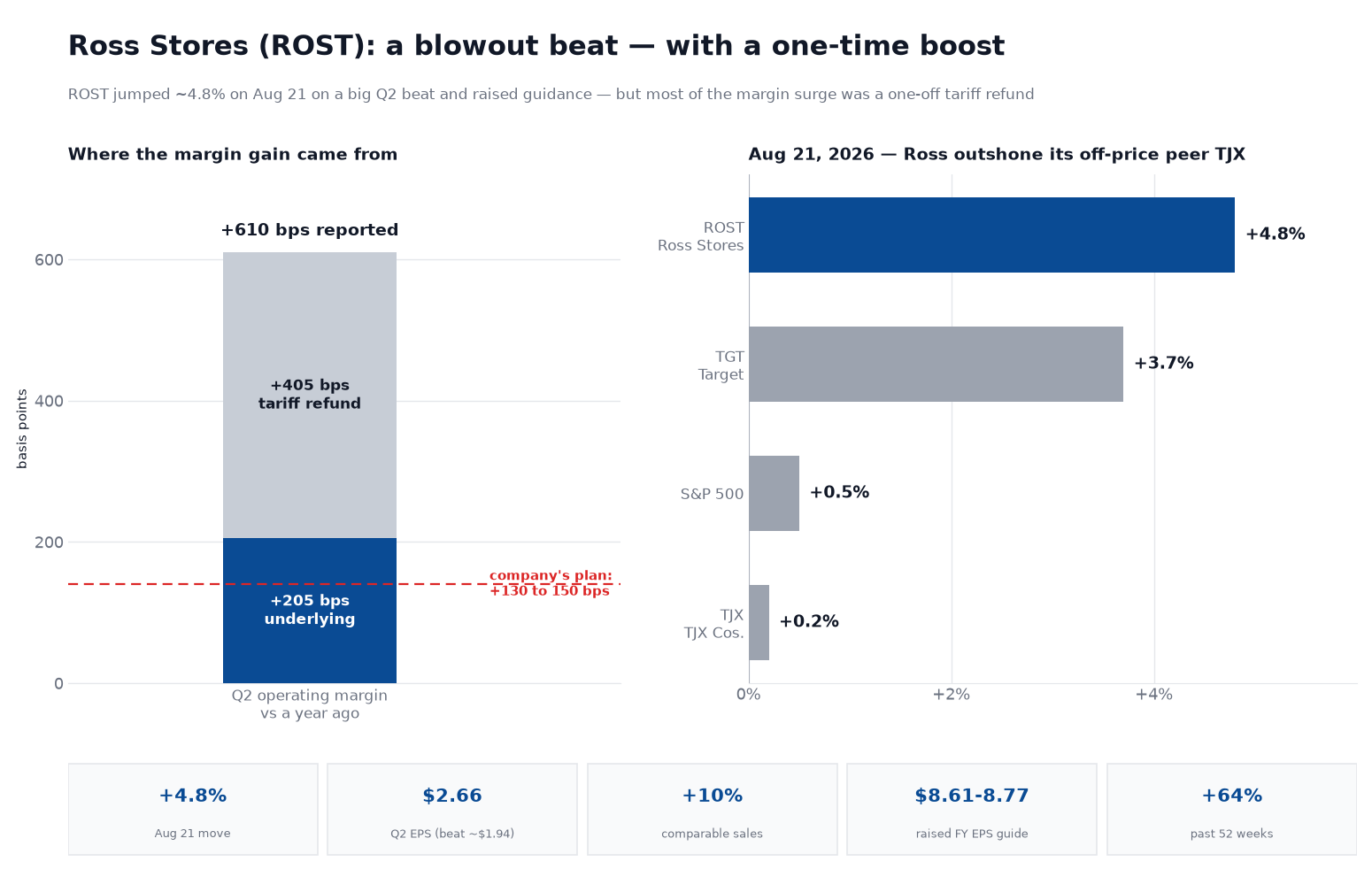
Ross Stores jumped about 4.8% to roughly $240 on August 21 after a strong fiscal Q2: earnings of $2.66 a share beat the ~$1.94 consensus, revenue rose 13% to $6.26 billion, comparable-store sales grew 10% on higher traffic, and management raised full-year EPS guidance to $8.61–$8.77. The catch: a one-time tariff refund (~$253 million, ~$0.60 a share) flattered the headline — of the 610-basis-point operating-margin expansion, about 405 bps was the refund, and ex-refund EPS was closer to $2.06 (still a beat, but a much narrower one). It was a healthier report than Walmart's, which beat but fell on slowing comps; Ross's +10% comp, though down from +17% in Q1, was far better. And it outran its direct off-price peer TJX (~flat), marking the move as mostly company-specific — though Target's ~4% rally showed the retail tape wasn't uniformly flat. After a ~64% run to near its highs, the stock trades ~28x forward — rich for retail.

Why Ross Stores stock jumped — a big Q2 beat and a raised outlook
On Friday, August 21, 2026, Ross Stores (NASDAQ: ROST) rose about 4.8% to roughly $240, from a $228.99 prior close [1]. The off-price retailer had reported fiscal second-quarter results the evening before, and they were a clear beat: earnings of $2.66 a share topped the roughly $1.94 consensus (though a one-time tariff refund flattered that figure — more below), revenue rose about 13% to $6.26 billion (ahead of the ~$6.15 billion expected), and — most tellingly for a retailer — comparable-store sales grew 10%, driven by higher customer traffic [2]. Management then raised full-year earnings guidance to $8.61–$8.77 a share, with third- and fourth-quarter outlooks also above Wall Street's estimates, and lifted its 2026 store-opening plan to about 115 new locations [2]. For a business whose thesis is steady, traffic-driven growth, that combination is close to ideal.
Read the beat carefully: a one-time refund amplified the headline
Two of the quarter's flashiest numbers deserve a closer look before anyone extrapolates them, because a single one-time item — a tariff refund of about $253 million, worth roughly $0.60 a share — flattered both [2]. Start with margins: Ross said its Q2 operating margin expanded 610 basis points year over year, an enormous jump — but 405 of those basis points came from that tariff refund, not the underlying business. Strip it out and the underlying operating-margin expansion was about 205 basis points, still comfortably above the company's own plan of 130 to 150 basis points [2]. The same applies to earnings: the headline $2.66 included that ~$0.60 refund, so the cleaner, ex-refund figure is roughly $2.06 — still ahead of the ~$1.94 consensus, but a far narrower beat than $2.66 suggests [2]. None of this means the quarter was weak underneath: the underlying margin gain beat plan and the ex-refund earnings still topped estimates. It simply means the headline was heavily amplified by an item that will not repeat — and that the traffic and comparable-sales strength, not the tariff refund, is the durable story. The market, to its credit, rewarded the quarter without appearing to mistake the one-off for the trend.
Ross rose on its beat — the mirror image of Walmart
Ross's reaction is a useful contrast to the other big retail report this week. Walmart also beat on earnings — and it, too, booked a tariff-related benefit — yet its stock fell, because its U.S. comparable sales were slowing and the stock was priced for more. Ross's setup was healthier: its comparable sales came in at a robust +10% on rising traffic — a step down from an even stronger +17% in the first quarter, but a world away from Walmart's deceleration — and it raised guidance, so investors rewarded it [2]. The lesson is the one this earnings season keeps repeating — a beat only helps when it beats what the market already expected, and when the underlying trend (here, traffic and double-digit comps) is pointing the right way.
Why it matters
Ross is a bellwether for the off-price model — buying brand-name overstock and selling it cheap — that has been one of retail's most durable winners. When its comparable sales accelerate to 10% on higher traffic, it signals that value-hungry shoppers are still trading down and hunting for bargains, a dynamic that tends to strengthen when household budgets are stretched. That its direct peer TJX barely moved on the same day underscores that this was Ross's own quarter, not just a rising tide. At the same time, the tariff-refund footnote is a reminder that 2026's retail margins are being shaped by policy as much as by operations: the same tariffs that pressure costs are, when refunded, temporarily padding profits. Untangling the durable from the one-off is the whole game in reading these reports — and Ross's quarter, underneath the one-time boost, was genuinely strong.
How the day's retail tape traded
August 21 sorted the retail complex by the quality of its news [5]:
| Name (ticker) | Aug 21, 2026 (intraday) | Read-through |
|---|---|---|
| ROST — Ross Stores | ≈+4.8% | Blowout Q2 beat, +10% comps, raised guidance [1][2] |
| TGT — Target | ≈+3.7% | Extending gains after its own quarter [5] |
| S&P 500 | ≈+0.4% | A modestly higher broad market [5] |
| TJX — TJX Cos. | ≈+0.2% | Ross's direct off-price peer — essentially flat, so the move was Ross-specific [5] |
Ross outran its closest competitor TJX by more than four points on the day — the signature of a strong company-specific reaction — though Target's concurrent ~4% rally is a reminder that the retail tape was not uniformly flat [5].
What the Street did with it
Coverage skews bullish and got more so after the print, which set off a flurry of same-day target increases. Across 20 analysts the consensus is a Buy with an average 12-month target near $270 (about 12% above Friday's level) and a median near $282, with the ratings running roughly 14 buys against 5 holds and one sell [6]. On the bullish side, Citi went to $290 (from $270, Buy), Robert W. Baird to $270 (from $250), and others piled on — Truist to a Street-high $310, Deutsche Bank to $294, Evercore to $290 and Jefferies to $285 — while Telsey Advisory already sat at $280 (Outperform) after raising a week earlier [6]. The more cautious camp lifted numbers too but stayed neutral and close to the stock's level: UBS at Neutral, $239 (from $232), and Morgan Stanley at Equal-weight, $234 [6]. Notably, the ~$270 average target sits below the cluster of fresh $285–$310 bull marks — held down by genuinely cautious targets such as UBS ($239), Morgan Stanley ($234) and Bernstein (~$240) — so the headline consensus blends real bull and bear views rather than simply lagging the news. Either way, the neutrals sitting near the current price capture the valuation tension in a compounder trading close to its highs.
What to watch
- Comparable-sales momentum. The 10% comp on rising traffic is the durable signal. Watch whether that pace holds into the back half against tougher comparisons [2].
- Underlying vs one-off margins. With 405 bps of the Q2 margin gain a tariff refund, watch whether the underlying ~205-bps improvement is sustained without the one-time help [2].
- Guidance follow-through. Management raised the full-year EPS range to $8.61–$8.77 — a figure that already includes the ~$0.60 one-time tariff benefit; watch the Q3 print (guided $1.75–$1.83) against that bar [2].
- Valuation and analyst targets. The stock sits above several neutral targets after a ~64% run. Watch whether the bulls' numbers pull the group up or the stock consolidates. Moves are tracked on the ROST stock page [6].
Illustrative valuation sensitivity
Ross has real, growing earnings, so the scenarios below are anchored to its forward earnings power (a forward P/E near 28×) and to the analyst target distribution (low ~$176, average ~$270, high ~$310), turning on whether comparable-sales momentum holds as the one-time tariff benefit rolls off. They are a descriptive, author-weighted exercise — not a forecast, target, recommendation, or intrinsic fair-value calculation — with subjective weights that sum to 100%.
| Scenario | Illustrative price | Weight | Key drivers |
|---|---|---|---|
| Upside | ~$300 | 30% | Comps stay strong on continued trade-down, the underlying margin gains stick, and the premium multiple holds as earnings compound toward the bullish targets [6]. |
| Middle | ~$270 | 45% | Growth normalizes as the tariff benefit rolls off; Ross drifts toward the consensus target as investors digest a rich valuation near the highs [6]. |
| Downside | ~$205 | 25% | Comps decelerate against tough comparisons or the consumer weakens, and a ~28× multiple on a retailer de-rates toward the low end of the target range [2][6]. |
Weighting those (0.30 × $300 + 0.45 × $270 + 0.25 × $205) gives an author-weighted reference value near $263, above Friday's ~$240 but a touch below the ~$270 consensus [1][6] — reflecting a genuinely strong quarter set against a premium valuation and a fading one-time tailwind. This is a Street-target-based scenario exercise and descriptive analysis of an earnings reaction, not investment advice.
ROST data snapshot — August 21, 2026 (intraday)
| Figure | Value | As-of / source |
|---|---|---|
| Intraday quote | ~$240 (+~4.8%); feed +4.79% | Aug 21 — StockAnalysis / Change Feed [1] |
| Prior close | $228.99 | Thu, Aug 20, 2026 [1] |
| 52-week range / change | $143.39–$257.00; ~+64% over 52 weeks (~7% below the high; above its 50-day ~$235 and 200-day ~$209 averages) | As of Aug 21 [4] |
| Market cap / EV | ≈$77B (321M shares); enterprise value ≈$78B; beta ≈0.9 (defensive) | Aug 21 — StockAnalysis [4] |
| Valuation | Trailing P/E ≈29×; forward P/E ≈28×; ≈3.1× sales; dividend yield ≈0.7% | Aug 21 — StockAnalysis [4] |
| Financials (TTM) | Revenue ≈$24.5B (+14%); net income ≈$2.7B (EPS $8.27, +31% YoY); operating margin ≈13.8%; gross margin ≈34% | TTM — StockAnalysis [4] |
| Volume | ~3.4M shares vs a ~2.4M 20-day average (~1.4×, elevated) | Aug 21 — StockAnalysis [4] |
| The quarter (fiscal Q2) | EPS $2.66 — including ~$0.60 from a one-time tariff refund, so ~$2.06 ex-refund (still beating ~$1.94); revenue $6.26B (up 13%, vs ~$6.15B); comparable sales +10% on higher traffic (down from +17% in Q1); operating margin +610 bps YoY (of which ~405 bps the tariff refund; ~205 bps underlying, above the 130–150 bps plan); FY EPS guide raised to $8.61–$8.77 (includes the ~$0.60 benefit) | Aug 20 — company [2] |
| Same-day retail tape | ROST ≈+4.8% vs TGT ≈+3.7% vs S&P 500 ≈+0.5% vs TJX ≈+0.2% (off-price peer, ~flat) | Aug 21 [5] |
| Analyst view | 20 analysts, consensus Buy, avg target ≈$270 (median ≈$282; range ~$176–$310); 12 strong buy / 2 buy / 5 hold / 1 sell / 0 strong sell; recent target raises: Citi $290, Baird $270, Truist $310 (high), Deutsche Bank $294, Evercore $290, Telsey $280 (Outperform, Aug 14); UBS Neutral $239, Morgan Stanley $234 | Aug 2026 — StockAnalysis / market coverage [6] |
The August 21 figures are intraday snapshots that moved through the session, not closing prices.
The setup at a glance
| Question | Answer |
|---|---|
| Why did Ross Stores stock jump on August 21? | It reported fiscal Q2 earnings of $2.66 a share the evening before, well ahead of the ~$1.94 consensus, on revenue up 13% to $6.26 billion and comparable-store sales up 10% on higher traffic — then raised full-year EPS guidance to $8.61–$8.77. The strong, traffic-driven beat and raised outlook lifted the stock about 4.8% [1][2]. |
| Was the big beat as strong as the headline? | Partly one-time. A tariff refund of about $253 million (~$0.60 a share) flattered both figures: of the 610-basis-point operating-margin expansion, about 405 basis points was the refund (leaving ~205 bps underlying, still above the 130–150 bps plan), and the $2.66 EPS was roughly $2.06 excluding the refund — still ahead of the ~$1.94 consensus, but a much narrower beat. The quarter was genuinely strong underneath; the headline was just amplified by an item that will not repeat [2]. |
| Why did Ross rise when Walmart fell on its beat? | Expectations and trend. Walmart beat but its U.S. comparable sales were slowing, and the stock was richly valued, so it fell. Ross's comparable sales came in at a robust +10% on rising traffic — down from +17% in Q1, but far healthier than Walmart's pace — and it raised guidance, so investors rewarded it. A beat only helps when it beats what the market expected and the underlying trend is pointing the right way [2]. |
| Why did Ross outperform TJX? | Because this was mostly Ross's own quarter. TJX, Ross's closest off-price competitor, was essentially flat on the day (~+0.2%) while Ross jumped ~4.8% on its results — a gap that marks the move as company-specific, even though Target's concurrent ~4% rally shows the broader retail tape was not entirely flat [5]. |
| Is Ross stock expensive? | It is a premium retailer. After a ~64% run over the past year to near its highs, Ross trades around 29 times trailing and 28 times forward earnings — rich for retail, though its earnings are growing about 30% and it is a low-beta, defensive compounder. The post-earnings pop carried it to roughly where the cautious analysts sit (UBS $239, Morgan Stanley $234) [4][6]. |
| What do analysts think? | Bullish overall, and more so after the print. The consensus is Buy with an average target near $270 (about 12% upside) across 20 analysts, and a wave of firms raised targets — Citi to $290, Truist to a Street-high $310, Deutsche Bank to $294, Evercore to $290, Baird and Jefferies into the $270–$285 range. A couple of neutral marks near the current price (UBS $239, Morgan Stanley $234) are the counterweight [6]. |
Ross Stores (ROST) stock FAQ
Why did Ross Stores (ROST) stock jump on August 21, 2026?
Ross Stores reported fiscal second-quarter results the evening before, and they were a clear beat. Earnings of $2.66 a share came in well ahead of the roughly $1.94 consensus, revenue rose about 13% to $6.26 billion (above the ~$6.15 billion expected), and comparable-store sales grew 10%, driven by higher customer traffic. Management then raised its full-year earnings guidance to $8.61–$8.77 a share, with third- and fourth-quarter outlooks also above estimates, and lifted its 2026 store-opening plan to about 115 new locations. The strong, traffic-driven beat and raised outlook lifted the stock about 4.8%.
Was Ross's big beat as strong as the headline?
Partly, and this is the key nuance in the quarter. A one-time tariff refund of about $253 million — worth roughly $0.60 a share — flattered two of the flashiest numbers. Ross's operating margin expanded 610 basis points year over year, but about 405 of those points were the refund; the underlying expansion was roughly 205 basis points, still above the company's own 130-to-150-basis-point plan. The same is true of earnings: the reported $2.66 included that ~$0.60, so the cleaner ex-refund figure is roughly $2.06 — still ahead of the ~$1.94 consensus, but a much narrower beat. The quarter was genuinely strong underneath (the underlying margin beat plan and ex-refund earnings still topped estimates), but the headline was heavily amplified by an item that will not repeat, which next year will face as a tough comparison. The durable story is the traffic and comparable-sales strength.
Why did Ross rise on its beat when Walmart fell on its beat?
It comes down to expectations and the direction of the underlying trend. Walmart also beat on earnings — and it, too, booked a tariff-related benefit — but its U.S. comparable sales were slowing and the stock was richly valued, so it fell. Ross's setup was healthier: its comparable sales came in at a robust +10% on rising traffic — a step down from +17% in the first quarter, but far healthier than Walmart's deceleration — and it raised guidance, so investors rewarded it. The recurring lesson of the season is that a beat only helps when it beats what the market already expected and the core trend is holding up, not just when the reported number tops the estimate.
Why did Ross Stores outperform TJX on the same day?
Because the move was mostly company-specific. TJX Companies — the operator of T.J. Maxx and Marshalls and Ross's closest off-price competitor — was essentially flat on August 21 (about +0.2%), while Ross jumped roughly 4.8% on its own results. If the day had been a broad off-price rally, TJX would have moved with it; the fact that it didn't marks Ross's gain as a reaction to its specific quarter — the +10% comps, the earnings beat and the raised guidance. That said, Target's concurrent ~4% rally shows the broader retail tape was not entirely flat, so it was not a pure vacuum either.
Is Ross Stores stock expensive after the jump?
It is a premium-valued retailer. After a roughly 64% run over the past year to near its 52-week high, Ross trades at about 29 times trailing and 28 times forward earnings — rich for a retailer — though its earnings are growing around 30% and it is a low-beta, defensive compounder with a long record of steady growth. Notably, the post-earnings pop carried the stock to roughly where several cautious analysts' price targets sit (UBS at $239, Morgan Stanley at $234), which is a sign that a lot of good news is already reflected. This is descriptive analysis, not a recommendation.
What do analysts think of Ross Stores?
They are bullish overall, and a wave of firms turned more positive right after the quarter. Across 20 analysts the consensus is a Buy with an average 12-month price target near $270 (about 12% above the August 21 level) and a median near $282, on a distribution of roughly 12 strong buy, 2 buy, 5 hold, 1 sell and no strong sell. Same-day (Aug. 21) target raises included Citi to $290 (from $270, Buy), Robert W. Baird to $270 (from $250), Truist to a Street-high $310, Deutsche Bank to $294, Evercore to $290 and Jefferies to $285 (Telsey Advisory was already at $280, Outperform, from a week earlier) — a cluster of fresh $285–$310 marks that sits above the ~$270 average. The counterweight is a pair of neutral firms sitting near the current price, UBS at $239 (Neutral) and Morgan Stanley at $234 (Equal-weight). That split captures a high-quality compounder trading near its highs.