Stock Analysis
Why did Danaher (DHR) stock fall ~13% on July 21, 2026 — a beat-and-raise undone by a core revenue guidance cut
Danaher fell nearly 13% on July 21, 2026 despite beating on adjusted EPS and raising its full-year earnings guidance. The company tied that raise partly to completing the Masimo acquisition early — while cutting full-year core revenue growth guidance to 3–4% from 3–6% and marking bioprocessing down to mid-single-digit growth. The market paid for the organic line, not the inorganic one. Bioprocessing peers Repligen and Sartorius fell in sympathy while instrument makers rose, on a day the broad market was up ~1%.
Summary
Danaher (NYSE: DHR) was trading at $175.20 at about 1:07 p.m. ET on Tuesday, July 21, 2026, down $25.91, or 12.88%, from Monday's $201.11 close [1][2]. This article was written intraday; the figures below are timestamped and are not closing prices.
The puzzle is that this was, on its headline numbers, a beat and a raise. Danaher reported second-quarter adjusted earnings of $1.94 a share against roughly $1.83–$1.84 expected, grew revenue 5.5% to $6.27 billion, and raised its full-year adjusted EPS guidance to $8.45–$8.60 from $8.35–$8.55 [3][4]. Companies that beat and raise do not usually fall 13%.
The answer is in the composition. Danaher's own release attributes the EPS increase to "strong Q2 earnings performance and earlier-than-anticipated completion of [the] Masimo acquisition" — that is, partly inorganic [3]. The organic measure moved the other way: full-year core revenue growth guidance was cut to 3.0%–4.0% from 3.0%–6.0%, with the bioprocessing growth outlook taken from high-single-digit to mid-single-digit [3][5]. The market separated the two and priced the organic line.
| Evidence level | What can be said |
|---|---|
| Documented | DHR traded −12.88% at $175.20 at ~1:07 p.m. ET on volume 3.29× its 20-day average with the session ~56% elapsed; Q2 adjusted EPS of $1.94 beat and revenue rose 5.5%; full-year core revenue guidance was cut to 3.0%–4.0% from 3.0%–6.0% while adjusted EPS guidance was raised to $8.45–$8.60; Q3 core guidance of 2.0%–3.0% is below the new full-year range; bioprocessing peers fell hard while non-bioprocessing tools names rose [1][2][3]. |
| Reported interpretation | The selloff reflects the market discounting an EPS raise the company itself ties partly to pulling the Masimo acquisition forward, while marking down the organic growth rate — with bioprocessing, the segment that drove Danaher's premium multiple, at the centre of the markdown [3][5]. |
| Author inference / not measurable | Whether bioprocessing's shortfall is genuinely "customer project timing," as management says, or the start of a demand problem cannot be settled from one quarter — orders grew mid-teens, which cuts against the bearish read. No sell-side note had been published at the time of writing, so no analyst reaction is reported here. The scenario values below are illustrative estimates, not forecasts. |
What changed
| Metric | Value | As of / source |
|---|---|---|
| Price (intraday) | $175.20 | Jul 21 2026, ~1:07 p.m. ET — StockAnalysis [2] |
| Prior close (Jul 20) | $201.11 | StockAnalysis [2] |
| Change | −$25.91 / −12.88% | Vs prior close, ~1:07 p.m. ET [2] |
| Day's range | $165.75 – $178.58 | Jul 21 2026, ~1:06 p.m. ET; the low sits ~3% above the 52-week low [2] |
| 52-week range | $160.93 – $242.80 | ~28% below the high [2] |
| Volume | ~15.76M sh | Vs a 4.79M 20-day average — 3.29× normal, with only ~56% of the session elapsed [2][6] |
| Market cap | ~$123.8bn | StockAnalysis, Jul 21 [2] |
| Valuation | 23.25× forward / 38.98× trailing | Vs Thermo Fisher at 20.74× forward, same source and day [2][7] |
| Analyst consensus | $242.52 (Buy, 26) | StockAnalysis, Jul 21 1:07 p.m. — predates any post-Q2 revision [2] |
Participation was heavy, and that matters here. Danaher traded about 15.8 million shares against a 4.79-million 20-day average — roughly 3.3× normal — with barely more than half the session gone [2][6]. On pace, the full day lands materially higher still. A double-digit decline on triple-average turnover in a $124 billion mega-cap reflects unusually heavy and broad repositioning, not a thin-tape drift. (Volume alone does not identify who traded — institutions, systematic funds, options hedging and retail all sit inside that print.) That distinguishes this from a move that can be dismissed as noise — though volume measures conviction, not correctness.
The catalyst: a beat and a raise that the market read as a downgrade
Taken line by line, Danaher's quarter was fine. Revenue of $6.27 billion rose 5.5% year over year; GAAP diluted EPS of $1.23 was up 60% from $0.77; adjusted diluted EPS of $1.94 rose 8.0% from $1.80 and came in above the roughly $1.83–$1.84 the Street wanted [3][4]. Core revenue grew 3.0%, or 4.5% excluding respiratory testing — a comparison distortion the company strips out because pandemic-era respiratory revenue is still rolling off [3].
The segment detail is where the softness shows. Against total sales growth, core growth was materially thinner in two of three segments:
| Segment | Total sales growth | Core sales growth | Core less total |
|---|---|---|---|
| Biotechnology | +4.0% | +2.5% | −1.5pp |
| Life Sciences | +5.5% | +5.5% | — |
| Diagnostics | +7.0% | +2.0% | −5.0pp |
Life Sciences — which CEO Rainer M. Blair said "delivered their strongest quarter in several years" — was the one segment where every dollar of growth was organic [3]. Biotechnology, which houses bioprocessing and is the franchise the market pays Danaher's premium multiple for, grew core sales just 2.5% [3].
Diagnostics needs a caveat, because the raw gap overstates the weakness. Its 7.0% total growth against 2.0% core is not five points of evaporating demand — the segment's reported growth came primarily from the Masimo acquisition, with acquisitions adding 1.5% and currency 1.0% to group reported sales [16]. And the 2.0% core figure is itself depressed by the respiratory-testing roll-off that Danaher now strips out explicitly: excluding respiratory testing, core sales grew 5.0% [3][16]. So the honest read of Diagnostics is mid-single-digit underlying growth flattered at the reported line by M&A and dragged at the core line by a known, disclosed comparison distortion — not a demand problem. The segment that actually drove the selloff is Biotechnology, where the 2.5% core figure has no such offsetting explanation.
Then came the guidance, and this is the crux:
| Full-year 2026 guidance | Previous | Now | Direction |
|---|---|---|---|
| Core revenue growth | 3.0% – 6.0% | 3.0% – 4.0% | Cut — top end −200bps |
| Adjusted diluted EPS | $8.35 – $8.55 | $8.45 – $8.60 | Raised — +$0.10 / +$0.05 |
| Q3 2026 core revenue growth | — | 2.0% – 3.0% | Below the new full-year range |
Note the asymmetry. The EPS raise is a dime at the bottom and a nickel at the top. The core revenue cut removed two-thirds of the guided range — the floor held at 3.0% while the ceiling fell from 6.0% to 4.0%, taking the band from 300 basis points wide to 100 [3][8]. A company guiding to 3–6% is telling you a 6% outcome is live; one guiding to 3–4% has taken that outcome off the table. And the Q3 guide of 2.0%–3.0% sits below even the reduced full-year range, which implies the reacceleration is back-half-weighted — a promise rather than a result [3].
A bioprocessing read-across, not a sector selloff
The same-day tape is unusually informative, because it makes the two easy explanations very hard to sustain. This was not a down market and it was not a health-care selloff. The S&P 500 ETF was up 0.90%, the Nasdaq-100 ETF up 1.95%, and biotech (XBI) up 2.27% [10]. The health-care sector ETF XLV was fractionally green at +0.08% — despite Danaher being 2.20% of it, a weight at which a −12.88% move alone subtracts about 0.28 percentage points from the index [10][11]. The rest of health care more than absorbed it.
But it was not purely idiosyncratic either. The damage was concentrated in bioprocessing exposure, and it split the tools complex cleanly in two:
| Company | Move (Jul 21) | Price | Bioprocessing exposure |
|---|---|---|---|
| Danaher (DHR) | −12.88% | $175.20 | Core franchise |
| Sartorius (SRT3, Xetra pref.) | −8.51% | €217.20 | Pure-play |
| Repligen (RGEN) | −7.67% | $134.34 | Pure-play |
| Thermo Fisher (TMO) | −1.69% | $517.34 | Diversified |
| Bio-Rad (BIO) | −0.89% | $299.21 | Limited |
| Agilent (A) | +1.49% | $132.20 | Minimal |
| Waters (WAT) | +1.71% | $363.64 | Minimal |
| Revvity (RVTY) | +3.19% | $109.84 | Minimal |
The gradient is almost perfectly ordered by bioprocessing exposure. The two pure-plays — Repligen and Sartorius — fell 7.7% and 8.5%. The diversified names barely moved. The analytical-instrument names, which sell into different end markets entirely, rose on a strong tape [12][13][14]. The pattern is consistent with a market repricing bioprocessing-specific growth expectations rather than the life-science tools group as a whole — though a day's relative moves show the shape of the repricing, not the reasoning behind it.
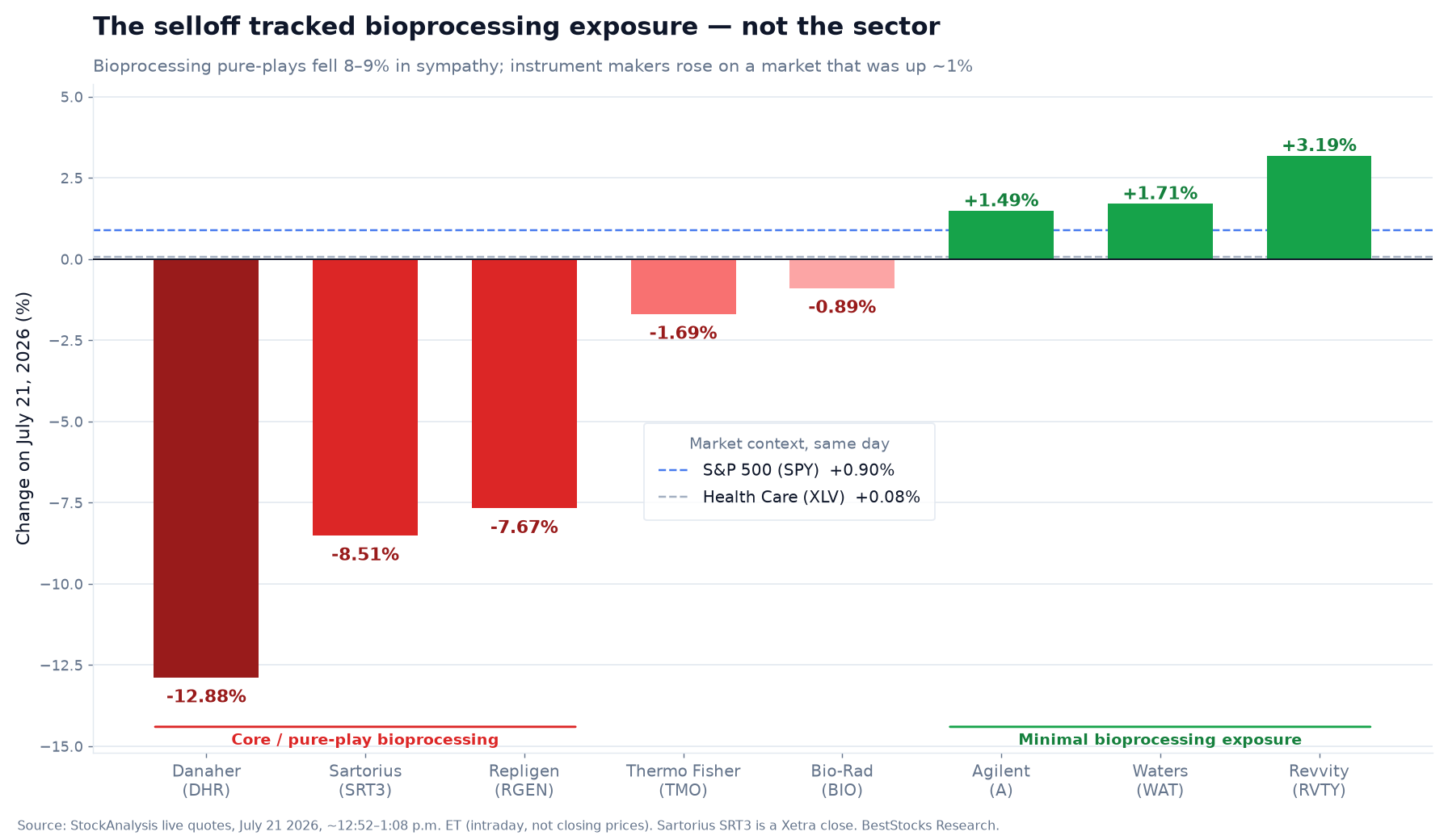
Danaher still fell roughly four to five percentage points more than the worst pure-play. That excess is the company-specific component — the guidance cut, the Q3 number below the full-year range, and the questions about an EPS raise leaning on acquisition timing. In other words, the move decomposes into a sector-adjacent read-across plus a Danaher-specific markdown, and the second piece is the larger one.
What the sell-side had not yet said
One thing this article deliberately does not contain is a list of post-earnings analyst reactions, because at the time of writing there were none. Danaher reported before the open; sell-side notes on a pre-market print conventionally publish the following morning. As of the 1:07 p.m. ET timestamp, the dated rating trackers cited here showed the most recent DHR analyst action as July 6, 2026 — Evercore ISI's Vijay Kumar trimming his target to $230 from $232 while maintaining Outperform, two weeks before the quarter [9][15].
This matters for how the widely-quoted consensus should be read. The $242.52 average target across 26 analysts [2] reflects a pre-print world in which core revenue could still grow 6%. Quoting it against a $175.20 price to imply ~38% upside would be a category error — the number has not been updated for the information that caused the drop. The honest statement is that the pre-earnings target cluster sat around $200–$270 (Piper Sandler $200 Neutral, DZ Bank $210, Barclays / Citi / HSBC / Evercore around $230, BofA $270) and that these will be revised [9][15].
Verification also turned up several stale items being circulated as current — a Rothschild & Co Redburn downgrade actually dated October 2025, an HSBC target cut from June 3, and an unverifiable claim of July target raises that contradicts Piper Sandler's actual Neutral rating. None are used here. Readers checking this story elsewhere in the next few days should check dates carefully.
What this means for value
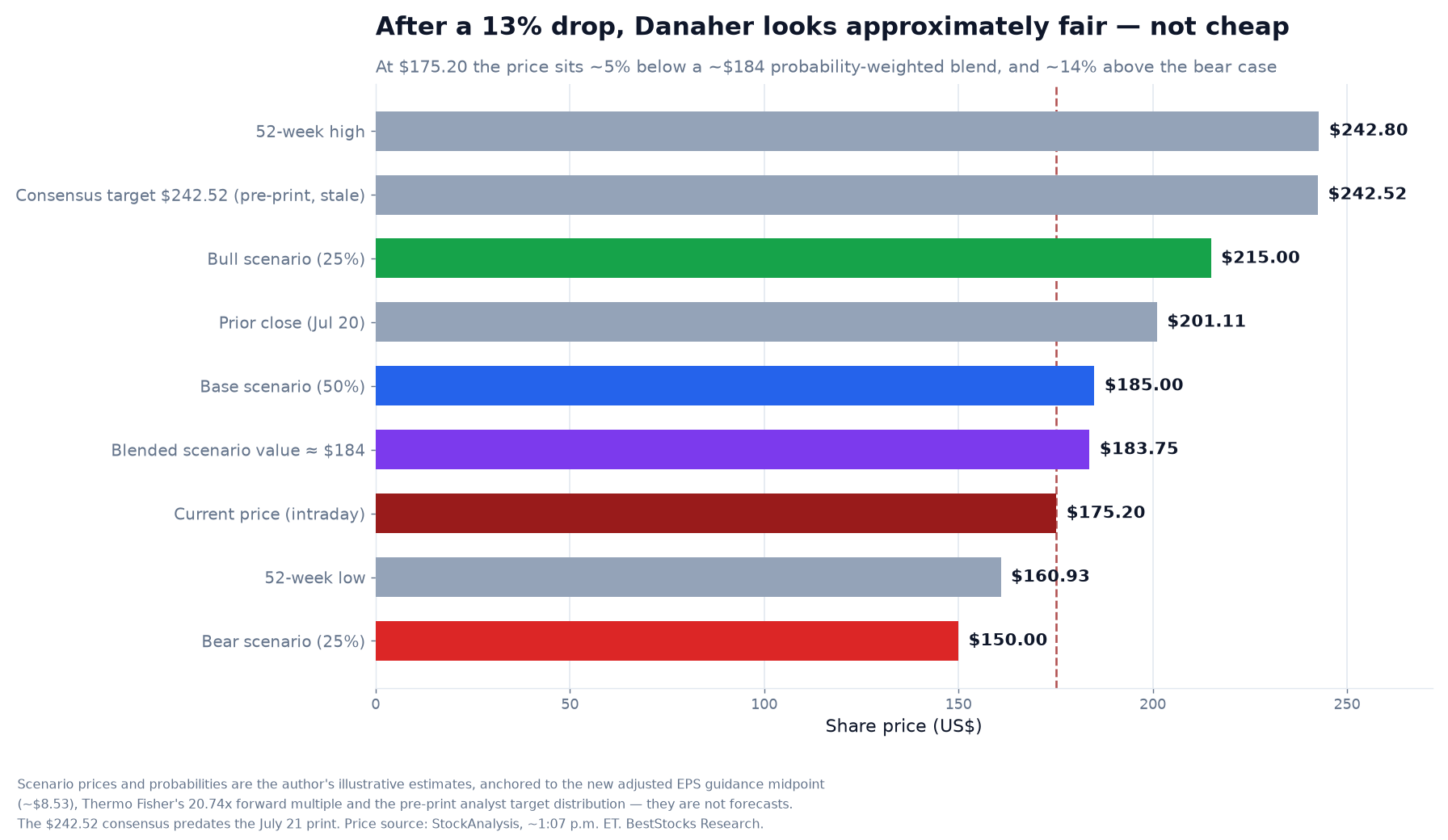
Danaher is a serial acquirer with a high-quality installed base, so its multiple is a function of the organic growth rate the market believes in. The scenarios below are the author's own illustrative estimates, anchored to the new adjusted EPS guidance midpoint (~$8.53), to Thermo Fisher's 20.74× forward multiple as a comparable, and to the pre-print analyst target distribution — not the output of a model. They sum to 100%.
| Scenario | Price | Probability | Key driver |
|---|---|---|---|
| Bull | ~$215 | 25% | Management's "timing" explanation proves right — mid-teens bioprocessing order growth converts to revenue, core reaccelerates through the 4% ceiling in H2, and Masimo plus StatLab compound. A ~25× multiple on ~$8.53, recovering most of the gap toward the pre-print $230 target cluster [3][9] |
| Base | ~$185 | 50% | Core growth settles in the guided 3–4%, mid-single-digit bioprocessing is the new run-rate, and the forward multiple compresses toward the low-22× area — still a modest premium to Thermo Fisher's 20.74×, justified by the acquisition engine but no longer capitalising 6% organic growth [3][7] |
| Bear | ~$150 | 25% | "Customer project timing" turns out to mask genuine demand softness; Q3's 2–3% guide proves a trend rather than a trough, the back-half reacceleration does not arrive, and DHR de-rates below Thermo Fisher to ~17–18× — taking it through the $160.93 52-week low [2][3] |
| Probability-weighted scenario value ≈ $184 (inputs blend to $183.75, rounded; an illustrative estimate, not an objective fair value) — the $175.20 intraday price sits about 5% below it, implying roughly +5% of upside, with the $150 bear case ~14% lower. | |||
The honest conclusion is that the selloff moved Danaher from expensive to approximately fair, not to cheap. A ~5% gap to a blended scenario value is inside the noise band of the assumptions behind it — meaningfully different from the ~19% discount Alcoa showed after its guidance cut. The asymmetry is not obviously attractive either: ~$40 of upside to the bull case against ~$25 of downside to the bear, with the bear scenario breaching the 52-week low. What resolves it is not the multiple but a single empirical question — whether mid-teens bioprocessing order growth shows up as revenue in the third and fourth quarters. Treat the ~$184 figure as an illustrative probability-weighted scenario value, not a target.
What to watch
- Bioprocessing orders-to-revenue conversion — the decisive variable, but on a longer clock than it first appears. Management disclosed mid-teens order growth against soft revenue and said more than $100 million has moved principally from Q2 and Q3 into 2027 [3][17]. A weak Q3 is therefore consistent with the timing explanation as well as with a demand problem; what discriminates between them is whether the deferred revenue actually lands in 2027 and whether order growth holds in the meantime.
- The Q3 print against 2.0%–3.0% core guidance — the full-year 3–4% range requires a back-half acceleration. A Q3 at or below the low end would make the 3% floor itself look optimistic [3].
- The first wave of analyst revisions — none had published at the time of writing. Where the $242.52 consensus resets, and whether any firm cuts its rating rather than just its target, will be the clearest read on how the sell-side interprets the guidance cut [2][9].
- The forward-multiple premium to Thermo Fisher — DHR still trades at 23.25× versus TMO's 20.74×. Whether that premium holds, widens or closes is the market's running verdict on Danaher's organic growth [2][7].
- Bioprocessing peers as a cross-check — Repligen and Sartorius fell in sympathy without reporting. Their own prints will show whether Danaher's markdown was company-specific or an industry signal [12][13].
- StatLab and Masimo integration — if the EPS raise is partly acquisition-driven, execution on those deals carries more weight than usual. StatLab is expected to close by the end of 2026 [3].
Frequently asked questions
Why did Danaher (DHR) stock fall on July 21, 2026?
Danaher fell about 12.9% to $175.20 intraday despite reporting a second-quarter beat. Adjusted EPS of $1.94 topped the roughly $1.83-$1.84 consensus and the company raised full-year adjusted EPS guidance to $8.45-$8.60 from $8.35-$8.55. But it cut full-year core revenue growth guidance to 3.0%-4.0% from 3.0%-6.0%, reduced its bioprocessing growth outlook from high-single-digit to mid-single-digit, and guided third-quarter core growth to just 2.0%-3.0% — below even the reduced full-year range. Danaher also attributed the EPS raise partly to completing the Masimo acquisition earlier than anticipated, meaning the earnings upside was partly inorganic while the organic growth outlook came down.
Did Danaher beat or miss earnings in Q2 2026?
It beat. Adjusted diluted EPS of $1.94 was up 8.0% from $1.80 a year earlier and came in above consensus estimates of roughly $1.83-$1.84. Revenue rose 5.5% to $6.27 billion and GAAP diluted EPS of $1.23 was up 60% from $0.77. The stock fell anyway because the market focused on the forward guidance rather than the reported quarter. The $1.23 figure that appears in some coverage is the GAAP number, not a miss against the adjusted estimate.
What exactly did Danaher change in its guidance?
Two things moved in opposite directions. Full-year 2026 core revenue growth guidance was cut to 3.0%-4.0% from the previous 3.0%-6.0% — the floor was unchanged but the ceiling came down 200 basis points, removing two-thirds of the guided range (the band narrowed from 300 basis points wide to 100). Full-year adjusted diluted EPS guidance was raised to $8.45-$8.60 from $8.35-$8.55, an increase of $0.10 at the bottom and $0.05 at the top. Danaher also guided third-quarter core revenue growth to 2.0%-3.0%, below the new full-year range, which implies any reacceleration is weighted to the fourth quarter.
What happened with Danaher's bioprocessing business?
Bioprocessing sits inside the Biotechnology segment, which grew total sales 4.0% but core sales just 2.5%. CEO Rainer M. Blair said that while customer project timing impacted bioprocessing revenue, underlying order trends remained strong and bioprocessing orders grew mid-teens in the quarter. The company nonetheless reduced its bioprocessing growth outlook from high-single-digit to mid-single-digit. On the earnings call management quantified the displacement: more than $100 million of revenue has shifted, principally out of the second and third quarters and into 2027, and management said it considers it highly unlikely those pushouts do not return. That detail matters for how quickly the question can be settled — because the revenue was deferred into 2027 rather than merely delayed by weeks, a soft third quarter is consistent with both the timing explanation and a genuine demand problem. Whether the shortfall is timing or the beginning of a demand problem is the central unresolved question for the stock.
Was this a life-sciences sector selloff?
Not broadly — the weakness was concentrated in companies with direct bioprocessing exposure, and the same-day tape shows it. The broad market was up — the S&P 500 ETF gained 0.90%, the Nasdaq-100 ETF 1.95% and biotech (XBI) 2.27% — while the health-care sector ETF XLV was fractionally positive at +0.08%. The damage tracked bioprocessing exposure specifically: pure-plays Sartorius and Repligen fell 8.51% and 7.67%, diversified Thermo Fisher fell 1.69% and Bio-Rad 0.89%, while instrument makers with minimal bioprocessing exposure rose — Agilent +1.49%, Waters +1.71% and Revvity +3.19%. Danaher fell four to five points more than the worst pure-play, which is the company-specific component.
What did analysts say about Danaher after the Q2 report?
Nothing yet, as of the time of writing. Danaher reported before the market opened and sell-side reaction notes to a pre-market print conventionally publish the following morning. The most recent dated analyst action on DHR was July 6, 2026, when Evercore ISI's Vijay Kumar trimmed his target to $230 from $232 while maintaining Outperform — two weeks before the quarter. This is important context for the widely quoted $242.52 consensus price target across 26 analysts: it predates the print entirely and has not been revised for the guidance cut, so comparing it to the current price to infer upside would be misleading.
Is Danaher stock cheap after the July 2026 drop?
It looks approximately fair rather than cheap. Even after a 13% decline, DHR trades at 23.25 times forward earnings versus Thermo Fisher's 20.74 times, so the premium survived the selloff. On the author's illustrative probability-weighted scenario value (bull ~$215 at 25%, base ~$185 at 50%, bear ~$150 at 25%, blending to about $184), the $175.20 intraday price sits roughly 5% below that blend — a gap inside the noise band of the assumptions behind it. The bear case at ~$150 would take the stock through its $160.93 52-week low. What resolves the question is whether the mid-teens bioprocessing order growth converts into revenue in the second half. These figures are illustrative descriptive analysis, not investment advice.