Energy
Fervo Energy (FRVO) Stock Drops 16.6% as 2027 Revenue Outlook Flags Curtailment Risk
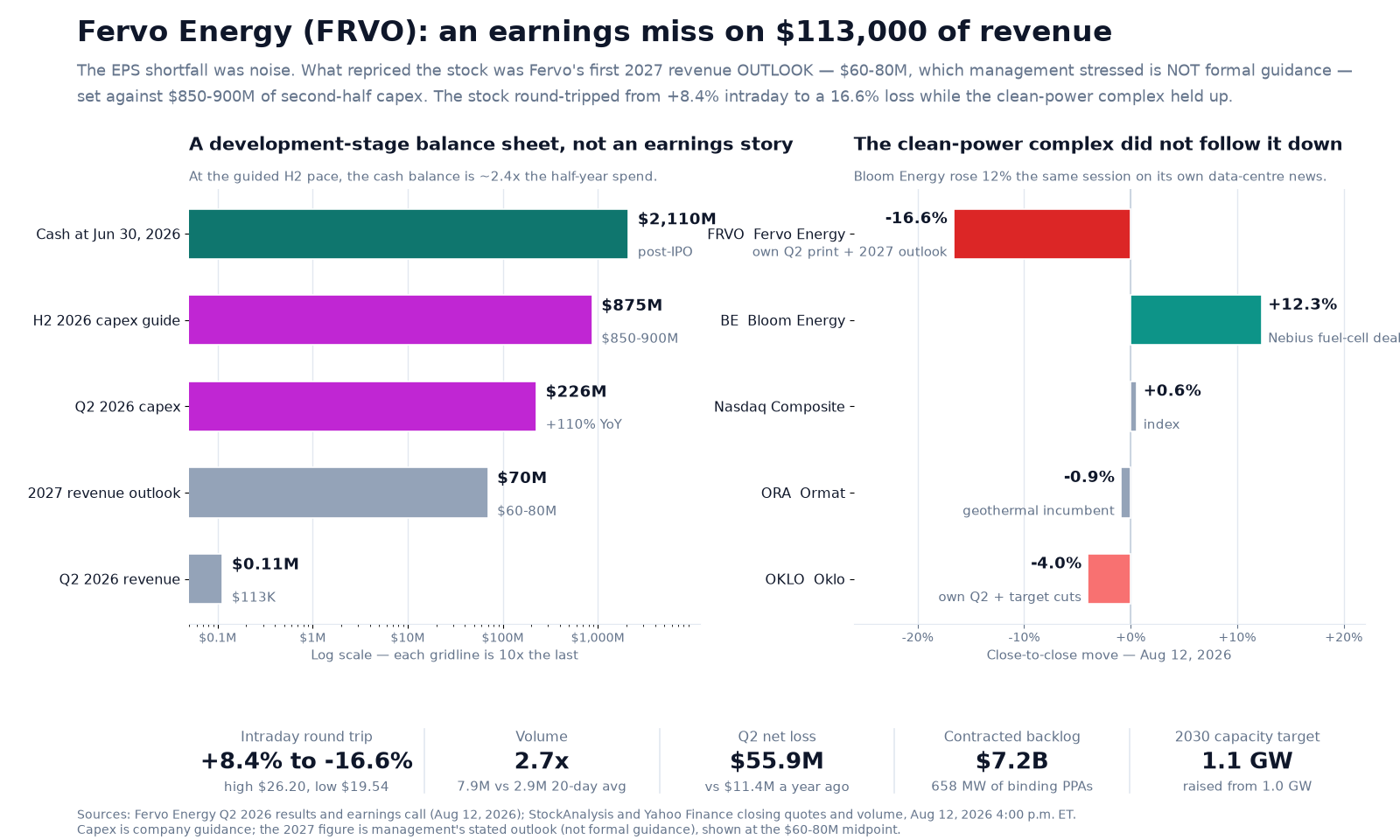
Fervo Energy closed down 16.6% at $20.16 after its first full quarter as a public company. The headline was a 415% EPS surprise, but on $113,000 of revenue that percentage is uninformative — what repriced the stock was Fervo's first 2027 revenue outlook of $60-80 million (explicitly not formal guidance) and the transmission-curtailment risk attached to it, set against $850-900 million of second-half capex. The stock round-tripped from +8.4% intraday to a 16.6% loss while Bloom Energy rose 12% and Ormat barely moved.
Why Fervo Energy stock fell on August 12
On Wednesday, August 12, 2026, Fervo Energy (NASDAQ: FRVO) closed down 16.6% at $20.16, from a $24.17 prior close [3][4]. The wire copy called it an earnings miss: a loss of $0.38 per share against a consensus near $0.08–$0.09, which some feeds rendered as a "415% miss" [6]. Read that percentage with care. Fervo booked $113,000 of revenue in the quarter [1]. The percentage surprise is unusually uninformative for a development-stage company because it compares a $0.38 GAAP loss with a small expected loss of roughly $0.08–$0.09, which makes the miss balloon — the denominator is a near-zero consensus EPS, not revenue. The GAAP loss itself is real; what is misleading is treating that surprise as the story.
What actually repriced the stock was Fervo's first look at 2027 revenue — a $60 million to $80 million outlook — and the caveat management attached to it. CFO David Ulrey was explicit that this is not formal guidance: "Given the reliability of our assets and the contracted nature of our revenue, the range we are providing today is likely wider than we would ordinarily provide," reflecting potential transmission-related curtailment that management framed as specific to 2027 rather than a problem with well or plant performance [2]. For a stock whose value rests on a schedule, a hedged first revenue number is the news. The tape shows the market working that out: shares traded as high as $26.20, up 8.4%, before reversing to a $19.54 low — a fall of about 25.4% from the intraday high, on 2.7x average volume [3][5].
What changed
Fervo develops Enhanced Geothermal Systems using horizontal drilling and multi-stage stimulation to provide firm, always-on power — the kind data centres need and one of the few carbon-free sources that supplies it. It listed on Nasdaq in May 2026, raising about $2.2 billion, and this was its first full quarter public [1][12]. The quarter delivered [1][2]:
- Revenue of $113,000 and a net loss of $55.9 million, widened from $11.4 million a year earlier on higher general and administrative and non-operating expense; the operating loss was $28.7 million and the first-half net loss $87.7 million. (The $0.38 figure is GAAP diluted loss per share attributable to common shareholders, while $55.9 million is consolidated net loss, so the two do not divide cleanly.) [1]
- Cash and equivalents of $2.11 billion at June 30, up from $461.8 million at the end of 2025, against total assets of $3.54 billion and total liabilities of $554.3 million, with total debt of about $228.4 million [1][2].
- Capex of $226.5 million in the quarter, up 110% from $108.0 million a year earlier, with $850–900 million guided for the second half [2].
- Cape Station Phase I — roughly 100 MW across three GeoBlocks — reached mechanical completion on GeoBlocks 1 and 2, with first power from GeoBlock 1 targeted for Q4 2026 and full production toward the end of that quarter; GeoBlocks 2 and 3 follow with initial power in early 2027. Phase II (400 MW) is tracking to 2028 [1][2].
- 658 MW under binding power purchase agreements and a $7.2 billion revenue backlog, against a development pipeline the company puts above 50 GW [2].
- The 2030 capacity target was raised to 1.1 GW from 1.0 GW; the company also referenced the $421 million of non-recourse project debt it closed earlier in 2026 for Cape Station Phase I [1][2].
Read as a list, that is not a bad quarter: construction is on schedule, the long-term target went up, and the balance sheet is the strongest it has ever been. The problem is that none of it resolves the question a newly public developer has to answer — when does the power, and the cash, actually arrive.
The curtailment caveat is the part that matters
Curtailment means the grid tells you to stop delivering power you are capable of producing, usually because the transmission to carry it is not ready. Management was explicit that the $60–80 million range reflects this rather than any doubt about the wells or the plant, that it depends on partners and regulators outside Fervo's control, and that the circumstances are specific to 2027 [2]. That may well be right. It is also the least satisfying kind of risk for a shareholder: one the company cannot fix by executing well.
The scale of the mismatch gives it force. Fervo expects to spend $850–900 million in the second half of 2026 to generate, the following year, $60–80 million of revenue it has just told you might be curtailed [2]. Set against $2.11 billion of cash, the balance equals roughly 2.4 times the midpoint of that half-year capex — though that is a coverage ratio, not a runway calculation, because it ignores operating cash burn, future project financing and revenue. A first revenue number is normally where a development story becomes a financial one. Here it arrived with an asterisk.
Why it matters
Fervo is the purest listed bet on geothermal becoming mainstream firm power for data centres. Its problem this quarter was not demand — 658 MW is contracted under binding PPAs — nor capital, with $2.11 billion in the bank. It was delivery: the business is moving from construction milestones toward commercial revenue, and the new risk is that transmission can delay monetisation even if the plant performs. That is the same interconnect bottleneck slowing the wider power build-out behind AI, visible at Bloom Energy and the data-centre landlords at Riot Platforms. The difference is that Fervo has no operating cash flow to absorb a delay.
How the peers and sector traded the same day
The cross-market and peer tape argues against a broad clean-energy selloff and is consistent with a predominantly company-specific reaction — and unusually, the rest of the complex went the other way. With the Nasdaq Composite up about 0.6% and the S&P 500 up about 0.3% after a cooler inflation print, clean-power names were flat to sharply higher while Fervo fell [7][8][9][10]:
| Name (ticker) | Aug 12 close | Own catalyst? |
|---|---|---|
| FRVO — Fervo Energy | −16.6% | Yes — Q2 print and the first 2027 revenue outlook [1][3] |
| BE — Bloom Energy | +12.3% | Yes — renewed attention to its fuel cells powering Nebius AI data centres [9] |
| OKLO — Oklo | −4.0% | Yes — its own Q2 and a round of analyst target cuts [8] |
| ORA — Ormat | −0.9% | No — the listed geothermal incumbent barely moved [7] |
| Nasdaq Composite (index) | +0.6% | CPI came in slightly cooler [10] |
Ormat's near-flat session provides additional evidence that the market was not indiscriminately selling listed geothermal exposure. The incumbent, with operating capacity and real revenue, finished essentially flat. What sold off was Fervo's specific schedule.
What to watch
- First power from GeoBlock 1 in Q4 2026 — the milestone that converts this from a construction story into an operating one. GeoBlocks 1 and 2 are mechanically complete, so the remaining risk is commissioning and interconnection, not drilling; management targets full production toward the end of the quarter [1][2].
- The duration of any 2027 curtailment — management says the exposure is specific to 2027 and comes from partners and regulators outside its control. If the 2028 outlook carries the same caveat, the market will reprice the whole schedule rather than one year of it [2].
- Capital and funding against the build schedule — $2.11 billion sits against guided second-half capex of $850–900 million, before further project-level debt like the $421 million already closed for Phase I. Watch the mix of project versus corporate funding, and any equity issuance [1][2].
Illustrative valuation scenarios
These are a descriptive, probability-weighted price-anchor exercise — not a forecast or a recommendation. Because Fervo is pre-revenue, an EV/revenue multiple is arithmetically true but analytically useless (the close implies ~58x the 2027 outlook midpoint). The anchors below use a simplified enterprise value against the $7.2 billion contracted backlog, adding back net cash of about $1.88 billion on roughly 294.6 million shares; at the $20.16 close that is 0.56x backlog [1][2][5]. Backlog is contracted revenue over time, not EBITDA, cash flow or asset value, so the multiples and probabilities are author-imposed assumptions rather than market-standard outputs. Two inputs are held fixed and are limitations: net cash at its June 30 level and today's share count, so the anchors do not price in further project debt or equity issuance. Probabilities are the author's own illustrative estimates and sum to 100%.
| Scenario | Price anchor | Prob. | Key drivers |
|---|---|---|---|
| Bull | ~$37 (1.25x backlog) | 25% | GeoBlock 1 delivers first power in Q4 2026, curtailment proves genuinely confined to 2027, and the 1.1 GW 2030 path stays credible — the market pays a premium to contracted backlog for a de-risked builder. Near the middle of the current (pre-print) $34–$51 analyst range [2][11]. |
| Base | ~$22 (0.64x backlog) | 45% | Construction stays broadly on schedule but 2027 revenue lands in the anticipated range with curtailment biting, and the multiple stays close to where it is now while the market waits for first power [2]. |
| Bear | ~$12 (0.23x backlog) | 30% | First power slips past Q4 2026, curtailment extends beyond 2027, or the capex curve forces an equity raise at a discount. Below the $16.89 52-week low [1][3]. |
Blending those (0.25 × $37 + 0.45 × $22 + 0.30 × $12) gives a probability-weighted anchor near $23 — roughly 13% above the close, and about half the pre-print analyst average, a gap that is mostly timing [11]. The result is highly sensitive to commissioning timing and future capital requirements: with ~$1.88 billion of net cash inside a $5.94 billion market value, the equity behaves more like a funded option on Cape Station than like a utility. This is descriptive analysis of a corporate event, not investment advice.
FRVO data snapshot — August 12, 2026 (timestamped)
| Figure | Value | As-of / source |
|---|---|---|
| Prior close | $24.17 | Tue, Aug 11, 2026 [3] |
| Closing price | $20.16 (−$4.01, −16.59%) | Aug 12, 4:00 p.m. ET — StockAnalysis [3] |
| Corroborating close | $20.16 (−16.59%); $20.25 after hours | Aug 12, 4:00 p.m. ET — Yahoo Finance [4] |
| Intraday range | $19.54 – $26.20 (high = +8.4% vs prior close; a fall of ~25.4% from high to low) | Aug 12 session — StockAnalysis and the cited quote feeds [3][4] |
| Volume vs average | 7.90M vs a 2.91M 20-day average — ≈2.7x (2.1x the 3-month average) | Aug 12 close [3][5] |
| 52-week range | $16.89 – $42.65 (≈44% below the high; ~−44% YTD) | As of Aug 12 [4] |
| Market cap | ≈$5.94B (294.6M shares; 200.8M float) | At the close, Aug 12 [3][5] |
| Balance sheet | Cash $2.11B; total debt $228.4M; net cash ≈$1.88B (≈$6.37/share) | At Jun 30, 2026 — company results [1][2] |
| Enterprise value | ≈$4.06B simplified (market cap + debt − cash) — 0.56x the $7.2B backlog; ~$3.7M per MW of the 1.1 GW 2030 target | Aug 12 [1][2] |
| Analyst targets | Avg $42.82–$45.00 (range $34–$51, 11–12 analysts) — largely pre-print | Aug 12 — Investing.com / StockAnalysis [11] |
Two independent feeds agree on the $20.16 close, the $24.17 prior close and the −16.59% move; some aggregators quoted a larger decline intraday, but the figures here are closing prices. The third-party statistics page had not yet incorporated the June 30 post-IPO balance sheet at the time of writing, so that row uses the company's own figures.
The setup at a glance
| Question | Answer |
|---|---|
| What was the news? | Q2 2026 results on Aug 12: revenue $113,000, net loss $55.9M, cash $2.11B, Q2 capex $226.5M — plus a first 2027 revenue outlook of $60–80M (explicitly not formal guidance) and H2 2026 capex guidance of $850–900M [1][2]. |
| Was it really an earnings miss? | Not in any useful sense. On $113,000 of revenue, a −$0.38 GAAP loss against a ~−$0.09 consensus produces a percentage surprise that is uninformative for a development-stage company. The 2027 outlook and its curtailment caveat did the repricing [2][6]. |
| What is curtailment? | The grid instructing a generator to stop delivering power it can produce, typically because transmission is unavailable. Management says the 2027 exposure comes from partners and regulators outside its control and is specific to 2027 [2]. |
| Was it a sector move? | No — the opposite. Bloom Energy rose 12.3% on renewed attention to its Nebius deployment, Ormat was down just 0.9% and the Nasdaq rose 0.6%. Only Oklo, with its own Q2 and target cuts, also fell [7][8][9]. |
| Is the project on track? | Yes, on the company's account: GeoBlocks 1 and 2 are mechanically complete, first power is targeted for Q4 2026 (full production toward the end of the quarter), and the 2030 capacity target was raised to 1.1 GW [1][2]. |
| How is it valued? | ≈$5.94B market cap, but ~$1.88B of that is net cash, so the business carries ~$4.06B of simplified enterprise value — 0.56x the $7.2B contracted backlog [1][3]. |
| When is the next catalyst? | First power from Cape Station GeoBlock 1, targeted for Q4 2026; third-quarter results are likely in November on the normal quarterly cadence, though no date was announced as of Aug 12 [2]. |
Fervo Energy (FRVO) stock FAQ
Why did Fervo Energy (FRVO) stock fall on August 12, 2026?
Fervo closed down 16.6% at $20.16 from a $24.17 prior close after reporting second-quarter 2026 results. The widely reported EPS miss — a loss of $0.38 against a consensus near $0.08 to $0.09 — is misleading, because the company booked only $113,000 of revenue, so the percentage surprise is uninformative for a development-stage company. The actual driver was Fervo's first look at 2027 revenue, a $60 million to $80 million outlook that management explicitly said is not formal guidance, and its disclosure that the range reflects transmission-related curtailment risk. The stock traded as high as $26.20, up 8.4%, before reversing to close near its low, on about 2.7 times average volume.
What did Fervo say about 2027 revenue?
Fervo gave a first look at 2027 revenue of $60 million to $80 million, but was careful to say this is not formal guidance. CFO David Ulrey said the range 'is likely wider than we would ordinarily provide,' because it reflects potential transmission-related curtailment — the grid being unable to take all the power Fervo can produce — rather than any doubt about the wells or plant. Management framed the curtailment exposure as specific to 2027 and dependent on partners and regulators outside the company's control. Because Fervo is still pre-revenue, this first outlook, hedged as it was, carried more weight with the market than the headline EPS figure.
What is transmission curtailment and why does it matter for Fervo?
Curtailment is when a grid operator instructs a generator to stop delivering power it is capable of producing, usually because the transmission capacity to carry that power is unavailable. Fervo's management said its 2027 revenue range reflects curtailment risk rather than any concern about well or plant performance, that it depends on partners and regulators outside the company's control, and that the circumstances are specific to 2027. It matters because it is a risk Fervo cannot eliminate through good execution — the constraint sits in infrastructure it does not own.
When is Cape Station expected to produce power?
On the company's own account, Cape Station Phase I — about 100 MW across three GeoBlocks — has reached mechanical completion on GeoBlocks 1 and 2, with first power from GeoBlock 1 targeted for the fourth quarter of 2026 and full production toward the end of that quarter. GeoBlocks 2 and 3 are expected to follow with initial power in early 2027, ramping over the following months, and Phase II, at 400 MW, is tracking toward 2028. Fervo also raised its 2030 installed-capacity target to 1.1 gigawatts. First power from GeoBlock 1 is the milestone that would convert Fervo from a construction story into an operating one.
Was the Fervo drop part of a broader clean-energy selloff?
No — the rest of the complex moved the other way. On the same session Bloom Energy rose 12.3% on renewed attention to its fuel cells powering Nebius AI data centres, Ormat, the listed geothermal incumbent, fell just 0.9%, and the Nasdaq Composite rose 0.6%. Only Oklo also declined, by 4.0%, following its own second-quarter report and a round of analyst target cuts. Ormat's near-flat close is the clearest evidence that the market was repricing Fervo's specific schedule rather than geothermal economics.
How much cash does Fervo have, and is it profitable?
Fervo held $2.11 billion in cash and equivalents at June 30, 2026, up from $461.8 million at the end of 2025, following a May 2026 IPO that raised roughly $2.2 billion, against total debt of about $228.4 million. It is not profitable: the company reported a net loss of $55.9 million in the second quarter, widened from $11.4 million a year earlier, and a first-half loss of $87.7 million, on revenue of $113,000. This is a development-stage company building its first commercial-scale plant, so losses and heavy capital expenditure are expected; against guided second-half capex of $850 million to $900 million, the cash balance is roughly 2.4 times that half-year spend, though that is a coverage ratio rather than a runway figure.