AI Infrastructure
Legence (LGN) Stock: Why a Record Q2 Sold Off — Then Rebounded — on Margins and an Impairment
Legence reported a record Q2 FY2026 before the open on August 13 — revenue up 111% to $1.26 billion, adjusted EBITDA up 114%, a record $5.67 billion backlog that is ~60% data-center, and raised full-year guidance — yet the stock fell about 7.9% that day before rebounding ~6% on August 14. The selloff was about a real gross-margin slip (17.4% from 21.5%), a $41.1 million impairment in its sustainability-services unit, and a premium multiple (~14x FY26 EBITDA) after a hot run-up; the bounce reflected a mostly non-cash loss, solid cash generation, low ~1.6x leverage, and a 26%-above-consensus EBITDA beat. Peers were roughly flat, confirming the move was company-specific.
Why Legence stock swung on its record second quarter
On Thursday, August 13, 2026, before the open, Legence (NASDAQ: LGN) reported a record second quarter — revenue up about 111%, adjusted EBITDA up 114%, a record backlog, and raised full-year guidance — and the stock fell about 7.9% for the day, trading down as much as roughly 9% intraday on heavy volume [1][4]. The next session it reversed: by early afternoon on Friday, August 14, LGN was around $67, up about 6%, recovering most of the drop [2]. A record quarter sold and then bought back the next day is a puzzle worth unpacking — and the answer is a real margin slip, a genuine but contained impairment, and a stock that had run up hot into a premium valuation.
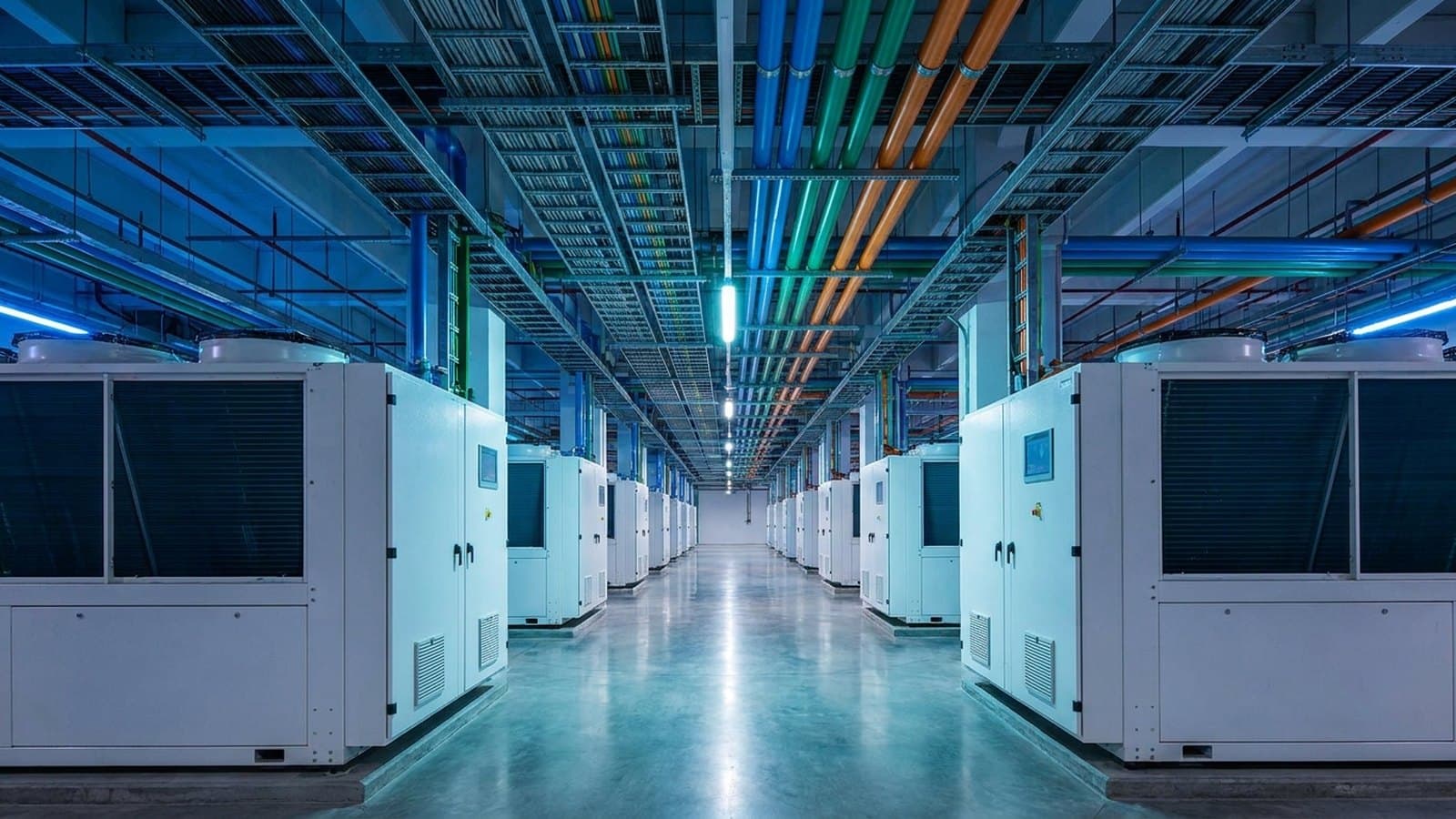
Legence gives investors exposure to the data-center buildout through physical mechanical, electrical and sustainability (MEP) infrastructure services — designing, building and maintaining the cooling, power and controls that make a data center run. It is a Blackstone-backed, acquisitive consolidator that went public on September 12, 2025, so it trades with the volatility of a young, richly valued name with a thin post-IPO float [3].
The earnings scorecard: strong growth, weaker margins
On the top and cash-earnings lines, the quarter beat and the company raised guidance [1]:
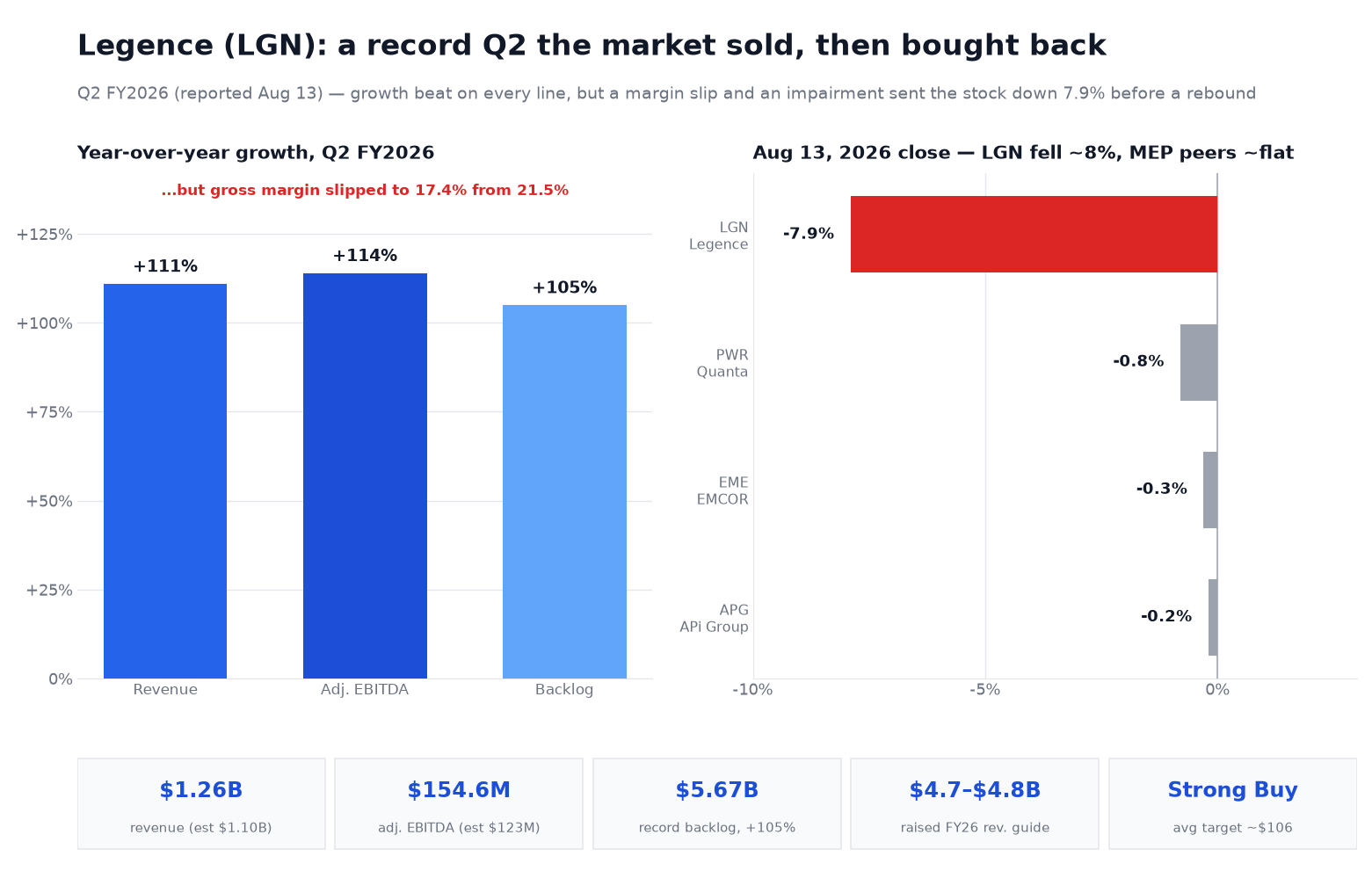
- Revenue $1.26 billion, up 110.7% (from $598.9 million), about 15% above the ~$1.10 billion consensus; revenue growth excluding the Bowers Group acquisition was about 60% (a non-GAAP measure) [1][5].
- Adjusted EBITDA $154.6 million, up 114%, about 26% above the ~$123 million consensus and above the $115–125 million guide, at a 12.2% margin — roughly flat year over year (about 12.1% a year ago) but up about 90 basis points sequentially [1][5].
- Raised full-year 2026 guidance to revenue of $4.7–4.8 billion (from ~$4.1–4.3 billion) and adjusted EBITDA of $565–585 million [1].
- Record backlog and awarded contracts of $5.67 billion, up 105%. The firmer, contracted figure is $4.02 billion of remaining performance obligations, of which 65–75% is expected to convert within 12 months; data centers and technology are about 60% of backlog, up from roughly 36% a year earlier [1].
What spooked the tape sat lower on the income statement. Gross margin fell to 17.4% (18.5% on an adjusted basis) from 21.5% a year earlier (21.8% adjusted) — a real, roughly 330–410-basis-point compression, worst in the Engineering & Consulting segment (adjusted gross margin 31.1% versus 33.2%) with the Installation & Maintenance segment also under some pressure [1]. And Legence swung to a GAAP net loss of $27.8 million attributable (a $34.6 million consolidated loss), or $(0.37) per diluted share [1].
The margin slip and the impairment, explained
Two things drove the loss and the sell-off, and it is worth separating them. The gross-margin compression is partly mix — the Bowers acquisition and faster-growing, lower-margin installation work reweighting revenue — but it was not purely optical: adjusted gross margin fell across the business, and Engineering & Consulting saw genuine cost and demand pressure. What kept it from flowing through to profitability was operating leverage below gross profit: selling, general and administrative expense fell to 11.7% of revenue from 12.1%, which is why adjusted EBITDA margin held roughly flat even as gross margin slipped [1].
The GAAP loss, meanwhile, was largely non-cash. It included a $41.1 million impairment — $21.6 million of goodwill and $19.5 million of long-lived assets — taken against a sustainability-services reporting unit in Engineering & Consulting, reflecting genuinely lower new-contract demand and reduced revenue and cash-flow projections for that business, on top of $73.9 million of stock-based and other non-cash compensation and $44.2 million of depreciation and amortization [1]. That impairment is a real negative — a piece of the business is shrinking — but it is a segment issue, not a crack in the data-center demand that drives the backlog. Notably, interest expense was not the problem: it actually fell to $16.9 million from $30.4 million a year earlier [1]. BTIG cut its price target to $100 from $120 (keeping a Buy rating) on the margin concern, even as it acknowledged the beat [6].
Why it matters
Legence is a way to own the AI-infrastructure build-out one step removed from the chips and clouds — the physical plant of a data center. That market is growing fast: data centers and technology went from about a third to about 60% of a record $5.67 billion backlog in a year [1]. The bull case is that this demand has years to run and that Legence, as a scaled MEP consolidator, compounds revenue and EBITDA through organic growth and acquisitions while it de-levers. The bear case is that an acquisitive consolidator at a premium multiple has little room for the gross-margin slip, segment impairment and GAAP loss it just printed. The same tension runs through the AI-infrastructure names we track, from the memory suppliers at SanDisk to the data-center engineering backlog at Sterling Infrastructure.
How the peers and sector traded the same day
The clearest evidence that this was a company-specific reaction, not a sector move, is that Legence's closest data-center-infrastructure peers were roughly flat on the same session while LGN dropped nearly 8% [8]:
| Name (ticker) | Aug 13, 2026 close | Read-through |
|---|---|---|
| LGN — Legence | −7.9% | Its own Q2 print: margin slip + impairment-driven loss into a rich multiple [1] |
| PWR — Quanta Services | ≈−0.8% | Electrical/infrastructure services peer; no shared catalyst [8] |
| EME — EMCOR Group | ≈−0.3% | Closest MEP-contracting comparable; data-center demand intact [8] |
| APG — APi Group | ≈−0.2% | Safety/specialty services peer [8] |
With Comfort Systems, EMCOR and Quanta essentially unchanged while Legence fell nearly 8%, the move was clearly about Legence's specific print — the margin line and the sustainability-services impairment — not the data-center demand picture that supports the whole group [8].
What the Street did with it
The analyst reaction captured the split: trim the target on margins, keep the rating on the growth [6]. BTIG cut to $100 from $120 but reiterated Buy, citing margins despite the ~26% EBITDA beat. Coming into the print the sell side was broadly constructive — Bernstein had initiated at Outperform — and the stock carried a consensus "Strong Buy" across roughly 17 analysts with an average target near $106 (range about $80–$125), well above the ~$67 price [7]. Even the firm most vocal about the margin worry stayed bullish on the business; the debate is about the multiple, not the demand.
What to watch
- Gross-margin trajectory. Watch whether gross margin stabilizes as the Bowers acquisition laps and installation mix normalizes, and whether SG&A leverage keeps holding adjusted EBITDA margin steady [1].
- The sustainability-services unit. The $41.1 million impairment flags real demand softness in Engineering & Consulting; watch whether it stays contained or spreads [1].
- Customer and backlog quality. One Installation & Maintenance customer was 17.2% of Q2 revenue, up from 5.7% a year earlier — watch that concentration, plus the conversion of the $4.02 billion contracted RPO (65–75% due within 12 months) and whether the data-center share keeps rising [1].
- De-leveraging and organic growth. Revenue ex-Bowers grew about 60%; watch the organic/acquired split and whether net leverage keeps falling from ~1.6x as cash builds. Moves are tracked on the LGN stock page and the earnings calendar [1][7].
Illustrative valuation sensitivity
The scenarios below are a descriptive, author-weighted exercise — not a forecast, target, recommendation, or intrinsic fair-value calculation. Each price is expressed as an EV/FY26-adjusted-EBITDA multiple to make it concrete: implied price = (multiple × ~$575 million FY26 adjusted-EBITDA guidance − ~$749 million net debt) ÷ 108.05 million shares [1]. The weights are the author's subjective assumptions; the downside deliberately sits below the Street's ~$80 target floor to capture a de-rating case [7]. The percentages are illustrative and sum to 100%.
| Scenario | Illustrative price | Weight | Key drivers |
|---|---|---|---|
| Upside | ~$125 (≈25x EV/FY26 EBITDA) | 30% | Gross margin stabilizes, the sustainability softness stays contained, backlog converts, and the premium multiple holds — toward the high end of the analyst range [7]. |
| Middle | ~$100 (≈20x EV/FY26 EBITDA) | 45% | Guidance is delivered and leverage keeps falling, but gross-margin questions keep some discount on the multiple, holding the stock near the consensus target — still above today's price [1][7]. |
| Downside | ~$50 (≈11x EV/FY26 EBITDA) | 25% | Margin compression persists, the sustainability weakness spreads or a large customer rolls off, and the multiple de-rates toward the lower post-IPO range near the 52-week low — below the Street's target floor [2][3]. |
Weighting those (0.30 × $125 + 0.45 × $100 + 0.25 × $50) gives an author-weighted scenario value near $95, above the ~$67 quote and today's ~14x forward multiple [2]. The point is the width of the band, from the 52-week-low area to $125: on a fast-growing but currently GAAP-loss-making consolidator, small changes in the margin trajectory move the valuation a lot. This is descriptive analysis of a corporate event, not investment advice.
LGN data snapshot — August 14, 2026 (intraday, session open)
| Figure | Value | As-of / source |
|---|---|---|
| Earnings-day close | $63.24 (−7.9%; intraday low ≈−8.8%) | Thu, Aug 13, 2026 — Q2 reported pre-open, heavy volume [4] |
| Intraday quote | ≈$67.05 (+6.0%) | Aug 14, ~12:03 p.m. ET — StockAnalysis [2] |
| Day's range (Aug 14) | $63.35 – $67.94 | Aug 14 session, still open [2] |
| Prior-day run-up | +5.7% on Aug 12 (into the print; close $68.68) | Aug 12 session [4] |
| 52-week range | $26.96 – $107.24 (IPO Sep 12, 2025) | As of Aug 14 [2] |
| Market cap | ≈$7.24B (108.05M shares) | Aug 14 — StockAnalysis [2] |
| Valuation | ≈14x FY26 adj-EBITDA guide (≈26x trailing); ≈43x forward P/E; trailing P/E n/a (GAAP loss) | Aug 14 — StockAnalysis [3] |
| Balance sheet | Total debt $1,041.4M, cash $292.0M → net debt ≈$749M; net leverage ≈1.6× reported (1.5× pro forma), from ~3× at IPO; H1 operating cash flow $194.5M | At Jun 30, 2026 — 10-Q [1] |
| Q2 FY2026 results | Revenue $1.26B (+110.7%); adj. EBITDA $154.6M (12.2% margin); gross margin 17.4% vs 21.5%; GAAP EPS −$0.37 (incl. $41.1M impairment) | Reported Aug 13 — release / 10-Q [1] |
| Backlog / guidance | Backlog + awarded $5.67B (+105%); contracted RPO $4.02B (65–75% within 12 mo), ~60% data-center; FY26 guide raised to rev $4.7–4.8B / adj. EBITDA $565–585M | Aug 13 — company release [1] |
| Analyst consensus | Strong Buy; avg target ≈$106 (range ~$80–$125); BTIG $100 (from $120), Buy | ~17 analysts — StockAnalysis / BTIG [6][7] |
The BestStocks event page corroborates the Aug 14 gain (about +5.8%, near $67). Aug 14 prices are intraday snapshots that moved through the session, not closing prices; the $63.24 Aug 13 figure is a settled close.
The setup at a glance
| Question | Answer |
|---|---|
| What happened? | Legence reported a record Q2 FY2026 before the open on Aug 13 (revenue $1.26B, +111%; adj. EBITDA $154.6M, +114%; raised guidance) — yet the stock fell ~7.9% that day, then rebounded ~6% on Aug 14 [1][2]. |
| Why did a record quarter fall? | Gross margin fell to 17.4% from 21.5%, it took a $41.1M impairment in its sustainability-services unit and posted a GAAP loss (−$0.37), and it trades at a premium (~14x FY26 EBITDA, ~43x forward P/E) after running up ~5.7% into the print [1][3]. |
| Why did it bounce back? | The loss was mostly non-cash (impairment, stock comp, D&A) and cash generation is solid ($194.5M H1 operating cash flow); SG&A leverage held adjusted EBITDA margin as gross margin slipped; net leverage is a low ~1.6x and falling; and the beat and raised guidance reasserted [1]. |
| Is the impairment a red flag? | A contained one: the $41.1M charge reflects softer demand in Legence's sustainability-services reporting unit — a real negative for that business, but separate from the data-center demand that drives the backlog [1]. |
| Was it a sector move? | No — peers were roughly flat (Quanta ≈−0.8%, EMCOR ≈−0.3%, APi Group ≈−0.2%) while LGN fell ~8%, confirming a company-specific reaction [8]. |
| What do analysts think? | Consensus "Strong Buy," average target ~$106 (range $80–$125, above the price); BTIG trimmed to $100 on margins but kept Buy [6][7]. |
Legence (LGN) stock FAQ
Why did Legence (LGN) stock fall on August 13, 2026?
Legence reported a record Q2 FY2026 before the open — revenue up 110.7% to $1.26 billion (about 15% above consensus), adjusted EBITDA up 114% to $154.6 million (about 26% above consensus), and raised full-year guidance — yet the stock fell about 7.9% (and as much as ~8.8% intraday). The selloff was driven by a gross-margin slip to 17.4% from 21.5% a year earlier, a $41.1 million non-cash impairment ($21.6 million goodwill and $19.5 million long-lived assets) taken against its sustainability-services business, a GAAP net loss of $27.8 million (−$0.37 per share), and a premium valuation after the stock had run up about 5.7% into the print. BTIG cut its price target to $100 from $120 on margin concerns while keeping a Buy rating.
Why did LGN rebound the next day?
On August 14 the stock recovered roughly 6% to about $67. The GAAP loss was mostly non-cash — the $41.1 million impairment, plus $73.9 million of stock-based compensation and $44.2 million of depreciation and amortization — while the business generated $194.5 million of operating cash flow in the first half. Adjusted EBITDA still beat consensus by about 26% because SG&A leverage (11.7% of revenue, down from 12.1%) offset the gross-margin slip, net leverage was a low ~1.6x (down from about 3x at the IPO), and the raised guidance and record data-center backlog reasserted. Together those gave buyers a reason to fade the initial drop.
What was Legence's Q2 impairment, and is it a red flag?
Legence took a $41.1 million non-cash impairment — $21.6 million of goodwill and $19.5 million of long-lived assets — against a sustainability-services reporting unit in its Engineering & Consulting segment, reflecting lower new-contract demand and reduced revenue and cash-flow projections for that business. It is a genuine negative for that unit, but a contained one: it reflects weakness in the sustainability-consulting business rather than in the data-center demand that drives Legence's record backlog. The thing to watch is whether that softness stays isolated or spreads.
Why did Legence's gross margin fall, and does it matter?
Gross margin fell to 17.4% (18.5% adjusted) from 21.5% (21.8% adjusted) a year earlier — a real compression, worst in Engineering & Consulting (adjusted gross margin 31.1% versus 33.2%), partly from a mix shift toward lower-margin installation work and partly from cost and demand pressure. It did not flow through to adjusted EBITDA margin, which held roughly flat at 12.2%, because SG&A fell to 11.7% of revenue from 12.1% — operating leverage below gross profit. The key question is whether gross margin stabilizes as the acquisition mix normalizes; it is the number the bear case rests on.
What does Legence do, and is it an AI-infrastructure stock?
Legence provides mechanical, electrical and sustainability (MEP) infrastructure services to data-center buildouts and other complex facilities — designing, building and maintaining the cooling, power and controls that make a data center run. It is effectively a 'picks and shovels' way to own the AI-infrastructure build-out one step removed from the chips and clouds. Data centers and technology grew to about 60% of its record $5.67 billion backlog, up from roughly 36% a year earlier. Legence is a Blackstone-backed, acquisitive consolidator that went public in September 2025, so it trades with the volatility of a young, richly valued name.