AI Infrastructure
Credo (CRDO) Stock Jump: The OmniConnect 'Memory Wall' Pitch and a Sector Melt-Up
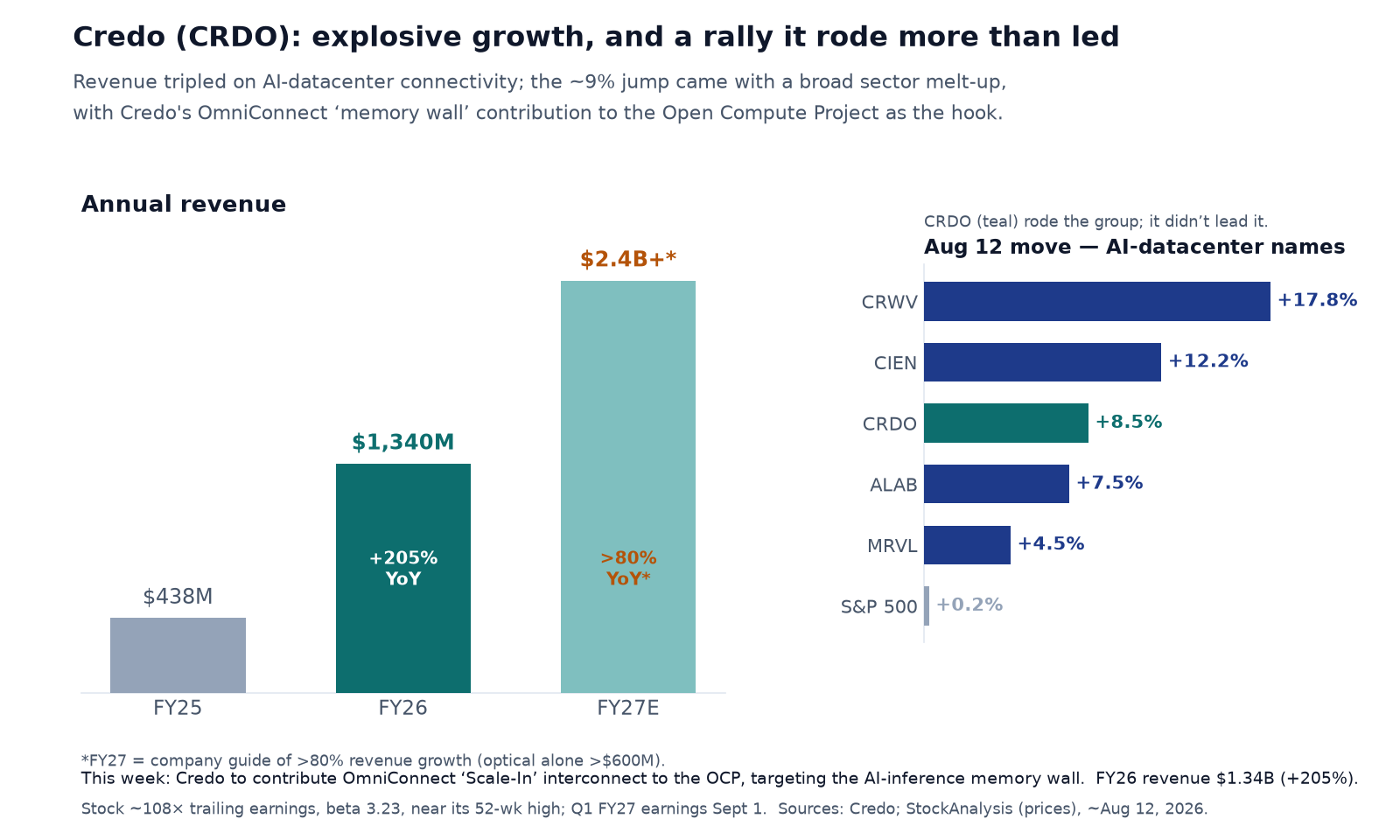
Credo Technology jumped ~8.5% to ~$269 as it announced plans to contribute its OmniConnect 'Scale-In' interconnect to the Open Compute Project, targeting the AI-inference 'memory wall.' But the day was mostly a broad AI-datacenter rally — CoreWeave +18%, Ciena +12%, Astera +7.5% — that Credo rode more than led, on below-average volume. Revenue tripled last year, but the stock is up ~87% YTD and has nearly caught its average target ahead of Sept 1 earnings.
Summary
On Tuesday, August 12, 2026, Credo Technology (NASDAQ: CRDO) rose about 8.5% to roughly $269 from a $247.69 prior close [3][4]. The stock-specific hook was Credo's plan, announced this week, to contribute its "OmniConnect Scale-In" interconnect to the Open Compute Project (OCP) to attack the AI-inference "memory wall" — the bottleneck where expensive compute sits idle waiting on memory [1][2]. But the honest read is that this was mostly a sector melt-up: the whole AI-datacenter complex ripped on the day — CoreWeave +18%, Ciena +12%, Astera Labs +7.5%, Marvell +4.5%, against an S&P up just 0.25% — and Credo rode the wave rather than leading it [7][9][10]. The company underneath is remarkable — revenue tripled last year — but the stock has already run ~87% in 2026 into a September 1 earnings date, and it has nearly caught its own average price target.
What changed
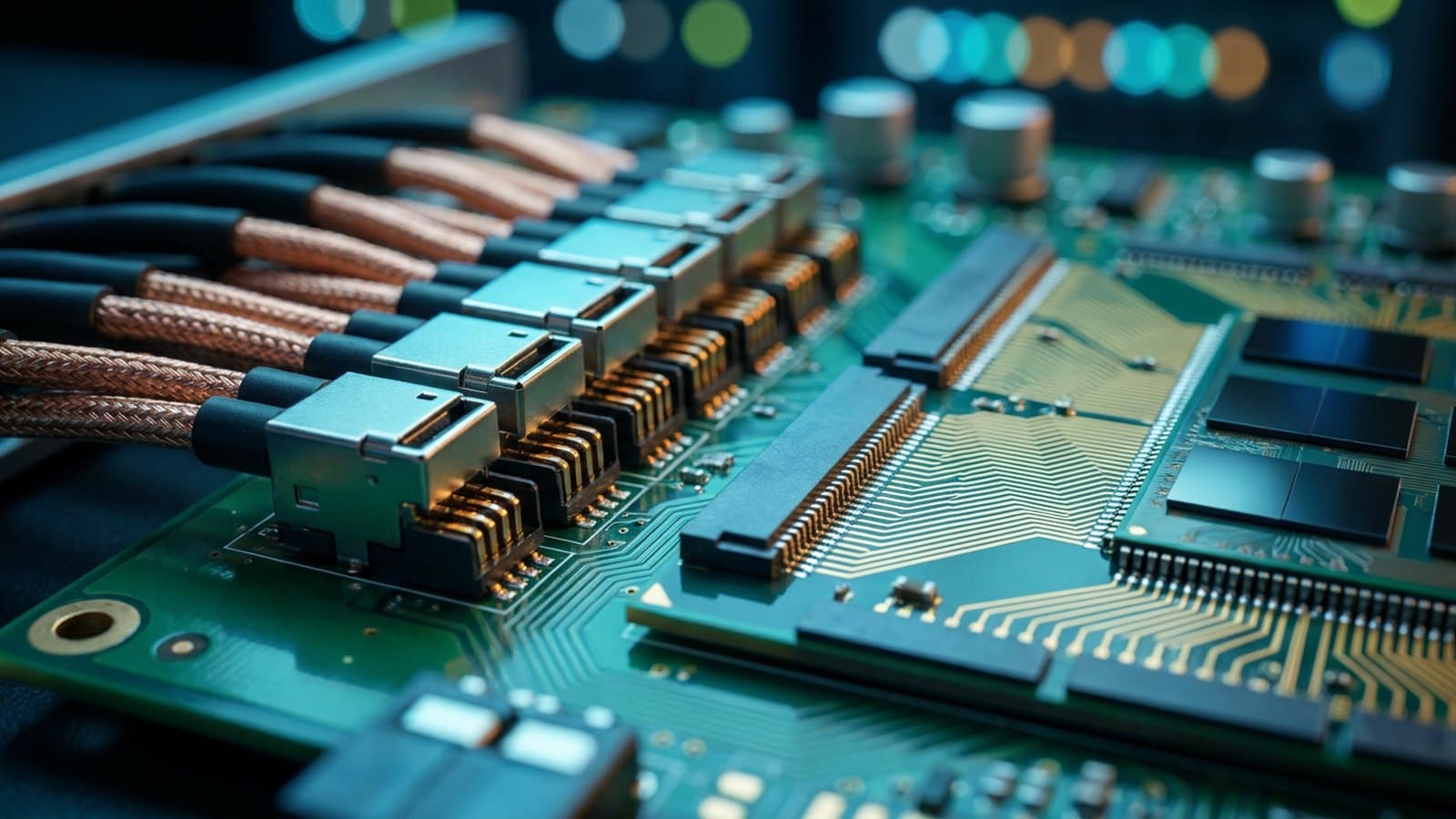
Credo is a connectivity company: it makes the unglamorous but essential parts that move data around AI data centers — ZeroFlap active electrical cables (AECs), optical DSPs and transceivers, and SerDes chiplets. This week's news pushes it up the stack toward standards-setting [1][2]:
- Credo said it will contribute its OmniConnect lightweight AXI framer specification to the OCP, part of its OmniConnect AXI-over-VSR (very-short-reach) SerDes bus, and it established the OCP "Open Chiplet Economy Lightweight Serial Interconnect Workstream" [1].
- The pitch is the "memory wall": in AI inference, memory bandwidth and capacity — not raw compute — are increasingly the constraint. OmniConnect connects compute engines to external memory chiplets to scale memory density (Credo cites up to ~25x) without redesigning the processor [1][2].
- Contributing the spec to an open standard is a land-grab move: if OmniConnect becomes the way the industry wires scale-in memory, Credo sits at the center of it [2].
That is a genuine, forward-looking positioning story. What it is not, on its own, is an +8.5% catalyst two days after the fact — which is why the tape matters.
A sector move, not a solo one
The clearest evidence is the peer tape. When CoreWeave is up 18% and Ciena 12% on the same session, an 8.5% move in an AI-connectivity name is the group re-rating, not a Credo-specific event [7][9]. Two more tells point the same way: the move came on below-average volume — roughly 1.8 million shares at an intraday snapshot against a ~5.2-million 20-day average — which is momentum participation, not a heavy accumulation breakout [3][8]; and Credo's own earnings are still weeks out, with first-quarter fiscal 2027 results due September 1 [3].
Why it matters
The "memory wall" is becoming the defining bottleneck of AI inference. As models get larger and inference volumes explode, the expensive GPUs increasingly wait on memory bandwidth and capacity rather than compute — so the value migrates toward whoever can feed them data fastest and cheapest. Credo's bet is that a lightweight, open interconnect for scale-in memory becomes standard infrastructure, and contributing it to the OCP is how you make a proprietary edge into an industry default. It is the same connectivity tailwind we tracked in optical at Lumentum and Applied Optoelectronics, one layer over — the plumbing between compute and memory. The question the tape raises is not whether Credo is well-positioned, but how much of that is already in a stock that has tripled its revenue and its multiple at once.
How the peers and sector traded the same day
This was an AI-datacenter group move, and Credo was a mid-pack participant in it. With the S&P 500 up 0.25%, the connectivity and neocloud names ran several times the market [7]:
| Name (ticker) | Aug 12 move | Note |
|---|---|---|
| CRWV — CoreWeave | +17.8% | Neocloud/AI-datacenter leader; led the group [7] |
| CIEN — Ciena | +12.2% | Optical systems; riding Lumentum's blowout read-through [7] |
| CRDO — Credo | +8.5% | ~$269; OmniConnect/OCP hook + the sector bid [1][3] |
| ALAB — Astera Labs | +7.5% | ~$335; closest connectivity peer [9] |
| MRVL — Marvell | +4.5% | ~$222; custom silicon & connectivity [10] |
| S&P 500 (index) | +0.25% | Broad market roughly flat [7] |
That Credo sat in the middle of the pack — below CoreWeave and Ciena — is the point: the day belonged to the theme, and Credo's OmniConnect news gave it a credible reason to be near the front of it, not a reason to move alone.
What to watch
- September 1 earnings (Q1 FY2027) — the real catalyst. After ~87% YTD, an in-line print into a ~30x-forward multiple may not be enough; the market will want the >80% growth guide reaffirmed or raised [3].
- OmniConnect traction — does the OCP contribution convert to named design wins and adoption? A standard is only a moat if the industry actually builds on it [1].
- Optical ramp toward >$600M — Credo's fiscal-2027 story leans on optical scaling; watch that line specifically [5].
- Customer concentration — Credo's growth has leaned on a small number of large hyperscalers; diversification (or the lack of it) shapes the risk [2].
- Insider activity and the multiple — insiders trimmed into July strength; continued selling into a ~108x trailing multiple would be a yellow flag. Moves are tracked on the CRDO stock page and the earnings calendar [11].
Illustrative valuation scenarios
The scenarios below are a descriptive, probability-weighted price-anchor exercise — not a forecast or a recommendation. The high end is anchored to named analyst targets (Stifel $350, BofA $340); probabilities are the author's own illustrative estimates and sum to 100%.
| Scenario | Price anchor | Prob. | Key drivers |
|---|---|---|---|
| Bull | ~$340 | 35% | AEC and optical share gains compound, OmniConnect converts to design wins, and the >80% fiscal-2027 growth guide is beaten; the stock re-rates toward the top-target cluster. Anchored to Stifel's $350 / BofA's $340 [6]. |
| Base | ~$290 | 40% | Strong growth continues but the stock consolidates near its 52-week high and average target after an ~87% year, holding a premium multiple on rising estimates. Near the ~$285 consensus [4]. |
| Bear | ~$180 | 25% | An AI-capex digestion or a high-beta momentum unwind compresses the multiple, and memory-wall standardization proves slower than hoped. Well below the target range but far above the 52-week low ($86) [3]. |
Blending those (0.35 × $340 + 0.40 × $290 + 0.25 × $180) gives a probability-weighted anchor near $280 — essentially on top of both the ~$269 price and the ~$285 average target [3][4]. In other words, after the run the stock sits close to fair value on the Street's own math: the growth is exceptional, but the easy re-rating is behind it, and a 3.23 beta means the path there will not be smooth. This is descriptive analysis of a corporate event, not investment advice.
Why is Credo (CRDO) stock up today?
Credo rose about 8.5% to ~$269 on August 12, 2026, driven mostly by a broad AI-datacenter rally (CoreWeave +18%, Ciena +12%, Astera Labs +7.5%) rather than a single company event [7][9]. The stock-specific hook was Credo's announcement this week that it will contribute its OmniConnect "Scale-In" interconnect to the Open Compute Project to address the AI-inference "memory wall" — a positioning move ahead of its September 1 earnings [1][2].
CRDO data snapshot — August 12, 2026 (timestamped)
| Figure | Value | As-of / source |
|---|---|---|
| Prior close | $247.69 | Mon, Aug 11, 2026 [3] |
| Primary intraday quote | $268.64 (+8.46%) | Aug 12 — StockAnalysis [3] |
| Corroborating quote | $269.18 (+8.68%) | Aug 12 — FinViz [4] |
| Intraday range | $254.58 – $270.99 | Aug 12 session [3] |
| Volume vs average | ≈ 1.8M at snapshot vs ~5.2M 20-day avg (below-average pace) | Aug 12 — StockAnalysis [3][8] |
| 52-week range | $86.49 – $308.67 | As of Aug 12 (near high) [3] |
| Market cap | ≈ $50.1B (~186.5M shares) | At the intraday quote, Aug 12 [3] |
| Valuation | P/E ≈ 108 trailing; ~30–44x forward; beta 3.23 | Aug 12 — StockAnalysis / FinViz [3][4] |
| Momentum | +87% YTD; +115% over 1 year | As of Aug 12 — FinViz [4] |
Each figure is valid only at its stated time; two independent feeds (StockAnalysis and FinViz) agree on both the ~$269 price and the ~8.5% move.
The setup at a glance
| Question | Answer |
|---|---|
| What was the news? | Credo will contribute its OmniConnect "Scale-In" interconnect (a lightweight AXI framer spec) to the Open Compute Project to address the AI-inference memory wall, establishing an OCP workstream around it [1][2]. |
| Was that the whole reason for the jump? | No. The bigger driver was a broad AI-datacenter rally (CoreWeave +18%, Ciena +12%, Astera +7.5%); Credo rode the group on below-average volume [7][9]. |
| How is the business doing? | Exceptionally. FY2026 revenue tripled to $1.34B (+205%), net income rose over 800%, and FY2027 is guided to over 80% growth (optical alone above $600M) [3][5]. |
| Is the stock expensive? | Very. ~108x trailing / ~30x forward earnings, beta 3.23, +87% YTD, near its 52-week high, and already close to its ~$285 average target [3][4]. |
| When is the next catalyst? | First-quarter fiscal 2027 earnings on September 1, 2026 [3]. |
Credo Technology (CRDO) stock FAQ
Why did Credo (CRDO) stock jump on August 12, 2026?
Credo rose about 8.5% to roughly $269, driven mostly by a broad AI-datacenter rally that lifted the whole group — CoreWeave +18%, Ciena +12%, Astera Labs +7.5%, Marvell +4.5% — against an S&P up just 0.25%. The stock-specific hook was Credo's announcement this week that it will contribute its OmniConnect 'Scale-In' interconnect to the Open Compute Project to address the AI-inference memory wall. Credo rode the sector move rather than leading it.
What is OmniConnect and the 'memory wall'?
The memory wall is the growing gap between how fast AI processors can compute and how fast memory can supply data, which leaves expensive compute idle. In AI inference, memory bandwidth and capacity are often the real constraint, not compute. Credo's OmniConnect is an interconnect (a lightweight AXI framer over its AXI-over-VSR SerDes bus) that connects compute engines to external memory chiplets to scale memory density — Credo cites up to about 25x — without redesigning the processor. Contributing the specification to the Open Compute Project is an attempt to make it an industry standard.
Was the jump a company-specific event?
Mostly not. The dominant driver was a sector-wide AI-datacenter rally, and Credo's move (+8.5%) sat in the middle of the pack, below CoreWeave (+18%) and Ciena (+12%). The move also came on below-average volume — roughly 1.8 million shares at the snapshot versus a ~5.2 million 20-day average — which points to momentum participation rather than a heavy, stock-specific accumulation breakout.
How fast is Credo growing?
Very fast. Fiscal-2026 revenue tripled to $1.34 billion, up about 205% year over year, and net income rose more than 800%. Management guides fiscal 2027 to over 80% revenue growth, with optical products alone expected to exceed $600 million. Credo makes data-center connectivity — active electrical cables, optical DSPs and transceivers, and SerDes chiplets — that scales with AI-infrastructure build-outs.
What have analysts said about CRDO?
Sentiment is bullish but the targets have largely caught up to the price. After a wave of July raises — Stifel to $350, Bank of America to $340, Evercore ISI initiating at $325, and Barclays to $300 — the average 12-month target sits near $285, only about 6% above the ~$269 price, with a Strong Buy consensus across about 19 analysts. Insiders were also trimming stakes into the July strength.
Is CRDO stock expensive?
Yes, on any conventional measure. The stock trades near 108x trailing and roughly 30–44x forward earnings, carries a beta of about 3.23 (triple the market's volatility), is up ~87% year to date, and sits just below its 52-week high near its average analyst target. The growth is exceptional, but much of it is priced in, and the next real catalyst is first-quarter fiscal 2027 earnings on September 1. This is descriptive analysis, not investment advice.